Beginner Controversial Subjects.

Messages
561
Edit My Images
Yes
Today, I went down to the local town, in order to photograph an Orange march and some of the demonstrators who are against the march.
Only because its been the speekalation over the last couple of weeks.
In saying that it could be any emotive subject that I am writing about here.
Staying a respectable distance I took quite a few shots, I also was surprised by the amount of police in attendance.
There was a bit of shouting and swearing from the demonstrators and a few in reply from the Orange Order members.
Is it ok to post photographs on here, I was quite taken aback by the reaction of some of the public, they were proper angry and upset.
I don't want to anger anyone but I do want to photograph what I saw and show it.
What are your opinions on this.
Thank you in advance.
Ps, I am not attached to any of the groups that I am writing about.
 
British law is, unless I've misunderstood it for more than 60 years, "in public, your face is public".

That said, it's up to the admins what they they will permit here.
 
Photography at some protests/demos can be fine as long as approached with care. You always risk getting caught up in some aggro though if you are not very ‘aware’.
However there are some ‘events’ that are off the scale for the potential for a bad outcome and this has to be at the top of the tree. Personally, I wouldn’t even be there, let alone take photographs that would more than likely really upset some possibly very volatile people. Just my opinion!
 
being an Orange march I guess Northern Ireland ,so no wonder you have concerns about posting photos of the march. Personally I would not seeing how volatile it can get. Back in 1971 I was in Belfast attending my best mans wedding. Few weeks later the reception venue was bombed. Staying with the brides family was not safe as a local newspaper office nearby was blown up
 
Last edited:
Today, I went down to the local town, in order to photograph an Orange march and some of the demonstrators who are against the march.
Only because its been the speekalation over the last couple of weeks.
In saying that it could be any emotive subject that I am writing about here.
Staying a respectable distance I took quite a few shots, I also was surprised by the amount of police in attendance.
There was a bit of shouting and swearing from the demonstrators and a few in reply from the Orange Order members.
Is it ok to post photographs on here, I was quite taken aback by the reaction of some of the public, they were proper angry and upset.
I don't want to anger anyone but I do want to photograph what I saw and show it.
What are your opinions on this.
Thank you in advance.
Ps, I am not attached to any of the groups that I am writing about.

This is a photography forum so I would post the pictures.
 
being an Orange march I guess Northern Ireland ,so no wonder you have concerns about posting photos of the march. Personally I would not seeing how volatile it can get. Back in 1971 I was in Belfast attending my best mans wedding. Few weeks later the reception venue was bombed. Staying with the brides family was not safe as a local newspaper office nearby was blown up
There are Orange Order marches in England and Scotland.
 
The politics behind the Orange Order/Apprentice Boys marches is delicate, but they are marching in public and the bigger ones are shown on TV, both national (UK) and local. There is no good reason not to show them on TP so long as you do not overtly attach a political statement to them,. I'd say the same about the pro=Palestine demo's we are seeing occasionally here (in NI) too. For balance. And because we are photographers on a photography forum. If you choose to also post on FB groups, that's another matter nothing to do with us.

Indeed we are in the marching season now so there'll be plenty of this and they are great opportunities - I'll be doing the same, after sussing out the degree of local feeling.
 
It's an Orange/Apprentices' march.

Probably one of THE most controversial political stand-offs in the entire UK.
They make EDL/AntiFa stand-offs look like a polite tea party.

What on earth did you expect?
I did expect there to be some negative reactions between the marchers and the demonstrators, and that is about all that happened, 8AM in the morning in a sleepy town in NE Scotland it was all over by 8.45
 
Oh and get some proper local advice. Photographing that sort of stuff can be a little dodgy for your health.
I have been watching the situation for about 2 or 3 weeks, heavy police presence did actually encourage people to shout and the marchers to shout back. (I think because everyone felt safe with all the police being in attendance). Some of the protesters were shouting at the police, but that is another story.
It was very noisy with the drums, I doubt if they could have made any more noise.
Dodgy for my health, I did not feel threatened, plenty people with cameras and phones were there doing the same as I was.
 
The camera isn't really a neutral recording device when operated by a human. I don't know much about the orange marches, so will use the recent far-right marches as an example.. I've seen photographers share pictures from those marches that make the protesters look stoic, patriotic, friendly, etc.. while other photographers have shown them to be drunks, ugly, racist, etc.. it's probably quite hard (or impossible - i don't know) to make a truly objective photo. So you might find, by sharing the pictures you're also sharing your politics - would that put you at risk in your local community if people viewed them and made it an issue?
 
I know what your saying here, and it all depends who is looking at the photograph. I think no matter what we do, some people have already decided what they see.
Really don't have any political views because I don't really follow stuff like that.
Not thinking about what people might say or think because I have no control over that.
 
It's likely that more 'characterful' people make for more interesting pictures. Which side they belonged to if you presented such pictures would possibly cause people to make assumptions about your personal politics even if you just wanted to show your most interesting images.
 
Yes this is a hard decision for me, in no manner would I want to upset any one or promote either side in this.
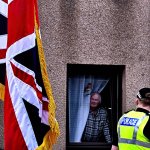
But here is a cropped photograph from today.
There is only one face in it and its a resident. I do have the uncropped version, but I will edit it a bit more.
Man In The Window.
100 Orange.JPG
 
Last edited:
The camera isn't really a neutral recording device when operated by a human. I don't know much about the orange marches, so will use the recent far-right marches as an example.. I've seen photographers share pictures from those marches that make the protesters look stoic, patriotic, friendly, etc.. while other photographers have shown them to be drunks, ugly, racist, etc.. it's probably quite hard (or impossible - i don't know) to make a truly objective photo. So you might find, by sharing the pictures you're also sharing your politics - would that put you at risk in your local community if people viewed them and made it an issue?
Even if you could take neutral pictures it doesn't mean they will be neutrally presented.

Possibly one of the best known examples of this is Gordon Parks pictures of Harlem and him falling out with Life Magazine over how they used them.

To quote from the New York Times (this was the first link I found, but the Gordon Parks vs Life Magazine story has been discussed many times in many places)

"If the magazine’s aim in publishing it was to inform its readers about a pressing social dilemma — and boost sales through dramatic and controversial images — it did so by perpetuating stereotypes. While the photo essay focused on a community beset by racism and poverty, its view of Harlem was narrow, a foreboding and stifling cityscape shrouded in mist and shadows.

During the editorial process, photographs were aggressively cropped and manipulated, often to complement the article’s graphic layout. In one photograph, Life’s editors, intent on creating a dramatic picture of Mr. Jackson and a friend viewing the open coffin of fallen gang member, cropped out a third teenager and darkened the distracting background.

Life’s editors largely dismissed many photographs that focused on the more affirmative events and rituals of everyday life. While he recorded the violence and aggression of the Midtowners, Mr. Lord said, Mr. Parks “made just as many pictures of intimate moments of quiet domesticity and boisterous, carefree Harlem street life.” "


Last edited:
Even if you could take neutral pictures it doesn't mean they neutrally presented.

Possibly one of the best known examples of this is Gordon Parks pictures of Harlem and him falling out with Life Magazine over how they used them.

To quote from the New York Times (this was the first link I found, but the Gordon Parks vs Life Magazine story has been discussed many times in many places)

"If the magazine’s aim in publishing it was to inform its readers about a pressing social dilemma — and boost sales through dramatic and controversial images — it did so by perpetuating stereotypes. While the photo essay focused on a community beset by racism and poverty, its view of Harlem was narrow, a foreboding and stifling cityscape shrouded in mist and shadows.

During the editorial process, photographs were aggressively cropped and manipulated, often to complement the article’s graphic layout. In one photograph, Life’s editors, intent on creating a dramatic picture of Mr. Jackson and a friend viewing the open coffin of fallen gang member, cropped out a third teenager and darkened the distracting background.

Life’s editors largely dismissed many photographs that focused on the more affirmative events and rituals of everyday life. While he recorded the violence and aggression of the Midtowners, Mr. Lord said, Mr. Parks “made just as many pictures of intimate moments of quiet domesticity and boisterous, carefree Harlem street life.” "


Context is everything
 
Context is everything
This is true but surely the viewer or reader provides that context?

We all project our own history on to what we see, hence I think that whatever the writer or photographer puts in front of us is viewed through a filter comprised of our experiences and prejudices.
 
This is true but surely the viewer or reader provides that context?

We all project our own history on to what we see, hence I think that whatever the writer or photographer puts in front of us is viewed through a filter comprised of our experiences and prejudices.
This is one of those undeniable truisms that in practice has so many nuances, it doesn't actually mean all that much.

Contexts can be manipulated to trick the viewer, and while we all come with our own experiences, prejudices, and biases, different people approach this differently. e.g scientists, professional pollsters, and I assume journalists, are taught to be aware of their potential biases, along with techniques to overcome them.

While others seem convinced of their lack of bias and find it easy to just dismiss evidence that questions their "obviously correct" opinion.

I know we are talking about viewing photographs, but I still think this personal " bias awareness" matters to how we view the world, and photographs.
 
This is one of those undeniable truisms that in practice has so many nuances, it doesn't actually mean all that much.

Contexts can be manipulated to trick the viewer, and while we all come with our own experiences, prejudices, and biases, different people approach this differently. e.g scientists, professional pollsters, and I assume journalists, are taught to be aware of their potential biases, along with techniques to overcome them.

Journalists come in different flavours.

And the there are the flavours we think they have.

You can talk to one group and they wouldn't trust the BBC because it is 'right wing'. And then talk to another a group then they wouldn't trust the BBC because it is 'left wing'.

There's something oddly reverse Orwellian in this - where government and media are confounded by the doublethink of their wider audience (whereas in Orwell's version doublethink was part of what allowed the government and media to control the wider audience).
 
Last edited:
So here is a thing, I went to a car show today and while there I met the camera club syllabus secretary.
Nice bloke from Glasgow a wee bit older than I am and we get on well together.
I told him I was at the march yesterday and about taking the photographs etc.
Asked him what he thought, he was fine with it and says he has seen many a march while he lived in Glasgow.
In addition I asked would my photographs be suitable for the internal club comps and he said that they would be.
Its in a public place and its a real fact of life, he seemed not fazed at all.
So food for thought, and just shows what the gap is between what people think about the same thing.
 
Journalists come in different flavours.
Yes indeed, and many professional journalists are employed in jobs where they write for their audience, leaving their own biases behind.

Others, such as columnists, are employed because they have views that match the publication's audience profile. These people may or may not come with formal training in journalism.

I think journalism, probably like being a politician, is a morally/ethically complex profession. But I suppose many jobs are like this.


And the there are the flavours we think they have.

You can talk to one group and they wouldn't trust the BBC because it is 'right wing'. And then talk to another a group then they wouldn't trust the BBC because it is 'left wing'.
While the BBC isn't immune to making mistakes, I'm still fairly comfortable with the idea that they try to avoid bias in their reporting.

There's something oddly reverse Orwellian in this - where government and media are confounded by the doublethink of their wider audience (whereas in Orwell's version doublethink was part of what allowed the government and media to control the wider audience).
 
So here is a thing, I went to a car show today and while there I met the camera club syllabus secretary.
Nice bloke from Glasgow a wee bit older than I am and we get on well together.
I told him I was at the march yesterday and about taking the photographs etc.
Asked him what he thought, he was fine with it and says he has seen many a march while he lived in Glasgow.
In addition I asked would my photographs be suitable for the internal club comps and he said that they would be.
Its in a public place and its a real fact of life, he seemed not fazed at all.
So food for thought, and just shows what the gap is between what people think about the same thing.
There is a big distinction between the legality of taking photos in a public place and the relative safety/sensibility of doing so when being present at the 'event' can put you in a position of serious risk.
Posting photos after the event could also put you at serious risk if someone didn't want to be seen or seen doing what they were, especially would this be so if the event was in your locality where you were known/recognisable.
There will be different opinions on whether or not to post the photos, based purely on the photos, but in this particular type of event, IMO, there is greater need for individual care to avoid possible unwanted negative consequences.
That's just personal safety, not posting rules.
 
Last edited:
This is true but surely the viewer or reader provides that context?

We all project our own history on to what we see, hence I think that whatever the writer or photographer puts in front of us is viewed through a filter comprised of our experiences and prejudices.
This is one of those undeniable truisms that in practice has so many nuances, it doesn't actually mean all that much.

Contexts can be manipulated to trick the viewer, and while we all come with our own experiences, prejudices, and biases, different people approach this differently. e.g scientists, professional pollsters, and I assume journalists, are taught to be aware of their potential biases, along with techniques to overcome them.

While others seem convinced of their lack of bias and find it easy to just dismiss evidence that questions their "obviously correct" opinion.

I know we are talking about viewing photographs, but I still think this personal " bias awareness" matters to how we view the world, and photographs.
Yep - and for example if you saw the same same portrait of a protester at a palestinian march in the daily mail, morning star and at an exhibition at the NPG. The captions and accompanying pictures and text would be different, editorial direction would be different...


Someone posted in one of the local facebook groups (not photography) the other day, it was a candid photo of a couple in the distance, sat down on grass, sharing a moment and showing their backs to the camera. The caption from the person who posted the photograph, was around seeing this nice moment and wanted to find the couple in case they wanted a copy of the picture. There were 100+ comments when I looked at it all saying the photographer was a creep, you shouldn't post it, 'privacy laws'. imo it wasn't a good picture, but there was nothing wrong with it - posted here or on instagram it would get a different reaction.
 
So here is a thing, I went to a car show today and while there I met the camera club syllabus secretary.
Nice bloke from Glasgow a wee bit older than I am and we get on well together.
I told him I was at the march yesterday and about taking the photographs etc.
Asked him what he thought, he was fine with it and says he has seen many a march while he lived in Glasgow.
In addition I asked would my photographs be suitable for the internal club comps and he said that they would be.
Its in a public place and its a real fact of life, he seemed not fazed at all.
So food for thought, and just shows what the gap is between what people think about the same thing.


If you'd mentioned that it was a Scottish march, my reaction would have been different.

I know press photographers that have been beaten up for covering the Orange Marches in the Province. By both sides of the religious divide.
 
Last edited:
Yep - and for example if you saw the same same portrait of a protester at a palestinian march in the daily mail, morning star and at an exhibition at the NPG. The captions and accompanying pictures and text would be different, editorial direction would be different...
A caption can completely change our understanding of a picture.
Someone posted in one of the local facebook groups (not photography) the other day, it was a candid photo of a couple in the distance, sat down on grass, sharing a moment and showing their backs to the camera. The caption from the person who posted the photograph, was around seeing this nice moment and wanted to find the couple in case they wanted a copy of the picture. There were 100+ comments when I looked at it all saying the photographer was a creep, you shouldn't post it, 'privacy laws'. imo it wasn't a good picture, but there was nothing wrong with it - posted here or on instagram it would get a different reaction.
Some people are very sensitive about these things, but some people are very sensitive about everything :-(
 
If you'd mentioned that it was a Scottish march, my reaction would have been different.

I know press photographers that have been beaten up for covering the Orange Marches in the Province. By both sides of the religious divide.
Just out of interest, are England, Wales, and Scotland officially "Provinces"?

Given that Scotland and England ceased to exist as countries in 1707, I suppose they are both technically provinces of the UK, but I'm used to people still calling them countries.
 
Just out of interest, are England, Wales, and Scotland officially "Provinces"?

Given that Scotland and England ceased to exist as countries in 1707, I suppose they are both technically provinces of the UK, but I'm used to people still calling them countries.

Northern Ireland is a Province, Ulster; as in one of the four provinces of the island of Ireland.

And Scotland and England are still classed as individual countries, despite unification. NI and Wales are not.
 
Northern Ireland is a Province, Ulster; as in one of the four provinces of the island of Ireland.

And Scotland and England are still classed as individual countries, despite unification. NI and Wales are not.
Sorry, I obviously misunderstood what you wrote, (which read as if you were saying Scotland was a province).
 
Back
Top