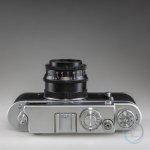
Zorki 4 diopter - Am I really that stupid?

Messages
1,894
Name
Stephen
Edit My Images
Yes
My Zorki 4 has a diopter but I haven't the faintest idea how to use it. It's either SO simple that I can't see the wood for the trees ... or. I am confused. I understand about lining up the object I want to focus on using the turning the focusing "ring" to line up the image, so what do I do with the diopter?
 
My Zorki 4 has a diopter but I haven't the faintest idea how to use it. It's either SO simple that I can't see the wood for the trees ... or. I am confused. I understand about lining up the object I want to focus on using the turning the focusing "ring" to line up the image, so what do I do with the diopter?
A diopter is normally a corrective lens to go over the viewfinder for if you normally wear glasses, but take them off to use the camera.

The rangefinder is the focus method where you align the two images until your subject is correctly aligned.
 
If there is dioptre adjustment then you use that until the frame lines are as sharp as possible and any viewfinder info is sharp as possible. Then when you focus the image it should be correct. I have only used a dioptre wheel on an autofocus camera. The wheel ones you wheel back and forth like a tiny mouse scroll wheel and i assume the lever ones you move side to side.
 
Last edited:
If you have the lens/image focused but the image in the viewfinder is still not sharp because your eyesight isn't quite good enough, then you use the diopter to correct your eyesight and make viewfinder image better.
There are usually other things that the viewfinder displays (compositional grids, exposure information, etc) that can be used to correct your focus with the diopter adjustment even without a lens/image.
 
Thanks everyone, looking forward to making a few mistakes with this old camera. Love a challenge.
Just remember with the Zorkis, don't adjust the shutter speed until the shutter has been cocked
 
It's not a true diopter, in my experience. It frustrates me no end. A diopter is something you adjust which is fixed to compensate for that particular eye. The one on the Zorki is not fixed. The best way I can describe it is that it acts as a zoom/focus in its own right. But it's independent and not connected to the lens, so the actual field of view could be anything. At least that's how I understand it.
 
Looks like a rip off of the Leica feature which you use to adjust focus in the viewfinder to compensate for different eyesight problems, mainly short sightedness I imagine. The Focal Press Leica Guide (Thirtyfirst Edition 1956) labels it 'Eyeypiece magnifier'. My 1947 edition doesn't mention it, strangely because my pre-war Leica IIIA had the feature. The Leica Book (1967) calls it 'Rangefinder eyesight adjustment'.
 
Looks like a rip off of the Leica feature
The first Zorki was basically a FED camera, after that factory had been damaged during the war, which was basically a copy of the pre war Leica, the later Zorki 4 again is a Leica copy, apart from the removable back.
 
A diopter is normally a corrective lens to go over the viewfinder for if you normally wear glasses, but take them off to use the camera.

The rangefinder is the focus method where you align the two images until your subject is correctly aligned.
It's also a term often used for close up 'filters' which would be tricky to use with a rangefinder, as parallax means the viewfinder won't see the same as the lens & focus will need to be done by calculation/measurement.

Technically diopter is a measure of the strength of a lens defined as one over the focal length in meters. So A +4 diopter is a 250mm lens. Unlike focal lengths diopters can be added to work out the effect of two lenses in close proximity. So a +4 in front of a 100mm lens (+1 diopter) works out to be a total of +5 or a combined focal lengths of 200mm.
 
Last edited:
It's also a term often used for close up 'filters' which would be tricky to use with a rangefinder, as parallax means the viewfinder won't see the same as the lens & focus will need to be done by calculation/measurement.

Technically diopter is a measure of the strength of a lens defined as one over the focal length in meters. So A +4 diopter is a 250mm lens. Unlike focal lengths diopters can be added to work out the effect of two lenses in close proximity. So a +4 in front of a 100mm lens (+1 diopter) works out to be a total of +5 or a combined focal lengths of 200mm.
Cheers, I’d assumed the OP meant the integrated viewfinder diopter rather than a screw on filter.
 
A dioptre is a unit of refractive power. It is a unit, like "inch", or "metre".

Usually on a camera there is an adjuster, so that you can use a viewfinder without glasses. It's strength may be indicated in diopters.
 
I've still got a roll in mine to finish. Heaven knows if I will get anything useful out of it. It's actually quite difficult to shoot. But I've enjoyed it. :D
 
Back
Top