Section 44 is alive and well in Portsmouth

Messages
10,100
Name
Rob Telford
Edit My Images
No
Thought this might be worthy of highlighting on this forum, especially as Urban75's Photographers Rights And The Law In The UK is often cited here.

http://www.urban75.net/forums/threa...ights-discussion.174440/page-20#post-10683147

Boo38 said:
Well, it seems s.44 of the Anti terror law is still rife in Hampshire.

I was stopped & searched under said act yesterday for taking a photograph of an Ambulance and a police car outside a property in my area, the usual Q's ensued and when I didn't consent they slapped on the bracelets and detained me for the purposes of a search under s.44.....and there was me thinking it had been canned as it was unlawful??


Boo38 said:
So far I have informed my local MP and have emailed the Professional Standards Department, I'm about to send them a hard copy of my complaint also.
The form the use was a C12 A?? And they use codes for what type of search, mine was search code 'J' which translates into 'Terrorism s.44(2)'
I took some quick legal advice from a local firm I use and they simply said to make a formal complaint to the front desk at the station, that proved to be as much use as indicators on a submarine.

the poster has uploaded a scan of his C12A S&S form showing Search Code/Legal Power Exercised as 'J', with the rear of the form indicating that 'J' means the search was conducted under 'Terrorism s.44(2)'

That would be the legislation that was deprecated by the Home Secretary in July last year and repealed by Parliament in March this year. :rules:

If you read further, his MP is actively on the case.
 
The law still exists, it's never been repealed (that will take years).

The guidelines and policy relating to it's use have changed. So while it's use isnt "unlawful" under current UK law, by the sounds of it they have acted against policy and nationally agreed guidelines.
 
Last edited:
The guidelines were changed in July 2010.

However, ss44-47 of the Terrorism Act 200 were repealed in March 2011 by The Terrorism Act 2000 (Remedial) Order 2011 (Statutory Intrument 2011 No. 631).

SI 2011/631 said:
Current stop and search powers no longer to have effect

2. The Terrorism Act 2000 is to have effect as if sections 44 to 47(g) of that Act (power to stop and search) were repealed.


The new wording of s47 under SI 2011/631, replacing s47 in the 2000 Act, grants power to search vehicles only (not individuals) without reasonable suspicion in designated areas.

Repeal was necessary to comply with the UK's international treaty obligations under the EHCR.

You can read the explanatory memorandum to this piece of legislation here.
 
Ah, I was aware the legislators had applied to get it repealed but I thought this was awaiting approval and / or a new green paper issued?

I'll read up on the links and check a few other sources... What you've posted makes sense though.
 
Last edited:
Musicman, if you're active on U75 get the OP (boo38) to get in touch with me as I went through all this with Portsmouth a year ago.

As part of the force's resolution of my formal complaint (for which I received an official apology) they were supposed to be undertaking to better educate frontline staff about discontinuation of s44. Might prove some useful background for the OP.
 
Thanks and done (I'm cybertect on that thread)?

I'll act as intermediary for passing email addresses if he doesn't want to register here.
 
Last edited:
Musicman

S44 has been replaced, by this, contained in the SI you quote
Replacement powers to stop and search in specified locations

3.—(1) The Terrorism Act 2000 is to have effect as if before section 48 (and the italic cross-heading before it) there were inserted—
“47A Searches in specified areas or places

(1) A senior police officer may give an authorisation under subsection (2) or (3) in relation to a specified area or place if the officer—

(a)
reasonably suspects that an act of terrorism will take place; and


(b)
considers that—


(i)
the authorisation is necessary to prevent such an act;


(ii)
the specified area or place is no greater than is necessary to prevent such an act; and


(iii)
the duration of the authorisation is no longer than is necessary to prevent such an act.


(2) An authorisation under this subsection authorises any constable in uniform to stop a vehicle in the specified area or place and to search—

(a)
the vehicle;


(b)
the driver of the vehicle;


(c)
a passenger in the vehicle;


(d)
anything in or on the vehicle or carried by the driver or a passenger.


(3) An authorisation under this subsection authorises any constable in uniform to stop a pedestrian in the specified area or place and to search—

(a)
the pedestrian;


(b)
anything carried by the pedestrian.

Clearly it does allow police to search an individual, and not just a vehicle.

It may be that the stop form has been incorrectly filled in, I don't know. Irrespective of that, if the authorisation is in force in that area, which wouldn't surprise me, given what lives in Portsmouth, then a stop under the new section is perfectly lawful.
 
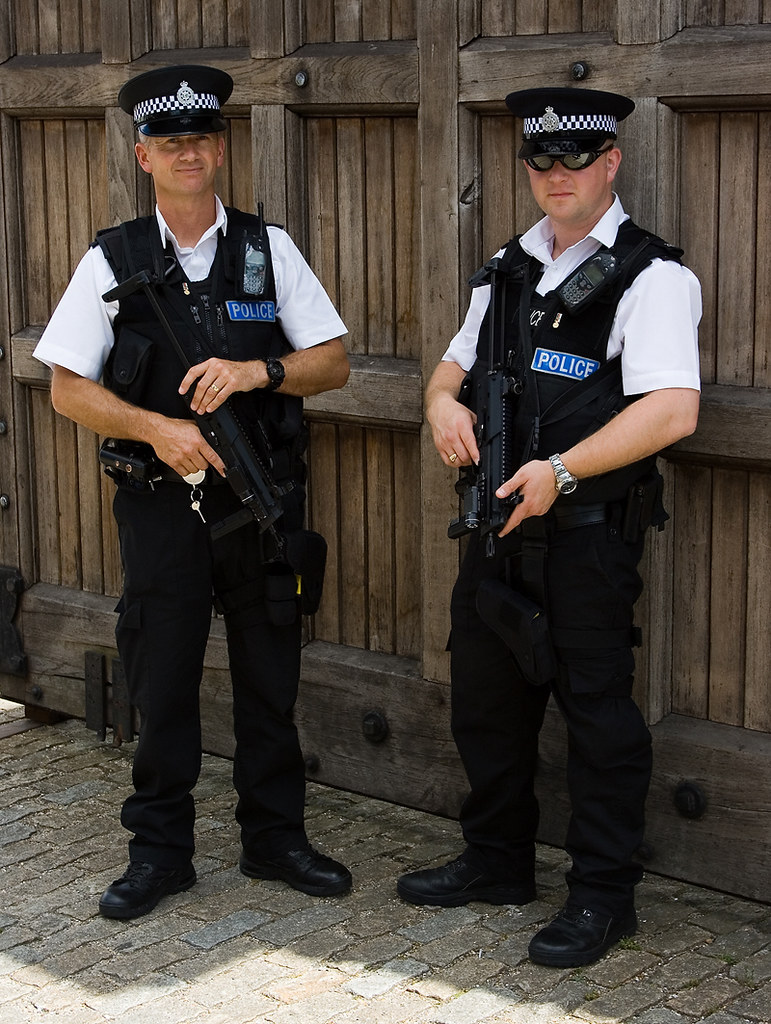
These guys outside Portsmouth dockyard never complained when I took this

4800707659_88e71fbdd6_b.jpg
 
It may be that the stop form has been incorrectly filled in, I don't know. Irrespective of that, if the authorisation is in force in that area, which wouldn't surprise me, given what lives in Portsmouth, then a stop under the new section is perfectly lawful.

But only if the officer reasonably suspects that an act of terrorism will take place.

Otherwise its unlawful for officers to stop and search individuals within whatever area under this section.


Am I right?
 
These guys outside Portsmouth dockyard never complained when I took this

4800707659_88e71fbdd6_b.jpg

These guys are Ministry of Defence Police and are responsible for the policing of the dockyard and its perimeter. They will have jurisdiction outside of the fence but would leave that to the locals (Hampshire).
 
Musicman

S44 has been replaced, by this, contained in the SI you quote


Clearly it does allow police to search an individual, and not just a vehicle.

It may be that the stop form has been incorrectly filled in, I don't know. Irrespective of that, if the authorisation is in force in that area, which wouldn't surprise me, given what lives in Portsmouth, then a stop under the new section is perfectly lawful.

Of course the Police need *some* anti-terror powers but as the replacement, S43 is considerably less wide open to misuse.

The Inspector who dealt with my case explained the difference as like "if my officers 'reasonably suspect that an act of terrorism will take place' I want them to be doing a damn sight more than a stop and search."

The way I understood it, S43 is the means by which you get an imminent threat off the street and into the station when you may not have the luxury of time or detailed intelligence.

There is absolutely no excuse for officers to still be detaining people under S44 powers, especially in Portsmouth. It's nearly 18 months since the powers were discontinued and the resolution of my case a year ago included specific conditions that local officers should be reminded/ made aware of such discontinuation.

Even if officers on the beat have forgotten this - which, let's face it, shouldn't happen - the reporting and recording systems in place (whereby officers radio through to control at point of detention) should pick up such an error before it's too late.

Notwithstanding a lack of impartial information about the build up to this guy's detention this seems to be a clear case of using a sledgehammer to crack a walnut, with the added complication that the sledgehammer was unlicensed and the walnut wasn't even real.
 
Forbiddenbiker

No, you aren't.
If the authorisation is in force, then any officer can stop and search anyone.
Its a senior Police Officer that has to make that decision, once its made, then a front line PC doesn't have to have any suspicion, or belief. As I said, I have no idea if one is or not in force in Pompy, it just wouldn't surprise me, given that Portsmouth is one big Navy base.

Andwhynot. Please stop going on about something you clearly don't understand.
S43, requires the Officer doing the stopping to have some form of suspicion. But we aren't taking about that.
The stop form says S44 on it. Was that a mistake, and what was meant was the replacement for S44, ie the one I quoted above? I don't know, nor do you.
In any case, there is a replacement, its as quoted. It applies to everyone when its in force, not just photographers. Like all law, like all powers to stop search and detain. Other people get stopped and asked what they are doing without it being a problem. Perhaps its the photographers attitude that causes many of these so called issues. I have never had a problem with it, but maybe because I don't argue the toss, just get on with it.
 
Last edited:
Forbiddenbiker

No, you aren't.
If the authorisation is in force, then any officer can stop and search anyone.
Its a senior Police Officer that has to make that decision, once its made, then a front line PC doesn't have to have any suspicion, or belief. As I said, I have no idea if one is or not in force in Pompy, it just wouldn't surprise me, given that Portsmouth is one big Navy base.

Andwhynot. Please stop going on about something you clearly don't understand.
S43, requires the Officer doing the stopping to have some form of suspicion. But we aren't taking about that.
The stop form says S44 on it. Was that a mistake, and what was meant was the replacement for S44, ie the one I quoted above? I don't know, nor do you.
In any case, there is a replacement, its as quoted. It applies to everyone when its in force, not just photographers. Like all law, like all powers to stop search and detain. Other people get stopped and asked what they are doing without it being a problem. Perhaps its the photographers attitude that causes many of these so called issues. I have never had a problem with it, but maybe because I don't argue the toss, just get on with it.

Maybe because you are an ex policeman helps :D

Plus your view on an policeman right to stop anybody without any excuse,sound more like a police state :(
 
Andwhynot. Please stop going on about something you clearly don't understand.

My understanding's fine, thanks.

S43, requires the Officer doing the stopping to have some form of suspicion. But we aren't taking about that.

I was, for good reason - it applies universally, unlike the 'replacement' you're 'going on about'.

In any case, there is a replacement, its as quoted. It applies to everyone when its in force, not just photographers. Like all law, like all powers to stop search and detain. Other people get stopped and asked what they are doing without it being a problem. Perhaps its the photographers attitude that causes many of these so called issues. I have never had a problem with it, but maybe because I don't argue the toss, just get on with it.

Mentioning the 'replacement' is an unnecessary complication. Powers granted under S47a are substitute powers in order to respond to threats which are specific and, it can be assumed, imminent. You're alluding to this with your phrase "when it's in force", without clarifying that the powers can only be used for up to 14 days at a time and are not for continuous or blanket use.

The stop form says S44 on it. Was that a mistake, and what was meant was the replacement for S44, ie the one I quoted above? I don't know, nor do you.

You're right, we don't know what the officers meant- but I don't think that matters.

If the officers wrote S44 thinking it was lawful, they were wrong.
If they wrote S44 and meant S43, they were wrong and misguided about the purpose of S43 and, FWIW, the same applies for S47a as the "reasonable suspicion" terminology carries over.

Don't get me wrong - I have no issue with being asked to account for my actions, it happens to me quite a lot and, aside from the one time I too was unlawfully detained under the S44 powers after the discontinuation, the police officers have always been models of courtesy and professionalism.

The photographer's actions in this instance were clearly of interest to the police and I fully defend their position to want to know what he was doing. But looking at the above situation objectively, I can't reach any conclusion whereby they can have had "reasonable suspicion" to use anti-terror powers against someone taking photographs at an incident attended by emergency services in a residential area, at night.
 
Forbiddenbiker

No, you aren't.
If the authorisation is in force, then any officer can stop and search anyone.
Its a senior Police Officer that has to make that decision, once its made, then a front line PC doesn't have to have any suspicion, or belief. As I said, I have no idea if one is or not in force in Pompy, it just wouldn't surprise me, given that Portsmouth is one big Navy base.

....

Ah I see it now... gutted! :gag:

Damn it if you haven't got your ideals Bernie.

It might appear a useful tool now, but its also hiding a powerful weapon of oppression.

.... just get on with it.

My point exactly!

:nono:
 
Simon
Why should having been a policeman help? I don't mention it when I get stopped, there's no need too.
Oddly, even though I have never mentioned it, I have never had a problem with Police being uncivil, exceeding powers, or in fact anything. I wont pretend that no police officer has ever been rude, anyone can have a bad day, but perhaps many of the bad examples are more to do with the attitude of those who're stopped, or would you prefer to pretend that ever photographer is a paragon of virtue?


Andwhynot
We are talking about S44, and it's replacement, therefore S43 really doesn't matter. S43 is in force all the time, and requires something to cause you to be stopped under it. S43 & 47b do not directly require that. You mentioned S43, and its not germane.
I posed the question did he write but mean because there is a general assumption that he was using a defunct power. Have you never written something down wrongly?

Forbidden,
how is it an instrument of oppression? Its a power to stop you, stop meaning to temporarily detain. Ask you what you are doing and search you. Provided there is nothing unlawful in what you are doing, in which case other powers come into play, it gives a Police Officer no powers to prevent you from what you're doing. It's intended to deter terrorism, or to provide intelligence about it. How you think thats oppressive I have no idea.
 
Bernie

To be hosent,when i got stopped early this year,it was the first time since i was a kid,and the old local sergeant used to call us over and ask we were up to,that i had any contact like this in the street.
So i was very taken back,when they were very hard on me,and as far as i was concerned i had done nothing wrong,and i think that where the problem starts.
I would say most,not all photographer are not of a criminal mind,and it comes as quite a shock to them,when stopped for taking photos in the street,which most of them had been doing without any problems for a long time, till S44 came out.
And now what making it worst,now that, S44 has been stopped,is that some police officers & PCSO,are still stopping photographer sometime under the anything i can come up with section.
 
Its a power to stop you, stop meaning to temporarily detain. Ask you what you are doing and search you. Provided there is nothing unlawful in what you are doing, in which case other powers come into play, it gives a Police Officer no powers to prevent you from what you're doing. It's intended to deter terrorism, or to provide intelligence about it. How you think thats oppressive I have no idea.

It's not a simple "power to stop you" at all, no wonder it's abused if this is what the police think, to use S43 it has to be on someone "whom he reasonably suspects to be a terrorist".
 
Well its the bigger picture your blind to for me Bernie... I feel your blind to it so Im kinda stuck on how to explain it too you...

If I might just ponder how Thomas Jefferson might refer to these growing layers of modifications and the supposed needs they stem from, then maybe this quote of his would fit.

I would rather be exposed to the inconveniences attending too much liberty than those attending too small a degree of it.
Thomas Jefferson


Then he might have followed up the worrying consequence of such modifications with ...
Force is the vital principle and immediate parent of despotism.
Thomas Jefferson


Type thing. ;)
 
Last edited:
Simon
There are probably several thousand people stopped per day and asked what they are doing. Of those I'd suggest very few are photographers, and less than one of those a week, is stopped for reasons that may not justify being stopped, be that just misinterpretation of powers, or sometimes for vindictive reasons.
So in reality the scale of this 'problem' is minute, it certainly isn't to the scale you seem to think it is.
Police have always had powers to stop the public, and I'm afraid, like it or not, I could always think of a reason to stop almost anyone, long before the current terrorism acts came along. In fact if you drive a car you are far more likely to be stopped for no real reason at all, because any constable can, just to see your documents.
No ones suggested that drivers are criminalised by this, so why do you think photographers are?
Also, I've no idea how old you are, but I was first stopped in 1983, and Austin someone or other an MP was campaigning in Amateur photographer in the early 90's because photographers were being asked why they were taking photos of kids. so no, there's nothing new in any of this. Whats more given its been happening since at least the early 80's, and probably since Fox Tolbot thought that the view from a window would make a good first photo, no ones really impinging on yours, mine or anyone elses general right to take photos of pretty much what they want.
Of those few photographers who are stopped, no one with any experience in life would deny that a percentage either bring it on themselves and some make matters worse.
Certainly in my experience, most photographers were fine when stopped, could understand why and were left to get on with it within minutes. Of course there was the added advantage of I didn't have to do the asking as what now has to be a formal stop. But a fair number immediately went into attack mode, and that was only going to end one way for them given the circumstances they were in.
Yes, mistakes happen, in every walk of life, no doubt in yours as well as my former and current occupation. No ones dies because those mistakes, so in the big scheme of things its not that much of an issue 99.99% of the time.

Forbidden
So you consider that your safety, and the continuation of the freedom you think you have is infringed by being asked what you are doing?
Well, we've had stop and search in the UK codified in law since 1839. And before that it was just common law, but our freedoms aren't particularly under threat.
From the other point of view stop and search is a useful deterrent and detection method in crime.
I am sure Jefferson did not mean to imply that any civilised society would or should hamstring crime prevention, because its slightly inconvenient to a few. In reality most countries have a stop and search power given to their police. Yes, some like North Korea are real Police States, but the majority are far from it, and that includes the UK, in fact the UK has probably the most accountable Policing system in the world, and a stop/search power, of which there are many, isn't a threat to you, any more than it is to me.
 
Last edited:
Austin Mitchell.... ;)
 
Forbidden
So you consider that your safety, and the continuation of the freedom you think you have is infringed by being asked what you are doing?
Well, we've had stop and search in the UK codified in law since 1839. And before that it was just common law, but our freedoms aren't particularly under threat.
.

No I don't consider that point. I consider that one should be assumed inocent untill proven guilty.

Unlike your stand point and that of the police with this new layer ...who can now assume guilt of a person wandering through an area, up to and not until the person corporates, and proves themselves innocent.

Thats not unlike a common tactic used by police states to control its populations right. ;)
 
Last edited:
There are probably several thousand people stopped per day and asked what they are doing. Of those I'd suggest very few are photographers, and less than one of those a week, is stopped for reasons that may not justify being stopped, be that just misinterpretation of powers, or sometimes for vindictive reasons.
So in reality the scale of this 'problem' is minute, it certainly isn't to the scale you seem to think it is.

Since the Met always refused to provide any numbers on how many photographers were stopped under s44, there's no stats either way. As a group, photographers probably didn't do as badly as black and Asian youths, but it was happening often enough to provoke large crowds to assemble at public demonstrations in protest against the law.

One of the significant problems with s44 was that the power was drawn far too widely and it was implemented in a way that went well beyond the stated intentions during Parliamentary debate.


If we're looking at numbers, in its last year of operation, over 100,000 searches were conducted under s44, resulting in not one single arrest for a terrorism related offence.


Police have always had powers to stop the public, and I'm afraid, like it or not, I could always think of a reason to stop almost anyone, long before the current terrorism acts came along.

But you were always open to challenge that you were not acting on reasonable suspicion. S44 removed even that on a permanent basis in large parts of the country for the sake of 'expediency'.

The evidence seems to suggest that the Police (the Met in particular) took the powers granted to them removing even that fig leaf and ran half way round the planet with them.

S47 under the new framework is much more tightly drawn.

In fact if you drive a car you are far more likely to be stopped for no real reason at all, because any constable can, just to see your documents.
No ones suggested that drivers are criminalised by this, so why do you think photographers are?

As far as I'm aware I'm not required by law to pay an annual fee to the government to own a camera, nor to have it insured, or to have it inspected by a technician to make sure I have not made modifications deemed illegal by the State. Nor am I required to submit to a test to prove that I am a responsible individual to use photographic equipment.

Similarly, I'm not obliged to provide, to any official that asks, documentation explaining my entitlement to walk down a street on similar grounds.

If that ever happens, I'll seriously be considering moving to a different country.

As some people are so often fond of pointing out, there are no such thing as "photographers' rights". However, this does not mean that the rights of people taking photographs are not indirectly impinged upon by law framed for other purposes.

For myself, I see that as an opportunity for solidarity with other groups in society who may be disproportionately affected by bad law.
 
Last edited:
No I don't consider that point. I consider that one should be assumed inocent untill proven guilty.

Unlike your stand point and that of the police with this new layer ...who can now assume guilt of a person wandering through an area, up to and not until the person corporates, and proves themselves innocent.

Thats not unlike a common tactic used by police states to control its populations right. ;)

Well said :)
The biggest loss in the current climate of constant terror alert is our gradual erosion of freedom
 
Back
Top