sunrise

Messages
91
Edit My Images
Yes
Hi,just wondering the best way to go about getting a great sunrise pic,i am assuming it may be best to have the sun still just below the horizon,or are there special grad filters(i do have an ND8 grad)that can protect the lenses and the camera from the direct sun.
I have often seen pictures that other people have taken of sunrises at a beech with the sun just above the horizon,i have thought about doing something similar...but am nervous about damaging my camera & the lenses,obviously its a given that one does NOT look through the viewfinder directly at the sun.
If anyone can point me in the right direction than that would be great,i am in no way a great photographer,but am always out trying to get a great shot...& trying to learn :-)
 
Last edited:
Hi,just wondering the best way to go about getting a great sunrise pic,i am assuming it may be best to have the sun still just below the horizon,or are there special grad filters(i do have an ND8 grad)that can protect the lenses and the camera from the direct sun.
I have often seen pictures that other people have taken of sunrises at a beech with the sun just above the horizon,i have thought about doing something similar...but am nervous about damaging my camera & the lenses,obviously its a given that one does NOT look through the viewfinder directly at the sun.
If anyone can point me in the right direction than that would be great,i am in no way a great photographer,but am always out trying to get a great shot...& trying to learn :-)

Don't worry about it. You'll not do any damage to your eyes or anything else when the sun is that low to the horizon. Just point and shoot when it looks nice, and adjust exposure to taste.

A grad often works well, but watch out for flare reflections that you won't see in the viewfinder. They're off the shiny surface of the sensor, so only visible in the actual image (or in live view).
 
This download http://photoephemeris.com/ is very useful and is free for PCs and Macs

It tells you the direction and times of sunrise and sunset for anywhere on earth for any day and helps in planning the best locations.

As sunrises (and sunsets too) change very quickly it is useful to be there about 45 mins before it is due to happen.

A tripod is not always essential but is very useful, especially if you are using AEB.

Dave
 
I would use ISO100, F11, most important for me anyway is to have some foreground interest IE rocks, drift wood, patterns in the sand or something else like a pier/structure :thumbs:
 
Last edited:
I would use ISO100, F11, most important for me anyway is to have some foreground interest IE rocks, drift wood, patterns in the sand or something else like a pier/structure :thumbs:

^ This is how I approach sunsets too - Manual mode, small aperture and low ISO, take a few test shots at various shutter speeds until I get the exposure I want to really bring out those colours (preferably with a tripod as shutter speeds can get very slow). If using one of the camera's auto modes then experiment by lowering the "exposure compensation" setting by a stop or two until you get the desired exposure.
 
Last edited:
As the boys above, small aperature, camera on tripod, longish exposure.

I do a lot of sunrises at this time of year as my proper job means that I leave work in darkness but can be up and do a sunrise before work.

My favourite for this kind of shot is a 3 stop reverse ND grad, living at the seaside with a nice defined horizon the reverse grad works a treat at holding back the sky.

As always it is recommended to shoot in raw, if you're not up for that yet you can use your white balance to put some more warmth into the sky.

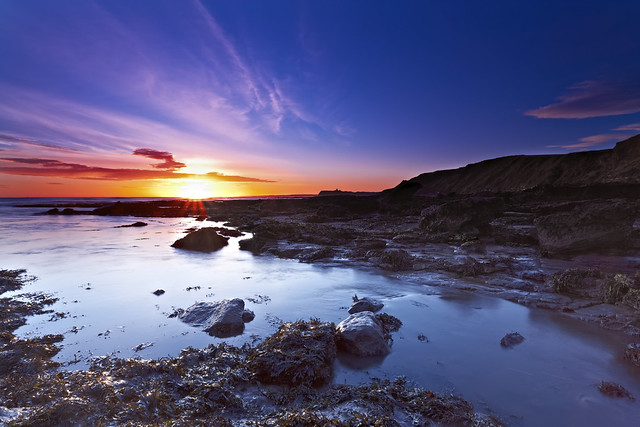
As a guide this was 2 seconds at f14, ISO 100.

Burniston Sunrise by mark_mullen, on Flickr

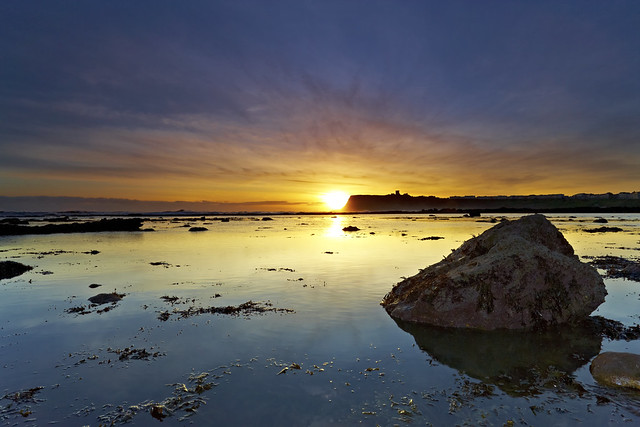
and this was 1/13 at f16, ISO100.

Scalby Mills Sunrise 2 by mark_mullen, on Flickr

Both shots were taken with the reverse grad.
 
Lovely shots, Mark. I regretted not having a reverse grad when I was out shooting a sunset last week (I have a set of 85mm Hitech soft grads but as you know they're no good when the sky is that bright at the horizon, although I did briefly consider inverting one and only sliding it partially into the holder). Which make reverse grad do you use?
 
Last edited:
If you are shooting directly at the sun, for me it all depends on cloud cover. If the sky is good, that is a visible sun with good amount of cloud I could well be shooting with the sun above the horizon. Generally tho the time between the whole of the sun being just under the horizon to being half above it is ideal.

If you are shooting 90-180 degrees away from the sun keep shooting well after the sun has risen but again a good sky is required.

f/11, iso 100, tripod, 3 stop grad.

Saying this, prepare to be disappointed as it seems more often than not the sky doesn't want to play ball.
 
Last edited:
Hello

I am very new to all this so excuse my daft question. What is a ND Grad? Sunsets and rises is one thing I want to get into and think they sound interesting and I fancy a tinker around with them. I have a Canon 400D if that help people point me in the right direction.

:)
 
sjc1919 said:
Hello

I am very new to all this so excuse my daft question. What is a ND Grad? Sunsets and rises is one thing I want to get into and think they sound interesting and I fancy a tinker around with them. I have a Canon 400D if that help people point me in the right direction.

:)

It's a filter that goes in front of the lens. The top part is dark the bottom is clear, helps combat over exposing the sky. Many use Lee, but they are expensive and usually a long waiting list. Hitech and Cokin are also popular.
 
Back
Top