Very similar Adobe alternatives, the ArtCraft apps

Are we underestimating just how fundamentally AI is changing the economics of software development?

The interesting thing isn’t that someone can now write an app in their bedroom. It’s that the same person can potentially operate an entire software business from their bedroom.

The barriers to entry are collapsing. Software development, testing, documentation, customer support, billing, licensing and infrastructure can increasingly be automated or outsourced. What once required a company employing 20 people might increasingly be done by one or two.

And that changes the competitive landscape enormously.

I do think Adobe needs to worry about hundreds or thousands of small developers producing highly capable, specialist applications at a fraction of the traditional development cost. Those applications don’t even need to replace Photoshop. They just need to do particular jobs better or more cheaply. Collectively, they could take away a substantial part of the market.

Big software companies still have enormous advantages, especially their established ecosystems and customer bases. But I suspect they’re in for a much rougher ride than many people expect. As an aside, the German state of Schleswig-Holstein started migrating its government computers from Windows and Microsoft Office to Linux and LibreOffice in 2024 after a long pilot project.

I think we’re witnessing a fundamental change in the software industry.
 
The bottom line here is that this ‘free’ software costs the end user nothing, and appears to have very little cost to the ‘developer’.

Meanwhile the huge tech firms have invested trillions of dollars into AI, for no obvious short or mid term return.

The big question is will the bubble burst before costs come down or will we have to get honest about how much this ‘free’ AI stuff actually costs.
 
I do think Adobe needs to worry about hundreds or thousands of small developers producing highly capable, specialist applications at a fraction of the traditional development cost. Those applications don’t even need to replace Photoshop. They just need to do particular jobs better or more cheaply. Collectively, they could take away a substantial part of the market.
But that's been the case for years. There's been numerous open source applications that offer huge amounts of functionality for free and crucially, they do it better than these vibe coded apps do. Or look at Davinci Resolve, completely free for the standard version and fully functional yet many people pay huge amounts of video editing applications. There's been free open source and fantastic alternatives to Microsoft Office yet it's still a huge seller for Microsoft.

Even putting aside many of the issues with these vibecoded apps (which even the authors aren't aware of because they didn't write the code), there's a lot more to it than just the software being 'free'

Ironically while it is genAI Adobe need to worry about, it's not this that's the issue it's people using genAI tools to generate images and videos they want instead of Adobe tools.
 
The bottom line here is that this ‘free’ software costs the end user nothing, and appears to have very little cost to the ‘developer’.

Meanwhile the huge tech firms have invested trillions of dollars into AI, for no obvious short or mid term return.

The big question is will the bubble burst before costs come down or will we have to get honest about how much this ‘free’ AI stuff actually costs.
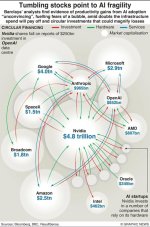
The financial aspect to the 'AI bubble' is not always what it seems, it's known as circular financing, they're basically all investing and purchasing from each other, and it all leads back to the big winner, nVidia.

I remember reading articles on this years ago.

So tech giants, chipmakers, and cloud providers fund AI startups or frontier labs, which then use that exact capital to buy hardware, chips, or cloud capacity from the same financiers,
The AI company uses that money to rent servers (Microsoft Azure or AWS) or purchase specialized processors (Nvidia GPUs), turning the initial cash they invested into the investor's reported revenue.
Both the supplier and the customer log massive revenue growth and valuation bumps on paper, even though a significant portion of the money is recycled within the same tight circle of companies.


759240198_1793297335364370_8608290466495866847_n.jpeg
 
There's been numerous open source applications that offer huge amounts of functionality for free and crucially, they do it better than these vibe coded apps do. Or look at Davinci Resolve, completely free for the standard version and fully functional yet many people pay huge amounts of video editing applications. There's been free open source and fantastic alternatives to Microsoft Office yet it's still a huge seller for Microsoft.

Businesses need reliability and support, patches for security when bugs are found. No major business could live with unsupported software except in specialised and unique positions. So 'free' software isn't considered. Some European governments have been trying to use open source applications in general situations, but the change is slow because it takes time to build support and infrastructure in order to move 30,000 civil servants across to an unfamiliar and complex suite of applications.
 
The financial aspect to the 'AI bubble' is not always what it seems, it's known as circular financing, they're basically all investing and purchasing from each other, and it all leads back to the big winner, nVidia.

I remember reading articles on this years ago.

So tech giants, chipmakers, and cloud providers fund AI startups or frontier labs, which then use that exact capital to buy hardware, chips, or cloud capacity from the same financiers,
The AI company uses that money to rent servers (Microsoft Azure or AWS) or purchase specialized processors (Nvidia GPUs), turning the initial cash they invested into the investor's reported revenue.
Both the supplier and the customer log massive revenue growth and valuation bumps on paper, even though a significant portion of the money is recycled within the same tight circle of companies.


View attachment 495163
The almost mythical revenue is the other half of my point.
All of the AI providers are spending vastly more money on data centres and energy than they could possibly hope to recoup if they had a realistic revenue model.

Currently they’re bearing all the cost which is why we’re enjoying ‘free’ or reasonably priced products. Which is what’s in the headline of your diagram here.
It’s a bubble that could potentially lead to a bigger crash than the banking crisis.

Cynical minds might suggest that the ‘AI is coming to destroy you’ headlines are attempts by these people to beg governments to step in to slow down their spending.
 
Businesses need reliability and support, patches for security when bugs are found. No major business could live with unsupported software except in specialised and unique positions. So 'free' software isn't considered. Some European governments have been trying to use open source applications in general situations, but the change is slow because it takes time to build support and infrastructure in order to move 30,000 civil servants across to an unfamiliar and complex suite of applications.
This^
But there’s worse even ignoring AI.
The US government have the legal power to access any information held using any US owned software.

This is obviously a risk to all foreign governments who have obviously built their business practices on American software.

Some European governments are putting lots of effort into abandoning American products, but after decades of adoption it’s not straightforward.

Meanwhile the U.K. government appears to have its fingers in its ears continuing with Microsoft and AWS as if it’s not technically a breach of U.K. law.
 
These companies taking on Adobe and Microsoft will have an advantage in being in first, but there may be others following, and/or at a certain point, for simple tasks, the use of AI may allow people to recreate their own software, or at least specific something for specific tasks. They will need to work fast to stay ahead of the pack.

If the aim of these companies recreating these apps is to offer the software for free, and make money on added AI capabilities, it is a business model that relies on AI. :thinking:

And so we have the AI bubble, the longer it goes on for, the larger the impact it will have on everybody worldwide. The companies involved in the bubble have been clever in financially involving the US government in the bubble, so that may sustain it for longer than it should, because they have a government willing, at least with the current orange man in charge, to bend rules to quickly build out the infrastructure, and not have any legal oversight to constrain them in any way. If/when it starts to go wrong, they may have to step in to support it all.

The 2008 collapse of the U.S. housing market affected the whole world, and that was just one country's financial housing mismanagement having an effect, but this AI bubble will have effects in almost every country simultaneously. And the longer it sustains for, the more people will be reliant on it all working without interruptions, and the bigger a crash could be. The Ukrainian attack on the Russian data centres shows how much a few breaks in a network can have big effects on the internet at least, even though in that case it reduces a huge amount of Russian bots on the internet. AI will be affecting things beyond just the internet if/when it pops.
 
Last edited:
Just my two cents as a lay person, these apps are more likely going to affect smaller software companies than larger ones. Adobe will lose some customers no doubt but any professional business is very unlikely to leave Adobe. Someone has to maintain the software and deal with any legal issues. Would any proper business use a piece of software that someone just created at home? It could be risky from a security point of view or even if it crashed during important times. It’s more likely that Adobe will have to balance what they charge and what they offer more carefully, it now makes it easier for largish software companies to catch-up without having to make labour intensive investments, that helped Adobe become the market leader.
Lets address that head on. Large companies probably won't rush to buy from one man band developers, but their it departments are probably already onboard with openai or anthropic subscription. The same it department may be instructed to initiate development of the said replacement software, and the same ai agents will be responsible for qc, and even proactive bug fixes and feature releases. The ai agents steered by the it department become the new adobe and Microsoft. This is easily realistic by 2030. Just dont be surprised if it is still not commonplace by 2027. All it takes is one company show the lead, and leapfrog others and i believe we already have that.

Take a look at Getty images. The hated dinosaur is bankrupt and getting restructured under chapter 11 protection. Nobody needs them anymore, nobody wanted them for a long time already
 
Businesses need reliability and support, patches for security when bugs are found. No major business could live with unsupported software except in specialised and unique positions. So 'free' software isn't considered. Some European governments have been trying to use open source applications in general situations, but the change is slow because it takes time to build support and infrastructure in order to move 30,000 civil servants across to an unfamiliar and complex suite of applications.
Well there is lobbying from Microsoft and the likes which is well known, and there is usually resistance of change on personal level. Both are despicable.

We are looking at far greater shift than different vendor company here. This is train replacing canal cargo boats, this is electrification and internet sweeping away printed media and phone orders
 
Well there is lobbying from Microsoft and the likes which is well known (why are bureaucrats not using apple? Forget linux or libreoffice...), and there is usually resistance of change on personal level. Both are despicable.

We are looking at far greater shift than different vendor company here. This is train replacing canal cargo boats, this is electrification and internet sweeping away printed media and phone orders
 
Back
Top