The Amazing Sony A1/A7/A9/APS-C & Anything else welcome Mega Thread!

We’ll see how 50 shots turns out when I’m back home.

For now though I’m just going to enjoy some normal photography, only got the 1 lens with me so kind of limited but it’ll be good to test myself with the 24-70.

Only real wish would have been an extra day to get hold of the 35GM because the landscapes here are amazing.
Which 24-70 have you got, is the 35gm that much better for landscape?
 
I think whatever the focal length it's going to suit some things better than others, I'm not convinced 65mm is going to be any better or worse than the other focal lengths. Of course it fills a nice gap between 50mm and 85mm.

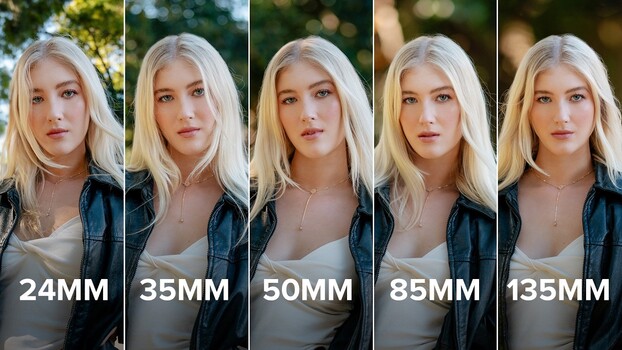
The view of some is that wider angle lenses distort people pictures too much, big nose syndrome etc, but longer lenses can create another unflattering look when they appear to make faces flatter or fatter, of course it's not the lens is camera to subject distance and framing. Mrs WW is conscious of this as along with some other non western people she thinks she has a big face.

I'm not bothered about either effect and sometimes a bit of distortion can create an effect to go for. I'm just a happy snapper not a portrait shooter, but I'd imagine that a really good 65mm might be somewhere near the sweet spot for people who are bothered about these effects.
 
Which 24-70 have you got, is the 35gm that much better for landscape?
Sony 24-70GM.

35GM 1.4 is my most favourite lens ever and I’d choose it over almost all other lenses, especially as a light carry around lens for landscapes.

The 1.4 is irrelevant for long exposures anyway as I usually shoot around f8 or f11 for everything in focus. :) I just love the IQ out of it.
 
Not sure how well this will show but the sky here is stunning. :)

55214069178_20782df4da_b.jpg
 
The view of some is that wider angle lenses distort people pictures too much, big nose syndrome etc, but longer lenses can create another unflattering look when they appear to make faces flatter or fatter, of course it's not the lens is camera to subject distance and framing. Mrs WW is conscious of this as along with some other non western people she thinks she has a big face.

I'm not bothered about either effect and sometimes a bit of distortion can create an effect to go for. I'm just a happy snapper not a portrait shooter, but I'd imagine that a really good 65mm might be somewhere near the sweet spot for people who are bothered about these effects.
Well as you said, distortion is created by subject distance not focal length so it depends how you're shooting.

These are shot at 35mm, no distortion

A1_9538 Re-Edit by Toby Gunnee, on Flickr

A1_06067-Edit by Toby Gunnee, on Flickr

And these at 50mm, no distortion

A7R02785-Edit by Toby Gunnee, on Flickr

A7R02765-Edit by Toby Gunnee, on Flickr

Even just a head and shoulder shot at 50mm doesn't show distortion

A1_09285-Edit by Toby Gunnee, on Flickr
 
Well as you said, distortion is created by subject distance not focal length so it depends how you're shooting.

These are shot at 35mm, no distortion

A1_9538 Re-Edit by Toby Gunnee, on Flickr

A1_06067-Edit by Toby Gunnee, on Flickr

And these at 50mm, no distortion

A7R02785-Edit by Toby Gunnee, on Flickr

A7R02765-Edit by Toby Gunnee, on Flickr

Even just a head and shoulder shot at 50mm doesn't show distortion

A1_09285-Edit by Toby Gunnee, on Flickr
There is obvious distortion in the first and last one that I can see even on my phone. There will be distortion with all of them.

It is the normal distortion that you get from using a 35mm or 50mm.

You can’t really compare unless you also shot the exact same set up with an 85 or longer focal length but the difference would be very noticeable.

Good example shown here.
 
Last edited:
There is obvious distortion in the first and last one that I can see even on my phone. There will be distortion with all of them.

It is the normal distortion that you get from using a 35mm or 50mm.

You can’t really compare unless you also shot the exact same set up with an 85 or longer focal length but the difference would be very noticeable.

Good example shown here.
There's a hint in the last one, but it looks pretty natural to me. I can't see any facial distortion in the first, maybe I just have distorted eyes :lol:
 
There's a hint in the last one, but it looks pretty natural to me. I can't see any facial distortion in the first, maybe I just have distorted eyes :LOL:
It’s not really a big deal and people will prefer different things. Every focal length will have a different effect, distance from the subject will off course make a difference as well.
 
Well as you said, distortion is created by subject distance not focal length so it depends how you're shooting.

These are shot at 35mm, no distortion...

Ok. I'll try and expand.. If I take a couple of shots at 20mm with different framing at different distances one of which is a head and shoulders shot and the other is with the full body filling less than half the vertical height in landscape one will show a degree of wide angle distortion and the other one will not because the distance in the head and shoulders shot made it more likely and the landscape shot with someone in it made it less likely. Shots in betewwn those distances but at the closer end of things may show distortion to some extent.

With a lens of 85mm and longer you are going to be further away and the further away you go I'd guess the more chance you have of flat big face syndrome. Yes, distance matters but you have your framing in mind and the distance to get that framing is decided by the focal length.

I see levels of distortion in my own pictures which are usually 24 to 50mm but I don't care and in fact somtimes it's what I'm going for rather than an accident of focal length and framing / distance but for people who are more geeky or getting paid I guess the sweet spot is between 50 and 85mm so 65mm could be right in there.
 
Last edited:
Ok. I'll try and expand.. If I take a couple of shots at 20mm with different framing at different distances one of which is a head and shoulders shot and the other is with the full body filling less than half the vertical height in landscape one will show a degree of distortion and the other one will not because the distance in the head and shoulders shot made it more likely and the landscape shot with someone in it made it less likely. Shots in betewwn those distances but at the closer end of things may show distortion to some extent.

With a lens of 85mm and longer you are going to be further away and the further away you go I'd guess the more chance you have of flat big face syndrome. Yes, distance matters but you have your framing in mind and the distance to get that framing is decided by the focal length.

I see levels of distortion in my own pictures which are usually 24 to 50mm but I don't care and in fact somtimes it's what I'm going for rather than an accident of focal length and framing / distance but for people who are more geeky or getting paid I guess the sweet spot is between 50 and 85mm so 65mm could be right in there.
Yeah I get all of that, I was just reiterating my point that there’s no “magic focal length” that is better for shooting with (y)
 
Yeah I get all of that, I was just reiterating my point that there’s no “magic focal length” that is better for shooting with (y)

If you want to find a spot at which the picture of a person or anything else I suppose looks pretty natural and free from the distortion you see at wider focal lengths or longer focal lengths (with the same framing) then yes I think there is a magical point and depending upon what you see and what you want in this context I think it is somewhere between 50 and 85mm with both of those focal lengths being at the end... so... 60 to 70 or 75mm? Maybe?

I think another thing that matters or rather two things are also the height and angle at which you hold the camera and take the picture.
 
If you want to find a spot at which the picture of a person or anything else I suppose looks pretty natural and free from the distortion you see at wider focal lengths or longer focal lengths (with the same framing) then yes I think there is a magical point and depending upon what you see and what you want in this context I think it is somewhere between 50 and 85mm with both of those focal lengths being at the end... so... 60 to 70 or 75mm? Maybe?

I think another thing that matters or rather two things are also the height and angle at which you hold the camera and take the picture.
I understand what you’re saying, but that’s one specific thing based on your preference. Some prefer the compression that a 105mm or 135mm give over truly natural appearance, so maybe I should have said no magic focal length for everyone (y)
 
I understand what you’re saying, but that’s one specific thing based on your preference. Some prefer the compression that a 105mm or 135mm give over truly natural appearance, so maybe I should have said no magic focal length for everyone (y)

I think preference and what looks natural or accurate are two different things. ATM I prefer 35/40mm but sometimes use 24, 28 or 50mm and I accept that in some compositions these lenses will / can give an unnatural look and sometimes that is what I'm going for and sometimes it's just a result of the focal length framing and distance.

65mm may give a more natural / accurate result than 35mm but my preferences which include size, weight and FoV mean that I'll probably always prefer something wider than 65mm.

Anyway. The reason we got into this was I think that I mentioned that some might see 65mm although it is a rather odd length as a sweet spot. I think some will. Some will be more attracted to the wide aperture.
 
Last edited:
I think preference and what looks natural or accurate are two different things. ATM I prefer 35/40mm but sometimes use 24, 28 or 50mm and I accept that in some compositions these lenses will / can give an unnatural look and sometimes that is what I'm going for and sometimes it's just a result of the focal length framing and distance.

65mm may give a more natural / accurate result than 35mm but my preferences which include size, weight and FoV mean that I'll probably always prefer something wider than 65mm.

Anyway. The reason we got into this was I think that I mentioned that some might see 65mm although it is a rather odd length as a sweet spot. I think some will. Some will be more attracted to the wide aperture.
I’m sure some will love the 65mm (y) With regards to natural looking, don’t they say that 50mm is closest to what we see with the eyes?
 
I’m sure some will love the 65mm (y) With regards to natural looking, don’t they say that 50mm is closest to what we see with the eyes?
They do, but they are wrong that would be 40mm, you could also argue 45mm, the exact answer is 43mm.
 
Last edited:
They do, but they are wrong that would be 40mm, you could also argue 45mm, the exact answer is 43mm.
42-50mm I believe. The eyes are dynamic though depending on whether they’re focussing near or far so there isn’t actually one set focal length (y)
 
I’m sure some will love the 65mm (y) With regards to natural looking, don’t they say that 50mm is closest to what we see with the eyes?

I think our brains do a bit more corrections than our software does at the mo. Our FoV is wide but it's only the central area (around 40/50mm or so) which has good resolution and the rest is pretty poor except for detecting movement. Perspective wise I agree that 50mm is about what we see.
 
Last edited:
42-50mm I believe. The eyes are dynamic though depending on whether they’re focussing near or far so there isn’t actually one set focal length (y)

Nope. People used to always say 40mm was closest then for some reason that became 50mm likely because 50mm lenses were more readily available.

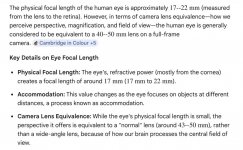
According to A.I

The physical distance from the lens to the retina in a relaxed human eye is approximately 17mm–22mm, but this does not directly translate to a 17-22mm camera lens because the eye’s "sensor" is curved, while a camera's is flat.

40mm–43mm: This is often cited as the most accurate "normal" lens because it closely matches the diagonal size of the 35mm full frame camera and provides a perspective that feels natural to the human eye, balancing context and focus.
 
Nope. People used to always say 40mm was closest then for some reason that became 50mm likely because 50mm lenses were more readily available.

According to A.I

The physical distance from the lens to the retina in a relaxed human eye is approximately 17mm–22mm, but this does not directly translate to a 17-22mm camera lens because the eye’s "sensor" is curved, while a camera's is flat.

40mm–43mm: This is often cited as the most accurate "normal" lens because it closely matches the diagonal size of the 35mm full frame camera and provides a perspective that feels natural to the human eye, balancing context and focus.
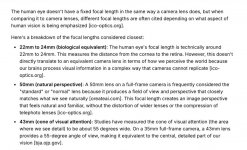
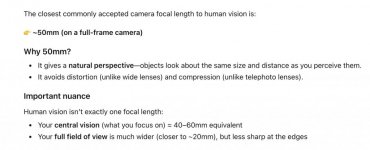
The issue with AI is that it uses the same internet we do, and as a result is just as ambiguous. Here's one google search and two different AI searches (y)

Screenshot 2026-04-18 at 11.39.29.jpgScreenshot 2026-04-18 at 11.40.45.jpg

Screenshot 2026-04-18 at 11.42.26.jpg
 
I think making a direct accurate photography terms definition in mm of what we see is difficult because so much of it depends on the work our brain puts in. It's a radically different process than an A7cII + 40mm + CS2026 can manage today.

Mrs WW wouldn't thank me for using this as an example so don't tell her :D

1-DSC01776.jpg

To me the unreality of this photo as opposed to how our brains would process this view at the time is obvious. It really is different to how I would see and understand and perceive her by eye and the difference is the capture and processing chains, my eye and brain v Sony kit and Adobe software. One day the kit and the processing might produce a result which is indistinguishable from how and what we saw at the time by eye.
 
I think making a direct accurate photography terms definition in mm of what we see is difficult because so much of it depends on the work our brain puts in. It's a radically different process than an A7cII + 40mm + CS2026 can manage today.

Mrs WW wouldn't thank me for using this as an example so don't tell her :D

View attachment 479551

To me the unreality of this photo as opposed to how our brains would process this view at the time is obvious. It really is different to how I would see and understand and perceive her by eye and the difference is the capture and processing chains, my eye and brain v Sony kit and Adobe software. One day the kit and the processing might produce a result which is indistinguishable from how and what we saw at the time by eye.
Yeah, as I mentioned the eye has somthing called accommodation so it's not one set focal length, hence the discrepancies and ambiguity.
 
Yeah, as I mentioned the eye has somthing called accommodation so it's not one set focal length, hence the discrepancies and ambiguity.

Ah. I'd never heard of that. So it's accommodation and the brain doing a lot of the work.

I don't know if tech can ever reproduce what we see in a 2D image. The physicality and constraints of a frame or screen might make this impossible. Maybe it would have to be 3D?
 
Which was the yearly springtime visit to this blossom tree
Have to wait for mine, I took the Hasselblad this year, but need to wait till I shoot the rest of the roll...

I was also metering differently, and forgot some tape across where I think I need a new seal so might have a light leak... don't get this kinda anticipation on digital :)
 
Last edited:
Ah. I'd never heard of that. So it's accommodation and the brain doing a lot of the work.

I don't know if tech can ever reproduce what we see in a 2D image. The physicality and constraints of a frame or screen might make this impossible. Maybe it would have to be 3D?
Well obviously the brain interprets everything, but it's the lens that physically changes shape and as a result you get a change in the focal length, that's what accommodation is (y)
 
Have to wait for mine, I took the Hasselblad this year, but need to wait till I shoot the rest of the roll...

I was also metering differently, and forgot some tape across where I think I need a new seal so might have a light leak... don't get this kinda anticipation on digital :)

I shot it on the Yashica Mat 124g too. First two shots of a fresh roll so same for me :ROFLMAO:
 
In my constant desire for a hipster retro camera I’ve been looking at the Nikon ZF today. Initially I thought it looked very interesting but then I saw that Nikon doesn’t make any Z lenses with an aperture ring.

Firstly I much prefer shooting with an aperture ring, but secondly it makes me wonder why Nikon made the ZF. It’s been made deliberately to give a retro ‘film camera’ experience, but you’ll only ever get 2/3 of that experience as you’ll never have an aperture ring, it seems a bit odd to me :thinking:
 
In my constant desire for a hipster retro camera I’ve been looking at the Nikon ZF today. Initially I thought it looked very interesting but then I saw that Nikon doesn’t make any Z lenses with an aperture ring.

Firstly I much prefer shooting with an aperture ring, but secondly it makes me wonder why Nikon made the ZF. It’s been made deliberately to give a retro ‘film camera’ experience, but you’ll only ever get 2/3 of that experience as you’ll never have an aperture ring, it seems a bit odd to me :thinking:

This is going to sound really weird, but I know what I mean :p :ROFLMAO: The ZF hasn't really appealed to me because I think it's gone too retro. Or it's trying to hard to be retro maybe? Something like that. Plus, it's a Nikon.... :exit:
 
In my constant desire for a hipster retro camera I’ve been looking at the Nikon ZF today. Initially I thought it looked very interesting but then I saw that Nikon doesn’t make any Z lenses with an aperture ring.

Firstly I much prefer shooting with an aperture ring, but secondly it makes me wonder why Nikon made the ZF. It’s been made deliberately to give a retro ‘film camera’ experience, but you’ll only ever get 2/3 of that experience as you’ll never have an aperture ring, it seems a bit odd to me :thinking:

That does seem daft. You could use film era lenses though.
 
Could also adapt e-mount lenses with bonus compatibility with your existing Sony kit?
 
Getting used to my new-to-me A1, definitely enjoying the resolution over my A9. AF subject recognition isn't quite as good as the A6700 nor even a Canon R5 (dare I say it) but it's definitely far faster at hitting focus and so sticky:


Central Park April 2026-3

Central Park April 2026-6
 
Getting used to my new-to-me A1, definitely enjoying the resolution over my A9. AF subject recognition isn't quite as good as the A6700 nor even a Canon R5 (dare I say it) but it's definitely far faster at hitting focus and so sticky:


Central Park April 2026-3

Central Park April 2026-6
Have you updated the firmware?
I believe they improved the subject detection a bit with one of them, though R5 is probably still better overall. To some extent even the A7iv was better for subject detection compared to A1.
 
Back
Top