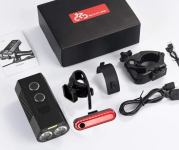
Cycle Lights

Messages
2,077
Edit My Images
Yes
I believe there are some cyclists here and I would appreciate some advice regarding lights for my bike please; are these items where I should stick to known brands or can I save a few pounds with less well known names ?
Looking online I think I probably will need 900 lumens or will this be overkill ? My trips will be town centre followed by unlit country lanes
Any other advice gratefully received
 
my advice would be two lights up front and two up back, don't have to be expensive.
but at both end one constant and one flashing. front white, back red.
you will get shot down for flashing at the front though,
 
I'm lucky enough that anywhere I cycle usually would be well lit up on darker evenings. At the moment I just have a pair of chargeable lights that just clip on via an elasticated band, easily mounted and taken off. I think they are only 300-400lm. I have been looking to something a bit stronger though, for the odd times I would venture into less well lit roads. At the moment it's more to be seen than to see. But with Autumn closing in, and now that I have an E-bike, [which is more consistently faster travelling] I would like something stronger.
 
A real 900 lumens is enough for serious mountain biking through unknown trails in pitch black - this is massive overkill for the road. Even Chinese 900 lumens (probably about 300) is more than you need unless riding unlit country lanes at speed. I've built a few sets of lights over the years, starting with 12V halogen bulbs and large battery packs, moving to importing LEDs and voltage controllers and running 1650 cells.

I'd suggest 100 lumens rear, with a broad lens will be much better than a brighter light with a small diffuser because these can dazzle motorists (and will be brighter than a typical brake light). You want to be seen, rather than antagonise or cause an accident. Up-front 100 to 300 lumens depending on where you ride, aimed like the dipped beam of a car and not like a main beam into their eyes.

Flashing light will get you noticed, but they make it harder to judge speed and distance - I would recommend not to use them because they make it harder to tell how far away you are and how fast you're traveling, so you're more likely to be hit.

When choosing and using lights, remember that road users should respect each other, and it's not a battle between 2 wheels and 4.
 
Flashing light will get you noticed, but they make it harder to judge speed and distance - I would recommend not to use them because they make it harder to tell how far away you are and how fast you're traveling, so you're more likely to be hit.
Totally agree, I find the flashing lights make it very difficult to assess the scene, as I do the banks of LEDs on some EVs.
 
I have no issues with cyclists and bright lights, as long as they are pointing down just like car dipped beam, guy came out of the darkness the other night with 3 lights on the front, yep I saw him coming but then closer all I could was a big white light in my eyes, I was probably down down to a slower pace than him until he passed by and vision restored, and judging by the speed it had electric assistance. Fit lights and then at night get some to hold it steady and walk towards it, if you get ‘blinded’ by your lights remember cars approaching and bigger than you, otherwise, keep saving the planet guys.
 
Last edited:
Flashing light will get you noticed, but they make it harder to judge speed and distance - I would recommend not to use them because they make it harder to tell how far away you are and how fast you're traveling, so you're more likely to be hit.

I don't agree as a lifetime cycle rider a flashing and a fixed light at both ends gets you noticed and people are more aware of you and that is always the point on a bike wether day or night, to be seen even if it causes a slight inconvenience to the car driver, i am not into front lights being searchlight type lights to be fair, most areas at night are well lit by other forms of lighting so an ultra bright "pea" light is what i recomend and then about 6 inces along the bar a flasher.
 
500/600 lm for me - bright enough. Just have normal (not flashing) - tend to buy a decent bran like Lenzyne as will be more reliable and last years, not break after 4 months.
 
Most areas are not well lit in my experience. Street lights are often set back now and the overhang is shorter, so the road doesn't seem to get the same amount of light. Then there are car headlights to compete with, often blindingly bright.

I've tried my lights dipped, but it doesn't seem to get noticed by drivers, especially those either pulling out from a side street or those pulling into the street I'm already on. The only thing that's worked is lights straight ahead and flashing. They notice it and slow down. However, all of my cycling is on small local 30mph roads. I'd probably reassess if on larger and faster roads.
 
I've tried my lights dipped, but it doesn't seem to get noticed by drivers, especially those either pulling out from a side street or those pulling into the street I'm already on.

The current trend for super-bright point sources of light isn't helping to get riders noticed. A larger but less intense light source would be more effective. With a point source like a lensed led if it's not shining in the driver's eyes then it's going to be much harder to see. And if it is in their eyes then they will be dazzled and that might cause them to have an accident with something else. The way lights have evolved isn't good right now.
 
Apart from sorting out the lights, I assume you have some protective head gear. You mentioned cycling in the dark on unlit country roads. "My trips will be town centre followed by unlit country lanes."

Sends shivers down my spine. There are too many idiots driving cars at speed along narrow, winding country roads in the dark. I wish you well but it's not something I'd do if I didn't have to. I think riding a bike in daylight hours carries quite a risk with the heavy volume of traffic not to mention those who just don't like cyclists and fail to give them a wide berth or just don't register/see them as they drive out of a side road.
 
The current trend for super-bright point sources of light isn't helping to get riders noticed. A larger but less intense light source would be more effective. With a point source like a lensed led if it's not shining in the driver's eyes then it's going to be much harder to see. And if it is in their eyes then they will be dazzled and that might cause them to have an accident with something else. The way lights have evolved isn't good right now.

I can only really comment on my own experiences and unfortunately the only way to get noticed and stop the drivers ploughing through me was to dazzle them with the strobe effect. I'd rather not, but nothing else worked and if it's a toss up between them slowing down and me not being flattened.... lol
 
Apart from sorting out the lights, I assume you have some protective head gear. You mentioned cycling in the dark on unlit country roads. "My trips will be town centre followed by unlit country lanes."

Sends shivers down my spine. There are too many idiots driving cars at speed along narrow, winding country roads in the dark. I wish you well but it's not something I'd do if I didn't have to. I think riding a bike in daylight hours carries quite a risk with the heavy volume of traffic not to mention those who just don't like cyclists and fail to give them a wide berth or just don't register/see them as they drive out of a side road.
I do have a helmet plus a hi vis jacket. Unfortunately there are too many idiot drivers everywhere and I'm predominantly a motorist. Living in a rural area I think you get used to narrower roads and I'd rather ride on those than the main roads near me
 
Most areas are not well lit in my experience. Street lights are often set back now and the overhang is shorter, so the road doesn't seem to get the same amount of light. Then there are car headlights to compete with, often blindingly bright.

I've tried my lights dipped, but it doesn't seem to get noticed by drivers, especially those either pulling out from a side street or those pulling into the street I'm already on. The only thing that's worked is lights straight ahead and flashing. They notice it and slow down. However, all of my cycling is on small local 30mph roads. I'd probably reassess if on larger and faster roads.
My local council has spent-and still spending-loads of money replacing street lights, yes posts are away from kerbside but overhanging light units are longer and the led? units spread light better meaning no dark spots, I’m told the also dim slightly at late hours overnight, never noticed but it may be past my bedtime.
 
My local council has spent-and still spending-loads of money replacing street lights, yes posts are away from kerbside but overhanging light units are longer and the led? units spread light better meaning no dark spots, I’m told the also dim slightly at late hours overnight, never noticed but it may be past my bedtime.

The ones around me are barely even a metre overhang. I'm sure I read that these new led street lights use directional optics, so we are getting more dark spots? There's certainly more glare, but I don't feel like there's actually more light hitting the road.
 
We have led street lights in the village, I think that individual emitters are lensed and we tend to see a bright pool below the unit with rapid fall-off and dark patches, particularly compared with the old diffused sodium lights.
 
The lighting needs for roads compared with off-road mountain biking are quite different. Anything that is really powerful and floods light is counter productive, unless you are dodging tree branches and rocks. Floods of light on shared paths are inappropriate - they blind oncoming cyclists and dog walkers.

As has been said, if you have flashing, don’t let it be annoying and make absolutely sure you have steady as well.

Hi-vis is useless in the dark. Reflective is effective, but hi-vis is invisible. As for headgear, there’s an assumption that you’ll be hit and that you’ll hit your head - so take steps to not be hit (by understanding other road users, cycling defensively, etc.). Cycle helmets are a side show, they do not do what people think they do, they make it more likely that you’ll hit your head, and they aren’t nearly as effective as people think they are. Plus they are a fantastic way of battering cyclists, “He wasn’t wearing a helmet” when his chest was crushed… his fault.

Look at shape of beam, and a brightness that allows you to see the road far enough ahead to stop or avoid obstacles, without dazzling oncoming traffic. Similar to ideal car headlights.
 
We have led street lights in the village, I think that individual emitters are lensed and we tend to see a bright pool below the unit with rapid fall-off and dark patches, particularly compared with the old diffused sodium lights.
We have those,too and have had them for a number of years. As you'll appreciate, they cut down on a lot of light pollution and I love dark skies. Much better whenever I can photograph lightning and can't leave the house due to heavy rain.
 
We have those,too and have had them for a number of years. As you'll appreciate, they cut down on a lot of light pollution and I love dark skies. Much better whenever I can photograph lightning and can't leave the house due to heavy rain.

They do, but more hazardous for anyone relying on them to provide consistent lighting for walking or cycling after dark. At least, our versions are.
 
The lighting needs for roads compared with off-road mountain biking are quite different. Anything that is really powerful and floods light is counter productive, unless you are dodging tree branches and rocks. Floods of light on shared paths are inappropriate - they blind oncoming cyclists and dog walkers.

As has been said, if you have flashing, don’t let it be annoying and make absolutely sure you have steady as well.

Hi-vis is useless in the dark. Reflective is effective, but hi-vis is invisible. As for headgear, there’s an assumption that you’ll be hit and that you’ll hit your head - so take steps to not be hit (by understanding other road users, cycling defensively, etc.). Cycle helmets are a side show, they do not do what people think they do, they make it more likely that you’ll hit your head, and they aren’t nearly as effective as people think they are. Plus they are a fantastic way of battering cyclists, “He wasn’t wearing a helmet” when his chest was crushed… his fault.

Look at shape of beam, and a brightness that allows you to see the road far enough ahead to stop or avoid obstacles, without dazzling oncoming traffic. Similar to ideal car headlights.
Don't hi-vis vests/jackets have silver reflective strips ? ..but if not, surely, when car headlight beams hit a hi-vis jacket it will definitely show and at some distance. The OP said that he will be cycling in town centres so hi-vis would be beneficial and if he cycles there in the dark shop lighting and street lighting will highlight his presence. Out in the countryside, it's true, it seems, that reflectivity drops of dramatically so the answer is to get one with reflective strips.

When I suggested protective head gear I was thinking of a cyclist being knocked off his/her bike or even hitting an object on the roadway or more likely, these days..a pothole and being thrown off balance and off the bike and their head hits the road. Surely, some protection is better than no protection ? Also..why would a cycle helmet make it more likely that a cyclist would hit their head on the ground ?
I'm very sceptical about what you've said so I did some digging around.

1..A hospital-based Norwegian study published in 2024 has the following stats: A statistically significant 62% odds reduction for any head injury was found for helmeted compared to non-helmeted bicyclists"

2.
March 1st 2025...

A copy/paste so not my bold.

'Cycling offers tremendous health and environmental benefits, but safety remains a critical concern. One enduring debate centers on bicycle helmets – how much protection they actually provide, and how helmet use (or non-use) correlates with injury outcomes?'

Top 5 Key Helmet vs No Helmet Statistics​

1 – Helmets cut head injury risk by ~50%: Wearing a bike helmet reduces the risk of head injury by about 48–60% on average. (Source)

2 – Significant reduction in fatality risk: Helmet use is associated with a 34% reduction in the risk of death and serious injury in a cycling crash. (Source)

3 – Not wearing a helmet triples fatal head injury risk: Cyclists who do not wear helmets are about 3 times more likely to die from head injuries than those who do. (Source)

4 – Most cyclist fatalities involve no helmet: In the United States, 62% of bicyclists killed in 2022 were not wearing helmets. (Source)

5 – Helmet laws are linked to lower head injuries: Policies requiring bike helmets have been associated with roughly 20%–55% reductions in head injuries. (Source)

You also said... "As for headgear, there’s an assumption that you’ll be hit and that you’ll hit your head." I don't agree with that . Cyclists don't go out on the roads assuming they will be involved in a collision...despite the stats. but by wearing a helmet they are taking the precautions that safety experts suggest to minimise a head injury should they be involved in a collision.I can't recall any of the lycra riders I've seen out on the roads not wearing a helmet. Surely that tells you all you need to know about reducing the effects of a head injury ?

Please correct me if I'm wrong but you appear to think that this is another reason not to wear a helmet.. quote.. "Plus they are a fantastic way of battering cyclists, “He wasn’t wearing a helmet” when his chest was crushed… his fault." Do you honestly believe that is a good enough reason not to wear a helmet especially in the light of the above research results ?

You say...."they [helmets] do not do what people think they do..." What is it, then, that people think helmets do which they don't do and if people knew that then they wouldn't bother wearing one ? Whilst digging around I came across research results (Sept 2024) by Imperial College ,London that graded the effectiveness of cycle helmets so it's important for people to do some research regarding that. The article also stated this. "Injuries and deaths from cycling have declined in recent years . However, cyclists remain vulnerable road users and cycling accidents can be serious, with head injuries being one of the main causes of death and life-changing injuries for cyclists involved in collisions"

You say.."take steps not to be hit" and cite.."understand other road users" How can someone do that and what exactly does that mean.."understanding other road users ? " I can think of a few scenarios when a cyclist needs to be on his/her guard. Oncoming cars 'in a hurry' and overtaking, approaching a left side junction when a vehicle is stationary there waiting to make a turn.. I've read that eye contact is a good idea but that's during daylight hours. Passing stationary cars when a door might be flung open and maybe pedestrians stepping out on to the roadway. Is that, maybe,"the understanding" you mean ?

 
Last edited:
They do, but more hazardous for anyone relying on them to provide consistent lighting for walking or cycling after dark. At least, our versions are.
Yes..I did notice that when they first appeared. Our city council did get a lot of complaints along those lines.
 
I've gone flying through the air a few times over the years - not one time would a helmet have mattered
 
Don't hi-vis vests/jackets have silver reflective strips ? ..but if not, surely, when car headlight beams hit a hi-vis jacket it will definitely show and at some distance. The OP said that he will be cycling in town centres so hi-vis would be beneficial and if he cycles there in the dark shop lighting and street lighting will highlight his presence. Out in the countryside, it's true, it seems, that reflectivity drops of dramatically so the answer is to get one with reflective strips.

When I suggested protective head gear I was thinking of a cyclist being knocked off his/her bike or even hitting an object on the roadway or more likely, these days..a pothole and being thrown off balance and off the bike and their head hits the road. Surely, some protection is better than no protection ? Also..why would a cycle helmet make it more likely that a cyclist would hit their head on the ground ?
I'm very sceptical about what you've said so I did some digging around.

1..A hospital-based Norwegian study published in 2024 has the following stats: A statistically significant 62% odds reduction for any head injury was found for helmeted compared to non-helmeted bicyclists"

2.
March 1st 2025...

A copy/paste so not my bold.

'Cycling offers tremendous health and environmental benefits, but safety remains a critical concern. One enduring debate centers on bicycle helmets – how much protection they actually provide, and how helmet use (or non-use) correlates with injury outcomes?'

Top 5 Key Helmet vs No Helmet Statistics​

1 – Helmets cut head injury risk by ~50%: Wearing a bike helmet reduces the risk of head injury by about 48–60% on average. (Source)

2 – Significant reduction in fatality risk: Helmet use is associated with a 34% reduction in the risk of death and serious injury in a cycling crash. (Source)

3 – Not wearing a helmet triples fatal head injury risk: Cyclists who do not wear helmets are about 3 times more likely to die from head injuries than those who do. (Source)

4 – Most cyclist fatalities involve no helmet: In the United States, 62% of bicyclists killed in 2022 were not wearing helmets. (Source)

5 – Helmet laws are linked to lower head injuries: Policies requiring bike helmets have been associated with roughly 20%–55% reductions in head injuries. (Source)

You also said... "As for headgear, there’s an assumption that you’ll be hit and that you’ll hit your head." I don't agree with that . Cyclists don't go out on the roads assuming they will be involved in a collision...despite the stats. but by wearing a helmet they are taking the precautions that safety experts suggest to minimise a head injury should they be involved in a collision.I can't recall any of the lycra riders I've seen out on the roads not wearing a helmet. Surely that tells you all you need to know about reducing the effects of a head injury ?

Please correct me if I'm wrong but you appear to think that this is another reason not to wear a helmet.. quote.. "Plus they are a fantastic way of battering cyclists, “He wasn’t wearing a helmet” when his chest was crushed… his fault." Do you honestly believe that is a good enough reason not to wear a helmet especially in the light of the above research results ?

You say...."they [helmets] do not do what people think they do..." What is it, then, that people think helmets do which they don't do and if people knew that then they wouldn't bother wearing one ? Whilst digging around I came across research results (Sept 2024) by Imperial College ,London that graded the effectiveness of cycle helmets so it's important for people to do some research regarding that. The article also stated this. "Injuries and deaths from cycling have declined in recent years . However, cyclists remain vulnerable road users and cycling accidents can be serious, with head injuries being one of the main causes of death and life-changing injuries for cyclists involved in collisions"

You say.."take steps not to be hit" and cite.."understand other road users" How can someone do that and what exactly does that mean.."understanding other road users ? " I can think of a few scenarios when a cyclist needs to be on his/her guard. Oncoming cars 'in a hurry' and overtaking, approaching a left side junction when a vehicle is stationary there waiting to make a turn.. I've read that eye contact is a good idea but that's during daylight hours. Passing stationary cars when a door might be flung open and maybe pedestrians stepping out on to the roadway. Is that, maybe,"the understanding" you mean ?
The mistake is the assumption that these figures represent the whole story. They don't. They are specific to helmet wearing. If you look at Public Health, imposing cycle helmets damages public health because fewer people cycle. So more obesity, high blood pressure, diabetes. Also more pollution (and recent ULEZ figures indicate how serious that is).

When helmets were imposed in Australia, injury rates went up. Why? Reasons like: less cycling overall, helmets more likely to be worn off-road, risk compensation, and so on. So, fewer cyclists and of the cohort still cycling, more risky behaviour.

It is more dangerous to not cycle, than to cycle without a helmet.
 
I assume because your didn't strike your head on anything ?
If the country is worried about heads being struck on things, then there should be helmet wearing in cars, on stairs and in showers.
 
helmets more likely to be worn off-road, risk compensation, and so on.

Historically I have always worn a helmet for mountain biking because I expect to fall off occasionally and when racing (where it was compulsory, although in those days it was the helmets made of padded strips). Over the years I've had a few offs, but never damaged a cycle helmet. Our son did break his helmet falling off once, but that was when a big jump went wrong.
 
You don't normally post silly responses.
It is serious. If someone is going to wring hands about the wearing of cycle helmets to prevent head injuries, they should first consider pedestrian, stair, car and shower helmets. As well as alcohol helmets - maybe to be given out at pub closing time.

Cycling, amongst causes of head injuries, is almost unique in respect of the good that it does for the environment, for public health and for communities.

Besides, it isn’t clear why helmets were intruduced in a thread about cycle lights.
 
Last edited:
I'd go flashing lights as for me at least when I see flashing lights as a drive I assume its a cyclist and slow down adjust appropriately, I use the lowest legal lumens required. As a cyclist also I know how bright lights are these days and its difficult to orientate them and ensure we dont blind other road users. The proviz jackets have always ensured i'm seen.

Can't speak for off road, good luck
 
I assume because your didn't strike your head on anything ?

That was partially my point, falling off a bike you're very unlikely to land on your head - instinct kicks in and your hands go forward to brace the impact. I'm just talking standard falls, not being run into or going off at high speeds. A cyclist probably has less chance of being hit by a vehicle than a pedestrian, if they're abiding by the rules, sticking to cycle lanes etc. If it's so dangerous to ride without a helmet, why isn't it mandatory, if it was then of course I'd wear one.
 
That was partially my point, falling off a bike you're very unlikely to land on your head - instinct kicks in and your hands go forward to brace the impact. I'm just talking standard falls, not being run into or going off at high speeds. A cyclist probably has less chance of being hit by a vehicle than a pedestrian, if they're abiding by the rules, sticking to cycle lanes etc. If it's so dangerous to ride without a helmet, why isn't it mandatory, if it was then of course I'd wear one.
It isn't mandatory because it is unclear that it is a good thing*, and because the effect on Public Health would be significant.

* e.g. a consultant brain surgeon saying they are a good thing. A consultant brain surgeon does not see all the cyclists that have not had a head injury. Nor what compulsory helmet wearing does to cycling.

It's a bit like a Prison Officer being asked to comment on crime in the country.
 
I understand why pro-cyclists wear them, the Tour de france for example - those guys can hit 50kmph in tight groups, crashes there could result in all kinds of injuries. Even at that, I don't recall many head injuries to pro cyclists

The worst injuries suffered in the Tour:


None of them mention head injuries


I'm doing max 15 - 18mph, sticking to my lane, if I fall it's always my own fault, no collisions [touch wood that never does happen] - at worst I'm getting scraped up on my arms/elbows/knees. It's a personal choice, I feel a helmet would hinder me more than help.

I thought this was a thread about bike lights btw, maybe we should return to that?
 
Last edited:
I'm doing max 15 - 18mph, sticking to my lane, if I fall it's always my own fault, no collisions [touch wood that never does happen] - at worst I'm getting scraped up on my arms/elbows/knees. It's a personal choice, I feel a helmet would hinder me more than help.

Not trying to willy-wave, at one time I had a Speedo on the mountain bike, and riding on the road downhill in the Chilterns 50mph was common and 65mph+ seen a few times. Off-road downhill sections were commonly 35-40mph.

The most common injuries I've seen from falling of bicycles at speed are grazing/friction burns, with occasional broken bones. One one our group had a high-speed impact with a tree when his front wheel came out, and he broke his neck & is paraplegic.

I've had a few offs, all low speed stuff, breaking ribs a few times and collar bone once.
 
Not trying to willy-wave, at one time I had a Speedo on the mountain bike, and riding on the road downhill in the Chilterns 50mph was common and 65mph+ seen a few times. Off-road downhill sections were commonly 35-40mph.

The most common injuries I've seen from falling of bicycles at speed are grazing/friction burns, with occasional broken bones. One one our group had a high-speed impact with a tree when his front wheel came out, and he broke his neck & is paraplegic.

I've had a few offs, all low speed stuff, breaking ribs a few times and collar bone once.


Since I got the e-bike I'm more aware what speeds I'm travelling, would never have guessed before on my old standard MTBs. I was going down a steep-ish hill recently and hit 35kph and that was scary enough for me lol!

I get more satisfaction [from the e-bike] going uphill at 15mph, on climbs I often used to dismount and walk up because it was a struggle.

I could probably count on one hand the amount of times I came off a bike and actually hurt myself, in 40yrs of cycling
 
There's a stat somewhere about statistically how many miles incident free the average cyclist will travel. I see to remember it is many 100,000 miles.

I've done over 50mph and it's pretty hairy!
 
The mistake is the assumption that these figures represent the whole story. They don't. They are specific to helmet wearing. If you look at Public Health, imposing cycle helmets damages public health because fewer people cycle. So more obesity, high blood pressure, diabetes. Also more pollution (and recent ULEZ figures indicate how serious that is).

When helmets were imposed in Australia, injury rates went up. Why? Reasons like: less cycling overall, helmets more likely to be worn off-road, risk compensation, and so on. So, fewer cyclists and of the cohort still cycling, more risky behaviour.

It is more dangerous to not cycle, than to cycle without a helmet.

You concluded your post with.".It is more dangerous to not cycle, than to cycle without a helmet".

You say I've made a mistake by assuming the numbers I posted did not represent the whole story. My post #22..last Sunday. We're talking at cross-purposes here. My point was about avoiding head injuries as well as reducing the seriousness of one by cyclists wearing a helmet. It wasn't about someone choosing not to cycle, after Australia made it compulsory to wear a helmet, because they didn't want to wear a helmet and consequently got less exercise and thus increasing the chances of premature death as a result of those conditions associated with a lack of exercise . eg heart problems, diabetes associated with being overweight etc. You mentioned some.

It's clearly safer..re head injuries, to cycle wearing a helmet which is why the lycra brigade wear them and parents I see with young children on bikes have them wearing helmets,too. I see adults riding their bikes wearing them and I did ask you why you thought that was the case which is what I'm in support of . You haven't challenged the data I posted you just said that those figures don't tell the whole story. Can we agree that, from avoiding a potential brain injury aspect, wearing a cycle helmet is a sensible thing to do ? I take onboard the points raised by the research results in Australia and the debate, really is, whether a government should mandate the wearing of cycle helmets or not. The same laws apply in New Zealand.

You did say that head injury rates in Australia increased after the legislation was rolled out across the whole of Australia. Several states already had laws to that effect. This is what I read. "The legislation increased helmet-wearing from 30-80% but was coupled with a decrease in cycling from 30-40% For motor cyclists the same legislation was a success so they thought the same would go for cyclists. Rates of head injuries among cyclists, which had been dropping through the 1980s, continued to fall before levelling out in 1993. A sharp reduction was expected but that could have been down to the 30-40% reduction in people cycling.

I have to say that I was surprised that you wrote this. It's not like you.

"If the country is worried about heads being struck on things, then there should be helmet wearing in cars, on stairs and in showers."

The risk to life and limb on the roads is far greater than someone walking downstairs..there are handrails..or someone taking a shower..there are anti-slip matts. Both in Australia and here in the UK, you have to wear a seat belt in a car and children have to be strapped into a special seat conforming to a certain standard ...in the UK..until they are 12 years old or 135cm in height. I had to check that. In Australia the same seat belt laws apply and children under 7 must be in a special seat..one that is 'approved'..ie a certain standard. A bit more re ages but you get the picture. So...just to make sure you know what my position is. I strongly support the wearing of cycle helmets both on and off public roads. I noted what Toni said re 'off road' and that his son experienced a fall off his bike that caused his helmet to break. He'd possibly have sustained a serious head injury had he not been wearing a helmet and the same goes for cyclists who are involved in bad roads accidents. It doesn't even need to involve a vehicle..I've seen some bad potholes around.

All that data from Australia is food for thought but about the consequences of compulsion and that is a different discussion. Out of interest I read this re the Netherlands which, as we know, is a keen cycling nation. It's dated 2024.

https://swov.nl/en/nieuws/fact-sheet-bicycle-helmets-effectiveness-use-and-measures. It's the national road safety institute and it's independent. It's interesting to see that the public there think that introducing legislation would discourage cycling.

"SWOV's updated fact sheet on bicycle helmets provides an up to date overview of the available research on bicycle helmets. The fact sheet includes research results that state that widespread bicycle helmet use in the Netherlands could prevent 100 to 110 traffic fatalities and 1,700 to 1,900 serious injuries annually. Helmeted cyclists are 60% less likely to sustain serious head injuries and 70% less likely to suffer fatal head injuries in a crash or fall.Currently, helmet usage among Dutch cyclists remains notably low by international standards, with only 5% of men and 3% of women wearing them. The main barriers to helmet adoption in the Netherlands include perceived discomfort, a belief that helmets are unnecessary, and inconvenience in carrying them. For children, parents indicate that peer pressure plays a major role, as their friends don't wear helmets either.While no Dutch organisations oppose voluntary helmet use, there is little support for mandatory helmet laws. The main concern is that mandatory helmets could significantly reduce cycling activity, although the available evidence for this is limited and not conclusive."


Out of interest. Back in 1983, would you have been in favour or against mandatory seat-belt wearing in cars ? Putting aside what age you were.
 
Last edited:
Out of interest. Back in 1983, would you have been in favour or against mandatory seat-belt wearing in cars ? Putting aside what age you were.
Sorry, I didn't read the rest, just caught this bit.

Seatbelts are a good idea. It is illustrative that you use them as a direct comparison with cycle helmets, when they are no such thing.
Enforcing seatbelts does not damage Public Health. Enforcing helmets does. Public Health is important...
 
Sorry, I didn't read the rest, just caught this bit.

Seatbelts are a good idea. It is illustrative that you use them as a direct comparison with cycle helmets, when they are no such thing.
Enforcing seatbelts does not damage Public Health. Enforcing helmets does. Public Health is important...
I asked because I wondered if you were opposed to the 'nanny state'. Many voiced that opinion at the time. They voiced the same sentiment when smoking in public places was to be banned.

Did I read that correctly ? You didn't read my post responding to you ?
 
Back
Top