Measuring Autofocus Speed

Messages
2,082
Edit My Images
Yes
Whenever a new camera model in a range is launched usually one of the much vaunted benefits is improved autofocus speed. Looking at camera reviews I often read that the autofocus is much faster than its predecessor.
However is this a subjective statement (which may be correct)? or is there objective data to support this?
 
I think it's both. Some aspects of autofocus can be measured for specific camera body and lens combinations (CIPA wrote a spec for that). Personally, the reliability of continuous autofocus tracking matters more than single-frame speed, and I don't think there is a standardised testing methodology for it; reviewers each do their own thing, so it's best to try it hands-on if you can.
 
I think it's both. Some aspects of autofocus can be measured for specific camera body and lens combinations (CIPA wrote a spec for that). Personally, the reliability of continuous autofocus tracking matters more than single-frame speed, and I don't think there is a standardised testing methodology for it; reviewers each do their own thing, so it's best to try it hands-on if you can.
I did wonder and as you say tracking autofocus is what most photographers want in the real world. I think it's probably like taking a more modern car for a test drive; most things feel better but only having purchased it and driven for a while do the quirks start to become noticeable
 
Whenever a new camera model in a range is launched usually one of the much vaunted benefits is improved autofocus speed. Looking at camera reviews I often read that the autofocus is much faster than its predecessor.
However is this a subjective statement (which may be correct)? or is there objective data to support this?
I often think it’s just a perception, with some of the modern mirrorless cameras AF lock on is near instant, I don’t know how much faster it can be than that. Focus speed between near and far subjects can be detected more, however I would hazard a guess this is more down to the lens motors than the camera body.

Where you can (imo) see a noticeable difference in AF is subject recognition and the ability to track without getting distracted by backgrounds. However, we are now reaching a point where this is getting pretty flawless too so, barring the odd ‘anomaly’ I’m not sure how much better this can get either. If we’re not too careful we’re going to end up with 50 different subjects we can choose from.
 
If we’re not too careful we’re going to end up with 50 different subjects we can choose from.
right..... canon R1 has three subject types (people, animals and vehicles), and people tracking can be further refined by four sports, and you can pre-load up to 10 specific faces to prioritize. it takes a while to configure and learn to use, but you have a good chance of filling a card with 100% usable frames.
 
right..... canon R1 has three subject types (people, animals and vehicles), and people tracking can be further refined by four sports, and you can pre-load up to 10 specific faces to prioritize. it takes a while to configure and learn to use, but you have a good chance of filling a card with 100% usable frames.
On top of a plethera of focus modes (tracking, AF-C, AF-S etc etc) and focus areas (single point, wide, centre etc etc) my A1 II has the following subject detection:-

Auto
People (with face memory and face priority select)
Bird/Animal
Bird
Animal
Insect
Car/Train
Plane

You can then choose which eye, or whether that's auto. Then there's

Tracking Shift Rnage
Recognition priority set
Recognition part
Recognition part select
Tracking persistence level
Recognition sensitivity
Animal Detailed settings
Bird details settings

And if this isn't enough you have:-

AF Level for crossing
AF tracking for speed changes
AF transition speed (video)
AF subject shift sensitivity
AF area registration

There's probably a few more bits, but as you can see it's getting ridiculous. Of course some of the things are super handy, but if we continue along this path are we going to get other subject option sub menus such as:-

Birds > Small Birds > Large Birds > Birds of Prey etc. etc.

Obviously with the last bit I'm being a bit facetious but you get my point ;)

One subject that I would like that's missing is Motorcyle/Motorcyle rider, I do believe some other systems have this.

 
On top of a plethera of focus modes (tracking, AF-C, AF-S etc etc) and focus areas (single point, wide, centre etc etc) my A1 II has the following subject detection:-

Auto
People (with face memory and face priority select)
Bird/Animal
Bird
Animal
Insect
Car/Train
Plane

You can then choose which eye, or whether that's auto. Then there's

Tracking Shift Rnage
Recognition priority set
Recognition part
Recognition part select
Tracking persistence level
Recognition sensitivity
Animal Detailed settings
Bird details settings

And if this isn't enough you have:-

AF Level for crossing
AF tracking for speed changes
AF transition speed (video)
AF subject shift sensitivity
AF area registration

There's probably a few more bits, but as you can see it's getting ridiculous. Of course some of the things are super handy, but if we continue along this path are we going to get other subject option sub menus such as:-

Birds > Small Birds > Large Birds > Birds of Prey etc. etc.

Obviously with the last bit I'm being a bit facetious but you get my point ;)

One subject that I would like that's missing is Motorcyle/Motorcyle rider, I do believe some other systems have this.


by the tine all that is set up a guy in a car will be home with his feet up having a coffee :exit:
 
Autofocus speed is highly dependent on environment/scene and camera setup (there are CIPA guidelines for that), but also/equally/moreso upon the lens in use. If you have a lens of high IQ, with fast drive motor(s), and lightweight focus elements, then any differences in focus speed will most likely be "incremental" and difficult to discern/measure without highly technical testing/equipment.

IME a lot of it is "impressions", and to some extent wishful thinking/"glow." In general, there are "differences," but not that one is necessarily better overall or in all situations... E.g. there are plenty of times where I find mirrorless AF to be lacking compared to the DSLR's dedicated PDAF system.
 
. there are plenty of times where I find mirrorless AF to be lacking compared to the DSLR's dedicated PDAF system.
That’s interesting, I’ve got to say the mirrorless I’ve used have been streets ahead in all areas of AF for me, such as lock on speed, subject recognition, subject tracking etc. However, I did only shoot Nikon DSLR and I know they had a history of the AF being distracted by backgrounds. I remember someone on here with a D5 (I think it was) having plenty of discussions about this with Nikon to try and resolve the issue of it focussing on the background when the backgrounds were ‘busy’.
 
However, I did only shoot Nikon DSLR and I know they had a history of the AF being distracted by backgrounds.
I don't find my Z9 to be any better in this respect. I think perhaps with easier subjects the mirrorless AF AI (subject recognition, etc) performs "better"... but I didn't/don't really have significant issues with DSLR's in those scenarios either (although I really didn't like the D7000 I had for a while, so maybe model dependent).
 
Last edited:
I don't find my Z9 to be any better in this respect. I think perhaps with easier subjects the mirrorless AF AI (subject recognition, etc) performs "better"... but I didn't/don't really have significant issues with DSLR's in those scenarios either (although I really didn't like the D7000 I had for a while, so maybe model dependent).
In my experience, it varies a lot by camera body. My Fuji GFX, for example, has comparatively poor AF performance vs, say, a Canon 1DXM2 DSLR. On the other hand, the Canon R1 is a big step up from the 1DXM2. I understand that mirrorless bodies can't detect the low-light assist beams emitted by flashes (and which were designed for DSLRs), but I have never found that to be a problem.
 
I understand that mirrorless bodies can't detect the low-light assist beams emitted by flashes (and which were designed for DSLRs), but I have never found that to be a problem.
Yeah, it's not about the focus assist with speedlights. It's about the lack of cross type sensors, and the fact that the DSLR's PDAF system is working with multiple real images that are (almost) always in-focus (as many as six) so it can (often) find subjects in/through distractions much better.

With mirrorless the AF is using the same image you see (actually two virtual images), so if the subject is way OOF the AF system can't see it; and it is likely to blow right past it if it is not large in the viewfinder. And the AI requires time to kick in and for the AF to switch modes (into subject recognition/tracking); it won't do that if it already locked onto something else w/o the subject also being discernable/recognizable and within the designated area (locked onto BG/FG).

There are tricks to help get the most out of the mirrorless AF, and those tricks also work with DSLR's... it's just that mirrorless is more dependent on using them. Of course, less demanding scenarios make the differences less apparent and even put the mirrorless ahead.

I wouldn't necessarily say the DSLR is way ahead in all demanding situations either; just "different." And I am comparing top level bodies (D4, D5, Z9)...
 
Last edited:
Yeah, it's not about the focus assist with speedlights. It's about the lack of cross type sensors, and the fact that the DSLR's PDAF system is almost always working with multiple real images that are (almost) always in-focus (as many as six) so it can (often) find subjects in/through distractions much better.

With mirrorless the AF is using the same image you see (actually two virtual images), so if the subject is way OOF the AF system can't see it; and it is likely to blow right past it if it is not large in the viewfinder. And the AI requires time to kick in and for the AF to switch modes (into subject recognition/tracking); it won't do that if it already locked onto something else w/o the subject also being discernable/recognizable and within the designated area (locked onto BG/FG).

There are tricks to help get the most out of the mirrorless AF, and those tricks also work with DSLR's... it's just that mirrorless is more dependent on using them. Of course, less demanding scenarios make the differences less apparent and even put the mirrorless ahead.

I wouldn't necessarily say the DSLR is way ahead in all demanding situations either; just "different." And I am comparing top level bodies (D4, D5, Z9)...
I know you know your stuff but I find this surprising, I've never seen this reported or mentioned in any comparison. I understand the pros of cross type sensors, but the pros of modern algorithms outweigh this.

That being said you've had first hand experience using these bodies so I'm not disputing your findings, I just find it surprising that's all (y)
 
I understand the pros of cross type sensors, but the pros of modern algorithms outweigh this.
The algorithm takes time to work.

I.e. using my Z9 with bird subject recognition active and in 3D focus mode (color/pattern recognition).
Initially it is in 3D focus mode and it will lock onto/track a point of color under the selected focus point (as advertised/described); and it doesn't care if it is a bird or not. After the initial focus acquisition it may detect that it is a bird, and then it may jump to the bird's eye; even if it is not the same area or color initially acquired. I.e. it abandons the 3D focus mode and switches into subject/eye tracking (it can't do both). But if not, it does not refuse to focus/function; it stays in 3D mode instead. I.e. it will focus on a human face, but it won't switch to subject recognition or track an eye.

And it behaves similarly in the other focus modes (wide area, etc). The easier the subject/situation is, the less time the algorithm needs; but it cannot even begin to function until the subject is already (very nearly) in focus in the viewfinder. It also needs a pretty decent image to work with (light/contrast/etc)... e.g. auto capture (subject recognition) is worthless for foxes at night (even at close range and side lit, I expected more). To be honest, I haven't entirely figured out what it needs; sometimes it seems to work pretty well with a dim image/viewfinder.

Obviously I can't speak about every camera make/model; over the years I've owned/used quite the variety and there are always differences. But the basic premise holds for all AI autofocus systems... it must first be able to see/discern the subject (focus), before it can then determine what kind of subject it is, and then (hopefully) find/track an eye. And the more deterministic (picky) the system is, the slower it will be (my Z9 will sometimes pick out a highlight on a leaf as being an eye, so not terribly picky).

If you pick a mode without subject recognition, or disable it, then the AF is basically handicapped compared to a DSLR (but it may benefit from faster processing, etc, of newer technology). Not that that is necessarily a problem either...(and a few mirrorless do have cross type points).
 
Last edited:
The algorithm takes time to work.

I.e. using my Z9 with bird subject recognition active and in 3D focus mode (color/pattern recognition).
Initially it is in 3D focus mode and it will lock onto/track a point of color under the selected focus point (as advertised/described); and it doesn't care if it is a bird or not. After the initial focus acquisition it may detect that it is a bird, and then it may jump to the bird's eye; even if it is not the same area or color initially acquired. I.e. it abandons the 3D focus mode and switches into subject/eye tracking (it can't do both). But if not, it does not refuse to focus/function; it stays in 3D mode instead. I.e. it will focus on a human face, but it won't switch to subject recognition or track an eye.

And it behaves similarly in the other focus modes (wide area, etc). The easier the subject/situation is, the less time the algorithm needs; but it cannot even begin to function until the subject is already (very nearly) in focus in the viewfinder. It also needs a pretty decent image to work with (light/contrast/etc)... e.g. auto capture (subject recognition) is worthless for foxes at night (even at close range and side lit, I expected more). To be honest, I haven't entirely figured out what it needs; sometimes it seems to work pretty well with a dim image/viewfinder.

Obviously I can't speak about every camera make/model; over the years I've owned/used quite the variety and there are always differences. But the basic premise holds for all AI autofocus systems... it must first be able to see/discern the subject (focus), before it can then determine what kind of subject it is, and then (hopefully) find/track an eye. And the more deterministic (picky) the system is, the slower it will be (my Z9 will sometimes pick out a highlight on a leaf as being an eye, so not terribly picky).

If you pick a mode without subject recognition, or disable it, then the AF is basically handicapped compared to a DSLR (but it may benefit from faster processing, etc, of newer technology). Not that that is necessarily a problem either...(and a few mirrorless do have cross type points).
My experience with the A1 and A1 II is somewhat different tbh, it’s almost telepathic.

Of course if you have it in subject detect mode and you’re not shooting that subject so it’s not in the frame it will still try and detect that subject, which on occasion can trip it up, but that’s user error imo and not a ‘fault’ of the AF.

Obviously in such situations it’s better to turn off subject recognition , but even then I’ve found every aspect of AF better than the DSLRs I’ve owned. Even the examples you’ve mentioned, i.e. when the subject is initially completely OOF. Of course there’s so many variables to this that it makes sense we can all have different experiences (y)
 
I had Canon DSLR's, 300D, 10D, 20D and 5D. Admittedly maybe not earth shattering technology there. Every mirrorless camera I've had apart from the Fuji's has been in a different league, a better one. I remember reading on the Canon website that if you took 3 pictures you'd see focus differences between them and this was normal. I don't think I care how fast a focus system like that is if it's that inconsistent plus there was that whole Micro Adjust fiasco and differences between bodies and lenses. Nightmare. Give me mirrorless every time :D
 
Last edited:
I had Canon DSLR's, 300D, 10D, 20D and 5D. Admittedly maybe not earth shattering technology there. Every mirrorless camera I've had apart from the Fuji's has been in a different league, a better one. I remember reading on the Canon website that if you took 3 pictures you'd see focus differences between them and this was normal. I don't think I care how fast a focus system like that is if it's that inconsistent plus there was that whole Micro Adjust fiasco and differences between bodies and lenses. Nightmare. Give me mirrorless every time :D
Sony mirrorless has made things so easy that it almost feels like cheating, I no longer have to worry about focussing and can just concentrate on composition, I know the camera will focus on what I want, and it will be tack sharp 99.99% of the time. As you say DSLR often needed micro adjusting, and there were tolerances which meant focus wasn't necessarily 100% tack sharp. I can't remember what the tolerances were, something like 1/3 of the zone of focus or something, I did have lengthy discussions with Nikon about it when I was having problems with my D750.

Whilst all this is great and on the whole I wouldn't want to go back, there are times though when it's nice to go back to basics which is why I enjoy shooting with my old fully manual SLR. I wouldn't want to shoot wildlife or motorsports this way nowadays though ;)
 
Sony mirrorless has made things so easy that it almost feels like cheating, I no longer have to worry about focussing and can just concentrate on composition, I know the camera will focus on what I want, and it will be tack sharp 99.99% of the time. As you say DSLR often needed micro adjusting, and there were tolerances which meant focus wasn't necessarily 100% tack sharp. I can't remember what the tolerances were, something like 1/3 of the zone of focus or something, I did have lengthy discussions with Nikon about it when I was having problems with my D750.

Whilst all this is great and on the whole I wouldn't want to go back, there are times though when it's nice to go back to basics which is why I enjoy shooting with my old fully manual SLR. I wouldn't want to shoot wildlife or motorsports this way nowadays though ;)
Totally agree with you regarding Sony...
 
Regarding micro focus adjustment on DDLSs while agree that it could be an issue it wasn’t for me , back in the day I sent my kit , 7D 2 and 300 2.8 and TCs to Canon to set up and it was spot on after that
But agree mirrorless is better in my case R5 makes it so much easier to track and shoot a moving animal and as said getting composition right
 
Regarding micro focus adjustment on DDLSs while agree that it could be an issue it wasn’t for me , back in the day I sent my kit , 7D 2 and 300 2.8 and TCs to Canon to set up and it was spot on after that
But agree mirrorless is better in my case R5 makes it so much easier to track and shoot a moving animal and as said getting composition right
Zooms were more of an issue as it was nigh on impossible to get it right for both ends of the zoom, I had both my D750 and 70-200mm f2.8 calibrated by Nikon and it still wasn’t always tack sharp. I remember Sigma brought out their dock and you could calibrate their lenses at different focal lengths of the zoom, but even then it wasn’t 100% perfect every time.
 
I wouldn't necessarily say the DSLR is way ahead in all demanding situations either; just "different." And I am comparing top level bodies (D4, D5, Z9)...
I’m gonna repeat, I trust your experience here with Nikon. But the same is not true of Canon or Sony, where the mirrorless AF even in the midrange is better than the best of their DSLR’s.

My R6 is two AF generations old, but on release it was measurably better at tracking than the 1dxiii it shared an image sensor with.

The later cameras make the R6 look fairly inconsistent apparently.
 
I’m gonna repeat, I trust your experience here with Nikon...
I think a lot of people using Nikon would disagree with me as well... but I don't really know why. I know many haven't tested/studied what the AF is actually doing, but I guess that doesn't much matter if the result is good (even if the reason isn't what you think).

I can only think that some/many were not as proficient with the DSLR. I never really had significant issues with AF and most subjects before, so I don't see a huge improvement now. But I also used a lot of the same tricks/techniques (function buttons assigned to different focus modes, prefocus, etc). And things that were really difficult before are still really difficult with a low success rate (swifts/swallows in flight, kingfisher hitting the water, etc) . Maybe Nikon is lagging behind now; I haven't heard about it if so...
 
Last edited:
I think a lot of people using Nikon would disagree with me as well... but I don't really know why. I know many haven't tested/studied what the AF is actually doing, but I guess that doesn't much matter if the result is good (even if the reason isn't what you think).

I can only think that some/many were not as proficient with the DSLR. I never really had significant issues with AF and most subjects before, so I don't see a huge improvement now. But I also used a lot of the same tricks/techniques (function buttons assigned to different focus modes, prefocus, etc). And things that were really difficult before are still really difficult with a low success rate (swifts/swallows in flight, kingfisher hitting the water, etc) . Maybe Nikon is lagging behind now; I haven't heard about it if so...
TBH I was under the impression that Nikon AF is lagging behind, according to the world of the internet anyway, however we are of course being extra picky as cameras are all fantastic these days.
 
I never really had significant issues with AF and most subjects before
I didn’t have ‘issues’ beyond the fact that the AF depended on a focus point, and the tracking wasn’t ‘smart’ in the same way that my subject detect is now.

My in focus keeper rate was fairly typical I believe for any DSLR I owned (for the 6d that was around 70% for tracking), and my AF keeper rate now is fairly typical too (over 90% whilst tracking).
 
I often think it’s just a perception, with some of the modern mirrorless cameras AF lock on is near instant, I don’t know how much faster it can be than that. Focus speed between near and far subjects can be detected more, however I would hazard a guess this is more down to the lens motors than the camera body.

This is something I became far more aware of when I got my Sony A9 over 5 years ago, what an amazing AF system it had. I'm sure I had a lens that struggled to keep up.


Where you can (imo) see a noticeable difference in AF is subject recognition and the ability to track without getting distracted by backgrounds. However, we are now reaching a point where this is getting pretty flawless too so, barring the odd ‘anomaly’ I’m not sure how much better this can get either. If we’re not too careful we’re going to end up with 50 different subjects we can choose from.

My guess is continuing to improve on low-light autofocus ability. Won't be long before we can eye-track in pitch dark! lol
 
I had a play with various mirrorless systems at the last Welsh camera show. They must have had all the autofocus bells and whistles operating as the focus speed was a bit slow on most of them. I think my D6 felt faster than everything except the Sony A9iii.
I've got a suspicion that mirrorless will not work as well on low light action- DSLRs are not limited by trying to fit phase detect sensors into the main sensor. The smaller phase detect sensors on mirrorless will get less light so take longer to generate a decent signal.
 
I had a play with various mirrorless systems at the last Welsh camera show. They must have had all the autofocus bells and whistles operating as the focus speed was a bit slow on most of them. I think my D6 felt faster than everything except the Sony A9iii.
I've got a suspicion that mirrorless will not work as well on low light action- DSLRs are not limited by trying to fit phase detect sensors into the main sensor. The smaller phase detect sensors on mirrorless will get less light so take longer to generate a decent signal.
I don't know what you tried but most of the latest few generations of mirrorless aren't slow, focus is nigh on instant even with the bells and whistles on. The D6 is rated to -4.5ev in the centre and -4ev everywhere else. Many mirrorless can focus down to -4ev, and some much lower such as -6.5ev and -7.5ev, and I believe the Nikon Z9 can focus down to -9ev in starlight mode (whatever that is) :eek:
 
I don't know what you tried but most of the latest few generations of mirrorless aren't slow, focus is nigh on instant even with the bells and whistles on. The D6 is rated to -4.5ev in the centre and -4ev everywhere else. Many mirrorless can focus down to -4ev, and some much lower such as -6.5ev and -7.5ev, and I believe the Nikon Z9 can focus down to -9ev in starlight mode (whatever that is) :eek:
You have to be careful with the specs... e.g. the D6 is rated down to -4.5 EV with *any lens. While the Z9 is rated down to -6.5 only with an f/2 lens used wide open; and down to -8.5 EV with an f/1.2 lens (it's picking up over 1 stop of that just by requiring a faster lens). This is because the mirrorless AF system is highly dependent on the image you see (and thus the lens); whereas the DSLR's PDAF system is largely independent (it has its own lenses with their own max apertures). So when I'm using my 600/6.3 on my Z9 it really is hindering the max capability notably.

Starlight view is just a higher gain level for the viewfinder/AF feed so the AI has a brighter image to work with.

(*min aperture ~ f/10 IIRC)
 
Last edited:
You have to be careful with the specs... e.g. the D6 is rated down to -4.5 EV with *any lens. While the Z9 is rated down to -6.5 only with an f/2 lens used wide open; and down to -8.5 EV with an f/1.2 lens (it's picking up over 1 stop of that just by requiring a faster lens). This is because the mirrorless AF system is highly dependent on the image you see (and thus the lens); whereas the DSLR's PDAF system is largely independent (it has its own lenses with their own max apertures). So when I'm using my 600/6.3 on my Z9 it really is hindering the max capability notably.

Starlight view is just a higher gain level for the viewfinder/AF feed so the AI has a brighter image to work with.

(*min aperture ~ f/10 IIRC)
It also depends on the system too, for example Sony stop down the lens all the time if using an aperture smaller than its max aperture rather than focussing with the lens wide open and stopping down only when taking the shot like DSLRs and some other mirrorless. They have a setting that you can use in low light situations where the aperture is wider during focussing but it’s still not fully open, it’s a kind of half way house.
 
It’s all relative. For my use case I find a
Sony A7c ridiculously fast and accurate at autofocus. Shooting at a recent event only 1 out of 700 shots was out of focus.

As epic as the af is I’m painfully aware there are cameras out there with significantly better af.
 
With mirrorless the AF is using the same image you see (actually two virtual images), so if the subject is way OOF the AF system can't see it; and it is likely to blow right past it if it is not large in the viewfinder. And the AI requires time to kick in and for the AF to switch modes (into subject recognition/tracking); it won't do that if it already locked onto something else w/o the subject also being discernable/recognizable and within the designated area (locked onto BG/FG).
This isn't correct and hasn't been for a long time at least for many mirrorless cameras. What you're describing is Contrast Detect AutoFocus (CDAF) but mirrorless cameras now also use Phase Detect AutoFocus (PDAF) using embedded components within the main sensor, the same as DSLRs so they no longer have the issues you mention. This means they can initially use the PDAF to quickly work out how out of focus the image is which can't be done with CDAF, jump the focus to roughly the correct position then nail the focus with CDAF. This means they can match the speed of a DSLR thanks to the same PDAF but improve on accuracy since the DSLR isn't focusing against the main sensor so may need lens adjustment to get focus dead on.

Sony introduced the technology in their NEX-5R way back in 2012 who are the first I remember doing it but there may have been other cameras that did it before then.

The CDAF only mirrorless cameras were functional but noticeably limited with their AF but I've found the newer mirrorless cameras to blow the older DSLRs out of the water, I thought the Nikon DSLR AF was impressive until I bought a Sony A9 and now a Nikon Z8 both which can manage incredible speed, tracking and accuracy.
I’m gonna repeat, I trust your experience here with Nikon. But the same is not true of Canon or Sony, where the mirrorless AF even in the midrange is better than the best of their DSLR’s.

My R6 is two AF generations old, but on release it was measurably better at tracking than the 1dxiii it shared an image sensor with.

The later cameras make the R6 look fairly inconsistent apparently.
It's not true of Nikon either, I've had the Sony A9 and Nikon Z8 both of which have remarkable autofocus performance. I'd dabbled in and out with mirrorless cameras before the A9 but always mixed with a DSLR but the A9 meant no DSLR was needed plus outwith AF it has the significant advantages of being completely silent and blackout free shooting.

Going back to the original subject, this reminds me of the Olympus E-3 which was their new flagship 4/3 (long before micro 4/3) DSLR and one of their main selling points was the new 11 point AF system which was the fastest AF system measured in time to lock on. That may well have been correct but in practice the autofocus system had significant problems where it could lock focus on an out of focus subject, I had my camera in for repair several times with no change and believe based on others having the same problem it was an inherent issue with the camera's AF system, eventually I changed to a Nikon D700 and its AF was a huge improvement. I'm sure the E-3 could lock on faster in some tests but it's pointless if it can't lock on correctly consistently.

It's difficult to measure AF performance so I usually try to get an idea from people's comments on a certain camera although as shown here that can vary quite a bit as well.
 
This isn't correct and hasn't been for a long time at least for many mirrorless cameras. What you're describing is Contrast Detect AutoFocus (CDAF) but mirrorless cameras now also use Phase Detect AutoFocus (PDAF) using embedded components within the main sensor, the same as DSLRs so they no longer have the issues you mention. This means they can initially use the PDAF to quickly work out how out of focus the image is which can't be done with CDAF, jump the focus to roughly the correct position then nail the focus with CDAF. This means they can match the speed of a DSLR thanks to the same PDAF but improve on accuracy since the DSLR isn't focusing against the main sensor so may need lens adjustment to get focus dead on.

Sony introduced the technology in their NEX-5R way back in 2012 who are the first I remember doing it but there may have been other cameras that did it before then.

The CDAF only mirrorless cameras were functional but noticeably limited with their AF but I've found the newer mirrorless cameras to blow the older DSLRs out of the water, I thought the Nikon DSLR AF was impressive until I bought a Sony A9 and now a Nikon Z8 both which can manage incredible speed, tracking and accuracy.

It's not true of Nikon either, I've had the Sony A9 and Nikon Z8 both of which have remarkable autofocus performance. I'd dabbled in and out with mirrorless cameras before the A9 but always mixed with a DSLR but the A9 meant no DSLR was needed plus outwith AF it has the significant advantages of being completely silent and blackout free shooting.

Going back to the original subject, this reminds me of the Olympus E-3 which was their new flagship 4/3 (long before micro 4/3) DSLR and one of their main selling points was the new 11 point AF system which was the fastest AF system measured in time to lock on. That may well have been correct but in practice the autofocus system had significant problems where it could lock focus on an out of focus subject, I had my camera in for repair several times with no change and believe based on others having the same problem it was an inherent issue with the camera's AF system, eventually I changed to a Nikon D700 and its AF was a huge improvement. I'm sure the E-3 could lock on faster in some tests but it's pointless if it can't lock on correctly consistently.

It's difficult to measure AF performance so I usually try to get an idea from people's comments on a certain camera although as shown here that can vary quite a bit as well.
I've actually just researched this and it appears that we are all wrong.

PDAF on both DSLRs and Mirrorless work in the same way (except where the PDAF sensors are located), they both split the light and measure if the two images align and if not it can calculate whether it's in front or behind and by how much and adjusts the lens accordingly. Initially mirrorless PDAF was slower due to the time it took to read the data, however nowadays sensor data can be read very quickly, and stacked sensors even faster and has surpassed DSLR.

Contrast detection does not split the image but instead analyses sharpness of transitions, it has no way of knowing whether it is front or back focusses so moves the lens back and forth to analyse which way makes the transitions sharper and hence why contrast detect is slower.

DSLR's had a tolerance and as long as the focus was within the circle of confusion is was considered correct, but might not be 100% tack sharp like mirrorless. One of the main reasons was due to the pathway from the PDAF sensor, and the microscopic changes in light when the mirror flips up. Mirrorless does not have this issue as the AF sensors are on the main sensor, and they tend to use hyrbid AF, i.e the majority is done using PDAF and then it uses CDAF at the last part to ensure absolute sharpness.
 
What you're describing is Contrast Detect AutoFocus (CDAF) but mirrorless cameras now also use Phase Detect AutoFocus (PDAF) using embedded components within the main sensor, the same as DSLRs so they no longer have the issues you mention.
No, I am not describing CDAF.

I've actually just researched this and it appears that we are all wrong.

PDAF on both DSLRs and Mirrorless work in the same way (except where the PDAF sensors are located), they both split the light and measure if the two images align and if not it can calculate whether it's in front or behind and by how much and adjusts the lens accordingly.

The principle is basically the same; and it is the same as the split prism finder in an SLR camera; but there are some significant differences.

The DSLR PDAF system does not "split the light." Instead it uses separate lenses in the PDAF module to receive and focus separate real images from different areas of the objective element. I.e. far left/far right, near top/near bottom. And it compares those real images (as many as 8) for phase position on separate AF detector lines. That is why DSLR AF points are associated with apertures... that area of the objective element has to be visible in order for that focus point to be usable. Because they are real images focused with separate optics, and because they are small images with large DOF, they are almost always (nearly) in focus and useful/effective.

Mirrorless and SLRs do "split the light" so to speak. What is actually happening is that they are measuring *two virtual images for phase (position offset) just before/after they combine as a single in-focus/real image. And just like the split prism view, those virtual images are out of focus until they combine as an in-focus image... they are what makes the image you see in the viewfinder/liveview. If the virtual images are very out of focus, they are not useful for phase detection; i.e. the range of front/back detection is much smaller.

IMO, what is making the mirrorless effective is the advancements in AI and processing speeds.

(*in a few cases 4 virtual images; a virtual image is a portion of the light from the optics that is converging to form the real image)

If you want more details, here is a video I made on the topic about 5 years ago.
Code:
https://youtu.be/zExwEMGLBIA?si=CLHXrNQDFlDsG1MN
 
Last edited:
No, I am not describing CDAF.


The principle is basically the same; and it is the same as the split prism finder in an SLR camera; but there are some significant differences.

The DSLR PDAF system does not "split the light." Instead it uses separate lenses in the PDAF module to receive and focus separate real images from different areas of the objective element. I.e. far left/far right, near top/near bottom. And it compares those real images (as many as 8) for phase position on separate AF detector lines. That is why DSLR AF points are associated with apertures... that area of the objective element has to be visible in order for that focus point to be usable. Because they are real images focused with separate optics, and because they are small images with huge DOF, they are almost always (nearly) in focus and useful/effective.

Mirrorless and SLRs do "split the light" so to speak. What is actually happening is that they are measuring *two virtual images for phase (position offset) just before/after they combine as a single in-focus/real image. And just like the split prism view, those virtual images are out of focus until they combine as an in-focus image... they are what makes the image you see in the viewfinder/liveview. If the virtual images are very out of focus, they are not useful for phase detection; i.e. the range of front/back detection is much smaller.

IMO, what is making the mirrorless effective is the advancements in AI and processing speeds.

(*in a few cases 4 virtual images; a virtual image is a portion of the light from the optics that is converging to form the real image)

If you want more details, here is a video I made on the topic about 5 years ago.
Code:
https://youtu.be/zExwEMGLBIA?si=CLHXrNQDFlDsG1MN
I found this which I thought read as though the light gets split on DSLR, but on reading it again I’m not sure it does.

 
Last edited:
I found this which I thought read as though the light gets split on DSLR, but on reading it again I’m not sure it does.

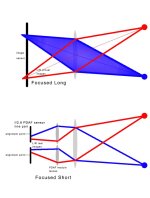
I can see how that is confusing/misleading. A couple over-simplified drawings to help explain:

In the first diagram you have the SLR/Mirrorless PDAF system and the two L/R virtual images. Because the image is focused long, the virtual images are hitting the sensor at different points (on different AF pixels/positions), and their phase is offset from where they should be (not conjoined). Note that the more OOF the virtual images are, the less distinct/useful they are (blue shading).
AF.jpg
In the second diagram you have the DSLR with it's pair of real images. Because they are collected from the outer perimeter of the objective lens they are wider (f/2.8) aperture focus points. And because both images are inside of where they should be (closer together) the image is focused short (converging ahead of the image sensor (early)).
 
Last edited:
I can see how that is confusing/misleading. A couple over-simplified drawings to help explain:

In the first diagram you have the SLR/Mirrorless PDAF system and the two L/R virtual images. Because the image is focused long, the virtual images are hitting the sensor at different points (on different AF pixels/positions), and their phase is offset from where they should be (not conjoined). Note that the more OOF the virtual images are, the less distinct/useful they are (blue shading).
View attachment 492049
In the second diagram you have the DSLR with it's pair of real images. Because they are collected from the outer perimeter of the objective lens they are wider (f/2.8) aperture focus points. And because both images are inside of where they should be (closer together) the image is focused short (converging ahead of the image sensor (early)).
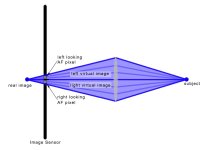
Ok, I'm not auire sure what you mean by virtual images? I thought with mirrorless you meant the real time image readout from the sensor, but then SLRs use the same system so it can't be that. I can understand that with DSLR the light source(s) hit the different AF sensors and it works out the difference between the two, but what are you referring to with the "virtual" images? From the diagram above it looks like the light source(s) hit the sensor but rather than a light source splitting and hitting each AF sensor in close proximity, the light from one side of the image hits a completely different part of the sensor (and therefore AF sensor) than light from the other side of the image, but I'm still struggling as to why this creates a virtual image?
 
Ok, I'm not auire sure what you mean by virtual images?
A real image only exists at the plane of focus (not sensor necessarily); otherwise it is just scattered/mixed light. A virtual image is just a portion of that scattered/mixed light that will become the real image when focused.

E.g. at every point on the objective element there is some of the light radiated from every point within the scene... there is a complete image in terms of light/information, but it is not a real image at that point; it is a virtual image.
I.e. an objective element can be any diameter w/o restricting the focal length. And a faster lens is faster because it is stacking more images (light from additional objective element area). But at any other point beside the plane of focus they are virtual images.

AF.jpg

That's how a split prism works as well... the prism has 1/2 that looks left and 1/2 that looks right as the image is being formed (or up/down).

Edit: I probably should have drawn the objective element much larger.
 
Last edited:
Back
Top