- Messages
- 106
- Name
- Andreas
- Edit My Images
- No
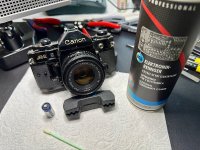
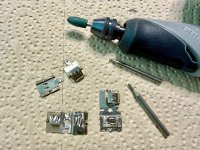
Over the past few days, I’ve shared a few examples of DIY repairs that—where technical documentation was available—were carried out according to professional guidelines.
I have many more posted on PHOTRIO and photo.net, so I won’t repost them here. My intention was to spark interest and highlight opportunities for DIY
Not everyone
wants to do repairs themselves, but many are also unsure whether a professional repair is worth the money and what to expect.
I invite anyone interested to discuss specific repair cases here and work together to determine what can be done and where it’s worth investing time or money. Topics include labor, tools, equipment, replacement parts, and questions about the repairability of electronics.
Maybe we’ll be able to get that one camera, motor, or lens—which had already been written off—up and running again. That would be great, because these items are no longer made.
Compact cameras
By the way, not only SLRs but also compact cameras are considered electromechanical cameras; see
Nikon TW20/Tele Touch 300: A closer look at technology; collaboration with AI Claude/Anthropic
Canon AF35M: A closer look at technology. Conclusion and lessons from collaborating with AI Claude (Anthropic)

 ️Caution: charged flash capacitor
Most of these compact cameras have built-in electronic flash units that draw their power from an electrolytic capacitor. This capacitor carries dangerously high levels of charge and voltage, just like the capacitors in the flash units of later SLRs. The capacitor can stay charged even after the batteries have been removed.
I therefore strongly advise against attempting to repair these cameras without expert knowledge. This also applies to accessory electronic flash units.
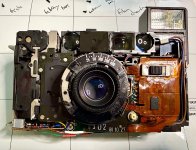
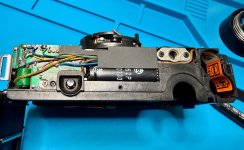
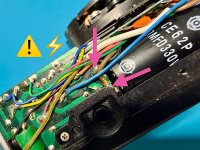
The flash capacitor at the bottom of a Canon AF35M (the black cylindrical component). The arrows point to its terminals, which can still carry high voltage after the batteries have been removed. Dangerously high voltage can also be present elsewhere in the flash circuit.
For information on servicing, see
Clean, Lube, Adjust (CLA): When does my electromechanical SLR need servicing?
+++
A word of caution
Please keep in mind that you’ll be using highly flammable solvents for service work, and their fumes are harmful to your health. Soldering also produces fumes that should not be inhaled. Dangerous high voltages can be present when handling electronics, especially in conjunction with electronic flash units and mains. Therefore, familiarize yourself with the safety regulations beforehand and ensure your safety. Depending on the activity, protective gear may be advisable.
All information is provided without guarantee. Any action you take upon the information in this report is strictly at your own risk.
This report describes my personal experience and approach; it does not constitute a professional or certified repair instruction. I am not liable for any property damage or personal injury resulting from actions taken based on the information provided in this report.
Acknowledgments
Without the work of Master Larry Lyells, in particular, we wouldn’t have the detailed technical information we need today for service/repair of electromechanical SLRs.
The SPT Journal and The Camera Craftsman, which he helped shape significantly as an author, and which contain all the necessary information and instructions, are available for a fee through Learn Camera Repair.
We owe our access to them to Eugene Pate, the founder of Learn Camera Repair.
As a Shodan in Jiu-Jitsu, I view camera repair as part of my Do, the Way. I am grateful to my revered Grandmaster, Erich Ebetshuber, 10th Dan in Jiu-Jitsu, for everything I have been privileged to learn from him.
I have many more posted on PHOTRIO and photo.net, so I won’t repost them here. My intention was to spark interest and highlight opportunities for DIY
Not everyone
wants to do repairs themselves, but many are also unsure whether a professional repair is worth the money and what to expect.
I invite anyone interested to discuss specific repair cases here and work together to determine what can be done and where it’s worth investing time or money. Topics include labor, tools, equipment, replacement parts, and questions about the repairability of electronics.
Maybe we’ll be able to get that one camera, motor, or lens—which had already been written off—up and running again. That would be great, because these items are no longer made.
Compact cameras
By the way, not only SLRs but also compact cameras are considered electromechanical cameras; see
Nikon TW20/Tele Touch 300: A closer look at technology; collaboration with AI Claude/Anthropic
Canon AF35M: A closer look at technology. Conclusion and lessons from collaborating with AI Claude (Anthropic)
️Caution: charged flash capacitorMost of these compact cameras have built-in electronic flash units that draw their power from an electrolytic capacitor. This capacitor carries dangerously high levels of charge and voltage, just like the capacitors in the flash units of later SLRs. The capacitor can stay charged even after the batteries have been removed.
I therefore strongly advise against attempting to repair these cameras without expert knowledge. This also applies to accessory electronic flash units.
The flash capacitor at the bottom of a Canon AF35M (the black cylindrical component). The arrows point to its terminals, which can still carry high voltage after the batteries have been removed. Dangerously high voltage can also be present elsewhere in the flash circuit.
For information on servicing, see
Clean, Lube, Adjust (CLA): When does my electromechanical SLR need servicing?
+++
A word of cautionPlease keep in mind that you’ll be using highly flammable solvents for service work, and their fumes are harmful to your health. Soldering also produces fumes that should not be inhaled. Dangerous high voltages can be present when handling electronics, especially in conjunction with electronic flash units and mains. Therefore, familiarize yourself with the safety regulations beforehand and ensure your safety. Depending on the activity, protective gear may be advisable.
All information is provided without guarantee. Any action you take upon the information in this report is strictly at your own risk.
This report describes my personal experience and approach; it does not constitute a professional or certified repair instruction. I am not liable for any property damage or personal injury resulting from actions taken based on the information provided in this report.
Acknowledgments
Without the work of Master Larry Lyells, in particular, we wouldn’t have the detailed technical information we need today for service/repair of electromechanical SLRs.
The SPT Journal and The Camera Craftsman, which he helped shape significantly as an author, and which contain all the necessary information and instructions, are available for a fee through Learn Camera Repair.
We owe our access to them to Eugene Pate, the founder of Learn Camera Repair.
As a Shodan in Jiu-Jitsu, I view camera repair as part of my Do, the Way. I am grateful to my revered Grandmaster, Erich Ebetshuber, 10th Dan in Jiu-Jitsu, for everything I have been privileged to learn from him.
Last edited: