Service and repair today: Who will follow in the footsteps of the old camera technicians?

Messages
126
Name
Andreas
Edit My Images
No
Factory trained—anyone who could say that as a camera technician had learned their trade directly at Nikon, Canon, Minolta etc. Firsthand.

Cameras for film are no longer manufactured by the major, long-established brands, nor have they been supported by them for quite some time. The factory-trained camera technicians have retired, started their own businesses, or—in some cases—retrained for new careers.

The market for used analog cameras is large and vibrant today.

Many young photographers work with film; a quick look at Reddit shows that film is in high demand. People are still taking photos with the SLRs, rangefinder cameras, and compact cameras from back then.

But the options for having equipment serviced and repaired affordably and as quickly as possible aren’t keeping up with the trend. It's not that easy to find professional camera repair shops. Some cameras aren’t accepted at all; for others, you have to wait months, and the prices are high.

Why is that? Why are so few people following in the footsteps of the old camera technicians, even though there’s demand in the market? Why are top electromechanical SLRs like the Nikon F4, Minolta 9000 AF, or Canon T90 virtually neglected when it comes to repair and service?

Technical documentation is available, and the work can be learned—it’s not rocket science.

Why do so few people choose to become camera technicians?
 
Last edited:
A good question Andreas. I suspect it's always been the way. I think you could say the same about old radios, TV's or computers. We all like to play, but few of us have an interest in the mechanicals. We humans are fickle, and it takes the fun out of it.
 
main problem with the "electromechanical" cameras as mentioned is not generally the mechanical - the T90 for example was produced between 1986-1991 so even the youngest versions are 35 years old. Things like the plastic flexible circuit boards have got to the point where, while they still work, they're not very flexible anymore - and a broken track on one of them is not the easiest of repairs. Spares - nope.

Biggest issue iirc with the T90 (at least the one that's killed off 3 of them i've owned) has been the EEE error - sticky magnet for the shutter release usually due to demagnetisation and gumming up through lack of use. Chances are the T90 had a fairly tough life for a few years, before being usurped by the EOS range and the EF lenses. I'd put money on them ending up in a camera bag, getting a film through them once a year at most for a couple of years, then stashed in a box for 25 years. Then someone buys them from the owners estate when they pass, and uses it "intermittently" - as - if I'm sure most of us film shooters will admit - most of our film cameras are used. Very few people buy a "pro-standard" 40 years ago camera, as our ONLY film camera - and - these cameras were pro tools - built to bash out 8-10 rolls a night, 6 days a week or more.

SO - you've a camera that you can't get spare parts for, apart from by stripping another camera - that has maybe 3 failure modes, so at best each donor camera will fix maybe 3 cameras if you're lucky. Instantly, that means that the commercial cost of the spares is very close to the cost of a replacement camera, once you've figured in the time to "strip the parts". That doesn't leave a lot of room for charging for your time. Assuming you want to earn at least minimum wage, and cover your (minimal) overheads and keep the taxman happy - figure £30 a hour - and that's probably very much on the low side.

Honestly - for a lot of these cameras - they're just not economically viable to fix - so - the only customers are going to be ones for which they have a sentimental attachment to the camera. That's instantly cutting down the numbers of actual potential customers for the service. I consider myself to be a bit of a soft-touch and terribly sentimental about things, but frankly - out of my collection of over 30 film cameras, there's maybe 4 of them that I'd actually be prepared to spend money on repairing - 3 of the 4 are very much mechanical, or "barely" electronic - having at most half a dozen wires in the case, all part of the meter and flash trigger circuit. And - honestly, if it comes to mechanical stuff - well - I can strip and rebuild watch movements (given enough time, a strong dose of beta-blockers, and 3 days off the coffee beforehand) so honestly, I'd probably have a go myself. Of course, if my EOS-3 ever dies, i'll probably end up paying enough to buy a mint condition EOS-1 just to get it going again. If there's anyone out there that's bats*** crazy enough to be taking on that kind of work.
 
Technical documentation is available, and the work can be learned—it’s not rocket science.


Documentation and skills are available but spares for the electro bit are, as Mark has pointed out, a finite commodity. Take out the electronics (flash contacts and meter connections are more electrical than electronic, IMO!) and, since the parts have been made, they can be made again (at a cost...)
 
main problem with the "electromechanical" cameras as mentioned is not generally the mechanical - the T90 for example was produced between 1986-1991 so even the youngest versions are 35 years old. Things like the plastic flexible circuit boards have got to the point where, while they still work, they're not very flexible anymore - and a broken track on one of them is not the easiest of repairs. Spares - nope.

I’m going to disagree with you on a few points now, but of course, this isn’t meant personally :) I have firsthand experience repairing the Canon T90.
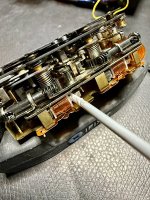
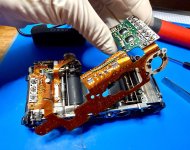
The flexible printed circuits (FPC) in the T90, as well as in other comparable electromechanical SLRs, do not age or deteriorate. As long as you don’t bend them too far, they’re sturdy—even when soldering.

Replacement parts come from decommissioned T90s, depending on the version.

Biggest issue iirc with the T90 (at least the one that's killed off 3 of them i've owned) has been the EEE error - sticky magnet for the shutter release usually due to demagnetisation and gumming up through lack of use.

The HELP/EEE error indicates that the shutter sequence did not complete properly; the shutter contacts do not open and close as they should, which triggers the error message in the viewfinder and on the LCD.

This is usually caused by contaminated shutter magnets—the T90 has two of them. The contact surfaces then fail to separate, or do so only with a delay or unreliably. The likely cause is the deposition of lubricants that outgas.

IMG_9491.jpeg

Cleaning the magnets is the solution here. These are hybrid magnets—that is, permanent magnets whose magnetic field is temporarily neutralized by coils. Demagnetization does not occur.

Keeping the T90 in good working order by triggering it is of limited use, if any, since the root cause—contamination of the magnets—has not been addressed.

IMG_9481.webp IMG_9483.webp

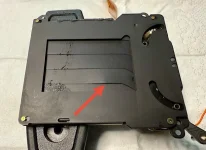
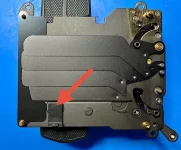
It can even be harmful, as a second cause of HELP/EEE can be a small plastic damper in the shutter that is deteriorating. The shutter slats then stick together, and since they are driven by spring force, the slats can bend when the trigger is pulled. The solution is to clean the shutter.

I’m currently using a T90 without a replacement damper; it works, but it’s not a permanent solution. I’m going to try butyl rubber as a replacement,

Chances are the T90 had a fairly tough life for a few years, before being usurped by the EOS range and the EF lenses. I'd put money on them ending up in a camera bag, getting a film through them once a year at most for a couple of years, then stashed in a box for 25 years. Then someone buys them from the owners estate when they pass, and uses it "intermittently" - as - if I'm sure most of us film shooters will admit - most of our film cameras are used. Very few people buy a "pro-standard" 40 years ago camera, as our ONLY film camera - and - these cameras were pro tools - built to bash out 8-10 rolls a night, 6 days a week or more.

When you look at the materials used in the T90’s internal construction, you have to give its designers a lot of credit.

IMG_9490.jpeg

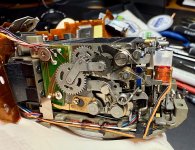
The mechanism inside the mirror housing is solidly constructed from metal and designed for heavy use. Plastic is used extensively, but only where the stress levels allow it.

IMG_9484.webp

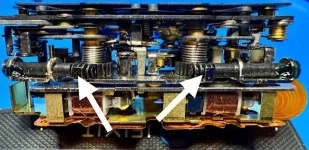
One weak point is the two plastic adjustment screws and gears in the spring tension mechanism of the shutter. These can bend or break, rendering the mechanism unable to be adjusted. In such cases, replacement parts can be taken from other T90s; colleagues with 3D printers have already come up with replacement designs.

The T90 can withstand a lot—it’s not called “The Tank” for nothing. It doesn't matter if you only use them occasionally. The known issues have other causes; see above.

SO - you've a camera that you can't get spare parts for, apart from by stripping another camera - that has maybe 3 failure modes, so at best each donor camera will fix maybe 3 cameras if you're lucky.

In my experience, aside from the shutter, very few replacement parts are needed.

Once, I replaced the main LCD because the IC underneath it—which controls it—was clearly defective. A double diode was causing the display to flicker, and that could be replaced as well. And a DC/DC converter was burnt due an obvious short. If batteries leak, the battery electrolyte must be removed; it’s corrosive, seeps through cables, and damages solder joints.

Instantly, that means that the commercial cost of the spares is very close to the cost of a replacement camera, once you've figured in the time to "strip the parts". That doesn't leave a lot of room for charging for your time. Assuming you want to earn at least minimum wage, and cover your (minimal) overheads and keep the taxman happy - figure £30 a hour - and that's probably very much on the low side.

That's why the better solution is to do it yourself.

Here I have summarized my experiences; all statements and repairs are based on the available technical documentation intended for professional camera technicians:

The Canon T90 in use today: Working reliably with one of the most powerful 35mm cameras comes at a price

Canon T90: Guide for service and repair work
 
Last edited:
Documentation and skills are available but spares for the electro bit are, as Mark has pointed out, a finite commodity. Take out the electronics (flash contacts and meter connections are more electrical than electronic, IMO!) and, since the parts have been made, they can be made again (at a cost...)

You can not only salvage original replacement parts from discarded cameras of the same model, but also the electronics—either completely or in parts. Often, individual components are replaced as well; the only limitation is soldering on the circuit boards, especially with ICs that have many fine pins.

The versions must match, and starting with the Nikon F4 from 1988, the manufacturer's hardware and software are required to adjust the electronics, but these are not available.

IMG_9492.jpeg

Here, I replaced the entire electronics assembly on a Nikon F3AF. The LCD was displaying nonsensical values, and I was unable to fix the suspected damage on the circuit board.

See

Nikon F3AF: All electronics replaced
 
A good question Andreas. I suspect it's always been the way. I think you could say the same about old radios, TV's or computers. We all like to play, but few of us have an interest in the mechanicals. We humans are fickle, and it takes the fun out of it.

I always thought that all boys wanted to become mechanics, engineers, or technicians when they grew up ;)
 
I recently read that Piero Pozzela of PPP cameras has stopped taking customer repair orders (https://camerajabber.com/photograph...omer-camera-repairs-after-more-than-15-years/). He'll apparently still do repairs, but for cameras he'll resell through his site.

That's a shame, but understandable.

Piero is thus transitioning from a camera repairman to a camera restorer who only restores select pieces when it makes financial sense for him. This also allows him to manage his workload and relieves him of the pressure to rush through jobs. He’s taking control of the process and benefiting from the experience he’s gained so far and the excellent reputation he’s built in the market.

At least that's my view,
 
Last edited:
I’m going to disagree with you on a few points now, but of course, this isn’t meant personally :) I have firsthand experience repairing the Canon T90.
shame you weren't around in the UK best part of 10 years ago, when I apparently wasted around £300 on 3 bodies that failed, that nobody over here was prepared to touch. I was basically just saying what I'd been told by the "professional repair people" i'd wasted money with.

Still - you live and learn - and at least I didn't let the "repair guys" keep the scrap cameras - got them going (more or less) myself with temporary bodge repairs, and flogged them on ebay again.

Honestly, i'm at the stage in life where I'm looking to get rid of my unused (mostly film) cameras "to a good home" before downsizing and retiring. Just thought that what I added might have been helpful - apparently not, other than allowing you to post a couple of links to take traffic away to another forum.

Ten years ago, I didn’t know anything about camera repairs, and there was nothing available about the T90 except for speculation. It was considered unreparable, just like other top-of-the-line electromechanical SLRs from the 1980s.

The situation didn’t change until a few years ago, when Gene Pate and learncamerarepair.com made professional US service manuals known and available. This gives you the key to attempting guided repairs without having to rush around.

Your description of the T90’s problems is valuable because it shows what users are facing. For the T90, there are quick fixes that get the camera working again, though they’re unreliable. And then there’s the repair—which is thorough but doable.

I’m sorry that I posted some links to competing forums, but that’s where the evidence for my statements lies—those are my repair reports. I had posted some of them here in this forum :)

However, it would be best to have the T90 serviced by a professional. I know of only one repair shop in the US that specializes in this, but it has an excellent reputation:

Camera Clinic
 
Last edited:
My Centon DF300 died with sticky shutter magnets just out of the original one year guarantee. It was a common failure.

Repairability should be part of all product design. It's wasteful to make things that you can't fix and just throw away.
 
My Centon DF300 died with sticky shutter magnets just out of the original one year guarantee. It was a common failure.

Repairability should be part of all product design. It's wasteful to make things that you can't fix and just throw away.

If it’s just a case of contamination, it can be fixed, just like other electronic problems in cameras, which are often caused by contact issues. The electronics themselves—that is, the components and circuit boards—are largely wear-resistant. Exposure to moisture or outgassing lubricants can lead to problems caused by corrosion and contamination. The same applies to leaked battery electrolyte—the number one killer.

The challenge is to access the problem areas and identify them beforehand. With the vertical-slit shutter in electromechanical SLRs and its magnets, this almost always requires extensive disassembly.

But with professional service documentation and experience, it’s doable.

It’s not worth it for repair shops, since it takes a lot of labor time that no one wants to pay for. That’s why users simply prefer a new used camera as the solution. But eventually, the supply will run out—either because there’s nothing left or because it’s too expensive.
 
Last edited:
However, it would be best to have the T90 serviced by a professional. I know of only one repair shop in the US that specializes in this, but it has an excellent reputation:

Camera Clinic
and there's the rub...

unless the camera held some deep sentimental value, even if I was still collecting, rather than divesting - I'd not be sending a £100 camera body overseas (particularly to america, under the current regime) then spending double it's value or more in time and effort on it's servicing - just to have a camera that I use once a year - and - don't actually enjoy using half as much as the Canon A1 that it shared the same lenses with. I bought a T90 because, frankly, it was the "missing link" between the A's and the film EOS's - that is - I bought it as a collector, to "complete a timeline" rather than any great desire for that camera.

As I say, it's academic now - last of the T's went long ago, when I realised that I wasn't really "enjoying" collecting cameras in the same kind of way I enjoyed buying, servicing, and wearing pre-quartz era Swiss dive watches - where I could buy things for under £50 "spares or repair" and half the time, all they needed was a thorough service and a clean - then I got to wear them and enjoy them in general life - before moving them on to another enthusiast, but now working, clean, with the Radium/Tritium Lume removed and replaced with something safer - and probably good for another 30 years wear.
 
Back
Top