Service and repair today: Who will follow in the footsteps of the old camera technicians?

Messages
145
Name
Andreas
Edit My Images
No
Factory trained—anyone who could say that as a camera technician had learned their trade directly at Nikon, Canon, Minolta etc. Firsthand.

Cameras for film are no longer manufactured by the major, long-established brands, nor have they been supported by them for quite some time. The factory-trained camera technicians have retired, started their own businesses, or—in some cases—retrained for new careers.

The market for used analog cameras is large and vibrant today.

Many young photographers work with film; a quick look at Reddit shows that film is in high demand. People are still taking photos with the SLRs, rangefinder cameras, and compact cameras from back then.

But the options for having equipment serviced and repaired affordably and as quickly as possible aren’t keeping up with the trend. It's not that easy to find professional camera repair shops. Some cameras aren’t accepted at all; for others, you have to wait months, and the prices are high.

Why is that? Why are so few people following in the footsteps of the old camera technicians, even though there’s demand in the market? Why are top electromechanical SLRs like the Nikon F4, Minolta 9000 AF, or Canon T90 virtually neglected when it comes to repair and service?

Technical documentation is available, and the work can be learned—it’s not rocket science.

Why do so few people choose to become camera technicians?
 
Last edited:
A good question Andreas. I suspect it's always been the way. I think you could say the same about old radios, TV's or computers. We all like to play, but few of us have an interest in the mechanicals. We humans are fickle, and it takes the fun out of it.
 
main problem with the "electromechanical" cameras as mentioned is not generally the mechanical - the T90 for example was produced between 1986-1991 so even the youngest versions are 35 years old. Things like the plastic flexible circuit boards have got to the point where, while they still work, they're not very flexible anymore - and a broken track on one of them is not the easiest of repairs. Spares - nope.

Biggest issue iirc with the T90 (at least the one that's killed off 3 of them i've owned) has been the EEE error - sticky magnet for the shutter release usually due to demagnetisation and gumming up through lack of use. Chances are the T90 had a fairly tough life for a few years, before being usurped by the EOS range and the EF lenses. I'd put money on them ending up in a camera bag, getting a film through them once a year at most for a couple of years, then stashed in a box for 25 years. Then someone buys them from the owners estate when they pass, and uses it "intermittently" - as - if I'm sure most of us film shooters will admit - most of our film cameras are used. Very few people buy a "pro-standard" 40 years ago camera, as our ONLY film camera - and - these cameras were pro tools - built to bash out 8-10 rolls a night, 6 days a week or more.

SO - you've a camera that you can't get spare parts for, apart from by stripping another camera - that has maybe 3 failure modes, so at best each donor camera will fix maybe 3 cameras if you're lucky. Instantly, that means that the commercial cost of the spares is very close to the cost of a replacement camera, once you've figured in the time to "strip the parts". That doesn't leave a lot of room for charging for your time. Assuming you want to earn at least minimum wage, and cover your (minimal) overheads and keep the taxman happy - figure £30 a hour - and that's probably very much on the low side.

Honestly - for a lot of these cameras - they're just not economically viable to fix - so - the only customers are going to be ones for which they have a sentimental attachment to the camera. That's instantly cutting down the numbers of actual potential customers for the service. I consider myself to be a bit of a soft-touch and terribly sentimental about things, but frankly - out of my collection of over 30 film cameras, there's maybe 4 of them that I'd actually be prepared to spend money on repairing - 3 of the 4 are very much mechanical, or "barely" electronic - having at most half a dozen wires in the case, all part of the meter and flash trigger circuit. And - honestly, if it comes to mechanical stuff - well - I can strip and rebuild watch movements (given enough time, a strong dose of beta-blockers, and 3 days off the coffee beforehand) so honestly, I'd probably have a go myself. Of course, if my EOS-3 ever dies, i'll probably end up paying enough to buy a mint condition EOS-1 just to get it going again. If there's anyone out there that's bats*** crazy enough to be taking on that kind of work.
 
Technical documentation is available, and the work can be learned—it’s not rocket science.


Documentation and skills are available but spares for the electro bit are, as Mark has pointed out, a finite commodity. Take out the electronics (flash contacts and meter connections are more electrical than electronic, IMO!) and, since the parts have been made, they can be made again (at a cost...)
 
main problem with the "electromechanical" cameras as mentioned is not generally the mechanical - the T90 for example was produced between 1986-1991 so even the youngest versions are 35 years old. Things like the plastic flexible circuit boards have got to the point where, while they still work, they're not very flexible anymore - and a broken track on one of them is not the easiest of repairs. Spares - nope.

I’m going to disagree with you on a few points now, but of course, this isn’t meant personally :) I have firsthand experience repairing the Canon T90.
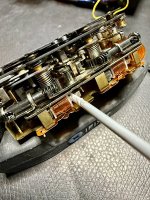
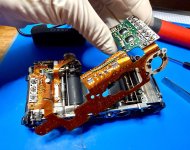
The flexible printed circuits (FPC) in the T90, as well as in other comparable electromechanical SLRs, do not age or deteriorate. As long as you don’t bend them too far, they’re sturdy—even when soldering.

Replacement parts come from decommissioned T90s, depending on the version.

Biggest issue iirc with the T90 (at least the one that's killed off 3 of them i've owned) has been the EEE error - sticky magnet for the shutter release usually due to demagnetisation and gumming up through lack of use.

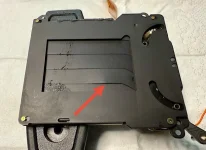
The HELP/EEE error indicates that the shutter sequence did not complete properly; the shutter contacts do not open and close as they should, which triggers the error message in the viewfinder and on the LCD.

This is usually caused by contaminated shutter magnets—the T90 has two of them. The contact surfaces then fail to separate, or do so only with a delay or unreliably. The likely cause is the deposition of lubricants that outgas.

IMG_9491.jpeg

Cleaning the magnets is the solution here. These are hybrid magnets—that is, permanent magnets whose magnetic field is temporarily neutralized by coils. Demagnetization does not occur.

Keeping the T90 in good working order by triggering it is of limited use, if any, since the root cause—contamination of the magnets—has not been addressed.

IMG_9481.webp IMG_9483.webp

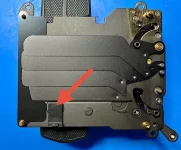
It can even be harmful, as a second cause of HELP/EEE can be a small plastic damper in the shutter that is deteriorating. The shutter slats then stick together, and since they are driven by spring force, the slats can bend when the trigger is pulled. The solution is to clean the shutter.

I’m currently using a T90 without a replacement damper; it works, but it’s not a permanent solution. I’m going to try butyl rubber as a replacement,

Chances are the T90 had a fairly tough life for a few years, before being usurped by the EOS range and the EF lenses. I'd put money on them ending up in a camera bag, getting a film through them once a year at most for a couple of years, then stashed in a box for 25 years. Then someone buys them from the owners estate when they pass, and uses it "intermittently" - as - if I'm sure most of us film shooters will admit - most of our film cameras are used. Very few people buy a "pro-standard" 40 years ago camera, as our ONLY film camera - and - these cameras were pro tools - built to bash out 8-10 rolls a night, 6 days a week or more.

When you look at the materials used in the T90’s internal construction, you have to give its designers a lot of credit.

IMG_9490.jpeg

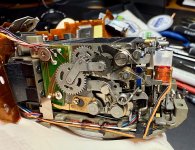
The mechanism inside the mirror housing is solidly constructed from metal and designed for heavy use. Plastic is used extensively, but only where the stress levels allow it.

IMG_9484.webp

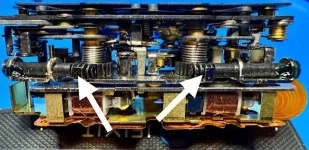
One weak point is the two plastic adjustment screws and gears in the spring tension mechanism of the shutter. These can bend or break, rendering the mechanism unable to be adjusted. In such cases, replacement parts can be taken from other T90s; colleagues with 3D printers have already come up with replacement designs.

The T90 can withstand a lot—it’s not called “The Tank” for nothing. It doesn't matter if you only use them occasionally. The known issues have other causes; see above.

SO - you've a camera that you can't get spare parts for, apart from by stripping another camera - that has maybe 3 failure modes, so at best each donor camera will fix maybe 3 cameras if you're lucky.

In my experience, aside from the shutter, very few replacement parts are needed.

Once, I replaced the main LCD because the IC underneath it—which controls it—was clearly defective. A double diode was causing the display to flicker, and that could be replaced as well. And a DC/DC converter was burnt due an obvious short. If batteries leak, the battery electrolyte must be removed; it’s corrosive, seeps through cables, and damages solder joints.

Instantly, that means that the commercial cost of the spares is very close to the cost of a replacement camera, once you've figured in the time to "strip the parts". That doesn't leave a lot of room for charging for your time. Assuming you want to earn at least minimum wage, and cover your (minimal) overheads and keep the taxman happy - figure £30 a hour - and that's probably very much on the low side.

That's why the better solution is to do it yourself.

Here I have summarized my experiences; all statements and repairs are based on the available technical documentation intended for professional camera technicians:

The Canon T90 in use today: Working reliably with one of the most powerful 35mm cameras comes at a price

Canon T90: Guide for service and repair work
 
Last edited:
Documentation and skills are available but spares for the electro bit are, as Mark has pointed out, a finite commodity. Take out the electronics (flash contacts and meter connections are more electrical than electronic, IMO!) and, since the parts have been made, they can be made again (at a cost...)

You can not only salvage original replacement parts from discarded cameras of the same model, but also the electronics—either completely or in parts. Often, individual components are replaced as well; the only limitation is soldering on the circuit boards, especially with ICs that have many fine pins.

The versions must match, and starting with the Nikon F4 from 1988, the manufacturer's hardware and software are required to adjust the electronics, but these are not available.

IMG_9492.jpeg

Here, I replaced the entire electronics assembly on a Nikon F3AF. The LCD was displaying nonsensical values, and I was unable to fix the suspected damage on the circuit board.

See

Nikon F3AF: All electronics replaced
 
A good question Andreas. I suspect it's always been the way. I think you could say the same about old radios, TV's or computers. We all like to play, but few of us have an interest in the mechanicals. We humans are fickle, and it takes the fun out of it.

I always thought that all boys wanted to become mechanics, engineers, or technicians when they grew up ;)
 
I recently read that Piero Pozzela of PPP cameras has stopped taking customer repair orders (https://camerajabber.com/photograph...omer-camera-repairs-after-more-than-15-years/). He'll apparently still do repairs, but for cameras he'll resell through his site.

That's a shame, but understandable.

Piero is thus transitioning from a camera repairman to a camera restorer who only restores select pieces when it makes financial sense for him. This also allows him to manage his workload and relieves him of the pressure to rush through jobs. He’s taking control of the process and benefiting from the experience he’s gained so far and the excellent reputation he’s built in the market.

At least that's my view,
 
Last edited:
I’m going to disagree with you on a few points now, but of course, this isn’t meant personally :) I have firsthand experience repairing the Canon T90.
shame you weren't around in the UK best part of 10 years ago, when I apparently wasted around £300 on 3 bodies that failed, that nobody over here was prepared to touch. I was basically just saying what I'd been told by the "professional repair people" i'd wasted money with.

Still - you live and learn - and at least I didn't let the "repair guys" keep the scrap cameras - got them going (more or less) myself with temporary bodge repairs, and flogged them on ebay again.

Honestly, i'm at the stage in life where I'm looking to get rid of my unused (mostly film) cameras "to a good home" before downsizing and retiring. Just thought that what I added might have been helpful - apparently not, other than allowing you to post a couple of links to take traffic away to another forum.

Ten years ago, I didn’t know anything about camera repairs, and there was nothing available about the T90 except for speculation. It was considered unreparable, just like other top-of-the-line electromechanical SLRs from the 1980s.

The situation didn’t change until a few years ago, when Gene Pate and learncamerarepair.com made professional US service manuals known and available. This gives you the key to attempting guided repairs without having to rush around.

Your description of the T90’s problems is valuable because it shows what users are facing. For the T90, there are quick fixes that get the camera working again, though they’re unreliable. And then there’s the repair—which is thorough but doable.

I’m sorry that I posted some links to competing forums, but that’s where the evidence for my statements lies—those are my repair reports. I had posted some of them here in this forum :)

However, it would be best to have the T90 serviced by a professional. I know of only one repair shop in the US that specializes in this, but it has an excellent reputation:

Camera Clinic
 
Last edited:
My Centon DF300 died with sticky shutter magnets just out of the original one year guarantee. It was a common failure.

Repairability should be part of all product design. It's wasteful to make things that you can't fix and just throw away.
 
My Centon DF300 died with sticky shutter magnets just out of the original one year guarantee. It was a common failure.

Repairability should be part of all product design. It's wasteful to make things that you can't fix and just throw away.

If it’s just a case of contamination, it can be fixed, just like other electronic problems in cameras, which are often caused by contact issues. The electronics themselves—that is, the components and circuit boards—are largely wear-resistant. Exposure to moisture or outgassing lubricants can lead to problems caused by corrosion and contamination. The same applies to leaked battery electrolyte—the number one killer.

The challenge is to access the problem areas and identify them beforehand. With the vertical-slit shutter in electromechanical SLRs and its magnets, this almost always requires extensive disassembly.

But with professional service documentation and experience, it’s doable.

It’s not worth it for repair shops, since it takes a lot of labor time that no one wants to pay for. That’s why users simply prefer a new used camera as the solution. But eventually, the supply will run out—either because there’s nothing left or because it’s too expensive.
 
Last edited:
However, it would be best to have the T90 serviced by a professional. I know of only one repair shop in the US that specializes in this, but it has an excellent reputation:

Camera Clinic
and there's the rub...

unless the camera held some deep sentimental value, even if I was still collecting, rather than divesting - I'd not be sending a £100 camera body overseas (particularly to america, under the current regime) then spending double it's value or more in time and effort on it's servicing - just to have a camera that I use once a year - and - don't actually enjoy using half as much as the Canon A1 that it shared the same lenses with. I bought a T90 because, frankly, it was the "missing link" between the A's and the film EOS's - that is - I bought it as a collector, to "complete a timeline" rather than any great desire for that camera.

As I say, it's academic now - last of the T's went long ago, when I realised that I wasn't really "enjoying" collecting cameras in the same kind of way I enjoyed buying, servicing, and wearing pre-quartz era Swiss dive watches - where I could buy things for under £50 "spares or repair" and half the time, all they needed was a thorough service and a clean - then I got to wear them and enjoy them in general life - before moving them on to another enthusiast, but now working, clean, with the Radium/Tritium Lume removed and replaced with something safer - and probably good for another 30 years wear.
 
So, what exactly is the problem with your Nikon F4?
Everything worked except shutter, so as previously posted got so far but was stuck on a screw (following youtube)..but thinking I should put it back together and sell it on ebay and let someone else fix it.
 
Why do so few people become technicians... Money. It's probably not worth it. How much would you pay someone per hour to repair an old film camera or lens? Probably not enough. It's even in the opening post... "the prices are high".

I repaired stuff for decades but that was then. These days most people wouldn't be willing to pay enough to make bothering worth my or many other peoples time so why would people do it if there are other ways of making more money per hour?

Given the shortage of qualified camera technicians and the high demand, I see good earning potential. If you specialize in high-end or rare cameras/lenses/equipment—for which owners are willing to invest in repairs and maintenance—it should be a profitable venture.
 
Last edited:
Given the shortage of qualified camera technicians and the high demand, I see good earning potential. If you specialize in high-end or rare cameras/lenses/equipment—for which owners are willing to invest in repairs and maintenance—it should be a profitable venture.

Imagine how much a year you'd want to make and divide that by the number of jobs you could do. Would people pay that much?

As above, if there's more money to be made doing something else why fix cameras? If you love doing it then fair enough but there are probably other ways of making more money in the same time or less.

Feel free to use the following fictional example to calculate the costs (I explicitly do not work on a commercial basis):

As far as I know, I’m the only one reporting online on repairs for the Canon T90, Minolta 5000/7000/9000 AF, and Nikon F4. That doesn’t mean I’m the only one who has something to say about it. As far as I know, there’s only one repair shop for these high-end SLRs—specifically for the T90.

Let’s assume that I’m well-practiced at identifying and troubleshooting common/typical problems and know the solutions. I can take these SLRs apart and put them back together—each in about 30 steps—without making any mistakes. I can work intensively for six hours a day, 5/7 days a week. Since I’m the only service provider, my order book is full for months.

My stock of discarded SLRs of these models for spare parts is well-stocked thanks to purchases I've made over the years. The workshop, equipment, and tools are all set up; everything is here and paid for. I don't pay any extra rent since I work from home.

I communicate with my clients via email every day.

How do I achieve the most profitable outcome for myself?
  • By maximizing throughput and lowering prices, or
  • by keeping throughput lower but setting prices high enough that I can just barely find enough customers to stay fully booked?
What do you think, without knowing my fixed costs and the profit I want to make from my work? How much should I charge for my work—per piece or a flat rate?
 
Last edited:
To answer the original question, people like this guy, who was teaching the ancient art of flint knapping to some enthusiastic kids at the Avebury Circle in Wiltshire, many years ago...

Flint knapping demonstartion at Avebury CAN_3903.jpg

There are many people like him who keep old skills alive and work out how to make replacements for both parts and tools that are no longer commercially available. "Good for them say I" !
 
Feel free to use the following fictional example to calculate the costs (I explicitly do not work on a commercial basis):

As far as I know, I’m the only one reporting online on repairs for the Canon T90, Minolta 5000/7000/9000 AF, and Nikon F4. That doesn’t mean I’m the only one who has something to say about it. As far as I know, there’s only one repair shop for these high-end SLRs—specifically for the T90.

Let’s assume that I’m well-practiced at identifying and troubleshooting common/typical problems and know the solutions. I can take these SLRs apart and put them back together—each in about 30 steps—without making any mistakes. I can work intensively for six hours a day, 6/7 days a week. Since I’m the only service provider, my order book is full for months.

My stock of discarded SLRs of these models for spare parts is well-stocked thanks to purchases I've made over the years. The workshop, equipment, and tools are all set up; everything is here and paid for. I don't pay any extra rent since I work from home.

How do I achieve the most profitable outcome for myself?
  • By maximizing throughput and lowering prices, or
  • by keeping throughput lower but setting prices high enough that I can just barely find enough customers to stay fully booked?
What do you think, without knowing my fixed costs and the profit I want to make from my work? How much should I charge for my work—per piece or a flat rate?

Questions that matter. How many T90's need repairing? How much can I make repairing them ? Can I make more repairing T90's than I can make doing something else?

Here's something that happens...

I'm really good at repairing X. I charge £100. Business is great but then Dave opens a shop "repairing" X and he charges £50. He's crap and gets loads of complaints but my customers ignore the fact that he's crap and gets loads of complaints and tell me I'm overcharging because Dave says he'll do it for £50. I give up because it's no longer worth it in money or grief and the market is slowing anyway as technology has moved on so I go and do something else for £200. Now there's just Dave who's crap and maybe another good guy somewhere if you can find him.

I sympathise but in reality if you can't find someone to repair something at a price you are happy to pay it's probably because there just isn't enough money in it. I gave up fixing stuff when the money dropped too far because too many Daves popped up and brought the price people thought they should be paying down and complaints went up and I found I could earn more money and take less grief doing something else. I expect something similar has happened in the world of camera repair and those who can do something else and make more money elsewhere are doing exactly that... or they've just got old and retired or died and younger people just don't see enough money in it.
 
Last edited:
Questions that matter. How many T90's need repairing? How much can I make repairing them ? Can I make more repairing T90's than I can make doing something else?

In my experience and opinion, every T90 and 9000 AF today needs servicing to clean out the sticky shutter. That means a thorough disassembly; shortcuts aren't sustainable or even possible. It's a good business opportunity.

I could still work in my trained profession as a PR specialist. But I'd rather use those skills to write my repair reports on the forums ;)
 
At a cost of how much?

I just asked that question; I haven't run the numbers myself since I have no intention of doing it. But based on the example, we should be able to come up with some figures. The unknowns are taxes and how much potential customers are willing to pay.

We could find that out here in the forum by conducting a poll. It wouldn't be representative, but it would serve as a rough guide.

Given the virtual monopoly on service and repairs for the SLRs mentioned as examples, it should be possible to turn a profit. But that's just an estimate.

How much would you be willing to pay?
 
Last edited:
I had Claude (Anthropic AI) research and calculate this. Based on my specifications, it arrived at the following conclusion:

A complete service of a Canon T90 takes 4 hours. Working 6 hours a day, 5 days a week, you can do about 6 cameras a week, because one hour a day goes on emails and shipping. To earn €1,500 a month after tax and social insurance, each service has to cost about €88. Once the spare parts in stock run out and donor cameras have to be bought, it comes to about €117.

A tested used T90 with a warranty costs €157 from a dealer, so a repair would be cheaper. What remains open is whether about 24 customers a month will bring in their cameras.

Given the assumed profit target, that would mean it is reasonably feasible. PR and marketing are key to attracting customers. With global demand, it remains to be seen whether the 24 mentioned per month can actually be achieved.

This is the calculation for a profit target of 1,000 EUR (company in Austria):

To earn €1,000 a month after deductions, you need about €16,500 in sales a year. Social insurance takes about €4,470 of that. There is no income tax, because the taxable income of about €10,200 stays below the tax-free limit of €13,539. At 287 services a year, each service comes to about €57. With the full 6 hours at the bench it is €48, and about €86 once donor cameras have to be bought for parts.

You could also keep the price at €88. Then about 188 services a year are enough, around 16 customers a month instead of 24.

So it also depends on how much you want to—or need to—earn.

If that’s not enough, you could consider buying broken cameras, repairing them, and selling them. Maybe as a side business.

Or you could achieve the status of a master craftsman, where it’s an honor just to be accepted as a customer and where people are willing to pay more.

In any case, it should be possible to earn a good living from repairs based on sound cost estimates.

As for me, I'm glad I don't have to make a living doing repairs. I much prefer writing repair reports. :)
 
Last edited:
I just asked that question; I haven't run the numbers myself since I have no intention of doing it. But based on the example, we should be able to come up with some figures. The unknowns are taxes and how much potential customers are willing to pay.

We could find that out here in the forum by conducting a poll. It wouldn't be representative, but it would serve as a rough guide.

Given the virtual monopoly on service and repairs for the SLRs mentioned as examples, it should be possible to turn a profit. But that's just an estimate.

How much would you be willing to pay?


No more than the camera was worth as a working model - around €120.

How long does a "thorough disassembly" and reassembly take?
 
How long does a "thorough disassembly" and reassembly take?

With some practice, it should be possible to complete this in four hours.
  • Remove the mirror box and shutter,
  • disassemble the shutter, clean it, glue in the replacement for the dampener, reassemble,
  • clean the magnets,
  • clean the contacts on the selection dial,
  • check and adjust the shutter—this can be a challenge if the adjustment screws or plastic gear are broken,
  • check and adjust the exposure metering system,
  • check the flange focal distance, and
  • reassemble.
It involves a lot of soldering, but the process is always the same. If problems other than the usual ones arise, the calculation no longer applies.

In other words, during the initial inspection of the T90, you must determine whether that is the case and whether a repair remains affordable. For example, identifying contact faults or defective components.
 
Well I only have one example of repair prices and is for my Nikon F4 and the quote to fix the shutter problem was £180, BUT I could buy another basic working one from Japan for £70...so I just swapped the view finder over. So it was a cheaper option and the repair shop loses out.
 
Well I only have one example of repair prices and is for my Nikon F4 and the quote to fix the shutter problem was £180, BUT I could buy another basic working one from Japan for £70...so I just swapped the view finder over. So it was a cheaper option and the repair shop loses out.

Service and repairs are a trade like any other. If you specialize in one or more types of equipment, the work should run like clockwork. Anything that deviates from that requires a special agreement with the customer—for example, troubleshooting uncommon electronic issues. At least that’s how I’d do it if I were running a business.

But as has often been said and shown, there are many things you can do yourself—if you're interested and have the time. It's neither magic nor a secret science. :cool:
So therefore check the alternatives before having a camera repaired at high cost as it could be cheaper.
Also does the F4 have gummed up or magnet...... shutter problems like the T90?
 
Also does the F4 have gummed up or magnet...... shutter problems like the T90?

Magnets can always get dirty. I’m not aware of any plastic dampener in the shutter that could degrade and cause the shutter blades to stick.

We’d have to take a closer look at the F4 using the available technical documentation and go through the troubleshooting instructions.

I always have Claude/AI Anthropic by my side as an assistant for repair projects. It can review the documents and draw conclusions from them. You'll see right away if it helps when you follow its suggestions.

"Stuck screw"—could you describe again which screw it is and exactly where it is?
Well as it was about 3-5 years ago and can't find the youtube I was using and can't remember it I printed how to get to the shutter all I remember that it was a small screw and didn't want to use so much force it would ruined the phillips head , but looking at your youtube https://www.photrio.com/forum/threa...ntrol-adjusting-replacing-the-shutter.220629/ it scares me as even if I got to the shutter how do I check to see if it working other than poking around with a needle to see if anything is stuck and even if the shutter was ok maybe it's an electrical problem......all this is beyond what very limited skill I have.
 
Last edited:
Back
Top