

1st play with my 10 stop ND Haida filter

Messages
1,031
Edit My Images
Yes
After seeing many posts about the 10 stop ND filters and liking what I saw, I took the plunge and got myself a Haida 72mm Slim PROII. Today I took it out for a play.....good grief, a big learning curve required (for me at least), so I will need plenty of practise before I can attempt a ‘proper’ shot.
I thought I would post one of my practise shots from today, I’m aware it’s nothing special re-composition etc.....just showing that this forum costs me money (and there is another post about a lens acquisition coming soon:)).......in the meantime I need to do some studying and practising regarding speeds and f numbers using this filter!!
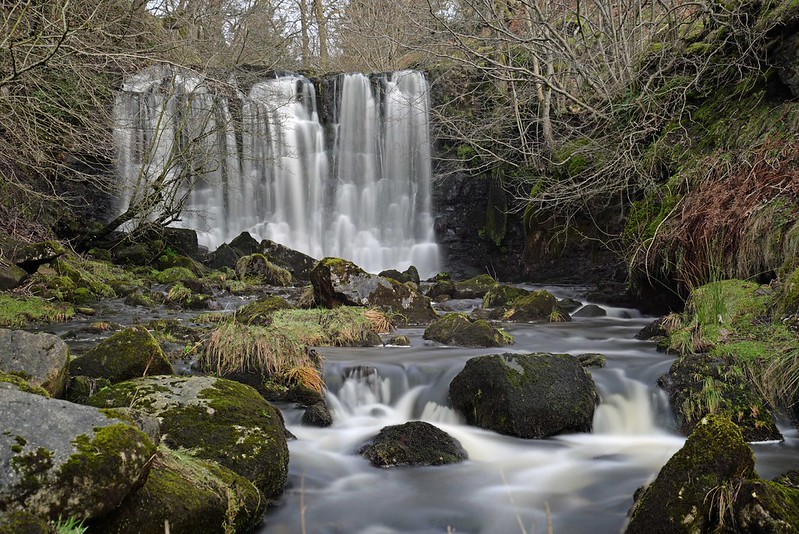

Scale Haw
by brickdav, on Flickr
 
That looks good :)

I wonder what the falls would look like up close and then turned 180 degrees!
 
I need to do some studying and practising regarding speeds and f numbers using this filter!!

10-stoppers are easy. Just set the aperture and ISO that you want to use in Av mode and take a meter reading without the filter. Note the shutter speed it recommends, multiply that by 1000, put the filter on, switch to manual mode and enter the Av, ISO (same as before) and the new shutter speed.

Multiplying by 1000 is simple. 1/100s becomes 1000/100s = 10s. 1/250s becomes 1000/250 = 4s. 1/30s becomes 1000/30, which is roughly 30s
 
That looks good :)

I wonder what the falls would look like up close and then turned 180 degrees!

Thanks Norkie, sadly you cannot get up close and to the side of these falls. Hopefully next week I'll find some more suitable waterfalls to practice with.

10-stoppers are easy. Just set the aperture and ISO that you want to use in Av mode and take a meter reading without the filter. Note the shutter speed it recommends, multiply that by 1000, put the filter on, switch to manual mode and enter the Av, ISO (same as before) and the new shutter speed.

Multiplying by 1000 is simple. 1/100s becomes 1000/100s = 10s. 1/250s becomes 1000/250 = 4s. 1/30s becomes 1000/30, which is roughly 30s

Many thanks for this Frank, should make things a lot easy for me. I did come across a web site called "The Ultimate Guide To Neutral Density Filters by Peter Hill" but I've yet to read it.
 
10-stoppers are easy. Just set the aperture and ISO that you want to use in Av mode and take a meter reading without the filter. Note the shutter speed it recommends, multiply that by 1000, put the filter on, switch to manual mode and enter the Av, ISO (same as before) and the new shutter speed.

Multiplying by 1000 is simple. 1/100s becomes 1000/100s = 10s. 1/250s becomes 1000/250 = 4s. 1/30s becomes 1000/30, which is roughly 30s

Sounds back-to-front to me. The ideal way is to start by deciding the shutter speed needed for the right amount of blur, then work back from that.

Also, no 'ten stops' ND filter I've ever tried has been exactly ten stops, and they can also vary slightly batch to batch. The Haida is likely to be a bit more than ten stops.

Another way of doing it, is to do a few tests to find out exactly how many stops ND your particular filter actually is, let's say 10 2/3rds stops. Then count down 32 clicks on the shutter speed dial (assuming exposure increments are set at 1/3rd stops).

This only works up to 30 seconds though (usually longest speed before B) so once you've worked out how many stops ND your filter is, jot down a table of shutter speed conversions on a small piece of card and keep it with the filter. (Yes, I know there are phone apps - this way is easier.)
 
Last edited:
i saw the other post about them, i'm not an expert but this look very good for a very cheap filter!
i'll think about investing soon.
 
This is an interesting link to a conversion table which you may find useful

http://www.achim-sieger.de/en/exposure-calculation-for-the-lee-big-stopper/

Its not just for a big stopper. The beauty is that you can adjust the filter density rating to match your actual filter and it will amend all the other conversion factors. The instructions tell you how - this is great for a beginner (like me). Using this I found that my Haida 10-stop is actually 9.75 stop. I downloaded the table and have made it into a small 4x 2.5in card which I keep in my camera back (got it laminated for £1.50 at Staples). Perfect if you dont have a smartphone app.
 
Easy way, get an app for your smartphone! :D
 
Smart phone...what's one of them?:) I'm bit of a dinosaur I'm afraid, I have a mobile (very old type) which only comes out of the draw when I go fell walking on my own!
 
Do you know the name of an app that works out the exposure for a Big Stopper?

I know there's an iOS app called "LongTime Exposure" by Thomas Penn which works out times with ND filters. Don't know if it's any good as I've not used it.
 
That's the app I use - it's pretty good, doesn't cover every shutter speed but enough to work things out. It goes 1/8000, 1/4000, 1/2000, 1/1000, 1/500 etc etc through to 30s and covers from 1 stop to 20stops

Apparently, a 30 s exposure will go to 1 year with a 20 stop. Handy
 
Ok, good experiment, but may I comment on its effect in this particular image (and many others)? The flowing water, especially that in the foreground, renders as a sort of furry plastic - somewhat unnatural. There ought to be a happy medium.

I admit that there are different approaches, but should our aim be to show nature as we emotionally experience it, or to demonstrate our grasp of some technique?
 
Ok, good experiment, but may I comment on its effect in this particular image (and many others)? The flowing water, especially that in the foreground, renders as a sort of furry plastic - somewhat unnatural. There ought to be a happy medium.

I admit that there are different approaches, but should our aim be to show nature as we emotionally experience it, or to demonstrate our grasp of some technique?

That was the thinking behind the point I made in post #5. The common technique seems to be to get the exposure time as long as possible, but that doesn't always give the best look.

Take waves for example. An exposure time of say three seconds will give plenty of burred water and feeling of movement, but still some roughly defined wave shapes. But if you go up to maybe 30 seconds and several passes of waves, then the sea begins to look like a smooth lake of milk. Fine if that's what you want, but choosing the right shutter speed for the desired effect is a fundamental consideration.

Ten-stop ND filters are extreme, and those folks that do a lot of this kind of work will also have maybe a six-stopper as well, perhaps three or four, too. But there is a lot of adjustment available with aperture and ISO to moderate the shutter speed even with just one filter to play with.
 
Back
Top