40D inbuilt Noise Reduction vs PP'ing

Messages
2,390
Name
Nick
Edit My Images
Yes
HI all,

Ive just discovered the option on my 40D to turn on noise reduction from within the camera's own menu.
Couple of questions

1) Does this affect RAWs or just Jpegs?
2) Is the noise reduction better/worse/same as applying NR in PPing such as Lightroom?
3) Do most users enable this option or turn it off?

As a side question, what ISOs are 40D owners comfortable using without it producing too much noise? I tried last night and tbh found that upto ISO 1600 was pretty good! In LR 3.3 by turning NR upto around 50pts it reduced nearly all noise, even when shooting at ISO 1600! Granted ISO 800 looked better and needed less reduction but ISO 1600 was still perfectly usable IMO

Interested to hear other user's opinions :)

Ty
 
I try and avoid anything over ISO800 myself, but yes higher seems kind of ok I guess.

100/200/400/800/1600 are real, the ones inbetween are 'faked' by the camera. Not sure how important this is but I stick to the standard set not the inbetweens.
 
The in-camera NR works only on jpgs - for RAW you need to manually adjust in DPP as required. I always had NR turned off as it severely affected the number of consecutive RAWs I could take. If I recall correctly, it dropped from 17 RAW to about 6 before the buffer expired. I found that using Noise Ninja, worked far better than using DPP or PS. The max I used was 800 as at 1600ISO there was noticable softening.
 
If NR only affects JPEGs and not RAWs (which I agree with), then why would enabling it affect how many RAW files you can store before the buffer fills?

Come to think of it, even if it did affect RAW files then the lowering of noise should result in a smaller file size, thus extending the number of shots the buffer can hold, surely?

If I have very noisy shots at very high ISO that I want to "rescue" then Noiseware is my tool of choice these days - very powerful noise removal with relatively little detail loss.
 
100/200/400/800/1600 are real, the ones inbetween are 'faked' by the camera. Not sure how important this is but I stick to the standard set not the inbetweens.
I've seen this quoted a few times now. How does this happen - after all, the signal just gets amplified on chip - it just depends how much it gets amplified by, so in reality ALL ISO levels are faked (apart from the base "ISO" of the chip).
 
I think what happens is that the "amplification" on the sensor is the same for the "intermediate" stops, so 100/125, 160/200/250, 320/400/500, 640/800/1000 etc etc.

The captured image then has it's exposure adjusted by plus or minus a third of a stop by the electronics, in much the same way as if you'd done that in PP on the RAW using Lightroom or whatever.
 
I think what happens is that the "amplification" on the sensor is the same for the "intermediate" stops, so 100/125, 160/200/250, 320/400/500, 640/800/1000 etc etc.

The captured image then has it's exposure adjusted by plus or minus a third of a stop by the electronics, in much the same way as if you'd done that in PP on the RAW using Lightroom or whatever.
Why would you do that? Surely it's easier to add more gain stages to the amplifier....
 
Presumably they do it for that very reason - that it's easier than adding more gain stages. I'm completely guessing here of course :)
 
I don't use the high ISO noise reduction feature, it decreases the buffer by quite a bit. I think it's mostly chroma noise reduction though. When I've tried it, files at 1600/3200 have a more film grain like look to them. I much prefer to apply noise reduction in post processing.

I use topaz denoise and find it very good.
I'll shoot at any ISO I need to on my 40D.
'Highest usable ISO' is something mentioned so much, and it's completely subjective to how you use the files. If you're someone who never does noise reduction and prints large sizes or crops a lot all the time, you're gonna notice noise a lot more than someone who does careful noise reduction and only views a web size.

With careful noise reduction selectively applied, I think you can get a reasonable A4 print from the whole ISO range (3200 included) on the 40D.
For the best noise reduction, it's best to apply different levels to different parts of the image.
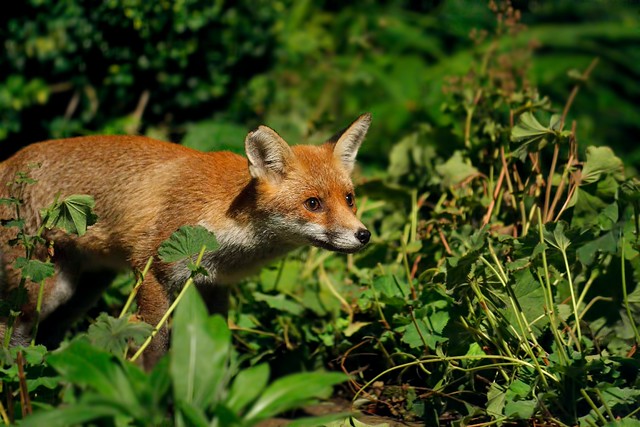
I use a strong filter on the background to completely remove any noise, then use a lighter much more detail sensitive filter on the subject. All done using two layers (one background layer with the heavy NR, one details layer with the light NR) in PS/gimp, then masking out the subject from the background layer to show the details.
The result is noiseless backgrounds and good detail on the subject.

Red fox by Adamhawtin, on Flickr

That's a shot at 3200. At web size you wouldn't know it was shot that high. At A4 it looks fine unless you look really close where you can see perhaps a tad less detail than my shots at lower ISO. Don't know how it would look at A3, but I think you would have to look quite close to see any flaws in quality.

You do have to be careful with the exposure when you go to/over ISO 800, there isn't too much leeway for pulling up shadows if you underexpose.
 
Last edited:
I try to avoid going over 800, but then that is probably because I don't do any editing on my photos and that side of it doesn't interest me, so I shoot in jpeg and keep them as they are straight from the camera.
 
Back
Top