77mm CPL advice

Gary Coyle

In Memoriam
Messages
12,654
Name
Gary
Edit My Images
Yes
Whats the best 77mm CPL with a max budget of £40-50, will be used with a Nikon 16-35mm f/4 VR if that makes any difference, cheers.

 
I think I got a 77mm Hoya Pro1 CPL when I got a Canon 70-200 and so far I've never used it other than the first time to try it. I only took a few shots with it but I could tell the difference straight away from a cheap filter I had. Never had a Marumi filter, didn't even know they made them, but I've had other gear made by them and they were all very well made and worked very well. I'm sure the same QC applies on all their products.
 
I really wouldn't buy CPL for such a wide lens, unless you are going to use it after sunset, or in a deep forest well away from the sun.

If you do the "obvious" sunny landscape, you will see patches of bright and very dark sky
 
Whats the best 77mm CPL with a max budget of £40-50, will be used with a Nikon 16-35mm f/4 VR if that makes any difference, cheers.


Marumi Super DHG. It's as good as the most expensive TBH, though I personally prefer the Hoya HD (because it only loses 1.2 stops of light, rather than 1.7-1.9 of most others).
 
I really wouldn't buy CPL for such a wide lens, unless you are going to use it after sunset, or in a deep forest well away from the sun.

If you do the "obvious" sunny landscape, you will see patches of bright and very dark sky
Not something i'd thought of, thanks, might just stick with my mid range zoom with CPL
 
Not something i'd thought of, thanks, might just stick with my mid range zoom with CPL

Try it first. You do not always get issues of patchy blue with a super-wide and polariser, in fact mostly it's not a problem, though it can be when the sun is low at certain angles.

I don't know why some persist with this myth, without any qualification, discouraging people from using the single most useful filter for landscapers.
 
Try it first. You do not always get issues of patchy blue with a super-wide and polariser, in fact mostly it's not a problem, though it can be when the sun is low at certain angles.

I don't know why some persist with this myth, without any qualification, discouraging people from using the single most useful filter for landscapers.


:agree:

...and also very useful to cut water reflections too.

I have used one with my 10-20mm sigma with no problems with sky or water.


Heather
 
Thanks Richard and Heather, i read somewhere that super-wide lenses are best using "slim" filters, is that correct and if so why/how are they slim.

I have a Hoya 67mm PRO1 Digital Circular PL Filter which works quite well on another lens so might just stick with what i know and buy the 77mm version.

Thanks
 
+1 for the Hoya Pro 1 digital. Got one on my Sigma 10-20 and its great.
Sometimes you can get a little darkening of the blue sky at the edges but as mentioned above, not always.
Great quality for the money.
 
Thanks Richard and Heather, i read somewhere that super-wide lenses are best using "slim" filters, is that correct and if so why/how are they slim.

I have a Hoya 67mm PRO1 Digital Circular PL Filter which works quite well on another lens so might just stick with what i know and buy the 77mm version.

Thanks

Yes, though this is a completely different issue to the one Daugirdas was referring to.

With a super-wide lens at shortest focal length, it's possible that the protrusion of a standard depth filter mount (5mm) can extend into the corners of the image and cause darkening. The correct term is 'mechanical vignetting' and slim-mount filters avoid this. Most have slim mounts anyway.
 
Try it first. You do not always get issues of patchy blue with a super-wide and polariser, in fact mostly it's not a problem, though it can be when the sun is low at certain angles.

I don't know why some persist with this myth, without any qualification, discouraging people from using the single most useful filter for landscapers.

It's no myth. This shot was taken to illustrate the fact and heavily compressed to show it even more but it shows just as much when SOOC. I'm afraid I don't remember exactly what time the shot was taken but the sun was high in the sky (well, as high as it gets in January!) EXIF hasn't been stripped (or if it has, it was by the gallery software - if it isn't there, I can find the original to establish more). It was shot on a 12-24 at 16mm on a D700 in Dx mode with the pol mounted on the bucket.

SkyBandPol2.jpg
 
I'm interested in a 77m polariser too, not for use with a wide angle lens but with either 70-200 or 300mm. Is there much difference between the Hoya pro-1 or hd series? I currently us hoya hd protectors (dont want to go into that debate).

The other day I was trying to get a photo of a black swan in dark water but the light reflecting off the water ruined the low key effect I was going for. I'm guessing a polariser would get rid of this light reflection if used properly.
 
I'm interested in a 77m polariser too, not for use with a wide angle lens but with either 70-200 or 300mm. Is there much difference between the Hoya pro-1 or hd series? I currently us hoya hd protectors (dont want to go into that debate).

The other day I was trying to get a photo of a black swan in dark water but the light reflecting off the water ruined the low key effect I was going for. I'm guessing a polariser would get rid of this light reflection if used properly.

The main difference is the extra half-stop of light transmission you get with the HD polariser, handy to keep shutter speeds up with a longer lens.
 
It's no myth. This shot was taken to illustrate the fact and heavily compressed to show it even more but it shows just as much when SOOC. I'm afraid I don't remember exactly what time the shot was taken but the sun was high in the sky (well, as high as it gets in January!) EXIF hasn't been stripped (or if it has, it was by the gallery software - if it isn't there, I can find the original to establish more). It was shot on a 12-24 at 16mm on a D700 in Dx mode with the pol mounted on the bucket.
SkyBandPol2.jpg

The 'myth' is that you 'can't' or 'shouldn't' use a polariser with a super-wide, when in fact of course you can, and the problem of patchyness with blue skies, though real as your shot illustrates, is certainly not the norm. And even when it does appear, very often the darker area doesn't look bad, or may be concealed by clouds or other elements in the scene, or it can be shifted left/right and moderated with rotation of the filter, or the filter simply removed and you've lost nothing. And it is clear from your shot that the sun is indeed low in the sky.

Here's an example taken with a Canon 10-22mm at 10mm, which is just about as ultra-wide as you can get.

Canon 10-22mm at 10mm, Hoya HD polariser.
5df2de1f-46f9-4cfb-b15b-ee092ce9d9db_zpsb82d164f.jpg
 
Nice shot of a Greek chapel. That shot shows the uneven polarisation as much as mine does Hoppy. The sky at the top is significantly darker than it is lower down (far more so than is natural down there).

Of course it's possible to use pols on UWAs, just as it's possible to use plain window glass as a protection filter but people need to be aware that there can be issues when doing so.


ETA Oh, you're right about the sun's angle - I was sure I had shot it near noon but it appears that I had shot it relatively early in the morning.
 
Last edited:
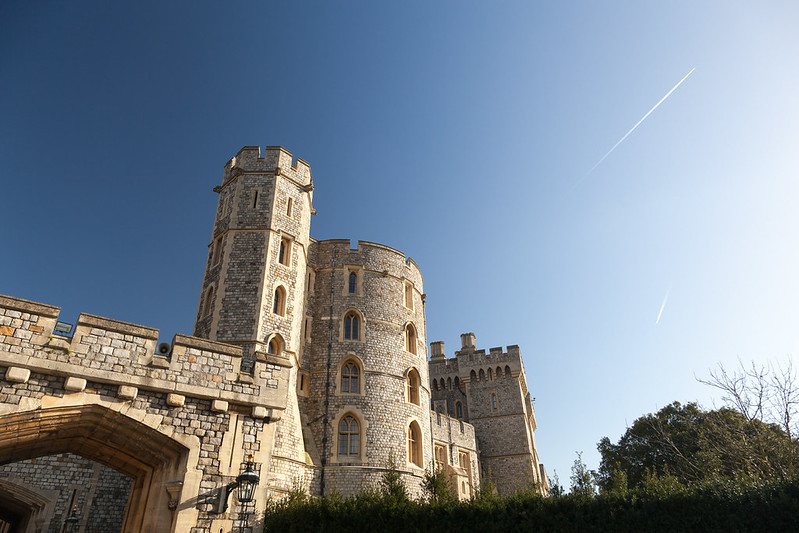
Here's another one of CPL doing its dark blue sky trick. I personally think this is what makes the shot, the shift in colour gives impression that it's sunny on the right and cloudless on the left.

8489736111_d312ba70fd_c.jpg

Windsor castle by wuyanxu, on Flickr


CPL for ultra wide angle will work. Only need to be careful not to have the dark blue in the middle of the image.
 
Nice shot of a Greek chapel. That shot shows the uneven polarisation as much as mine does Hoppy. The sky at the top is significantly darker than it is lower down (far more so than is natural down there).

Of course it's possible to use pols on UWAs, just as it's possible to use plain window glass as a protection filter but people need to be aware that there can be issues when doing so.


ETA Oh, you're right about the sun's angle - I was sure I had shot it near noon but it appears that I had shot it relatively early in the morning.

Yep. After all, darkening the blues in LR gives a lot more pleasant results for such photos. It's a nice chapel shot, but if it wasn't for the blue door it is almost a black and white photo with a patch of very dark blue near horizon.
 
Nice shot of a Greek chapel. That shot shows the uneven polarisation as much as mine does Hoppy. The sky at the top is significantly darker than it is lower down (far more so than is natural down there).

Of course it's possible to use pols on UWAs, just as it's possible to use plain window glass as a protection filter but people need to be aware that there can be issues when doing so.


ETA Oh, you're right about the sun's angle - I was sure I had shot it near noon but it appears that I had shot it relatively early in the morning.

Yes, that's true. When the sun is high, like almost directly above as here, the zone of polarisation runs in an even circle right around the horizon 360 degrees. The point being though, it looks fine, as it often does with a polariser and super-wide.

For this particular shot, with the sky being such a clear blue to start with, using a polariser made the sky too dark for my liking. All my keepers from that day were taken without a polariser - that doesn't happen often!
 
Here's another one of CPL doing its dark blue sky trick. I personally think this is what makes the shot, the shift in colour gives impression that it's sunny on the right and cloudless on the left.

8489736111_d312ba70fd_c.jpg

Windsor castle by wuyanxu, on Flickr


CPL for ultra wide angle will work. Only need to be careful not to have the dark blue in the middle of the image.

That would be with around 140-180 degree angle away from sun. Dark edge is not much better in my opinion. You can 'fix' that shot by adding a couple careful grads, but in practice that is a lot of unnecessary work.

In more cloudy conditions that problem is a lot lower, but usually CPL works best at longer focal lengths.

In practice darkening blue and bringing up yellow, orange and red slightly and boosting saturation can give very similar or even more pleasing results. It's just the reflections and ND effects that are more unique.
 
Back
Top