Advice re difficult flash conditions

Messages
11
Name
Tony
Edit My Images
Yes
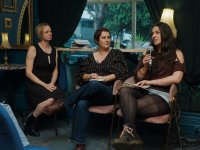
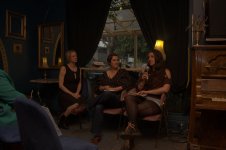
I recently had to take some pics at a book launch and poetry reading. Conditions were difficult:
-very dark room
-bright window behind speakers
-lamp behind my daughter's head
-1 bare speedlight only with no modifier
-I was seated quite close to the speakers and I didn't want to blind them with direct flash
- only bounceable surface was matt dark bown ceiling

I had my Fuji X-t4 with kit lens 18-55 and a manual flash. I ended up shooting at f4, 1/250, iso 800 and flash at about 1/2 -2/4 power pointed vertically at dark ceiling!
I am trying to attach raw and processed versions of 1 image. Could I have done anything differently?
 
Last edited:
The dark ceiling is the problem. For bounce flash to work you need a light ( white ideally) surface obviously.
In similar situation ( green ceiling) I've used a white card, or reporters note book to bounce off, a white shirt will work.
It's not ideal, but better than direct flash.
The old Metz 45 or 60 had a super huge bounce board that clipped onto the flash., sadly not something you see these days.
 
Last edited:
The old Metz 45 or 60 had a super huge bounce board that clipped onto the flash., sadly not something you see these days.

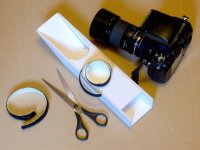
I used to make my own from cardboard.

The trick is to use Velcro or similar to attach it to the flash head. I also made a slightly more sophisticated version for closeup work...

Homemade Macro Flash reflectorTZ40 1010394.JPG
 
Difficult conditions but by no means unusual:)
You used the fastest shutter speed available to you, which reduced the effect of the bright window as far as you could.
The only thing that you could and should have done differently was to have the flash at FULL power.
 
At last I have managed to post pics. The reason I didn't use full power was my reluctance to hit the readers with max flash while they were trying to read. The ISO was raised to get as much flash illumination as possible at less power - if that makes sense... I got a pic of a white book page to correct WB later.

p.s This is my first real attempt at having to use flash properly and work through a problem
 

Attachments

  • _DSF0073_03.jpg
    _DSF0073_03.jpg
    135.2 KB · Views: 38
  • _DSF0073_02.jpg
    _DSF0073_02.jpg
    81.8 KB · Views: 37
Last edited:
I very much doubt whether anyone would have noticed any difference in the flashgun output, it wasn't even pointing in their direction.
And no, it doesn't make sense to use a low-powered flashgun at anything less than full power in a situation that shouts out for flash power . . .

But, that aside, I think that it worked out OK
 
firstly the generalisation, honestly when using on camera flash there is zero reason to use Manual flash settings. The best you can hope for is a lot of trial and error.

Think about when you’re bouncing flash and moving around, can you honestly calculate the distance from the flash, to the ceiling and back to your subject, guess how much light the bounce surface has absorbed, calculate based on the GN, and then do it all again if you move a few feet or decide to bounce off a wall instead of the ceiling. Miraculously TTL flash can do all that and so much more.

Back to your specific problem though, with the best will in the world, you’ll need a bounce card of some description, you can go as simple as a business card, or as complicated as a Rogue flashbender or a pop up flash softbox thing. I’ve got loads, there’s very little between them.

I’ve posted this before but my favourite bounce surface is the right angle between the wall and ceiling behind me, which is the closest thing you’ll find to a, umbrella at camera position.
 
Most of this was covered in my original post.

I had only a manual flash available
I was seated not moving around.
I had to time to get there early and get settings sorted - it took 4-5 trial shots
The ceiling and walls were dark brown
 
Most of this was covered in my original post.

I had only a manual flash available
I was seated not moving around.
I had to time to get there early and get settings sorted - it took 4-5 trial shots
The ceiling and walls were dark brown
I’d honestly missed the description of the flash as Manual.

Cos honestly and mirroring what I wrote above, I can’t think why someone would buy only a manual speedlight :)
 
@Phil V and I have approached this from different directions and we're both right.

I'm right because I approached this based on what Tony said, having no choice other than to make the best of the very basic equipment he had with him in conditions that, like so many, weren't designed for the benefit of photographers. He just turned up hoping for the best and had to do what he could with the reality.

Phil is right because his approach is more professional and he goes equipped with the right gear, or at least the gear that can deal with the environment adequately, which every experienced pro will always do.

But the main difference really is the professional, assertive attitude that is essential in photography.

Phil may or may not remember an outdoor shoot that he helped me with, years ago.
This was just as promo video, we shot it in a public park, and I should have applied for written permission 6 weeks in advance and should have paid a hefty fee, but I "forgot". So, the day before, I rang the local council and the conversation went something like this"

"Hi, it's Garry Edwards at Commercial Photography. I'm just ringing up to confirm that the shoot by the lake in Wibsey Park will be tomorrow morning, about 11 am, and will probably be all done in a few minutes - the risk assessment has been done, the insurance is in place, the public won't be affected in any way, so I'm just checking that it will be OK to drive just one car to the scene, for H&S reasons?"

"Erm yes, that sounds OK"

So, I had taken control of the situation and had permission, sort of, and I had a name I could quote if someone tried to stop me . . .

In Paul's situation, I would have just turned up, with more equipment, and I would have positioned myself in the best place, which wouldn't have been sitting in a row of chairs, and I wouldn't have asked whether that was OK or not, because my only interest would be to do the best possible job, and asking for permission is inviting refusal, so the rule is don't ask, do it until you're stopped - which nearly always works, because the person in charge can't be sure that someone senior hasn't already given permission - that's just me, but my guess is that most professionals - and amateurs with both experience and a pro attitude would do the same - and it's usually better to ask for forgiveness than permission anyway:)
 
I recently had to take some pics at a book launch and poetry reading. Conditions were difficult:
-very dark room
-bright window behind speakers
-lamp behind my daughter's head
-1 bare speedlight only with no modifier
-I was seated quite close to the speakers and I didn't want to blind them with direct flash
- only bounceable surface was matt dark bown ceiling

I had my Fuji X-t4 with kit lens 18-55 and a manual flash. I ended up shooting at f4, 1/250, iso 800 and flash at about 1/2 -2/4 power pointed vertically at dark ceiling!
I am trying to attach raw and processed versions of 1 image. Could I have done anything differently?
I'd probably have taken something to bounce the flash off, e.g. a large white reflector, and hoped to have placed it somewhere useful.
The reason I didn't use full power was my reluctance to hit the readers with max flash while they were trying to read.
Don't worry about that if you're bouncing off a wall or ceiling. It won't be a problem unless they're looking directly at a bare flashgun.

Since you had some setup time you could have tested whether it was actually a problem, too.
 
I am not a pro and was attending as a parent. The TTL flash I had ordered did not arrive in time so I used my Sunpak 383 that is about 25 years old... :)
 
Last edited:
I’d honestly missed the description of the flash as Manual.

Cos honestly and mirroring what I wrote above, I can’t think why someone would buy only a manual speedlight :)

Oddly - even on camera - I mainly use my TT685 as a manual flash these days. (Whereas in the past I was a true believer in only using TTL on camera and rearely used manual).

I think we just get bound to our habits - and once bound they don't change easily.
 
Phil may or may not remember an outdoor shoot that he helped me with, years ago.
Of course he remembers.

My memory is on its way out of the door, but I treasure every moment I spent with you Garry, and it was the best value training I ever had. Whether a workshop, this shoot, or just calling in for a chat in Bradford.
 
Tough spot, that dark ceiling really leaves you nowhere to bounce. I had a similar night in a school hall once and ended up just pointing the flash up anyway and living with it. Your shot came out a lot better than mine did, for what it is worth.
 
If and when my TTL flash arrives, faced with the same situation, should I:
-use camera in manual exp to knock down window light then use TTL Flash with spot metering on face?
-let camera work the whole thing out....?
 
If and when my TTL flash arrives, faced with the same situation, should I:
-use camera in manual exp to knock down window light then use TTL Flash with spot metering on face?
-let camera work the whole thing out....?
My general ‘easy’ flash setting (I have it on C1) is Manual with an ISO of 400, 1/100 and f5.6. But as you’ve alluded, in your situation I’d adjust ISO and/or aperture to give the required look to the window light.

Flash on ETTL, I don’t know about Fuji, but on Canon I only have the choice between Eval and centre weighted, and I believe it works better on centre weighted. BUT I do make a lot of use of Flash Exposure Compensation, which you would likely need due to the bright window in the frame.
 
My approach was camera in manual then control flash with flash power. Yours is camera in manual + TTL flash and adjust flash with flash exp comp. Sounds about the same.
I can see how TTL flash is better with moving subjects or reflectors but overall the approach is similar?
 
Last edited:
My approach was camera in manual then control flash with flash power. Yours is camera in manual + TTL flash and adjust flash with flash exp comp. Sounds about the same.
I can see how TTL flash is better with moving subjects or reflectors but overall the approach is similar?
Yes, but I suppose because I come from film where the only way of knowing whether the flash exposure was correct was to calculate it, and for bounced flash that’s not easy.

I see TTL flash (and auto thryister flash before it) as a great help. But I suppose if you’re gonna chimp And adjust, it’s the same thing.
 
My approach was camera in manual then control flash with flash power. Yours is camera in manual + TTL flash and adjust flash with flash exp comp. Sounds about the same.
I can see how TTL flash is better with moving subjects or reflectors but overall the approach is similar?
This Is an interesting question, or at least it interests me, so I’ll bore you with a fairly full answer, but the short answer is to do whatever works best for you:)

Longer answer: ETTL flash is incredibly useful technology; basically it doesn’t always get it right but it nearly always gets it almost right, it’s a natural choice in many shooting scenarios because of this, even for very experienced photographers.

I know nothing about either your camera or your new flash, but I’ll say this; new flashes include a lot of technology that works extremely well, plus various “marketing benefits” that are really only useful to the sellers in the sense that they try to persuade us to buy that particular flashgun. Flashgun development hasn’t changed much for many years, they are still very low-powered tools that pretend to be powerful, and their various marketing features just make them over-complicated, slow to use and increase the potential for error. It’s probably because of this that a lot of the old boys like myself use them mainly on manual settings, I find manual to be easier, faster and much more reliable, but neither auto nor manual are “right” for everyone.

Manufacturers tell us all sorts of things about their wonderful products, some statements are true and some are blatantly false, for example, they tell us that their products produce “beautiful soft light” when the truth is that the softness of the light is only about the size of the tiny flash head, which can only produce soft light if we photograph something the size of a pea with the flash almost touching the subject - which is one of the reasons why we normally bounce the light whenever we can. Power is another deception. For some reason manufacturers seem to forget to tell us about the real power output of their flashguns, few if any produce more than 70-100 watt-seconds of light, which is low. What they DO tell us is the guide number; this is amplified partly because of the mirror-like surface of the reflector, with the downside of creating very harsh and uneven light, and partly by the zoom settings available, which means that the flashguns that have the highest guide numbers tend to also have the longest zoom settings – the quoted guide numbers are with the flash set to the longest zoom setting, which many of us never use. I’ve written an intro article about this, a bit dated now but hopefully still helpful https://www.talkphotography.co.uk/tutorials/which-type-of-flash.153/

Yes, but I suppose because I come from film where the only way of knowing whether the flash exposure was correct was to calculate it, and for bounced flash that’s not easy.

I see TTL flash (and auto thryister flash before it) as a great help. But I suppose if you’re gonna chimp And adjust, it’s the same thing.
Yes, with film we had to get it right first time, and we’d only know whether it was right or not when we’d developed the film. This meant we had to calculate, and that we quickly learned to do it properly.

Go back even further, when the only flash we had was flashbulbs. I could write a whole article on their limitations. Still, basically they were single-use bulbs that were incredibly expensive, couldn’t be adjusted for power, had to be used at very low shutter speeds and so were overwhelmed if used in bright light. They typically had a guide number of just 24.4 or thereabouts at 100 iso. And, to make them even more limited, typical B&W film at that time was 100 iso, so was colour negative at best, colour slide, used by most pros, was originally 10 iso with Kodachrome, then improved to 25 iso, and my film of choice, Agfa CT18, was 50 iso. So, flash back then was limited, the real progress came with digital cameras and more powerful flashguns.

Let’s get right back on topic. It seems to me from what little you’ve said, that your main concern was exposure, i.e. that you wanted to have ENOUGH light for the shot to look right. That’s understandable and entirely normal for a beginner, but it’s the wrong approach. The right approach is to create the right QUALITY of light, not the right QUANTITY, i.e to create light that flatters the subject. It’s about creating the right shadows in the right places, and this applies to all photography regardless of the type of light used, and the trick is to make the lighting look so natural that non-photographers don’t even notice the lighting.

So, with this type of subject, we want the light to appear to come from where nearly all light comes from, which is basically from above, so bouncing the light from the ceiling and/or a wall behind you is the obvious way to go.

Personally, I’d do this.

  • Get myself in the right place for the shot.
  • Set the shutter speed to 1/250th, the fastest speed you can use with your camera I think, to reduce the effect of the ambient light as far as possible.
  • Take a test shot WITHOUT flash, this will show just how badly the shot is affected by the window and any other ambient light.
  • Turn on the flash, bounce it as well as you can and take a shot at full power. Does this show the window light adequately? – we don’t want the shot to look as if it was taken at midnight, and we don’t want the table lamp to look as if it’s switched off.
  • Take more shots if and as necessary, reducing the power in stages until it looks right to you. ETTL may or may not produce the results you want.
Oh, and as an aside, forget about all of the gadgets such as diffusers, which make bold claims but basically just waste light.

 
Back
Top