Astrophotography equipment - AstroTrac TT320X-AG

Not used one myself but a few friends have, all good reports from them.

It does need mounting properly though so the minimum is a decent solid tripod & a Manfrotto Junior geared head + ball head, I believe you can buy the complete package from most retailers.

(ps get the polar scope for it as well, it makes for precise alignment)

The other solution is the portable pier & the astrotrac wedge.

It should handle small telescopes as well, you could probably get away with something like a william optics ZS66 or maybe even the Megrez 72
 
I use an AstroTrac quite a lot, it would get a lot more use except that between the weather (wind, rain, cloud, fog), the moon and light pollution I don't get that much opportunity to do so. It is a great piece of kit but like most things it has its limitations.

The longer the focal length you intend to use, the more sturdy the tripod and heads have to be and polar alignment needs to be more and more accurate. Answering your question, a geared head isn't essential, but it will make your life a lot simpler. That specific head (or similar) is used to polar align the AstroTrac. You then need an additional head on top of the AstroTrac to point your camera at your intended target.

Since I am mostly using a large lens with mine (500mm f/4 L IS), I upgraded from the Manfrotto 410 junior geared head to the dedicated wedge, it is a lot more sturdier and easier to use. I also use my gimbal head to frame my intended target.

I can't imagine not being interested in astrophotography now, and the AstroTrac was my first foray into it and it has still got many more miles to go. For the foreseeable future I am not intending on getting a sturdier mount, or even a telescope. It, along with my lenses are all I need. Warning though, it consumes a lot of time (and ultimately cash as you always want to upgrade bits) and can be much more frustrating than macro photography :D

Capturing the data is only the first step, processing the image takes the most effort and has a fairly steep learning curve, however there are plenty of rainy nights to practice processing for that one time you actually get to image :p

Have a look at my Flickr set, all were taken with the AstroTrac and various lenses (as listed). Not great compared to a lot of stuff out there, but if you had told me this was possible 18 months ago I wouldn't have believed you.
http://www.flickr.com/photos/72858142@N08/sets/72157630844004642/


Probably my favourite from this year was PanSTARRS Comet C-2011 L4 in conjunction with M31 Andromeda Galaxy. This will never happen ever again and I only had one shot at it.
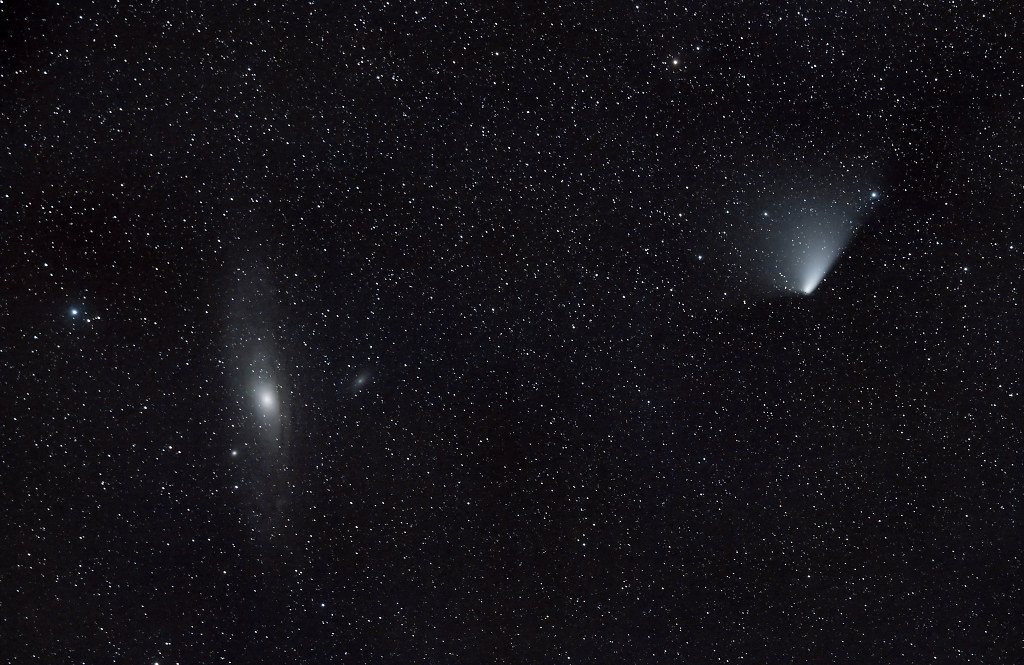
2013-04-06 - Comet C-2011 L4 (PanSTARRS) by StuartJPP, on Flickr

 
The dedicated wedge allows you to perform polar alignment a lot easier than a geared head and is much more stable for heavier loads. The one I got was the AstroTrac TW3100 Wedge. Don't worry about getting one, you will know if you need one in future.

The problem with pan and tilt heads for polar alignment is that you will spend a lot of time adjusting both pan and tilt to get alignment spot on. However it can be done, it will just be fiddly. After levelling your tripod, you need to align the "tilt" at your latitude, which in the UK is roughly 53° and then use the pan to get Polaris in the right position. Best bet is to try it with what you have got and only get a geared head or similar if you need one.

Depending on focal length used and exposure time, precise polar alignment is not strictly necessary. If you are imaging at 16mm and 30 second exposures, polar alignment doesn't have to be very accurate at all, however if you are using a 200mm lens and want 5 minute exposures, you have to have it pretty well aligned.

To start with, just get the AstroTrac, preferably with the polar scope. The polar scope will allow you to get more accurate alignment which you will want in the future even if you start off with wide angle images. Everything about astrophotography is an uphill battle, but the rewards are...well...rewarding.

On top of that you will also need an additional head (preferably ball head) to frame your target. This is what your camera will be mounted on and used to point at any position in the sky.

So just to recap, in your case the sequence is:
Tripod, pan & tilt head, AstroTrac, ball head then camera.

However the whole point of getting an AstroTrac is down to its tracking accuracy, otherwise you might as well build a barn door tracker mount.

There are other alternatives, Vixen Polarie, iOptron SkyTracker, it all depends on what your payload is going to be in the future. The AstroTrac has definitely got the largest payload capacity and is the most accurate of the lot and hence is more future proof.
 
Thank you so much for that detailed response, I am considerably clearer in my mind than I was 48 hours ago, that I definitely want to give this a try.

One possibly silly question that I haven't got my head around - is I have seen lots of photos of the stars (not trails) where there is scenery or a building in the forefront of the photograph.

Am I right in thinking these photos must have been merged in or does the software allow for them as well - what software would you recommend I look at first.

Sorry I don't know your name but thanks again

Andrew
 
Andrew,

I am not very experienced with nightscapes but generally there are a few ways of doing it.

Multiple exposures will do one of two things, either make the stars blurry if on a static tripod, or make the landscape blurry if tracking the stars. There are ways to get a 1/2 sidereal tracking rate where both are slightly blurred but probably not noticeable in a resized image.

What most people do is stack multiple images to get the nice detail in the Milky Way (to get the stars sharp and visible), and then take a single exposure with no tracking to get a sharp landscape. This can be either a long exposure or a short exposure but using artificial light like a torch to brighten up the foreground. The stack of MW images are then blended with the single foreground exposure.

If you are only wanting to do wide-angle nightscapes, you don't really need any tracking mount, at least not initially until you get your head around things. There are lots of people who use high ISO and fast, wise lenses to produce great results.


For stacking, programs like Deep Sky Stacker can be used and then Photoshop or similar used to process the results.
 
You can try RegiStax or similar to stack images of the moon. Ideally you want lots of images to stack, the more the better.

I tend to only take single images of the moon as it is bright enough, though after taking an interest in deep sky objects, you soon learn to hate the moon :lol:

If you are serious try browsing a dedicated astro group/forum like stargazerslounge. People post pictures and you can get an idea of the kit they have used...be warned though as it ranges from very basic to serious amateur.

Cheers,

Stuart
 
You shouldn't need to stack the moon, it is a very bright object, think of it as a large reflector illuminated by the sun! so 1/125 f8 ISO 200 should be in the ball park. That obviously is nowhere near enough exposure for stars, so if you want moon and stars you need to merge shots :D
 
There is still a reason for stacking pictures of the moon. Especially if you want try to use detailed pictures of the surface.

Stacking can also improve you can reduce impact of atmospheric seeing (blur) and pull more details.
 
There is a company on ebay selling a few of these - it transpires that its excess stock from another shop. Apparently the boxes were sealed brand new when they took them in, and only opened for serial numbers. The seller offers 90 day warranty but the downside is no manufacturers warranty.

Selling the complete lot including scope, battery holder for about £120 less than anywhere else.

Is it worth the risk - is there much that can go wrong -- don't know what to do

It sounds to me like by taking the serial numbers they have probably registered themselves for warranty
 
It is a fairly simple device. There is some electronics, but most parts are mechanic. I wouldn't require a full manufacturers warranty on devices like this one. If you find a good deal with 90 days warranty, go for it. You can always test it and return it if any issues.

Please bear in mind that you also need a very sturdy tripod (preferably equivalent of Gitzo series 3 or better) and two heads (one for polar axis and at least a ball head for composition). I have mixed experience with AA batteries. The astrotrac can be very picky when it comes to power source. You need a stable voltage. There is difference between using 1.5V alkalines or 1.2V rechargeables. If using rechargeables, make sure you use 10 batteries and not just 8 to have 12 volts. It might be challenging to have to charge 10 batteries. Better to use car adapter or AC adapter. I bought a Li-On battery pack that gives me power for one night of operation.

The auto-guider feature is not that important. It require much more complicated setup (which somewhat defeats the purpose of the device I think) and still can compensate the tracking error in one direction only. If you have a chance to get older device TT320X (without AG suffix), go for it, you can save some money and it is as good if not even better (there are more plastic parts on the new than on the older one).
 
Last edited:
This is probably a very basic but stupid question

Why does equipment like this have to be aligned with Polaris and not say the moon - and what do you do if for any reason your location does not allow a visual on Polaris

Curious on this one - no doubt more daft questions will spring to mind as I delve further into the hobby
 
This is probably a very basic but stupid question

Why does equipment like this have to be aligned with Polaris and not say the moon - and what do you do if for any reason your location does not allow a visual on Polaris
Fundamentally, due to the earths rotation.... (and you align slightly offset from Polaris, not exactly on polaris).

Basically, if you align exactly correctly, you can use a single motor to track the stars as the Earth rotates. This keeps everything static in the image. If you try and use 2 motors to keep the subject in the centre, you will find that everything off the central axis of the system rotates around that axis, causing circular smearing...

I've never tried aligning without being able to see Polaris :D
 
Back
Top
