Astrophotography

Cris_L

Take That's Biggest Fan
Messages
1,923
Name
Cris
Edit My Images
Yes
Obviously I'm busy trying to get the basics under my belt at the moment but astrophotography is definately something I will be interested in trying due to having a casual interest in astronomy.

Can anyone advise me on what sort of kit is required, without going as far at tripods capable of tracking etc. eg what power zoom lens for the moon - what settings etc?

many thanks in advance
 
I've had a go at "prime focus" astrophotography, where you use the telescope as a lens for your camera. It's very, very difficult!

For that kind of photography, you need a T-Ring adaptor (about £10) and an eyepiece for your telescope that has a mounting thread. Your telescope will need to be able to track a target, so you'll need a computer-assisted scope.

For more professional results, sadly, you'll need to spend quite a bit more money. You can purchase a CCD that plugs straight into the scope and records images, but you'll need to then link it up to a laptop, and there's quite a bit of software required - you'll be "stacking" images on top of each other. The biggest cost in all of this is the scope - especially if you're interested in deep-sky work.

You can, of course, take shots of the moon with a tripod and zoom lens - anything from 200 - 600mm would be good, but you will get far better shots with a telescope.
 
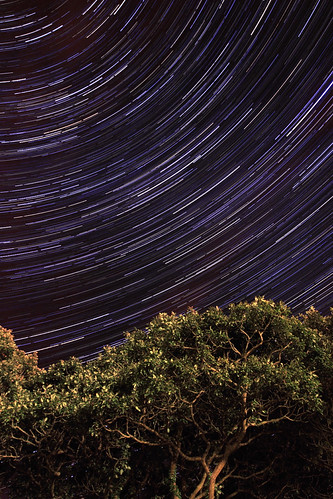
How about photographing the stars, I dont know the proper term but when they do a time exposure and the stars are like streaks of light?
 
How about photographing the stars, I dont know the proper term but when they do a time exposure and the stars are like streaks of light?

Hi Cris

I think you mean star trails! .... Something like this .... ?
3959551553_70414db055.jpg


I usually just stick the camera on a tripod, focus on something at the foreground and set the camera to take the longest exposures possible depending on the ambient light, then use startrails.de to stack the images! The software is simple and free :thumbs:
 
Rather than type out a load of info I will direct you to the following articles.

The only caveat I would make would be that for astrophotography prime lenses work better than zooms.

I used to use a little sigma 28mm manual focus for a lot of my star field shots and a sigma 400mm telephoto or prime focus of a telescope for the moon.

Finding the pole star.
http://www.youtube.com/watch?v=0TFZDO8KcTw


Shooting the moon guide
http://dpfwiw.com/moon.htm


How to take star trail photographs.
http://www.weatherscapes.com/techniques.php?cat=astronomy&page=startrails
 
Cris

Astrophotography is a very broad subject! Can you be a bit more specific about what you would like to do and what sort of shot you are trying to achieve? ..
 
Cris

Astrophotography is a very broad subject! Can you be a bit more specific about what you would like to do and what sort of shot you are trying to achieve? ..

Basically as much as I can do without having to buy too much additional kit.

Star trails, pics of the moon (if possible with a tripod and up to 250mm zoom lens), a landscape photograph incorporating the night sky etc
 
Cris, It is possible to get reasonable moon shots at 250mm, but you have to crop a long way to get any sort of scale. You really want a minimum of 600mm, and ideally at least 1200mm with an SLR to get an image you don't need to crop. You can do widefield with a static tripod (See this I wrote about it). You can also do startrails as indicated. Anything else and you are going to need to buy more kit, possibly lots of it.

For Deep sky imaging, you really need a heavy duty tracking mount. A 600mm ED refractor with an SLR is a good combination for the larger targets. To get some of the faint information, you really need a good guiding system, that's a second camera (which can do double duty as a high speed lunar/planetary camera) and a computer, or a specialised guiding camera with all the electronics attached.

For lunar/planetary, you really want a very long focal length, something above 3000mm, if not more. You will be operating at something like f/30 or more (they are diffraction limited optics, so even f/75, I've used it, isn't a problem, although getting enough light to the camera can be). You can get away with the same decent refractor (I am), but it's not ideal.

If you're wanting to do any form of imaging of our nearest star, you need specialist filters to cut 99.99999% of incident light (not expensive, I used some for my 55-250 with a pair of 58mm UV filters. Works a treat, but as the apparent size of the sun is the same as the moon, at 250mm it's pretty small in the frame) or you'll cook something, fast.

The single biggest expense for deep sky imaging is the mount. If it can't track accurately, and isn't stable enough, you won't get decent results. The load limit of the mount, is the upper limit and the thinking is that you want to be at about half the limit. If you put an expensive and stunningly good scope on top of a wobbly mount, you won't get better images, you'll probably get worse as the mount can't cope.

With a decent mount, you can use any lenses you might have, you'll be surprised just how big some targets are... my favourite image, I've produced, was shot with my nifty fifty, tracked with 33x5 minute exposures.

 
You dont need a tracking mount to be honest if you do get the bug!

I have an autoguided goto mount and a 600mm scope and the complete set up ways a ton and cost a fair few quid.
It is not very portable as i live in the middle of a city and the light polution is terrible so i also have to use filters to cut down on this but i met someone at our local club that uses an Astro-Trac and to be honest i will probabley get rid of my set up as soon as possible and buy one.

Have a look at http://astrotrac.com/Default.aspx

But you can get some good moon shots with a tripod and something like a 300mm or 400mm with TC's or do some widefield shots on a tripod with cable release as using something like a 17-40mm zoom you can expose for quite some time without getting any visible trails if you experiment.
 
Back
Top