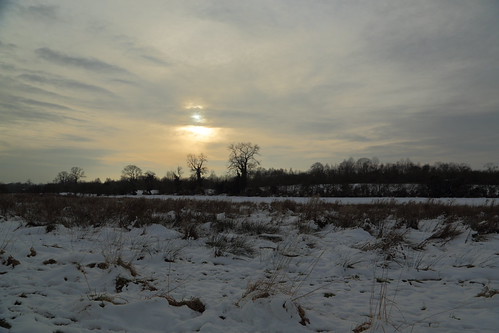
Canon 24-105 f4l

Messages
217
Name
Martin
Edit My Images
No
Hi all,

Purchased a 5d iii and 24-105 end of last year and have been using it every weekend pretty much since. However the more I use it the more I wonder if the lens is a little soft, more around the edges than anywhere else. As I moved from a 550d I'm not sure if this is to be expected a little more on full frame. Also was using a 100m 2.8l which I find pin sharp. Anybody have any thoughts?
 
You are comparing canon's sharpest sub £1000 prime to a wide range outdated zoom. It is not as sharp, and you will need to shoot past f/8 at high enough shutter speed to achieve similar. Or you need to think about 24-70mm II, which is incredibly sharp according to reports
 
Thanks for the quick reply, I suppose as the lens is an L series I was expecting it to be Pin sharp as well! After doing some resolution tests at various f no.s it is pretty sharp on the centre but fairly soft on the edges
 
I'm no expert but in the first picture even the centre is not sharp if you look at the hedge row.
The grass at the far end of the puddle is sharp. This leads me to think either the AF picked that area to focus on or the lens is front focussing.

If the AF picked a low focus point that would explain the sharpness there, combined with a relatively wide aperture might explain it.

The other image seems to be similar, but its pretty noisy, which makes it a bit harder to determine whats there.
 
In the first picture the aperture is F5.6, I'm not expert but wouldn't that have quite an effect on sharpness on the non focused on parts of the photo

Have you tried shooting wide with a higher f number?
 
Last edited:
The shot was quite wide and from memory the focal length was around 24 so depth of field should be inf beyond the focus point. Is that correct? I normally focus 1/3rd into the image
 
The shot was quite wide and from memory the focal length was around 24 so depth of field should be inf beyond the focus point. Is that correct? I normally focus 1/3rd into the image

The first shot was 24mm at f5.6 iso of 1250

Try one at 24mm at f11 or even f16, iso 100 and we could compare
 
The shot was quite wide and from memory the focal length was around 24 so depth of field should be inf beyond the focus point. Is that correct? I normally focus 1/3rd into the image

First shot, focus is on the puddle with infinity way out. Focusing 1/3rd into the image only works for things like groups of people, not landscapes that must include sharp infinity focus. Hyperfocal distance focusing is the technique for that - lots of threads on HFD, search against my user name.

You need to bone up on depth of field, and how it varies with focal length, aperture, and distance. Keep your shutter speed up too. Check the DoF you're getting with this calculator http://www.dofmaster.com/dofjs.html There is nothing at all wrong with the sharpness of the 24-105L. Sure the 100 macro is ultimately sharper but until you've absolutely nailed the basics you will not be seeing it.
 
HoppyUK said:
First shot, focus is on the puddle with infinity way out. Focusing 1/3rd into the image only works for things like groups of people, not landscapes that must include sharp infinity focus. Hyperfocal distance focusing is the technique for that - lots of threads on HFD, search against my user name.

You need to bone up on depth of field, and how it varies with focal length, aperture, and distance. Keep your shutter speed up too. Check the DoF you're getting with this calculator http://www.dofmaster.com/dofjs.html There is nothing at all wrong with the sharpness of the 24-105L. Sure the 100 macro is ultimately sharper but until you've absolutely nailed the basics you will not be seeing it.

Thanks for that, I do use the dof calculator and I was reading it as inf beyond the focus point and limited focus in front. If that's correct should everything beyond the focus point not be in focus? As has been pointed out on a previous response the hedge line is quite mushy!
 
The shot was quite wide and from memory the focal length was around 24 so depth of field should be inf beyond the focus point. Is that correct? I normally focus 1/3rd into the image
Let's take the first image. You are focused at half way up the puddle which must be 10-15 ft away from you. Now, DoFmaster says at 11ft is hyperfocal distance. But this makes an assumption that you are viewing a 10x8 print of the image from about 1ft. This equates on my 24" screen and viewing distance to somewhere around the 1280 or 1600 pixel image viewed full size. For me, those images are just about critically sharp.

If you pixel peep from the same viewing distance, that's the equivalent of getting 3x as close to the picture. Doing that means you have to view 3x as far away OR effectively cut the sensor size by a factor of 3. So, for DoF purposes, if you pixel peep, you effectively turn your 5D3 into a Nikon 1 sized sensor. Dropping 24mm, f5.6 and 15ft into Dofmaster and selecting a Nikon 1, you get near 10.1ft, far 29.5ft and the hyperfocal distance has shifted to 30ft. This puts the hedge line WAY out of focus.

Whilst it may be difficult to get your head around (took me about a year) you have to realise that DoF is ONLY visible when you view the image and changing the size of the printed image affects the DoF. If you want to find out why (in a non mathematical way) have a look here: http://photo.andysheen.co.uk/technical/depth-of-field-and-what-affects-it-explained/
 
Last edited:
Thanks arad85, you have given me some comfort regarding the lens and I will read up a lot more on DOF. Not as simple as I first thought this DOF!

Thanks again
 
try this on a tripod, Av, ISO100:
-24mm
-f13
-manual focus set to 1.5m
that's the setting I've memorised for hyperfocal distance at 24mm, everything from 0.75m to infinity should be sharp.

or try shooting a patterned wall front on. That's the standard way of testing if the lens is sharp or not.

or shoot a ruler at 45deg wide open, this is the standard way to test if the lens if back/front focusing.
 

1D8A0367 by wolfyccfc, on Flickr


1D8A0317 by wolfyccfc, on Flickr

I have no problem with the center of these images but thought the outer edges look soft and mushy, or am i being picky?

Right, what is going on here? The settings overall are all over place. 1/4000s f/5.6 and ISO1250 is probably more appropriate for very high speed action photography, like a jet fighter charging forward at full speed. For landscape this is only going to raise the eyebrows. 1/200s is more than plenty, so adjust all the rest.
You say you see mushy corners. Well I can't see anything sharp at all apart from bad over-sharpening artefacts. I had this particular lens and while it was not a 24-70mm, it was capable of a lot more than these examples on my humble 16MP FF from 2004. We are talking pin sharp centre - at 100% you think you can still expand it. The corners are not perfect, but your centre looks worse than the corners should be. What software are you using and how?
How are you focusing exactly? Why f/5.6? The hyperfocal distance is 4.2m and min sharp focus is 2.1m (presuming generous circle of confusion). Stop it down to f/11 and they are 2.2m and 1.4m, respectively. This is true for a perfect lens. A 24mm TSE II should be very close. 24-105mm is softer (but not this soft!) in the corners and have a curved field of focus. i.e. the corners will be focused a bit closer than the centre. You may want to adjust for that slightly.
I am not going to go into the composition and all the finer details as this is purely a test shot, but I do honestly recommend reading some good books on the subject. Your kit can deliver very impressive results :thumbs:
 
Thanks arad85, you have given me some comfort regarding the lens and I will read up a lot more on DOF. Not as simple as I first thought this DOF!
No... it's not simple. The best parallel I can think of is an impressionist painting. Up close, it is a collection of splodges, from a distance it is a thing of beauty. The photo is the same - you have to create the DoF depending hjow big you want to view it. As others have said, start by closing the aperture down. F8, F11 or even more are perfectly fine (although you will start to get in to diffraction effects beyond that on the 5D3 - diffraction is where the interference from the aperture causes more blurring than the circle of confusion if you read my link).

If you are going to use hyperfocal distance, you need to think how big you want to look at the image. If it is pixel peeping on a large screen, try setting the hyperfocal distance based on a small sensor camera (say the Nikon 1 series) and see what you get as a resultant image.

Let's do an example. Take a 5D3 with 24mm @ F11. It has a hyperfocal distance of 5.65 feet. So you set the focus to something about 6ft in front of you as "that's what the hyperfocal distance is". You come home, and look at the photo. As long as it is small on screen, it's fine. Blow it up to pixel peep and "OMG... there's something wrong with my lens"....

But as I said before, it's now the equivalent of a Nikon 1 (crop factor of 2.7) sensor as you have blown it up so much. A Nikon 1 with focus set to 5.65 feet has a depth of field that starts at 4ft and ends at 9ft. So, by definition, anything beyond 10 ft will look ropey. As to 200 yards.......

On the other hand, try taking the photo using the Nikon 1 figures. This has a hyperfocal distance of 15.3 feet with the same lens/aperture (remember, the hyperfocal distance is the distance where the horizon should look in focus on a 10x8 print viewed from ~1ft). Put it on your computer and pixel peep and you'll have a much more in focus picture (it should all be in focus from around 7 ft) as you have compensated your settings for the end viewing size.

Heh.. reading that back, I probably haven't imparted more information than I did in my original post, just explained it more wordily. Never mind! The bottom line is that a full frame sensor is capable of being a shallow DoF monster. You need to take that ability into account on the settings you use on the camera when you take a picture.
 
The hyperfocal distance is 4.2m and min sharp focus is 2.1m (presuming generous circle of confusion). Stop it down to f/11 and they are 2.2m and 1.4m, respectively.
And this is an example of someone who uses the numbers straight out of DoFmaster without taking into account the viewing size.... ;)
 
And this is an example of someone who uses the numbers straight out of DoFmaster without taking into account the viewing size.... ;)

read again what I said - presuming generous circle of confusion. Is further explanation needed? If OP took these straight numbers without even thinking about it he would be already a lot closer to a sharper shot.
 
Thanks guys all very helpful, I will read up between now and the weekend when I will venture out again.
 
Will look at Lightroom, point taken! Must say I am a bit embarrassed re the Iso of that shot. I normally have it as low as possible and use av so the shutter is the main variable.
 
read again what I said - presuming generous circle of confusion. Is further explanation needed?
Yes, because generous means different things to different people (I take it to mean "just a bit smaller" as opposed to "3x as small"). Referring back to a 10x8 at 1ft gives a good rule of thumb (if I want to be 30 x 24 at 1ft, or 60 x 48 at 2ft, I'd better cut the CoC by a factor of 3....)
 
Good comments from Andy on this as usual, and his link explains things well :thumbs:

As a comment, specifically on landscapes and technique, it is one of the few subjects where critical sharpness right to the edges is important, and even to the corners. That is a tough call for any lens.

It gets more complicated with diffraction, so even if you use a tripod and shoot everything at f/22, diffraction will ruin it (diffraction occurs regardless of lens quality). As a rule of thumb, diffraction begins to erode sharpness at f/numbers higher than f/8 on full-frame (f/5.6 on crop-format) and at f/22 it's bad.

So it's always a compromise, and one compromise keen landscapers are prepared to make is invest in an expensive tilt & shift lens. As well as being exceptionally sharp, they allow you to tilt the plane of sharp focus and align it better with the subject. Tilting doesn't actually increase DoF, but allows you to better exploit the DoF available and it's possible to get sharp focus from quite near to infinity at relatively low f/numbers.
 
daugirdas said:
Right, what is going on here? The settings overall are all over place. 1/4000s f/5.6 and ISO1250 is probably more appropriate for very high speed action photography, like a jet fighter charging forward at full speed. For landscape this is only going to raise the eyebrows. 1/200s is more than plenty, so adjust all the rest.
You say you see mushy corners. Well I can't see anything sharp at all apart from bad over-sharpening artefacts. I had this particular lens and while it was not a 24-70mm, it was capable of a lot more than these examples on my humble 16MP FF from 2004. We are talking pin sharp centre - at 100% you think you can still expand it. The corners are not perfect, but your centre looks worse than the corners should be. What software are you using and how?
How are you focusing exactly? Why f/5.6? The hyperfocal distance is 4.2m and min sharp focus is 2.1m (presuming generous circle of confusion). Stop it down to f/11 and they are 2.2m and 1.4m, respectively. This is true for a perfect lens. A 24mm TSE II should be very close. 24-105mm is softer (but not this soft!) in the corners and have a curved field of focus. i.e. the corners will be focused a bit closer than the centre. You may want to adjust for that slightly.
I am not going to go into the composition and all the finer details as this is purely a test shot, but I do honestly recommend reading some good books on the subject. Your kit can deliver very impressive results :thumbs:

I honestly don't mind if you comment on the composition, it was not a studied shot but all the same I am ready to learn anything thrown at me.
 
I honestly don't mind if you comment on the composition, it was not a studied shot but all the same I am ready to learn anything thrown at me.

:thumbs:
 
bin it and get Lightroom 4. Canon should be ashamed of that grossly out of date "stuff"

Take that with a pinch of salt DPP is perfectly capable of producing a decent sharp image in exactly the same way you camera is capable of doing the job. Lightroom is undoubtedly better but it's not quite the night and day argument presented here.

You'll probably get used to daugirdas after a while his opinions whilst usually based on truth tend to be a little extreme :D
 
Take that with a pinch of salt DPP is perfectly capable of producing a decent sharp image in exactly the same way you camera is capable of doing the job. Lightroom is undoubtedly better but it's not quite the night and day argument presented here.

You'll probably get used to daugirdas after a while his opinions whilst usually based on truth tend to be a little extreme :D

except that DPP falls a long way behind, and 5DIII deserves the best software there is (or why the hell pay £2k+ for it?). It's a bit like "chlorinated" tap water vs mineral water. Both can be consumed but one will not leave a pleasant taste in your mouth.

P.S. Alex, I suggest you take less personal approach as I am getting a little irritated by your comments. Go out and take some nice photos perhaps?
 
except that DPP falls a long way behind, and 5DIII deserves the best software there is (or why the hell pay £2k+ for it?). It's a bit like "chlorinated" tap water vs mineral water. Both can be consumed but one will not leave a pleasant taste in your mouth.

P.S. Alex, I suggest you take less personal approach as I am getting a little irritated by your comments. Go out and take some nice photos perhaps?

Put it this way Daugirdas, you have very high standards (and some excellent landscapes on your website) but seem to have issues where others simply do not. If you go looking for problems, they're usually easy to find.
 
arad85 said:
Let's take the first image. You are focused at half way up the puddle which must be 10-15 ft away from you. Now, DoFmaster says at 11ft is hyperfocal distance. But this makes an assumption that you are viewing a 10x8 print of the image from about 1ft. This equates on my 24" screen and viewing distance to somewhere around the 1280 or 1600 pixel image viewed full size. For me, those images are just about critically sharp.

If you pixel peep from the same viewing distance, that's the equivalent of getting 3x as close to the picture. Doing that means you have to view 3x as far away OR effectively cut the sensor size by a factor of 3. So, for DoF purposes, if you pixel peep, you effectively turn your 5D3 into a Nikon 1 sized sensor. Dropping 24mm, f5.6 and 15ft into Dofmaster and selecting a Nikon 1, you get near 10.1ft, far 29.5ft and the hyperfocal distance has shifted to 30ft. This puts the hedge line WAY out of focus.

Whilst it may be difficult to get your head around (took me about a year) you have to realise that DoF is ONLY visible when you view the image and changing the size of the printed image affects the DoF. If you want to find out why (in a non mathematical way) have a look here: http://photo.andysheen.co.uk/technical/depth-of-field-and-what-affects-it-explained/

Arad, read this and it's a great article. Even reading this shortish explanation it gets home that it's not just the settings of the camera that effect dof but also how much the image is magnified.
 
Arad, read this and it's a great article. Even reading this shortish explanation it gets home that it's not just the settings of the camera that effect dof but also how much the image is magnified.

Yes, DoF is all about magnification, even the lens aperture - it's the size of the hole that matters. And everything in the imaging chain affects it, from subject distance, focal length, aperture, sensor size, print size and viewing distance. Change any of these things and DoF changes. That includes viewing images at 100% on screen from close distance, and also cropping the image (effectively making the sensor smaller).

DoF is actually an illusion, as any lens is only ever focused with maximum sharpness at one point. The basis of DoF calculations (as explained in that link) is that if you view a 10in print from a distance equal to the diagonal, ie about 12in, then the human eye cannot distinquish details smaller than about 0.2mm (international standard). Therefore, anything smaller than that is said to be 'sharp' and within the DoF zone.
 
Arad, read this and it's a great article. Even reading this shortish explanation it gets home that it's not just the settings of the camera that effect dof but also how much the image is magnified.
Thank you for the kind words :)

Yes, how you view the image matters just as much as the lens and camera combination....
 
Well just testing now and found that at f8, ISo 100 and shutter speed of 200 when I focus well in the distance the auto focus does not go to infinity on the scale and stops between the last distance scale (20 feet) and the infinity line! Is this normal? Have tried focusing at various points and that's the highest it goes. I can manually focus and ftm to infinity!
 
Well just testing now and found that at f8, ISo 100 and shutter speed of 200 when I focus well in the distance the auto focus does not go to infinity on the scale and stops between the last distance scale (20 feet) and the infinity line! Is this normal? Have tried focusing at various points and that's the highest it goes. I can manually focus and ftm to infinity!

Yes, with shorter focal lengths for sure, though it's a bit unnerving when you first notice it.

The AF system needs focus to go just beyond infinity so it knows exactly where the sharpest point is. That's the first thing, then with shorter lenses there's a fair bit of leeway that the camera defines as within tolerance.

To find out exactly where infinity focus is, try live view with magnified image. It may vary with focal length (if it's a zoom) and may also vary very slightly according to ambient temperature due to expansion. You'd have to go from the sauna to the fridge to see it though.
 
There is a good article, can't find it but someone will have a link, it explains that infinity is not a fixed thing, it changes with temperature/air pressure.

For example at the moment my 24-105 is showing infinity halfway along the "hockey stick", often its at the start of it.

Perfectly normal.
 
Thanks guys, will read up on this. You've put my mind a rest. Just need to hone my skills then which I don't mind as that's in my control! Lol
 
Back
Top