Canon Lens for Northern Lights - Recommend

Messages
309
Edit My Images
No
As title really been searching through and these seem the most favourable (Canon 6D Body) :

Canon 14mm F2.8 II
Canon 24mm F1.4 II
Canon 16-35 F2.8 II
Also Samyang 14mm f2.8

I imagine all would be fantastic but which would one would be the most ideal? I will be using it for landscapes and the lights (if they appear). I am considering renting for this trip so really all are an option.

One extra thing, for daytime landscapes I have both a Polariser and 10 Stop BW 77mm Filters so for example won't be any good to me if i choose the 16-35mm, although I will also be taking a 24-105mm lens with me so not end of the world.

Appreciate any advice, especially from those who have been and used any of the above :)
Tom
 
I have both a Polariser and 10 Stop BW 77mm Filters so for example won't be any good to me if i choose the 16-35mm, although I will also be taking a 24-105mm lens with me so not end of the world.
I can't comment on the rest of your post (altho envious :)) but you can pick up a £2 step down ring to reduce your 77mm filters another size so they'll become usable no matter what :).
 
It really depends on what you want the reality is that the 6D having played with one is on almost the same standard as my 5D3 so I highly doubt you'd need to go below f/2.8 also below that is going to be that tiny little bit more challenging dealing with DoF...

I'd personally although never shot it be looking at hiring the 14/2.8 or the 16-35/2.8 if I needed that little bit more flexibility, I'm not really familiar with the samyang but for knowing it appears to suffer quite badly from lens coma where the light gets stretched at the edges of frame, which considering the stars are going to be part of your scene be quite off putting, I don't know if the optics of the canon version of this lens performs better on this front, I would hope it does

Considering this is a bucket list item of mine it is something I've spend a fair amount of time considering and I have put though in to the lens I'd take, I'd probably end up with the 16-35 just because of that little bit of flexibility it offers
 
I can't comment on the rest of your post (altho envious :)) but you can pick up a £2 step down ring to reduce your 77mm filters another size so they'll become usable no matter what :).

Trouble is I'm fairly sure some of those lens either don't have a filter thread or are in the 80+ filter size
 
Trouble is I'm fairly sure some of those lens either don't have a filter thread or are in the 80+ filter size

I will check but pretty sure:

14mm F2.8 - No filter/fixed hood
24mm F1.4 - 77mm Filter
16-35mm F2.8 - 82mm Filter

The filter size is a small issue really, it would be nice to use the 10stop but not the end of the world. Just reading up as much as i can on the net and leaning towards the 16-35 at the moment.
 
Samyang doesnt suffer from lens coma, its the canon 24 f1.4 that does that.

The best lens for aurora without a shadow of a doubt is the samyang 24mm 1.4. Its plenty wide on ff for aurora and its 2 stops faster than the 14mm. I ended up barely using the 14mm in norway and sold it when I got back. I'm keeping the samyang 24 though, its sharp as a tack, better than the canon 24 (which I also sold on). You can use 77mm filter thread with it too.
Forget about dof issues when shooting the aurora. Focus the lens on infinity at f1.4 (use a light in the distance to be sure) and then fire away. Its so good that you can actually use av mode with liveview rather than having to go bulb and count the seconds (move the liveview square to brightest part of aurora, you should be able to see it on led screen). With good aurora you're looking at 6-8 sec exposures with iso 1600, f1.4. Short exposures give you nice sharp stars.
Set exposure compensation to +2/3 or +1 to make sure the foreground is not underexposed (keep checking histogram and adjust as needed).
Obviously use a cable release or better still a battery operated remote release as cable can freeze up if its cold.

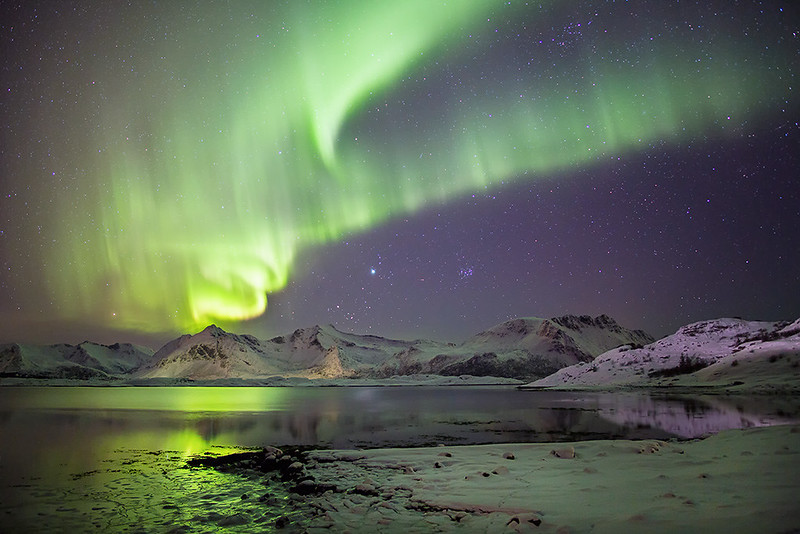
Here's an example using the above method with samyang 24 f.1.4

8551846284_7dd3723667_c.jpg
 
Last edited:
Small but important trick...if I'm photographing at night, I pre focus the lens at infinity and then put a piece of wide sticky tape so that the focusing ring can't accidentally be moved when it gets dark...and of course set the lens to "manual focus"!!

George.
 
Small but important trick...if I'm photographing at night, I pre focus the lens at infinity and then put a piece of wide sticky tape so that the focusing ring can't accidentally be moved when it gets dark...and of course set the lens to "manual focus"!!

George.

All well and good doing that but will not work for all situations especially if you've foreground interest, in fact I'll be honest it's very rare that I shoot at infinity in all the thousands of star scapes that I've shot
 
Yes, fair point, so you are using the hyperfocal point then?.......
 
Yes, fair point, so you are using the hyperfocal point then?.......

Yes for some photos but if I'm honest generally I'll aim to focus on either the foreground subject if the subject is particularly close say within 20 metres or I'll focus on the landscape in general as I've always held the believe a focus is always better with the stars marginally OOF that the landscape OOF that said most the time even though your at large apertures DoF isn't really a factor
 
For northern lights shots the foreground interest is usually far enough in the distance e.g mountain, lake, etc so infinity focus works fine.
 
Back
Top