Correcting Verticals, if not, why?

I think we need to draw the line between photographs taken with artistic intention and those taken for business purposes where a client is looking for something specific.

Personally I love wide angles and I position myself in such a way to get as much distortion as possible in some cases depending on the feel I am after. But if you're asked by a client to photograph a building then you need to bear in mind their requirements and be as anal as necessary about it.

Convergance is neither right or wrong - it's just another aspect that we need to be aware of so it cam be corrected/avoided if it isn't appropriate.
 
For what it's worth, much of my paid-for photography over the years, has been concerned with large warehouse installations of racking and shelving. It is not always possible to get perfect verticals given the circumstances and/or the layout of many such places. With this in mind I have always looked to Photoshop to adjust the verticals; for convergence, straightness and lens distortion (nobody likes the look of 'bendy racking'!). Just occasionally for effect (or because it just wasn't possible to do otherwise) I have deliberately shot so the verticals converge. Nevertheless, I have tried to make sure that it was obvious that this was the intended result.

And maybe, this is the crux of the matter. If the image looks just a little 'off' then it is not unreasonable to assume the convergence was unintentional and should be corrected. If there are strong converging verticals, then it is fair to assume it has been done for a purpose.

Anthony.
 
Okies Mate

Picture 1. Shot at 24mm
MG_8505.jpg
[/IMG]

Note the angles of the cranes. Verticals near the edge of the frame are the ones worst affected. Now, don't get me wrong, I don't mind cranes like the leaning tower but the MD of the construction company kind of likes them upright. Two ways of doing it.

One in photoshop. Filter-distort-lens distortion and correct the horizontal perspective until they are straight. Like this.

corrected.jpg
[/IMG]

Then you have to crop the image so you lose a bit!

Or..... you can borrow a tilt shift lens from the utterly fabulous Canon Bob and get this straight from camera.

2ADQ4812.jpg
[/IMG]

Ok so it's a crap sky. I'm shooting it about twice a week at the moment so hoping for some nice sunny or cloudy stuff but it gives you the idea.
 
....In film times, you wouldn't shoot wide angles, or try to straighten distortion at the print stage, you'd use a camera with movements and capture it straight.
You obviously went to a different school of thought to me.

Photography is subjective for one, and it's up to the viewer to discern whether they like a shot depending on certain elements, and that includes converging horizontals/verticals. Perspective is something that happens – things you see suffer from it – so why regard it as wrong just because there is technology available to correct it? Surely it's the choice of the photographer to decide whether they want to make the correction to suit the purposes of why they're shooting?

And as far as suggesting that in 'film times' (which haven't ended by the way) everyone was under pressure to correct – what a load of tosh! Never once did my college and university tutors (or the clients I shot for) ever question why I did or didn't correct verticals etc; it was my choice as a photographer. I used to shoot on 5x4 and would sometimes correct convergence but surely, suggesting that it is mandatory is not only pompous, but an amazingly limiting POV?

The above example is great to illustrate how to correct converging verticals but aside from that, the points on the horizon where they hit the edge of the frame would look better if they were in line, barrel distortion or no barrel distortion (or whatever you call it)...

Picture_18.jpg
 
Ali, the pics you've posted show exactly when and why you need to correct verticals in software. The building and cranes look crazy without it.

In film days you would have to find an elevated viewpoint to get the same result, and the chances are that would be impossible. (or use a t/s lens)
 
You obviously went to a different school of thought to me.

Photography is subjective for one, and it's up to the viewer to discern whether they like a shot depending on certain elements, and that includes converging horizontals/verticals. Perspective is something that happens – things you see suffer from it – so why regard it as wrong just because there is technology available to correct it? Surely it's the choice of the photographer to decide whether they want to make the correction to suit the purposes of why they're shooting?

I never said anything was wrong, what does technology have to do with anything ?

And as far as suggesting that in 'film times' (which haven't ended by the way) everyone was under pressure to correct – what a load of tosh! Never once did my college and university tutors (or the clients I shot for) ever question why I did or didn't correct verticals etc; it was my choice as a photographer. I used to shoot on 5x4 and would sometimes correct convergence but surely, suggesting that it is mandatory is not only pompous, but an amazingly limiting POV?

You feel you need to point out to ME that film times haven't ended..:lol:
Well no they haven't ended, I think I was probably referring to a time when film was the only option.
I never said anybody was under pressure to do anything, but there is expectation in certain areas even now.
I never said anything was mandatory and certainly nothing pompous, limiting maybe, but a long tele is kinda limiting for macro.
Are you reading somebody else's post or something :thinking: or is it the entire thread you think I'm responsible for.
 
How does one fix? Would be good to see more "before and after" examples, with a tutorial on what was done.

Does this apply to landscapes too?

Gary.

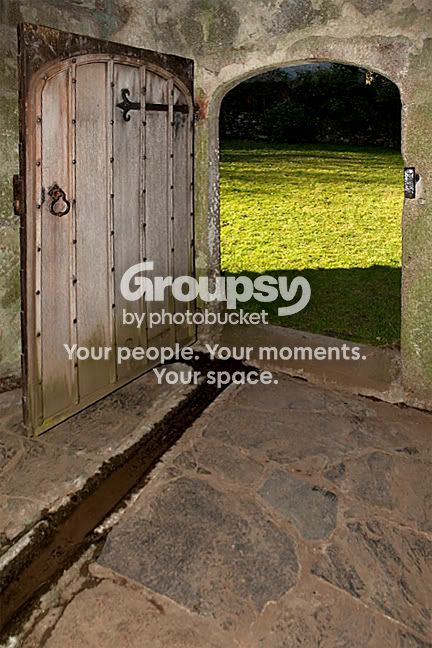
This example is a bit more extreme than I was actually meaning, but taken for the Spring challange from the legacy you started with your chairs challenge!

Original image as taken. Sigma 12-24 EX DG @ 24mm

springvert.jpg


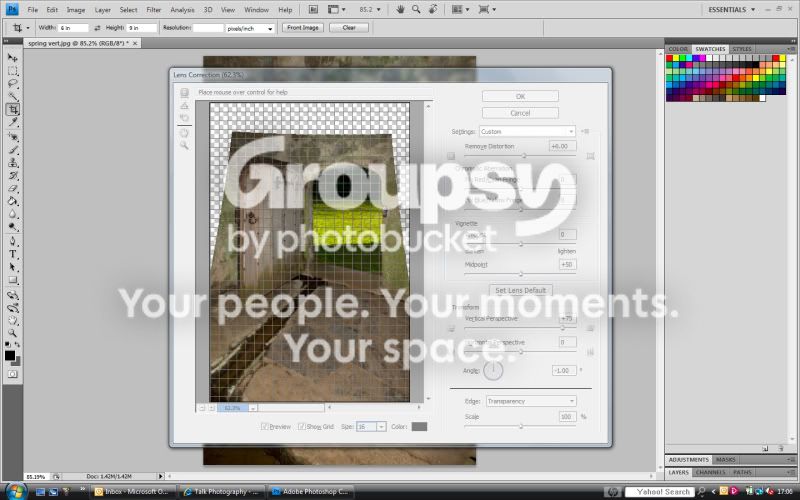
Corrected image below, using CS4 lens correction facility required: +6 Pincushion Distortion, -1.00 rotation and +75 Vertical Perspective

CS4dump.jpg


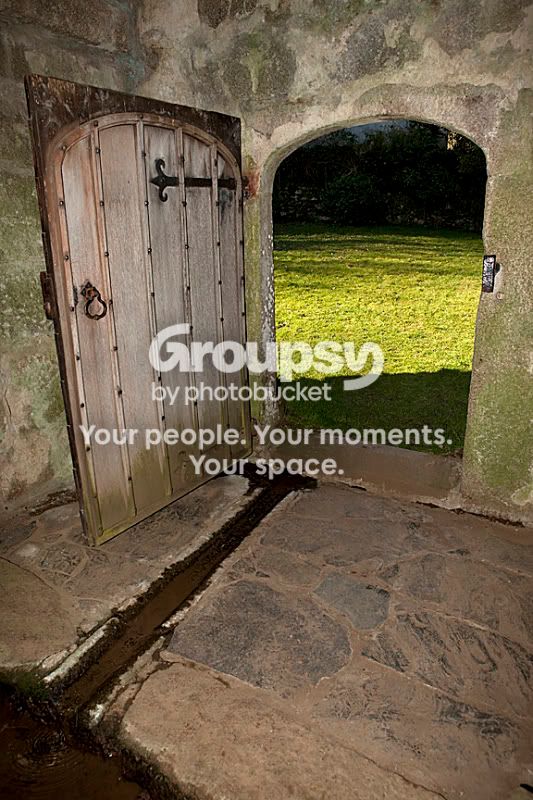
Then a crop, resize and sharpen and you have a corrected image.

springvertadj.jpg


As I said, this is a lot more extreme than you would usually do, and if you are planning on correcting the distortions then it is advisable to leave some space around the image to give you room to crop later!

Yes, you can do it for landscapes, but other than a correction of the horizon (where needed) I would not bother unless there were some verticals that were obviously tilting over.
 
I think that the main reason would be a lack of knowledge, either that this is possible to fix or how to do it.
 
I think that the main reason would be a lack of knowledge, either that this is possible to fix or how to do it.

I agree with this for sloped horizonatals, but people leave in distortion for effect
 
In film days you would have to find an elevated viewpoint to get the same result, and the chances are that would be impossible. (or use a t/s lens)

In film days (which still have not ended yet) an elevated position was not the only way to do it.

Either a tilt/shift lens or a view camera with movements will do it.

Basically, to get verticals vertical, the film (or sensor) must also be vertical. To get a view higher up the building you raise the lens. This lets the film see the lower part of the image the lens projects and as the lens projects the image upside down, this is the higher part of the building.


Steve.
 
The above example is great to illustrate how to correct converging verticals but aside from that, the points on the horizon where they hit the edge of the frame would look better if they were in line, barrel distortion or no barrel distortion (or whatever you call it)...

So you don't think that the building has actually been built on a bend in the river then?

Must be two pretty bad lenses to suffer such bad barrel distortion away from the edge of the frame :bang: perhaps AliB should let us know what they are so we can stay away from buying them. :lol:
 
In the cranes example it's a useful thing to be able to do because it is shot from a quayside. I can't move left, right or up and down.

Well, I can move up but the building faces the wrong way! :thinking:

The only way to change the perspective would be to use another crane.
I wonder if the boss will wear that? :D
 
Original image as taken. Sigma 12-24 EX DG @ 24mm

springvert.jpg
Well, I prefer the perspective of that original. The corrected, cropped, resized and sharpened one looks rather anodyne (to me) - and the original has a hint of craziness about it which, to me, suits the subject better.

(I'd consider shooting AliB's building and cranes from a distance with a telephoto rather than correct it too....;))
 
24-105mm f4 and 24mm Tilt Shift Ed. :)

And I can't shoot the building with a telephoto, there is no vantage point to shoot it from that does not include a load of derelict forground. It's the new Media City across from the Lowry in Manchester and being a regeneration zone, derelict forground is NOT what is required. Therefore there is only really one vantage point on the side of the quay at the Imperial War Museum.

I can shoot all day long from the other side, but from the water side, nada, ziltch....
 
24-105mm f4 and 24mm Tilt Shift Ed. :)

Ali, I was taking the mickey ;) the new building is obviously being built on the apex of a bend, yet someone wanted the horizon straightening :lol: And it would be highly unlikely that two L' lenses exhibited the sort of barrel distortion that was being suggested.
 
Ali, I was taking the mickey ;) the new building is obviously being built on the apex of a bend, yet someone wanted the horizon straightening :lol: And it would be highly unlikely that two L' lenses exhibited the sort of barrel distortion that was being suggested.

I know Ed, I'll get my tongue out of my cheek now. :) Promise. :naughty:
 
Joxby, sorry, had a bad day at work and I do have a habit of reading a lot into even the shortest of posts! I thought you were hinting that today it's a lazy person's first decision to just avoid even trying to correct convergence. I'd offer you some of my humble pie but I'm quite enjoying it... :)

As for the horizon comment, it not the horizon that should be straightened but the points at which they emerge from the edges of the frame. :)
 
S'ok Specialzz, you're never noncey for nothing :)

I think everyone will have their reasons, some of those will be lazy....probably..:lol:, some just like it, some don't notice it or are so used to seeing images this way they feel that's how they're meant to be.
Maybe they are maybe they aren't, it's not a judgement, thing is if we want straight shots of buildings or whatever, we have to work at it in some way or another, whether its camera movements, walking 5 miles for a tele shot or software correction.
If I'm honest, I've yet to see software correction as good as movement correction, minor barrel or pin cushion distortion gets sorted really well by most of the software apps, but if you want to move half a building 50 yards across a photo, its not surprising you see some softening/fuzzyness when pixel peeping.

I'll take a double slice of that pie, as long as I get the skin off the custard :D
 
This thread has been a real eye opener for me. I've never paid alot of attention to it but having a look back through some shots i can see some of mine have the excact problem (specifically buildings taken with the Sigma 10-20mm).
I've had a quick play and it's quick and easy to do and look much better :)
Thanks for the quick tutorial guys :thumbs:
 
Since the 1900’s to the 1930’s most hobbyist cameras had rising fronts, to enable photographs of tall objects with out distortion.

Since 1940’s most popular roll film cameras had become more basic and did not feature any movements.

All large format cameras with perhaps the exception of press and aerial cameras were provided with movements, both to correct distortions and or move the plane of focus as needed. This was taken to extremes with the development of the monorail camera.
Lenses for such cameras were provided with especially large image circles to accommodate this.

To day some students and “Art” photographers make a point of not taking advantage of these techniques, perhaps in the same way as some people have the need to hide their education or manners as a means of projecting their self image.

It is not that movements or their Computer equivalents must be used, but that for some purposes they are actually needed.

To not use a technique at the appropriate time, is akin to deliberately ignoring a customer’s brief, simply to demonstrate ones misplaced artistic superiority.
Or perhaps to use it as a cover for their lack of skill.
 
This thread has been a real eye opener for me. I've never paid alot of attention to it but having a look back through some shots i can see some of mine have the excact problem (specifically buildings taken with the Sigma 10-20mm).
I've had a quick play and it's quick and easy to do and look much better :)
Thanks for the quick tutorial guys :thumbs:

And therein lies one reason I love this place. :D

That and Specialman and Joxby having a love in moment.:naughty:
 
This thread has been a real eye opener for me. I've never paid alot of attention to it but having a look back through some shots i can see some of mine have the excact problem (specifically buildings taken with the Sigma 10-20mm).
I've had a quick play and it's quick and easy to do and look much better :)
Thanks for the quick tutorial guys :thumbs:

And there we have it. Good post Mangelwurzel :)
 
The result doesn't look right to me. It looks like you were looking "slightly down" upon the door (i.e. your eye level approximately level with the top of the doorframe) and therefore some perspective should be apparent.

You might try to "wriggle out of this" (no offence intended) by restating your assertion "this example is a bit more extreme than I was actually meaning", but it would've been better to have just got it right the first time and made the correction less severe. As it is the squareness of the door and the parallelness of the doorframe's verticals just look a bit unnatural to me and the foreground floor in front of the door has increased in apparent area distractingly.

I tend to like a bit of converging verticals because it's "arty" and a natural "organic" result of using wide-angle lenses. But then I am (as Terrywoodenpic would say) uneducated - joxby and AliB manage to make the point very well with their examples. Just looking at those makes one go "wow, what a difference!", whereas reading some of the comments in this thread makes me feel I'm being slated for "not knowing better".

Stroller.
 
In film days (which still have not ended yet) an elevated position was not the only way to do it.

Either a tilt/shift lens or a view camera with movements will do it.

Basically, to get verticals vertical, the film (or sensor) must also be vertical. To get a view higher up the building you raise the lens. This lets the film see the lower part of the image the lens projects and as the lens projects the image upside down, this is the higher part of the building.


Steve.

It's a good job I went for my tea when I did, otherwise I'd have been really, really cross that you didn't read all of my post.....
 
Ali, I was taking the mickey ;) the new building is obviously being built on the apex of a bend, yet someone wanted the horizon straightening :lol: And it would be highly unlikely that two L' lenses exhibited the sort of barrel distortion that was being suggested.

Ed,

Have you tried using the 24-105 zoom at 24mm?

L or not, you get barrel distortion.

If an image taken thus contains any obvious straight lines (eg the horizon), I put it through PTlens to correct it.
 
The result doesn't look right to me. It looks like you were looking "slightly down" upon the door (i.e. your eye level approximately level with the top of the doorframe) and therefore some perspective should be apparent.

You might try to "wriggle out of this" (no offence intended) by restating your assertion "this example is a bit more extreme than I was actually meaning", but it would've been better to have just got it right the first time and made the correction less severe. As it is the squareness of the door and the parallelness of the doorframe's verticals just look a bit unnatural to me and the foreground floor in front of the door has increased in apparent area distractingly.

I tend to like a bit of converging verticals because it's "arty" and a natural "organic" result of using wide-angle lenses. But then I am (as Terrywoodenpic would say) uneducated - joxby and AliB manage to make the point very well with their examples. Just looking at those makes one go "wow, what a difference!", whereas reading some of the comments in this thread makes me feel I'm being slated for "not knowing better".

Stroller.

Well, what can I say, wriggling about to start :p

I agree, the original image is better, but, had you not had the original to compare against the 'adjusted image' would have been acceptable. I only used that image to show how even quite extreme verticals could be corrected in Photoshop, I would not normally have corrected them in that instance as they were too extreme to start with, in fact, here is the image I entered into the challenge and I did not correct that even though it was less extreme.

As for you feeling slated for not knowing better, I do not think any comments were directed at anyone personally, and if only one person has learnt anything from this thread (and we do know that to be the case, and I suspect there are others too) then it has been a useful discussion. The real trick comes with knowing when converging verticals do require correcting and when they don't.

Photography is a subjective medium, 'one mans meat etc', and in my opinion, I believe there are certain instances when a minor amount of correction, makes a massive amount of difference to both the look and feel of an image.
 
As for you feeling slated for not knowing better, I do not think any comments were directed at anyone personally,
Didn't mean at all to single you out - quite the opposite. I think it's just an unintended "refraction" from the architectural pros on this thread, when they might not mean to apply such rigourous standards to amateurs (as they would to other pros).

... and if only one person has learnt anything from this thread (and we do know that to be the case, and I suspect there are others too) then it has been a useful discussion. The real trick comes with knowing when converging verticals do require correcting and when they don't.

Photography is a subjective medium, 'one mans meat etc', and in my opinion, I believe there are certain instances when a minor amount of correction, makes a massive amount of difference to both the look and feel of an image.
I agree entirely.

Stroller.
 
Ed,

Have you tried using the 24-105 zoom at 24mm?

L or not, you get barrel distortion.

If an image taken thus contains any obvious straight lines (eg the horizon), I put it through PTlens to correct it.

Yes, I had a 24-105L before I sold it to buy my 24-70L and agree you do get a little barrel distortion at 24mm, but nothing like that horizon on AliB's image.:lol:
 
People making corrections with PS distort may notice that when correcting an image with people in it, that they all become somewhat broad in the beam.

This is because unlike in camera correction with movements, it is not done around the lens axis.

To get over this you can shrink the width of the shot by half the amount of the original stretch. by using Transform distort again and pulling the sides in.
It can, with practice, be done in the original transform followed by a crop.

This expansion width wise always takes place, but is often unnoticeable.
For those who are not sure what I mean It can be see in EdBrays corrected Door shot,

The real geometric width of the doorway, is half way up the door way...
 
A good informative thread, and it's something that has always niggled me, especially when you see otherwise excellent images spoilt by sloping horizons, unnecessary converging verticals etc, particularly when it doesn't take much to put right.

It also annoys when you get a response like...'it doesn't bother me tbh' , I also got a comment when I mentioned that the horizon was curved (due to lens distortion/angling lens down) that the horizon is curved naturally so it was OK?
 
If you use a Program or plug in like PTLens any Horizon curvature due to lens distortion will be removed automatically. Of course if it was not level side to side, that must be corrected.
On distant seascapes There is often a slight natural curvature.
If one is anal about it curvature can quite easily be removed accurately with one of the Panoramic programs like PTAssembler. Or with less ease with PS.

Though I would not bother to remove "real" curvature myself.

No, if it were real, you would leave it. But I can't say I've ever noticed the actual curvature of the earth. May be I should look closer.....
 
I've got a shot somewhere that I took from the top of the Empire State building and you can actually see the curvature from up there. :)

On a nice clear crisp morning with no smog you can literally see for miles!
 
I've got a shot somewhere that I took from the top of the Empire State building and you can actually see the curvature from up there. :)

On a nice clear crisp morning with no smog you can literally see for miles!

Sorry Ali, but you've got to be a lot higher than that. The first picture showing curvature was taken by Alexander Dahl in 1933 from a balloon at about 36,000 ft. I've flown at 65,000 and it's not really obvious at that height until it's pointed out to you.

It's easy to think that a horizon and other things disappearing in to the distance to the sides are falling. I've seen it on many of my pictures, and knowing that the camera was level I've still tweaked them a bit.
 
Back
Top