Depth of field on prime versus zoom

Messages
51
Name
Garry
Edit My Images
Yes
I have a 50 1.8 prime and love the depth of field and blurry backgrounds it can create. Am contemplating a 35mm f2 prime (shooting DX) but wondered if a Sigma or Tamron 17-50 f2.8 (apart from the loss of a stop on the zoom) would create the same nice DoF.
Would say at 35mm f4 the pictures from both be the same?
 
same focal length
same subject distance
same apetuere
same camera

any lens you like

= same DOF
 
I may well be wrong on this, but as I understand it, the aperture blades in the lens has an effect on the blur in the OOF background, that may look different between the two lenses, but the DOF would be the same as Richard said.
 
So if i'm happy to use a 35mm prime at 2.8 or above then the zoom will give me the same results. Thats great news.

Thanks
 
jgs001 -

so whilst the DoF would be the same are you saying the nice blur in the background would differ?
 
jgs001 -

so whilst the DoF would be the same are you saying the nice blur in the background would differ?

yes, that's the simple answer.
Sorry I had to add the following. The quality of the blur can be so different that it might make you really think deeply about it. If you like the background blurs do not underestimate the way each lens produces it. They differ enough to be a major point on your decision on lens selection
 
Last edited:
Check your depth of field with this calculator http://www.dofmaster.com/dofjs.html

Bokeh is a complicated subject (and one which which a lot of folks differ) but there are two major aspects to it - one is the f/number obviously, and the other is field of view.

Longer lenses have a narrower field of view which means there is a lot less background visible behind the main subject. The background becomes relatively bigger, which tends to mean out of focus shapes are bigger and simpler, and are therefore less cluttered and distracting. They look better.

I think those two factors are more significant than any relative details of different lens constructions.
 
The zoom wont be as good as the prime but in the case of the Tamron it will do the job admirably.
I have one on my canon and whilst I would never see it as a replacement for my 50mm F1.8 it doe's cover a need I had at the wider angle and closer focusing end of things.

It would make a great replacement for your 18-135mm, though your lens collection seems to have a lot of overlap in focal lengths whilst retaining similar speeds, so you could use the 18-200 to cover the missing 50-135 range.
 
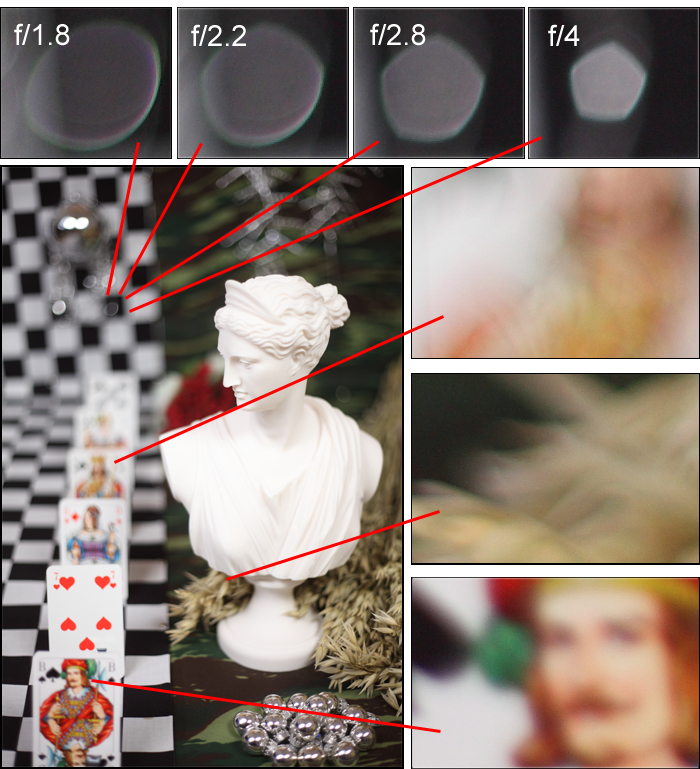
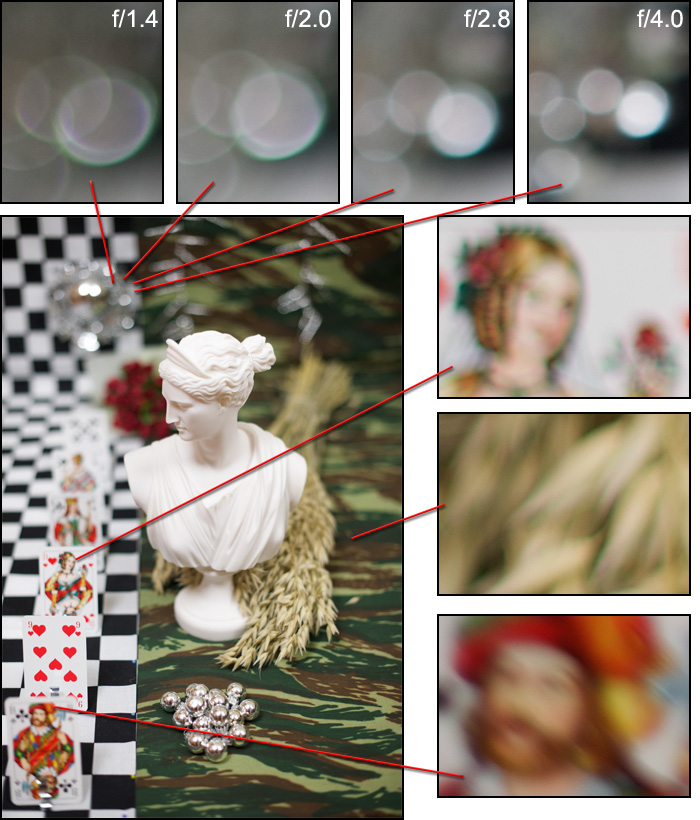
This site shows you the different Bokeh for some lens.


Canon 50mm f1.8 - 5 (non-circular) blades

bokeh.jpg


Nikon 50mm f1.4 - 9 (rounded) blades - @f2.8 + f4 is a lot less angular.

bokeh.jpg
 
Last edited:
I have a 50 1.8 prime and love the depth of field and blurry backgrounds it can create. Am contemplating a 35mm f2 prime (shooting DX) but wondered if a Sigma or Tamron 17-50 f2.8 (apart from the loss of a stop on the zoom) would create the same nice DoF.
Would say at 35mm f4 the pictures from both be the same?

The f number is what decides the depth of field (before you say anything Hoppy, shut up) so with both at f4 and at the same focal length, they'd be (essentially) the same. But for the maximum effect you want to be at f2 or less, really which obviously isn't possible with the f2.8 lenses. At f4 the effect just isn't particularly strong - all the background would be pretty much recognisable, if not exactly sharply focused.
 
Further to my post above, here's a quick demo of what focal length does to bokeh. Two pictures, both at f/4, one shot at 70mm and the other with the subject framed the same, but moving back a few feet at 200mm.

Same lens, Canon 70-200L 4 IS. Note that the depth of field is the same in both pics, because the main subject is the same size. It's the narrower field of view that has created the effect, due to the longer lens being used at a greater distance.

70mm f/4
IMG_3410.jpg


200mm f/4
IMG_3411.jpg
 
Last edited:
The f number is what decides the depth of field (before you say anything Hoppy, shut up) so with both at f4 and at the same focal length, they'd be (essentially) the same. But for the maximum effect you want to be at f2 or less, really which obviously isn't possible with the f2.8 lenses. At f4 the effect just isn't particularly strong - all the background would be pretty much recognisable, if not exactly sharply focused.

its a combination of apeture, focal length and shooting distance. As demonstrated in the post above, you can clearly have a shallow DOF af F4, if the shooting distance and the focal length are right
 
Back
Top