


- Messages
- 9,438
- Name
- Andy
- Edit My Images
- Yes
No, not another question  , more by way of a proof how all this works.
Let's take 2 cameras (one full frame, the other APS-C), 2 lenses (a 50mm and 80mm so that one that has a focal length of 1.6x the other) and some pictures. I'm not sure which combination of camera/lens/subject distance will produce the best results, so I'm going to take 4 pictures.
Because I'm a perfect 'tog, I don't need to do any post processing and can just send them for print them out directly. I'm not really sure how big I want my final print to be, so I print them out at a variety of sizes (6"x4", 9"x6", 12"x8" 15"x10" and 18"x12"). I'm also interested in how sharp the pictures appear, so I'm going to view them all from the same distance.
When I get them back and look at them, I'm shocked that different photos have different depths of field. How can that be - I've taken "the same" photo in 3 of the cases, but the depths of field are different. I'm confused.... so I put together a small spreadsheet that takes the equations from DoFMaster here: http://dofmaster.com/equations.html and plugs the values in that I have used.
Here is the summary of those results:
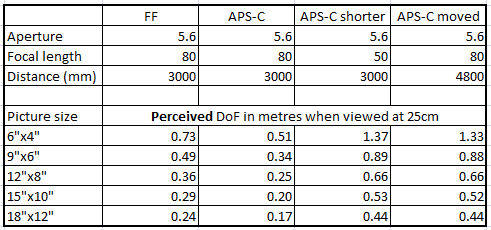
What can we see from these results? Well:
Can we once and for all put these arguments to bed.
Yes, I was bored
, more by way of a proof how all this works. Let's take 2 cameras (one full frame, the other APS-C), 2 lenses (a 50mm and 80mm so that one that has a focal length of 1.6x the other) and some pictures. I'm not sure which combination of camera/lens/subject distance will produce the best results, so I'm going to take 4 pictures.
- The first is with the full frame camera with an 80mm lens. My subject distance is 3metres (3000mm) and for artistic reasons I'm going to use f/5.6. This combination of distance and lens gets my subject to fill the frame nicely.
- The second photo I take is with the APS-C from the same position and with the same lens. OK, the field of view is smaller so my subject is bigger than able to be captured by the APS-C camera, but it's set up now so I'll take the picture.
- The third photo is with the 50mm lens on the APS-C body so I now get the same field of view as I did with the full frame and 80mm combination.
- The fourth photo I decide to take with the 80mm lens on the APS-C body as it's my favourite, so I move to 4.8m away to get a slightly different photo perspective but now my subject still fills the frame.
Because I'm a perfect 'tog
, I don't need to do any post processing and can just send them for print them out directly. I'm not really sure how big I want my final print to be, so I print them out at a variety of sizes (6"x4", 9"x6", 12"x8" 15"x10" and 18"x12"). I'm also interested in how sharp the pictures appear, so I'm going to view them all from the same distance.When I get them back and look at them, I'm shocked that different photos have different depths of field. How can that be - I've taken "the same" photo in 3 of the cases, but the depths of field are different. I'm confused.... so I put together a small spreadsheet that takes the equations from DoFMaster here: http://dofmaster.com/equations.html and plugs the values in that I have used.
Here is the summary of those results:
What can we see from these results? Well:
- If you print the same image bigger and you view it from the same distance, the depth of field shrinks. This makes sense as you are zooming into the picture - you're magnifying the data more.
- For the same lens, aperture and subject distance, and for a given print size the smaller sensor camera produces less depth of field. This is also sensible as to get a given print size from a smaller sensor, you need to magnify it more than that coming from a larger sensor to get the picture printed.
- For the same picture (i.e. same field of view) on the same camera, it doesn't really matter whether you trade focal length for distance, the depth of field is the same. However, as you move further away, the depth of field shrinks as a proportion of the subject distance (that is, the depth of field is the "same" but you are further away). This might help with subject/background isolation for example.
- For the same picture (i.e. same field of view obtained either by use of a different lens or different subject distance) printed at the same size but taken with different sensor sizes, the larger the sensor, the less the depth of field it has.
Can we once and for all put these arguments to bed.
- Depth of field is only relevant when you print an image. You can see this is the case because the print size is used in the depth of field calculations (you may need to look at the definition of Circle of Confusion here: http://en.wikipedia.org/wiki/Acceptable_circle_of_confusion to see that).
- If you have a particular print size in mind, the larger the sensor, the less perceived depth of field there will be in the print for "the same" photo (i.e. if you compensate for the smaller sensor with a shorter lens or moving further from the object.
- If you take a picture of an object from the same place with the same lens but on different format cameras, the smaller sensor will have less depth of field. This is sensible since you have to enlarge the image from the smaller sensor more to get a given print size. The pictures will have very different fields of view though.
Yes, I was bored

 So you'll be glad to know that I'll stay well away from this thread


 ). I can look at a 10in print from a normal distance and things don't look quite as sharp as I'd like them to, according to the international standards for DoF. The average PC monitor is capable of more than that, and the standard for magazine reproduction of 300dpi is more than double 0.2mm at around 0.08mm.
