Many thanks for raising these important points

"Diffraction limitation is determined fundamentally by f/number, not by the physical diameter of the aperture alone."
AFAIK the f number is a thing to keep the exposure constant between focal lengths and it does not give you the aperture diameter in mm on its own, you also need the focal length to determine the aperture size in mm. The aperture in mm is the focal length / f No. and this got me thinking...
On MFT with x2 crop but keeping the same FoV... Suppose I have a 10mm lens and just to keep the math simple I use it at f10 giving me an aperture of 1mm. I also have a 100mm lens and I used that at f10 giving me an aperture of 10mm. The much smaller apertures compared to FF are I suppose why smaller systems get into diffraction sooner when we use lenses to give us the same sort of FoV we get on FF, rather than for example using a 50mm lens on everything. Even if we did use the same lens on everything with smaller systems I'd expect the crop / greater magnification to also show diffraction more easily than a larger format image undergoing less magnification?
It's (nearly) all about the f/number, the higher it is, the greater the diffraction limitation. f/number, as you rightly say, is just a mathematical formula that's useful for exposure, it doesn't relate to the physical size of the actual or effective aperture of the lens (whether we use the term actual aperture or effective aperture depends on whether we speak English or American

) Personally, I use effective aperture a lot, as a basis for calculating depth of field, simply because on any given format/sensor size I know that the dof will be the same with, say, a 10mm effective aperture, regardless of F (focal length of lens), but that's just me and they way that I personally work.
Another factor is the quality of lens construction, in that a 9-bladed iris diaphragm is much closer to being round than a 5-bladed one, therefore the light will scatter more with a less round iris diaphragm than with one that has fewer sharp edges.
And yes, the greater magnification of a small image does show diffraction limitation more.
Generally I don't tend to worry too much about diffraction, if I want deeper depth I'll go to fxx and hope that the sliders help with any contrast and softness issues. If I think there is going to be a big hit to IQ I might just take a wider aperture shot too, it wont be the look I was going for but it'll be there just in case the smaller aperture shot is a bit meh.
I agree. It's something to be aware of, but not to worry about, or at least not to worry too much about - It's always better to get a shot with reduced image quality than to get no shot at all. Diffraction limitation can reduce image quality, which is why we need to take it on board, but it isn't normally so bad that we have to view it as an unbreakable rule. I frequently take shots on a full-frame camera at f/32, just to get the whole thing in acceptably sharp focus, even though I should limit myself to f/16.
But, diffraction limitation can be a real problem with very small formats, e.g. micro two-thirds or smaller, see this illustration below
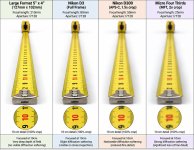
Now, we don't normally have access to f/128, except with large format lenses, but the detail crops at the bottom show what we'd get, in terms of diffraction limitation, if we were to use f/128 on progressively smaller image formats.




