dpreview iso comparison

Yeah but, the noise level is going to be the same on better composed shots.

I just never go above 6400. Never really a need to.
 
Surely you need controlled conditions to test? i think the dpreview is the most useful comparison i've seen, beats dxo's rather vague number where noise starts being visible, which is massively subjective where noise is visible at any iso if you're are peeping hard enough. Here you can see with your own eyes and make your own decision. No one is ever going to be able to test all these cameras themselves before buying.
 
Cagey75 said:
Yeah but, the noise level is going to be the same on better composed shots.

I just never go above 6400. Never really a need to.

And its useable.

With respect: people that say "I never go above xxxx ISO" are likely to be more concerned about the microscopic detail than the image as a whole.

Base ISO are your ultra sharp detailed images, the higher you go the more you need to be thinking about recovery and how the image looks without zooming in to see if it still looks sharp and clean.

Noise is so easy to fix, the problem older cameras had was keeping the detail at higher ISOs.

Noise doesn't make a bad image, if exposed well and controlled in PP there is no reason to say "I don't shoot at high ISO" ...if it's good enough for the makers it should be good enough for us :)
 
rjbell said:
Surely you need controlled conditions to test? i think the dpreview is the most useful comparison i've seen, beats dxo's rather vague number where noise starts being visible, which is massively subjective where noise is visible at any iso if you're are peeping hard enough. Here you can see with your own eyes and make your own decision. No one is ever going to be able to test all these cameras themselves before buying.

Welcome back Robert, I've been fighting this battle alone! Lol
 
Yeah but, the noise level is going to be the same on better composed shots.
I just never go above 6400. Never really a need to.

Here's a classic example of when ISO 12800 is the only way of getting the shot.
http://www.talkphotography.co.uk/forums/showpost.php?p=4980805&postcount=1314
As stated in that post, it prints superbly at A3+ despite the pixel peeping experience being a bit rubbish..

I've done my own tests and I find ISO 12800 is the highest I can go on the 5DIII in order to print to A3 with accurate colours.
On my old 5DII using the same criteria, the highest is ISO 3200.
I will go higher if there is no alternative, but only if I really need to.

Interesting stuff in this thread :thumbs:
I'm watching with interest.
 
And its useable.

With respect: people that say "I never go above xxxx ISO" are likely to be more concerned about the microscopic detail than the image as a whole.

Base ISO are your ultra sharp detailed images, the higher you go the more you need to be thinking about recovery and how the image looks without zooming in to see if it still looks sharp and clean.

Noise is so easy to fix, the problem older cameras had was keeping the detail at higher ISOs.

Noise doesn't make a bad image, if exposed well and controlled in PP there is no reason to say "I don't shoot at high ISO" ...if it's good enough for the makers it should be good enough for us :)

Seriously, you think that's usable? Usable for what? All that is usable for is recording an event that must be recorded, but for artistic, commercial or any other reason that requires something pleasing it is down right awful quality.

"If it's good enough for the makers..." seems like a silly argument. The makers have to sell cameras and have to say it'll shoot at xxxx iso, but that doesn't mean we as photographers have to use it when we know that it produces god awful images.
 
Last edited:
The23rdman said:
Seriously, you think that's usable? Usable for what? All that is usable for is recording an event that must be recorded, but for artistic, commercial or any other reason that requires something pleasing it is down right awful quality.

"If it's good enough for the makers..." seems like a silly argument. The makers have to sell cameras and have to say it'll shoot at xxxx iso, but that doesn't mean we as photographers have to use it when we know that it produces god awful images.

Good enough for me to use at gigs for example - I've shot lots of images at 12800 and I bet you wouldn't be able to puck one out.

You don't have to sell every single image you take either. Sometimes its nice just to get it in the first place.

This seems to be turning into a war between the image takers and the pixel peepers....
 
I understand getting a shot at a gig for sure. I guess it comes down to the semantics of usable. Usable to get a shot for yourself is different.

Not looking for a war despite your cheap jibe. :)
 
I don't really go over 3200 on my d5100, 6400 occasionally.
 
I think the conclusion is this....

We each have our own idea of what is acceptable and what isn't.

Some are concerned with clean images, others, getting a shot is more important.

I'd rather have something that I can either work on it bin later than not to have anything at all...but that's just me and I understand everone has their own views on what’s acceptable.
 
I suppose if 12,800 (or whatever high ISO you use) gets you a money-making shot of some celebrity's vajazzle as they step out of a taxi, then it's proving its worth. But there's an upper limit that is deemed acceptable and as already pointed out, that differs from person to person.

I never had a problem shooting at ISO 800 and 1600 on my D2x but many people thought the upper limit on that camera was 400. Again, it's down to how it suits the individual's view of things...

Personally, I'd take my D7000 to 3200 for general (work) shooting and that's it - any higher and the rubbish paper stock we use will just amplify the deficiencies in the image. For displaying on web then maybe I'd go higher.
 
Noise is so easy to fix, the problem older cameras had was keeping the detail at higher ISOs.

and dynamic range as well. But those photos have lost detail. Look nat the numbers and symbols on the bottom of the phone box. No matter how aggresive or good your NR you won't get that back.
 
boyfalldown said:
and dynamic range as well. But those photos have lost detail. Look nat the numbers and symbols on the bottom of the phone box. No matter how aggresive or good your NR you won't get that back.

Of course it will lose detail, you're expecting way too much to stand 5 meters away from very small text and to have it all in tact at 12800ISO when zoomed in to 100%.

The fact that its even readable is credit to the camera.
 
Of course it will lose detail, you're expecting way too much to stand 5 meters away from very small text and to have it all in tact at 12800ISO when zoomed in to 100%.

The fact that its even readable is credit to the camera.

so you mean you'd expect the level of detail to be the same if the same shot was taken at iso 200
 
DPReview comparometer is a useful guide - but seems quite capable of producing odd results.
One of the most glaring bloopers I've spotted is the inexplicable X10 RAW results http://www.dpreview.com/reviews/fujifilm-x10/19
ISO 100 looks shockingly bad and shows none of the mosaic pattern us X10 owners expect when pixel peeping.
Now go to ISO 200 - look familiar?
and ISO 400 - spotted any difference?
And ISO 800 looks like it has more fine detail than ISO 100 - eh? WTF! :thinking:

My guess is that the ISO 100 to 400 images are JPEG, not RAW which would account for the lack of mosaic.
And the X10 was set to 12 Mp and Auto DR, resulting in DR 400% for this image and hence no difference in the noise levels between ISO 100 and ISO 400 (ISO 400 is the lowest ISO for DR 400%).

One thing is for sure - the X10 is a quantum leap better than the dpreview comparometer would ever have you believe.

I wish dpreview would do is publish which lens and aperture was used along with the EXIF for each image.
That would answer quite a few questions!
This has really put me off the x10 from the images on dpreview they look awful. Both the x10 and xpro look really soft which makes me think there has been some sort of noise reduction applied.
 
rjbell said:
This has really put me off the x10 from the images on dpreview they look awful. Both the x10 and xpro look really soft which makes me think there has been some sort of noise reduction applied.

They aren't soft.

The lens Fuji had our on the x10 is seriously good. I had a portrait shoot the other day and my DSLR was being fixed so this came instead :)

Sharpness wise: as good as I would expect from my DSLR.
 
They aren't soft.

The lens Fuji had our on the x10 is seriously good. I had a portrait shoot the other day and my DSLR was being fixed so this came instead :)

Sharpness wise: as good as I would expect from my DSLR.
Whats the widest aperture at 50mm equiv?
 
And its useable.

With respect: people that say "I never go above xxxx ISO" are likely to be more concerned about the microscopic detail than the image as a whole.


Eh, no, I juts don't like using non-native ISO settings. The images you're posting show noise even viewed small. I don't like noise. Unless it suits the images, like a gritty gig B&W or whatever.

You really don't like anyone differing from you p.o.v do you?
 
Cagey75 said:
Eh, no, I juts don't like using non-native ISO settings. The images you're posting show noise even viewed small. I don't like noise. Unless it suits the images, like a gritty gig B&W or whatever.

You really don't like anyone differing from you p.o.v do you?

More of a case of do I need to care of people differ with my opinion on this and in this case, my opinion is that noise can be cleaned up - there is enough detail retained to keep the image (depending on what it's used for - I wouldn't be selling. portraiture at this IS).

I understand some people think that noise in a picture is the end of the world but I don't, that's my opinion and in my opinion, you can clear up 25600 on the D7000 to look decent.
 
More of a case of you just feel compelled to nit pick everyone else's points I think ;)

I was only giving mine. You were right in to say why it didn't suit you.
 
i was shooting dinner with friends in a dimly lit restaurant last week without flash, at ISO 3200 to 6400 and all shots look fantastic, no need for noise reduction or much editing. all shots look miles better than friends' phone cameras (not much competition, i know) and a few ended up as their FB profile pictures.

in fact, i've test printed 5D2 photos for ISO 6400 and 12800 RAW out of the camera without applying PP noise reduction. at standard 6x4, only 12800 has very slight noise on it, still perfectly usable. the key to test shots is to shoot at night, sensor noise only really appears in dark colours, shooting in daylight for purpose of comparison don't really make any sense.


but then, having said all those, i would still try my best to lower ISO. there is still large loss of dynamic range and colours when raising ISO. for example, when shooting landscape, i would only use 100 or 160 at a stretch.

the key is understanding what you want out of your camera, ability to shoot blur-less in low light? or ability to reproduce dynamic range? many times you HAVE to use high ISO to get usable shots, just got to be aware of the short comings.


the DPreview ISO comparison is great, i often use it to compare new cameras against my current ones. but no matter how high the ISO can be pushed on newer cameras, the dynamic range and colour sensitivity all decrease linearly. only thing high ISO allows is ability to get a picture in extreme conditions.
 
Cagey75 said:
More of a case of you just feel compelled to nit pick everyone else's points I think ;)

I was only giving mine. You were right in to say why it didn't suit you.

Nit pick...? I don't really see anything to be nit picked in this thread.

I wrote that days ago only for you to come back with an answer after the debate was dead an buried....
 
you use the setting that get you the shot you require be it iso 200 or 12800, I have printed shots at 12800 and printed at 18x12 and noise was not there, but i have also printed at 18x12 with iso 12800 where i have needed to convert to black and white as i found the noise for the type of shot was to much and distracted from the picture..

At the end of the day you do what you can with the gear you got that, and if you make money thats a bonus.
 
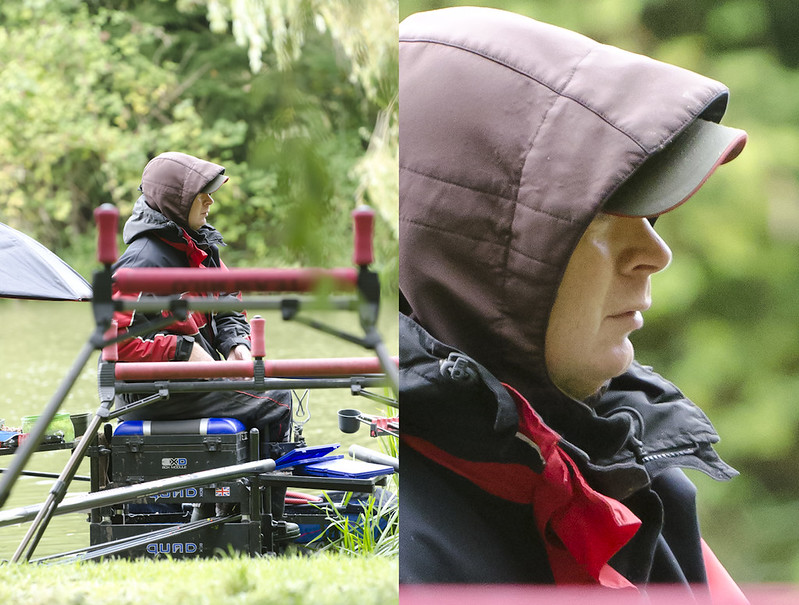
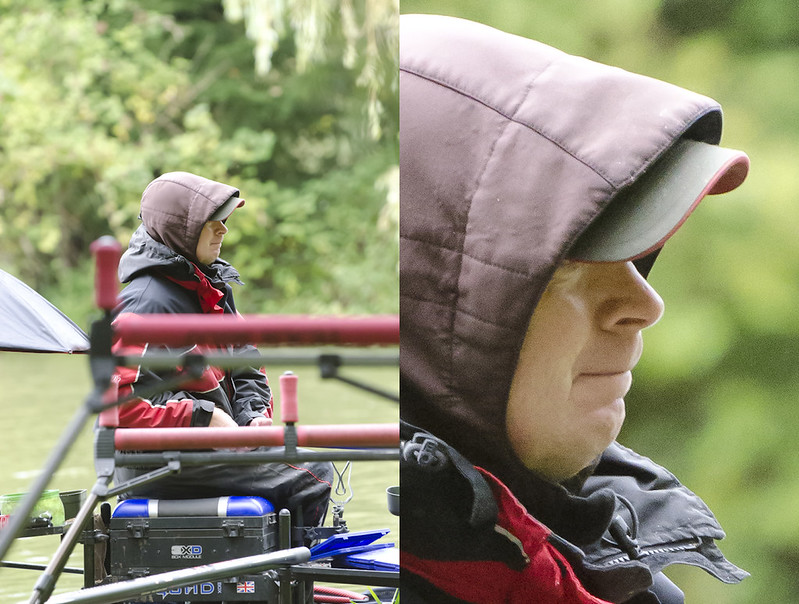
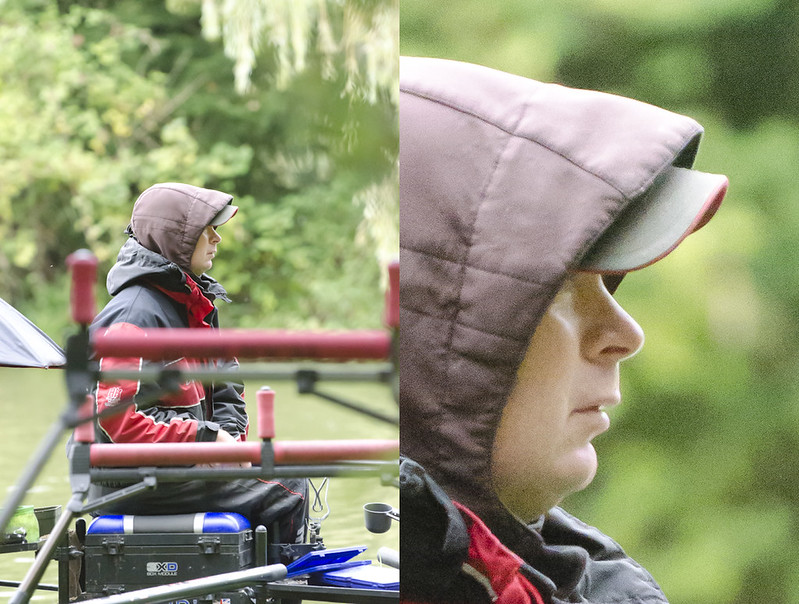
So here's a bit of a 'test' I did today while out on a shoot. I was shooting mainly at ISO 800 but ended up going up to 1600, which led me to see just how good the D7000 is at its higher settings.

I believe the exposure is about right so there's been no recovery or levels adjustment in any of the images, just a '50' sharpen and '50' luminance NR in LR3, basic adjustments that I feel are the two that will be most used by LR users. The images haven't had any WB change and were exported as they appeared o import. I think the setting the camera was on was 'standard', although these are raw (.NEF) files so not sure how LR3 translates that in-camera settings.

Two of the images were shot at 200mm but one (ISO 3200 shot) was taken at 160mm for some reason - I was laid on my stomach at the time in inches of mud so I think I might have been a little preoccupied :lol:

Each shot was taken using an off-centre AF point, roughly on the contrasty area where the side of his hood and his face meet, an area that's sure to get good AF.

Anyway, I've put the full image and a crop (the same size crop in each frame) to give a hint at what the noise levels are like and how the image properties are altered by the increase in ISO.

ISO 3200

ISO 3200 by Pat MacInnes, on Flickr

ISO 6400

ISO 6400 by Pat MacInnes, on Flickr

ISO 12,800 (Hi1)

ISO 12,800 by Pat MacInnes, on Flickr

If you want to have a look at larger version then click through to the original Flickr image :)

Personally, I'm happy with all three, although I can quite well image that there's little adjustment on the 12,800 shot (and possibly the 6400 shot) if the exposure is not nailed. This is something I'm going to try tomorrow with a series of shots at varying under and over-exposure levels.

The 3200 shot is excellent IMO and retains some really nice detail, contrast and overall saturation. TBH, the other two shots aren't bad either, although there's a definite drop on saturation and the darker tones start to look a bit thin and the blacks are muddy and lack detail.
 
Last edited:
The real challenge here is to expose well indoors as there are people here that believe you may not be as happy with the results.

So now you know you're OK with outdoors at 12800 take a few indoors and report back! :-)

Its not indoors vs outdoors. If you push the sensor - lots of shadows, dark areas etc etc you'll get a far noisier image
 
Lol you folks are killing me.

I thought we already concluded that indoor scenes are usually quite high on the dynamic range side!?

And its a trick if the eye.

There is the same noise at 12800 in any scene at any exposure, its how you disguise the noise the makes it appear useable it not.

If you take a look at a HDR scene at high ISO the shadows will "appear" more noisy but they have just as much as the highlights...you just won't notice them.

Ergo: you know to apply more NR to shadows and not as much for highlights...
 
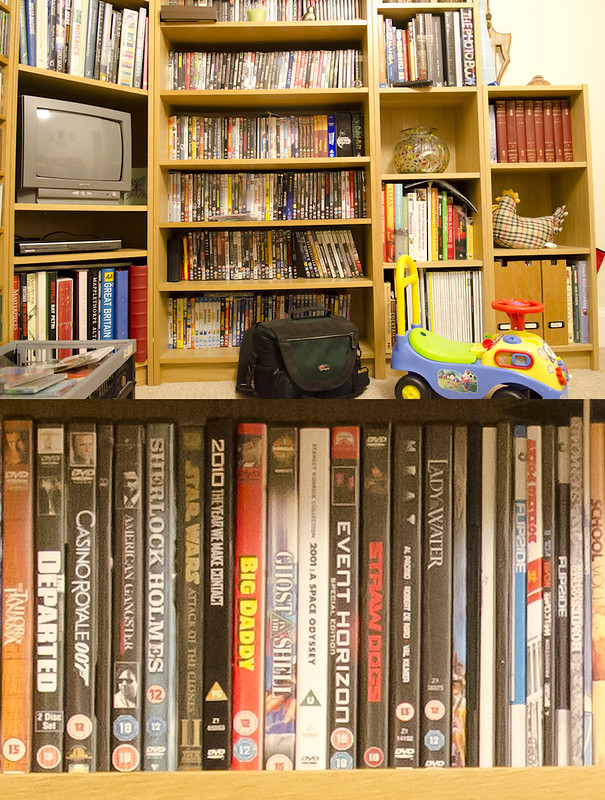
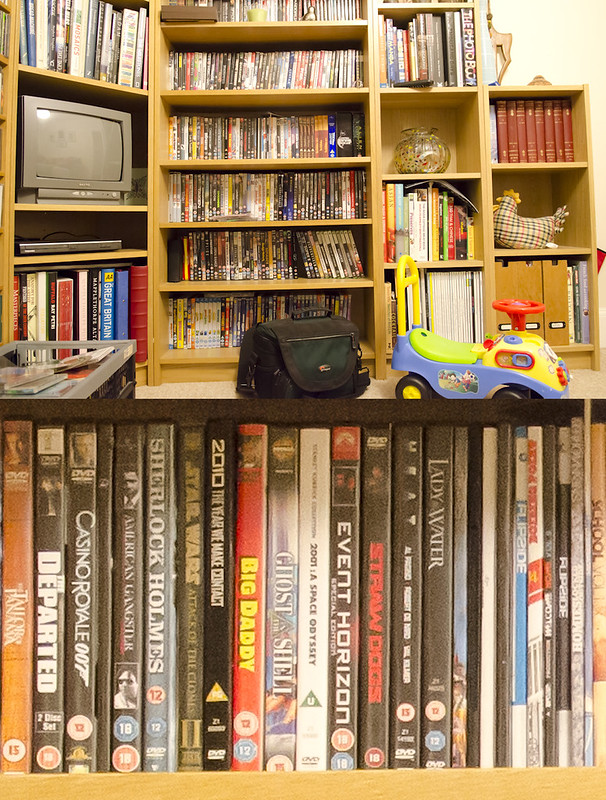
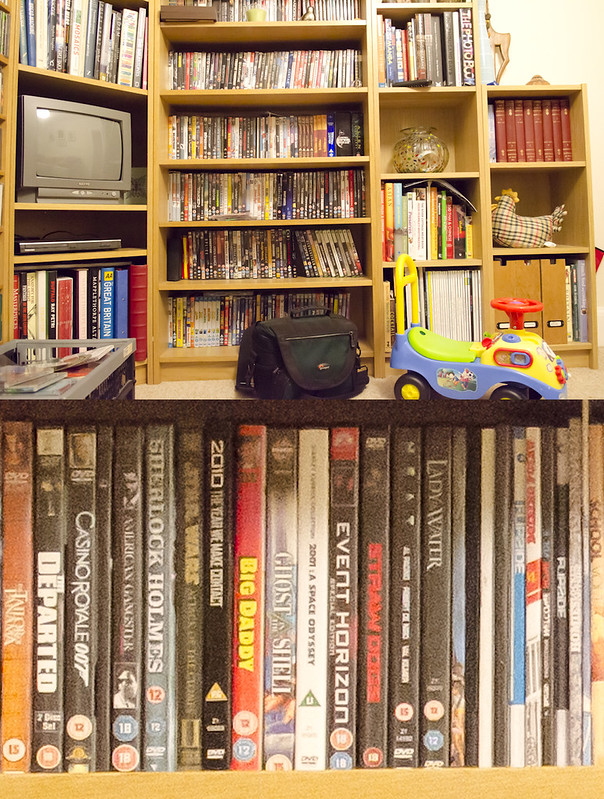
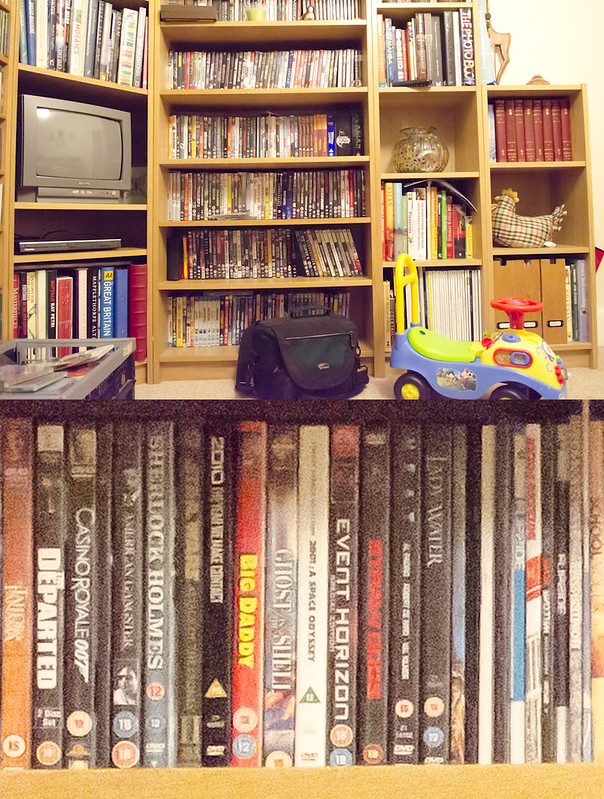
So here are some indoor shots.

The room is pretty dim - lit by one of those round paper lampshade that cost a few quid from IKEA with a 40W bulb inside.

I've left my tripod at the lake (doh!!) so the camera was rested on a sheet of anti-slip material and propped up on the lens hood. Focus was set to manual after using AF to focus on the 3rd row up of DVDs.

WB as set to the default 'tungsten' setting on the D7000.

Exposure was in Av mode with +0.3 exposure compensation, as that was what I deemed the 'correct' exposure (or as close as) and I used mirror-lockup to avoid camera shake as much as possible.

Imported into LR 'as shot' and with '50' sharpening and '50' luminance NR, as a standard amount across all four images.

Top shot on each image is the full sensor image, showing the overall contrast levels and colour range. The bottom shot is a crop of the less embarrassing DVDs in my collection :lol:

ISO 3200

ISO 3200 by Pat MacInnes, on Flickr

ISO 6400

ISO 6400 by Pat MacInnes, on Flickr

ISO 12,800 (hi1)

ISO 12,800 by Pat MacInnes, on Flickr

ISO 25,600 (hi2)

ISO 25,600 by Pat MacInnes, on Flickr

The Hi2 shot is pretty good for such a high ISO - in areas anyway - but the colour shift to magenta in the deep shadow areas is pretty grotesque. The other three shots don't show any colour shift in anywhere near that amount and are clearly useable 'as is', although there's obviously some WB tweaking required that will in turn affect the colour palette of the image.

Some of DVD titles are getting lost at ISO 12,800 and some become illegible at 25,800 (to be expected) although I was surprised at the larger fonts being legible at the highest ISO setting.

And yes, there is a lot of horrendous tat in my house :)
 
Last edited:
From point of views, in that indoor environment, the 3200 and 6400 (and probably the 12,800) just don't provide fast enough shutter speeds for zoom lens use for family snaps... with a f/1.8 lens then there is obviously a bit more of a shutter speed ceiling but then the widest most people will go will be a 35mm f/1.8, or maybe a f/1.4 Sigma 30mm.

I believe this concludes that flash is a Godsend.... ;)
 
Back
Top