Ebay gimbal heads

For £70 and if your on a budget/not to bothered about the quality then why not. I had a version of this years ago and it was OK, you could tell it was cheap but it did the job for a while.
 
I bought the same model from amazon. It's solidly built (though weighs less than the wimberley). It comes with a 2.5 in arca plate which was plenty big enough for the fore and aft movement necessary to balance my lens/camera combo. I had heard reports that the panning movement was "lumpy" but that certainly was not the case with mine.

The only possible negative is that the locking knob for the tilting axis also releases the whole bearing if loosened far enough. There is no problem if released by 1/4 to 1/2 turn. However 2 or 3 revolutions introduces some lateral play in the bearing. This would only become annoying if there was "creep" on the locking knob in use. So far (2/3 months) there hasn't been any.

The adjustment knobs are rubberised and can be operated with gloves on. I doubt if the bearings are sealed and so far the head has not been subject getting wet.

It's the only gimbal head of which I've had experience but I must say it's a joy to use when compared to the ball head I was using.

Incidentally there's a compass in the tilt locking knob (i.e.vertical). Very useful !!!
 
For £70 and if your on a budget/not to bothered about the quality then why not. I had a version of this years ago and it was OK, you could tell it was cheap but it did the job for a while.

+1 on that

however if you are planning on putting a 600mm f4 and a D4 on it, it might well be worth paying a little bit more. ;)
 
It certainly looks better than the Indian ones that did the rounds a few months back. People found those okay so I can't see this being THAT bad.
 
Think about the Manfrotto 393 as another alternative. I've personally owned one and they're brilliant for the price. Much better built than the copy Wimberleys

The fact that there's no vertical adjustment mechanism would make it a no-no for me. Having the up/down rotational axis going through the centre of mass is essential to total elimination of droop. With a properly balanced Wimberley, or one of its semi-decent clones, you can move the lens with just the slightest pressure of a little finger.

I used to own one of the Indian knock-offs and that was certainly usable, if not quite as smooth when panning as the real thing. My Black Widow is virtually indistinguishable from the Wimberly.
 
Once you set up the balance of a 393 you dont get droop, and also you can move the gear using finger tip.

When did you try the 393 ? Maybe you hadnt set it up right ?
 
Thanks for the feedback lads.

I did think about the 393 a while back, but then the price shot up.
 
The thing I don't get about items like this is that the manufacturer never spend another £5 rounding it off and polishing it up.

It is like they get so far then give up on purpose and make it look and feel cheap. For a few extra quid they would be able to turn an okay product into a pretty good alternative to the overpriced "real deal". They are 95% there already.

The compass embedded in the tilt tension knob just has to go...utterly pointless. They could use the £5 mentioned to put in some decent bearings and decent knobs.


Having said that, £69 isn't an awful lot to see if a gimbal head is for you.
 
Once you set up the balance of a 393 you dont get droop

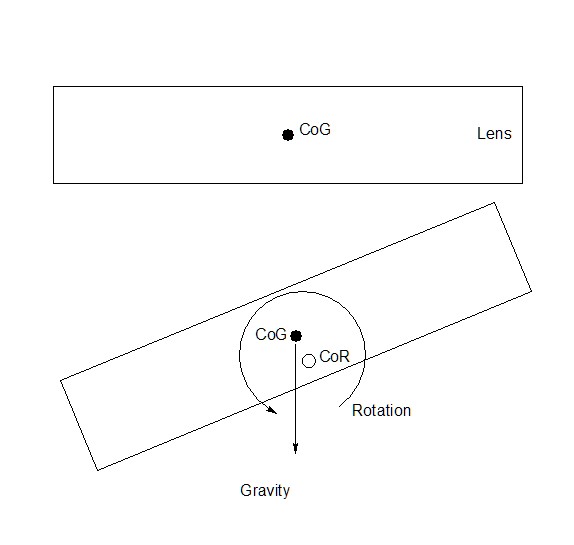
It's the laws of physics. If the centre of rotation isn't about the centre of gravity, then you will get droop. With some lenses it may be that their dimensions are such that the alignment happens anyhow. But without adjustment you can't be sure.

You can see in this image - LINK - that the rotation axis passes well below the centre of gravity. And that this one - LINK - has the axis well above the CoG. In both cases rotating the lens will make it unstable. It's gravity, and it's the law!

The gravitational force imparts a torque to the lens, making it rotate. This only happens when the centre of mass is different from the centre of rotation.
Torque.jpg


Now, with enough friction set on the head you'll be able to keep it in place - up to a certain point. It's just the same as with a ball head, the closer to horizontal the lens, the less friction required. But with a properly balanced gimbal there's no need for any friction at all.

Oh, and I tried a 393 at Park Cameras when I was looking for a gimbal and couldn't afford a Wimberley. I had used a Wimberley many times in the past - and knew how important vertical adjustment was. But I couldn't get the 393 (I think it had a 400 f2.8 on it) to work properly. That's when I got the Indian knock-off.
 
Last edited:
Back
Top