Explanation Required

Messages
94
Edit My Images
Yes
Apologies if this sounds a daft question.

I have a Canon 7D and have several lenses, in particular the 24 - 105 L which I use the most. My issue is, that I have spent nearly £1000 on this lens for the quality of glass and build used in making it.

I am however, having trouble understanding the effect of putting a filter / protector on the end that costs very little in comparison to the glass.

Can someone explain what effect having such a quality lens with a cheaper piece of glass in front of it has on the overall image quality. It seems to ruin the whole reason for purchasing such a lens if I am going to take photos with £80 of a filter on it.

Any explanation much appreciated.
 
I think you've pretty much answered - your own question. To put a real cheap bit of glass in front of an optic you've paid a small fortune for is nuts. If you absolutely have to use filters then get one of the best optical quality you can afford.

I've never been a big fan of filters anyway, especially since the advent of digital where pretty much any effect you would have achieved with a filter can now be done in editing. Apart from polarisers and grad filters I see little purpose in them these days and I just don't use them. I do always use a lens hood which I feel gives adequate protection from knocks.

However, if the camera is going to be used in a particularly hostile environment then it makes sense to fit a filter for protection of that front element. and to be fair Canon say that even their weather sealed lenses aren't fully protected without a filter fitted to protect against ingress of water past the front element.
 
Some say the lens is only as good as the filter so putting a £2 uv filter on a £500 lens is a tad silly I've done it and didn't notice any huge drop in IQ but then I'm only printing up to a4 on the 1:1 views you can defiantly notice the difference.

But then I've stopped using filters for protection and only really use ND grads and welding glass when I experiment (the 1:1 is shocking) as the way I see it is its its going to drop and smash then there no way the front element is going to come away unharmed at all and its my own darn fault for not having it secured.
 
Cheers guys, that answers my question. I did buy a UV Filter and a Polarising Filter when I bought the camera but have refrained from putting them on for the above reasons. I always use the hood so that is protecting the glass.

I do tend to dabble in buying a few filters in the future but from the info I have gathered on this forum, it appears that the Lee Filters are the best, although at a cost. I have no issue with spending the cash if its worth it so may end up purchasing the starter kit from Lee. In saying that, it appears they can't produce them quick enough.
 
I would much prefer to spend the money on a Lee kit knowing full well it will fit all my current lenses and any future lenses I buy. Yes, they are expensive, but I am guessing once you have bought a particular filter, it will last you years if looked after. :)

Having just had a quick look, they do seem to be on delayed delivery everywhere. I always use Warehouse Express were possible.
 
The other thing of course is that fitting a filter places a bigger area of glass right on the front of the lens where it's more prone to catching flare and reflections. Certainly in some situations such as shooting into the light, a filter is just going to add to the likelihood of picking up flare and would be best removed - if only for those shots.
 
I see many refrain from using filters as they can make the required adjustments in Photoshop etc. Is this the way it is going generally do you think ?
 
I would much prefer to spend the money on a Lee kit knowing full well it will fit all my current lenses and any future lenses I buy. Yes, they are expensive, but I am guessing once you have bought a particular filter, it will last you years if looked after. :)

Having just had a quick look, they do seem to be on delayed delivery everywhere. I always use Warehouse Express were possible.

You don't sound that keen on filters, a bit like me then, in which case think carefully about a Lee system. It's great big cumbersome thing, as well as expensive, and the only real reason to get it is becuase you want to use grads.

Since I prefer HRD techique to grads anyway, I rarely use square system filters and tend to use only a polariser or a very dark ND, both screw-in. They're better quality than Lee (being multicoated glass) and obviously much less bulky. Just get a stepping ring for your 70-200 and standardise on 77mm.
 
I see many refrain from using filters as they can make the required adjustments in Photoshop etc. Is this the way it is going generally do you think ?

I thinks so. In the film days there were valid reasons for having a bag full of filters - although it was still possible to get carried away and go OTT with the whole thing, but red, yellow and green filters were commonplace for B&W photography and were actually useful. Nowadays there's little they achieved that can't be done in editing.
 
The only part that appeals to me about the lee system is been able to move the grad around instead of the lens.

Good shout about the step down filters knew Id forgot something.
 
I had UV filters on all my lenses until recently. I was a bit disappointed with the sharpness of my 100-400L to start with on my 7D. I read on the forum that this lens wasn't great with a filter on so decided to try without one. I was amazed at the difference it made. They weren't cheap filters either, about £45 for the 77mm one for the 100-400L. I just shoot now without filters but with hoods on all the time, which I did anyway when I had the filters on. Obviously for CPl and ND etc. take off the UV filters first if you're using them.
 
Last edited:
I am however, having trouble understanding the effect of putting a filter / protector on the end that costs very little in comparison to the glass.

Well, the first thing that occurs to me is that a zoom lens is quite a complex thing involving many parts and almost certainly expensive hand assembly and test but a filter is a relatively simple device consisting of a glass, some coating and a threaded holder so TBH I'd be shocked if it cost as much as a zoom lens or anything approaching that cost.

I've used protection filters a lot and I've never noticed any optical quality issues at all, the only downside is when shooting into bright lights and for that the filter can always and relatively quickly be taken off, that for me is a tiny percentage of shots and a minor hassle and worth the advantages of being able to shoot relatively risk free on the beach or at other locations where crap can be expected to land on the lens and need to be wiped / cleaned away.
 
Last edited:
I still use a UV filter on my 24-105 as it was supplied with one. I can't tell any discernible difference with it off vs on (perhaps I just haven't stressed it). I had a UV filter on my 70-200. At long focal lengths and distances, it "broke" the lens. It went in the bin.... All my opther lenses are used without a filter.
 
Hi Firetographer,
The first thing I do when buying a lens is put a good quality UV filter on it. Good quality ones are not so expensive (£20-£30 depending on the size). They protect against UV (reducing the blue haze in distant landscapes etc), they protect the £1000 lens from scratches, they can be cleaned without fear of damaging the objective lens, and (on the L series) they complete the weather sealing. Certainly no point in putting a cheap UV filter on.

As with other filters, I agree with other posters, apart from a neutral density grad and a polarizer, I don't see a need for other filters. Since there are only these few filters worthy of consideration, I'd therefore buy the best quality versions. Poor quality polarizers can give a colour shift (my old Cokin was particularly bad).

Best wishes,
Dayve
 
Dayve said:
Hi Firetographer,
The first thing I do when buying a lens is put a good quality UV filter on it. Good quality ones are not so expensive (£20-£30 depending on the size). They protect against UV (reducing the blue haze in distant landscapes etc), they protect the £1000 lens from scratches, they can be cleaned without fear of damaging the objective lens, and (on the L series) they complete the weather sealing. Certainly no point in putting a cheap UV filter on.

As with other filters, I agree with other posters, apart from a neutral density grad and a polarizer, I don't see a need for other filters. Since there are only these few filters worthy of consideration, I'd therefore buy the best quality versions. Poor quality polarizers can give a colour shift (my old Cokin was particularly bad).

Best wishes,
Dayve

You know digital cameras don't suffer from UV light? UV filters were made for the film era where UV light would affect the film, causing haze. Digital sensors don't suffer from this, and the high pass filter which sits on the sensor contains it's own UV filter.

As a 'filter' UV filters are now defunct.
 
Hi Firetographer,
The first thing I do when buying a lens is put a good quality UV filter on it. Good quality ones are not so expensive (£20-£30 depending on the size). They protect against UV (reducing the blue haze in distant landscapes etc), they protect the £1000 lens from scratches, they can be cleaned without fear of damaging the objective lens, and (on the L series) they complete the weather sealing. Certainly no point in putting a cheap UV filter on.

Dayve
Any quality modern lens has multi coatings on each side of every lens element - even the ones which are cemented together and these coatings apart from reducing light loss and flare will do more to reduce UV than a filter can anyway. Use one for protection if you feel you need to but you will be getting no benefit at all as far as UV is concerned .
 
I am pretty much in agreement with CT and others, I see no point sticking 20 or 30 pounds worth of glass infront of a Nikon lens that costs £1000 to £2000, depending on which lens I am using, nor even an £80 filter, when all it is doing is actually reducing the image quality and increasing the chances of flare/bounced light. Ergo, the only time I use a screw on filter is for polarising, or if using lenses in particularly hostile environments, for example, if one was planning on standing by the side of a dirt track with rally cars passing by, you might want to protect from dust and chips with a std UV filter. In terms of grads, etc, I don't use them too often and usually for pleasure rather than work, so I opted for the cokin P square filter system, but if I found a need to use them more frequently for work, then I would be straight onto the Lee system.
 
I use cheap UV filters on all of my lenses for the following two reasons only:

1) it completes the weather sealing of the 40D/5Dmk2 body with any L lens;
2) I'd rather have a 99p filter scratched/damaged than my £1500 lens.
 
I use cheap UV filters on all of my lenses for the following two reasons only:

1) it completes the weather sealing of the 40D/5Dmk2 body with any L lens;
2) I'd rather have a 99p filter scratched/damaged than my £1500 lens.

But then you're reducing the quality of the £1500 lens to that of your 99p filter. You may as well have stuck with your kit lens. And anything strong enough to damage the element will simply smash the filter on the way through.

Also, its VERY hard to scratch a front element. I've not managed to do it in 20 years.
 
Last edited:
  • No UV/'protective' filter can improve image quality on a dSLR.
  • All UV/'protective' filters will cause some degradation in image quality.
  • The seriousness of this degradation tends to decrease as filter cost increases.
  • Good filters will cause degradation that is not noticeable under most conditions.
  • All filters, even the best, will cause noticeable degradation in some conditions.
  • Image degradation is worse with longer focal lengths - Link.

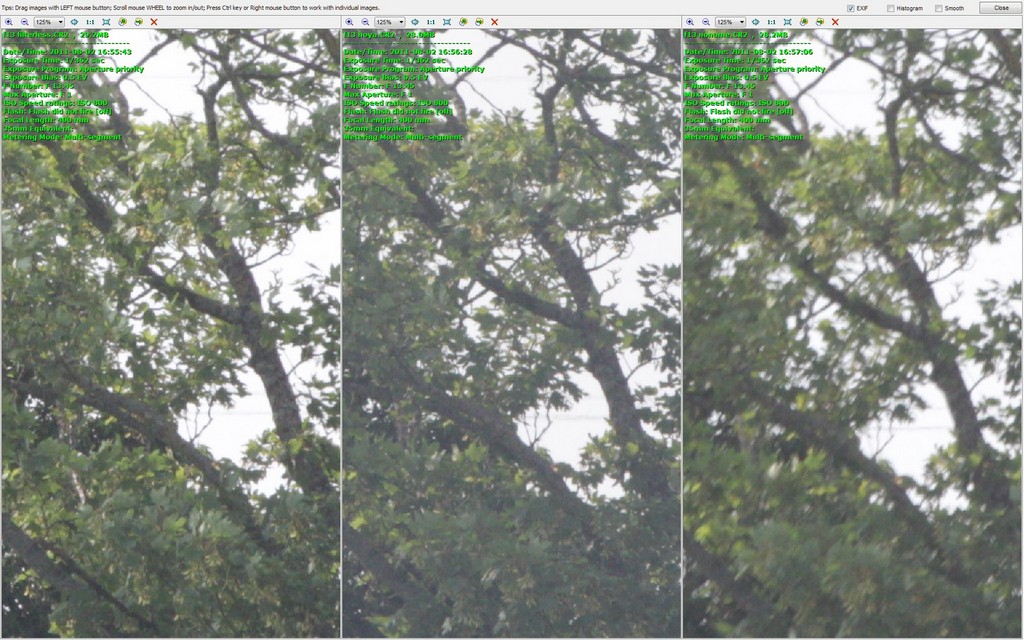
Here's a comparison between the 100-400 shot with no filter, an expensive filter and a cheap filter -

Filter%20Comparison%20100-400.jpg
 
Gregory Hicks said:
Uv filters arnt doing anythink are they....?

Well, the only thing they do do is degrade IQ. They certainly don't 'filter' anything and I'm hard pressed to think how they protect against lens breaking impacts...
 
odd jim said:
Well, the only thing they do do is degrade IQ. They certainly don't 'filter' anything and I'm hard pressed to think how they protect against lens breaking impacts...

Unfortunatly this i disagree with i belive it saves my 17-40 my pro1 d took the whole impact!!!!!!! Apart from that im not so sure what they do, they do protect the front glass thats about it though.....
 
I had a guy pour a glass of beer on my 16-35 a couple of weeks back. I would rather have had the cheap **** filter on there than not. Plus, don't you need a filter to complete the weather sealing?

I still get perfectly good images having the filter on, in fact I can't see any difference between using it and not using it in the type of photography I do.

As for protection I'm not talking about dropping the lens or smashing it with a hammer, but when you're trying to make your way through a packed night club, people/things are inevitably going to hit the camera/lens.
 
My hoods protected my glass adqauately. PS reduced haze etc. Weather sealing:? Dunnow, never had any probs with L glass, but apart from one wedding never took it out in adverse weather conditions. Use if you must, but avoid if you can is my opinion.
 
I still get perfectly good images having the filter on, in fact I can't see any difference between using it and not using it in the type of photography I do.

And what type of photography is that exactly ohara :thinking: Invisible photography :shrug: Since joining TP on 22-01-2009 you have 72 posts, only two of them being threads of your own and without pictures. Just curious :)

To answer the OP, as mentioned if you think you need it for weatherproofing or extreme conditions then fine. As for image improvement with a UV, forget it.
 
Last edited:
Thanks for all the responses, some very varied views here. It just does not feel right putting a filter on, I much prefer the hood to stay on and take full advantage of the lens quality. Im with odd jim on this one.
 
If I'm photographing motorsport from close to the action, I have a filter (clear or UV) on. Even on tarmac bits of stone get picked up and flung around, I've marshalled enough over the last 20+ years to be completely aware of this ;). I'm sure there are people that can look at an action shot and say "oh, look at the IQ degradation from the filter", I'm obviously not good enough to be able to spot it.

Landscapes, people, I don't, unless I'm using an ND grad, as flying stones are less of a risk.
 
It's one of those personal preference things like Canon/Nikon, Mac/PC which will be debated on photography forums forever.

My personal preference is to use UV filters, I feel this has been justified as I have had a UV filter smashed whilst on the camera, without a scratch on the lens. If there hadn't been a filter to take the brunt of the impact would the lens have been damaged? Probably. At the point of impact the lens hood was fitted, so I do not subscribe to the theory that a hood will protect the lens.

Obviously this is my experience and other people may choose to compromise the safety of their lens rather than image quality, as unfortunately it is an either/or thing.
 
Spot on mark, if you know the lens is at more than average risk thenprotection is the way. If it's unlikely that the lens is going to be damaged then leave it off. I've got filters for all of my lenses and never use them if I can help it.
 
Somebody smack me but what does the word op mean. Also regarding uv filters, they arecompletly pointless the guy in LCE stated that today when i purchased my new lens! Saved me a few £££
 
OP=original poster
 
Back
Top