

- Messages
- 5,617
- Edit My Images
- Yes
What does this mean - over exposing slightly ?
Why do people do it, and in what situations ?
Thanks for any help.
Why do people do it, and in what situations ?
Thanks for any help.


Main thing to remember about ETTR is to avoid clipping the IMPORTANT highlights (this is mentioned in at least one of the links above).
Clipped highlights cannot be recovered whereas noise can be reduced.


Funny this subject has come up as I was only thinking about this yesterday, albeit the other way round. I was wondering if it would be ok to slightly underexposed to get the shutter speed up a bit and then use pp software to brighten the image. By the looks of it this wouldn't be a good idea


 . I just thought underexposing would cause less noise than raising iso, how wrong one can be. I'm one of those people who used to think the iso changed the exposure


It's a point that is so important that I actually updated post #2 to put the explanation at the beginning of the thread.
To summarise, there are two big sins when it comes to noise...
1. underexposing at the sensor due to the chosen combination of shutter speed and aperture;
2. not raising the ISO value high enough to compensate fully for the underexposure
With #1 you often have no choice. That's just the way it has to be. With #2 you do have a choice, and you should take it. Whether you call it ETTR, ITTR or HTTR pushing the histogram towards the right should yield better photographs, with less noise and improved tonal range.

Does beg the question though as to why applying gain in the camera seems to work far better than applying it in post production. In fact your example above shows this. The ISO 3200 shot looks much cleaner and retains more detail than the 'pushed' ISO 100 shot.
It's because the gain applied in camera is done on the analogue signal from the sensor before it's converted into digital. The fake 'expanded' ISO settings on cameras are digital operations I believe.
It's because the gain applied in camera is done on the analogue signal from the sensor before it's converted into digital. The fake 'expanded' ISO settings on cameras are digital operations I believe.

With this in mind, the only thing I have a slight gripe with is the suggestion that iso is not part of the 'exposure triangle.' I 100% understand why you say that and I can also see that in absolute terms it's correct as you need some light to amplify in the first place so shutter and aperture become number 1 priority.
The only reason I say 'gripe' is because by saying that iso is not part of 'exposure triangle' it implies that it is not important in terms of exposure. But seeing as the gain is done in an analogue manner and hence cannot be applied later, then that to me says that iso is an important part of the 'exposure triangle'. Or am I talking rubbish?
I hope this doesn't sound picky, more just trying to compose my thoughts. I actually found your post really quite enlightening.

It's explained here....
http://www.luminous-landscape.com/tutorials/expose-right.shtml
http://www.cambridgeincolour.com/tutorials/digital-exposure-techniques.htm
http://www.ophrysphotography.co.uk/pages/exposingtoright.htm
IMPORTANT EDIT : There is a common misconception about the term "exposure" and it follows that the expression "Expose To The Right" or "ETTR" is actually a misnomer. People talk of the "exposure triangle" and playing the settings of shutter speed, aperture and ISO off against each other in order to arrive at the correct "exposure". While it is very convenient to talk in this way it is not quite accurate and can lead to misconceptions about noise and the cause of it.
When we talk about exposure what we are really talking about is how much light is captured by the sensor and how far the highlights are away from being clipped. In other words the exposure is an expression of how much light we recorded. Within the camera settings only two adjustments can influence the exposure (ignoring flash) - shutter speed and aperture. Large apertures let plenty of light to travel through the lens. Small apertures restrict the flow. Long/slow shutter speeds gather the light for a while so gradually the exposure can increase. High/short shutter speeds only let light be captured for a brief moment. The ISO setting has absolutely no influence on how much light the camera records. It is not part of the fictitious "exposure triangle".
The ISO is more like a brightness control, not an exposure control. It affects how bright the image looks, but not how much light was recorded. Now, when it comes to the topic of noise, high ISO often gets the blame for noisy images. This is the tail wagging the dog. The reason for noise is that insufficient light is recorded by the sensor. It is not sufficiently saturated. The "signal" is not as strong as it might be. You have underexposed the sensor. Raising the ISO helps to compensate for your underexposure by brightening the image. In so doing it actually improves the noise performance of your camera overall.
So, I believe that rather than referring to ETTR (Expose to the Right) it would actually be more appropriate to ITTR (ISO to the Right) or even HTTR (Histogram to the Right). In other words you set the shutter speed and aperture you need for creative control of your image (blur and DOF control) and then you raise the ISO, if necessary, to make the image appear as bright as possible without clipping important highlights.
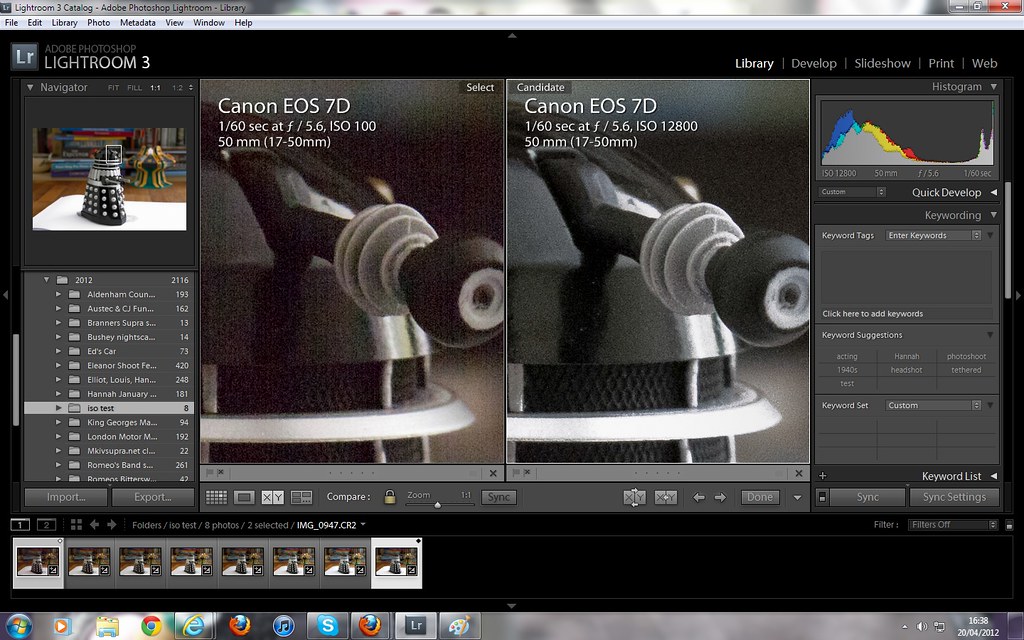
In post #9 I ran a little test/demo to demonstrate how two shots with identical exposures (same shutter speed and aperture) had completely different noise performance depending upon the ISO value chosen. The 100 ISO shot was a disaster. The equivalent shot at 3200 ISO was remarkably good.
<snip>
...My bugbear in all this is that people so often say that shooting at high ISO increases noise. The fact is that it doesn't....
<snip>
Here is a comparison of the underexposed shot at 100 ISO (after Auto Tone adjustment) against the ETTR shot at 3200 ISO (after Auto Tone adjustment), which was equally underexposed to begin with, but compensated for by increasing the ISO. I have not changed NR or any other settings. As you can see, far from increasing noise, raising the ISO has substantially reduced it.

According to what you wrote the ISO 100 image was 4.5 stops under-exposed and the ISO 3200 image was 0.5 stops over-exposed (or 'over-brightened', whatever word you want to use). So correctly exposing clearly results in a better image than massively under-exposing and then increasing the brightness with software.
But it'd be interesting to see how correctly exposing compares with over-exposing (which is the topic of this thread) with a higher ISO setting, then decreasing the brightness with software.


KIPAX said:So in TALK BASICS we are telling people ISO has no bearing on exposure and high ISO doesn't produce more noise..
I can't dispute or agree wiht the facts presented as I don't know enough.. What I do know its that we are not supposed to go this deep and techie in talk basics and telling people using high ISO has no effect on noise and ISO doesn't effect exposure is perhaps not the best post ...IMHO

I read it, and i paraphrase heavily here as...shooting brighter with a high ISO produces less noise and a better overall exposure than shooting darker with a lower ISO as post processing introduces noise on the way up but not the way down

So in TALK BASICS we are telling people ISO has no bearing on exposure and high ISO doesn't produce more noise..
I can't dispute or agree wiht the facts presented as I don't know enough.. What I do know its that we are not supposed to go this deep and techie in talk basics and telling people using high ISO has no effect on noise and ISO doesn't effect exposure is perhaps not the best post ...IMHO
How you can sit there and say that raising the ISO has increased noise has me completely baffled.
Been looking for a "dumbfounded" icon.. can't find one..
You say that raising ISO doesn't increase noise, but actually reduces it. I know what you're getting at but it's an odd way of putting it and is the reverse of what most folks would take that statement to mean. For example, if I shoot a scene using 1/250sec at f/5.6 with iso400, and then again at 1/2000sec at f/5.6 with the iso raised to iso3200, my 'exposures' will be the same, but the one at iso2300 will have a lot more noise.
....
You say that raising ISO doesn't increase noise, but actually reduces it. I know what you're getting at but it's an odd way of putting it and is the reverse of what most folks would take that statement to mean. For example, if I shoot a scene using 1/250sec at f/5.6 with iso400, and then again at 1/2000sec at f/5.6 with the iso raised to iso3200, my 'exposures' will be the same, but the one at iso2300 will have a lot more noise.

