

You are using an out of date browser. It may not display this or other websites correctly.
You should upgrade or use an alternative browser.
You should upgrade or use an alternative browser.
FULL FRAME 12.3MP VS NIKON D7100
- Thread starter mrk123
- Start date

LongLensPhotography
Th..th..that's all folks!
- Messages
- 18,834
- Name
- LongLensPhotography
- Edit My Images
- No
More megapixels is better... if you believe some marketing departments. Large screens also equal better pics. It is true.
Depends on the full frame camera, not jyst the amount of pixels. 7100 has some nice tricks up its sleave to help capture good images, auto iso and good noise control, minimum shutter speed based on focal length. Handy features if shooting natural light.

- Messages
- 5,822
- Edit My Images
- No
I disagree that the D700 will give much better image quality. The D700 will be better at high ISO, but at lower ISO settings and the lenses attached being equal I don't think the D700 will be running away with the IQ.
I find this site quite interesting, I read it in detail when I was considering the D600:
http://betterfamilyphotos.blogspot.co.uk/2013/03/high-iso-comparison-d7100-vs-d7000-d600.html
I find this site quite interesting, I read it in detail when I was considering the D600:
http://betterfamilyphotos.blogspot.co.uk/2013/03/high-iso-comparison-d7100-vs-d7000-d600.html
Last edited:

- Messages
- 6,473
- Name
- Ned
- Edit My Images
- Yes
I just spent a week on Safari with a D700 and a D3200 (granted, not a D7100 but pretty damn close WRT the sensor).
The extra resolution and reach of the D3200 is nice to have but all in all I prefer the images from the D700 by quite a long way, especially at high ISO.
That said, the Expeed 3 engine is rather nice - judges exposure in different situations rather well, especially sunsets.
The extra resolution and reach of the D3200 is nice to have but all in all I prefer the images from the D700 by quite a long way, especially at high ISO.
That said, the Expeed 3 engine is rather nice - judges exposure in different situations rather well, especially sunsets.

- Messages
- 3,209
- Edit My Images
- Yes
I disagree that the D700 will give much better image quality. The D700 will be better at high ISO, but at lower ISO settings and the lenses attached being equal I don't think the D700 will be running away with the IQ.
Oh yes it will. It is twice the sensor size, much lower pixel density, thus more forgiving on lens imperfections.
Full frame have a magical feel to them, especially on film or those low MP full frames. There's more than just high ISO performance.
The ONLY advantage D7100/5200/3200 have is ability to shoot something really far away and crop the image to gain perceived magnification. But that requires having the best of the best lens in front, otherwise might as well not take the shot!
- Messages
- 5,822
- Edit My Images
- No
OThe ONLY advantage D7100/5200/3200 have is ability to shoot something really far away and crop the image to gain perceived magnification. But that requires having the best of the best lens in front, otherwise might as well not take the shot!
You what??!!!
I don't have any f2.8 lenses on my D7100. Might as well stop taking shots and throw it in the bin.

- Messages
- 755
- Edit My Images
- Yes
The fact is its what the user does or doesnt need.
Half the FF people seem to bash crop sensors and wether they realise it or not half the time seem to insinuate that crop cameras can't produce good quality images when that statement just isn't true.
Crop cameras have come a long way, even basic entry models can give great results that 99% of people would be well and truely happy with.
I agree the higher mp crop cameras are less forgiving from error or lens imperfections for sure but to say full frame to crop is night and day on low to base iso isnt all that much.
High iso for sure, the 6D for example produces superb images at iso I wouldnt dream of using on my crop sensor but at low iso numbers.... I would happily take my crop camera and put the money saved to a quality lens.
Half the FF people seem to bash crop sensors and wether they realise it or not half the time seem to insinuate that crop cameras can't produce good quality images when that statement just isn't true.
Crop cameras have come a long way, even basic entry models can give great results that 99% of people would be well and truely happy with.
I agree the higher mp crop cameras are less forgiving from error or lens imperfections for sure but to say full frame to crop is night and day on low to base iso isnt all that much.
High iso for sure, the 6D for example produces superb images at iso I wouldnt dream of using on my crop sensor but at low iso numbers.... I would happily take my crop camera and put the money saved to a quality lens.
- Messages
- 755
- Edit My Images
- Yes
and as above... the comment 2 above is exactly what I am talking about, pointless elitest sounding attitude.
"But that requires having the best of the best lens in front, otherwise might as well not take the shot!"
I use sigma lens and not ONE canon L lens.... who cares? Not me.
"But that requires having the best of the best lens in front, otherwise might as well not take the shot!"
I use sigma lens and not ONE canon L lens.... who cares? Not me.
Great advice here thanks.
I am upgrading to a new model, and thinking why upgrade to something that is essentially 3 years out of date (D7000).
Could we assume that the D7100 is the next best thing to a full frame? I need video that is a fact.... And I'm guessing a full frame video DSLR is gonna cost big bucks..
Can i ask on here where one might be able to get the cheapest D7100???
I am upgrading to a new model, and thinking why upgrade to something that is essentially 3 years out of date (D7000).
Could we assume that the D7100 is the next best thing to a full frame? I need video that is a fact.... And I'm guessing a full frame video DSLR is gonna cost big bucks..
Can i ask on here where one might be able to get the cheapest D7100???
- Messages
- 755
- Edit My Images
- Yes
The problem is that there is always something round the corner... if you wait forever you will be asking the same question in 3 years time.
You answered your own question on the other post by saying you liked an image from your film camera.
The sensors are fantastic nowadays, contrary to belief so are the old tired 5 year old Canon 18mp sensor, wether the 7000 is 3 years old or not is an irrelevant point in all honesty, I got the 60D's full well knowing that a 70D was around the corner a year later but couldn't care less as I know its me thats getting the shots and not the camera.
Same with anything electrical, tv's, i purchased the then top of the range samsung and paid a fortune for it, (the B7000 series) and within 3 weeks the B8000 models came out, however the upgraded features were not of any relevance to me along with image quality of the B7000 being stunning.
You alone can be the only one to decide what specs you do and don't need, the 7100 will always offer some upgraded features, if it didn't then they wouldnt of made it.
As said, there are plenty of options like JJ says, but don't fall for the "Full frame is the only way or you will get crap pictures and your not a real photographer bs".
They offer benifits for sure, but then so does crop.
Try and then buy!
You answered your own question on the other post by saying you liked an image from your film camera.
The sensors are fantastic nowadays, contrary to belief so are the old tired 5 year old Canon 18mp sensor, wether the 7000 is 3 years old or not is an irrelevant point in all honesty, I got the 60D's full well knowing that a 70D was around the corner a year later but couldn't care less as I know its me thats getting the shots and not the camera.
Same with anything electrical, tv's, i purchased the then top of the range samsung and paid a fortune for it, (the B7000 series) and within 3 weeks the B8000 models came out, however the upgraded features were not of any relevance to me along with image quality of the B7000 being stunning.
You alone can be the only one to decide what specs you do and don't need, the 7100 will always offer some upgraded features, if it didn't then they wouldnt of made it.
As said, there are plenty of options like JJ says, but don't fall for the "Full frame is the only way or you will get crap pictures and your not a real photographer bs".
They offer benifits for sure, but then so does crop.
Try and then buy!
Last edited:
Well I thought my budget was £500 (D7000) but now thinking should I just go for the D7100 as the 24mp and 60fps seems to be more up to date.
Not that I'm some technology whore who just wants the best of the best (I still use 35mm cameras from the 70s and enjoy them very much - Olympus Trip 35).
But from a business and practical point of view, seems silly not to spend the extra 250 on up to date gear?
I'd say the D600 at a minimum of £1100 second hand body only is way too much... haha my original budget was £500
Not that I'm some technology whore who just wants the best of the best (I still use 35mm cameras from the 70s and enjoy them very much - Olympus Trip 35).
But from a business and practical point of view, seems silly not to spend the extra 250 on up to date gear?
I'd say the D600 at a minimum of £1100 second hand body only is way too much... haha my original budget was £500
- Messages
- 755
- Edit My Images
- Yes
for definate, if you can get the model up for not much extra and want it then most definately go for it!
I unfortunately cannot comment on the cameras as I am a Canon man so have no experience with the sensors etc.
look here for reviews and info, they are quite usefull I find
http://www.dpreview.com/reviews/nikon-d7100/13
I unfortunately cannot comment on the cameras as I am a Canon man so have no experience with the sensors etc.
look here for reviews and info, they are quite usefull I find
http://www.dpreview.com/reviews/nikon-d7100/13

- Messages
- 103
- Name
- john
- Edit My Images
- Yes
I think you need to try the camera out and see if it ticks the boxes for you. If you don't want to rent it, buy some small memory cards, go to a camera shop and take some photos with a D7000, D7100 and a D600, use the same lens (say a prime) and take your images on your memory cards home and look at them on your computer.
If you read around online you can play with ISO and apertures on the camera to find each ones strong and weak areas.
If you can't be bothered doing that you can download full size images for free from each camera and inspect them on your computer and do some pixel peeping.
Cost will be a factor. FF more expensive for camera and lenses.
Your opinion is the one that counts at the end of the day when your spending your money, so I'd always say do your homework first. The FF users will say FF is the best, the crop frame guys will say crop is just as good. It's only natural, you can get great results with both if you want to
If you read around online you can play with ISO and apertures on the camera to find each ones strong and weak areas.
If you can't be bothered doing that you can download full size images for free from each camera and inspect them on your computer and do some pixel peeping.
Cost will be a factor. FF more expensive for camera and lenses.
Your opinion is the one that counts at the end of the day when your spending your money, so I'd always say do your homework first. The FF users will say FF is the best, the crop frame guys will say crop is just as good. It's only natural, you can get great results with both if you want to
Last edited:

woof woof
I like a nice Chianti
- Messages
- 44,020
- Name
- Alan
- Edit My Images
- No
Full frame have a magical feel to them, especially on film or those low MP full frames. There's more than just high ISO performance.
Personally I think that other than noise performance at higher ISO the differences between "FF" and smaller formats is down to lenses, apertures and camera to subject distances.
I shot hunderds of comparison images between FF, APS-C and MFT and showed them to other people and the result was that no one, including me, could reliably tell what camera took what shot. You really have to pixel peep and look for clues IMVHO.
This says it all and my little experiments said the same...
http://www.luminous-landscape.com/reviews/kidding.shtml

- Messages
- 23,200
- Name
- Richard
- Edit My Images
- No
What would give better image quality??
All things being equal (if that's possible) the physically larger sensor will always give best image quality. Pixels hardly comes into it, within reason. It's simply because the lens doesn't have to deliver such high resolution for the same size final image output, and the underlying fact of optical physics is that when resolution goes up, so contrast goes down. And it's contrast that contributes most to perceived sharpness. This is basic lens MTF theory.
For a crop format DSLR to match full-frame, the lens must deliver 1.5x more resolution at the same level of contrast. This is a very big ask, and is only achieved when comparing a cooking grade full-frame lens with the very best lenses designed specifically for the smaller format.
Larger sensors also collect more light, so high ISO performance is better.
Last edited:
woof woof
I like a nice Chianti
- Messages
- 44,020
- Name
- Alan
- Edit My Images
- No
For a crop format DSLR to match full-frame, the lens must deliver 1.5x more resolution at the same level of contrast. This is a very big ask, and is only achieved when comparing a cooking grade full-frame lens with the very best lenses designed specifically for the smaller format.
But shoot RAW and process a smaller format image for best effect including boosting the contrast if required and no matter what the theory unless it's a high ISO shot the chance of you telling a FF shot from a smaller format shot are probably no better than chance.
I tried comparing shots taken with a FF and APS-C with the same lens and later tried FF, APS-C and MFT with the same or very similar lenses and the differences at low to middle ISO settings are very small.
- Messages
- 23,200
- Name
- Richard
- Edit My Images
- No
But shoot RAW and process a smaller format image for best effect including boosting the contrast if required and no matter what the theory unless it's a high ISO shot the chance of you telling a FF shot from a smaller format shot are probably no better than chance.
I tried comparing shots taken with a FF and APS-C with the same lens and later tried FF, APS-C and MFT with the same or very similar lenses and the differences at low to middle ISO settings are very small.
Yes, I see what you mean, but I'd phrase it rather differently. Putting 'best' quality to one side for a moment, both APS-C and even M4/3rds are quite capable of producing excellent results that are considerably better than most people need, and indeed we're all usually quite happy with results that don't even push those smaller formats to their limits. At the end of the day, APS-C DSLRs and CSCs outsell full-framers very many times over, so they can't be too bad.
But when push comes to shove, if you do as close a comparison test as reasonably possible - same lens, same aperture, same framing, same subject, same light, same processing etc (say Canon 5D2 vs 7D - similar pixel counts, same generation; or Nikon D700 vs D300, again very similar) then the larger full-frame format always wins. As of course it must.
Edit: they key point is really that what makes the difference is the physical sensor area that allows the lens the perform better, rather than the pixel count that everyone obsesses over.
Last edited:

- Messages
- 17,227
- Name
- Keith
- Edit My Images
- No
FX every time. Larger sensor = better mostly. If not, then the D800 is better than a lot of medium format sensors out there even at low ISO ... [it's not ..] And the D7000 is better than the D3s [it's not]
If you really think megapixels matter most, there are some cheap compacts out there 24mp+ ... Trouble is, the sensor they cram all that onto is no bigger than your pinky finger nail - you think they will out-perform a 10mp DX dslr? Dream on.
If you really think megapixels matter most, there are some cheap compacts out there 24mp+ ... Trouble is, the sensor they cram all that onto is no bigger than your pinky finger nail - you think they will out-perform a 10mp DX dslr? Dream on.
Last edited:
woof woof
I like a nice Chianti
- Messages
- 44,020
- Name
- Alan
- Edit My Images
- No
But when push comes to shove, if you do as close a comparison test as reasonably possible - same lens, same aperture, same framing, same subject, same light, same processing etc (say Canon 5D2 vs 7D - similar pixel counts, same generation; or Nikon D700 vs D300, again very similar) then the larger full-frame format always wins. As of course it must.
Edit: they key point is really that what makes the difference is the physical sensor area that allows the lens the perform better, rather than the pixel count that everyone obsesses over.
Yes, but how big do you have to print or how close do you have to view or pixel peep to tell the images apart?
I used to print but these days much less so and some people hardly ever do. Even many who do print may never print an image large enough to make what can be minor differences visible. Of course once you start to crop and print differences can quickly appear so like higher ISO's that's a special case.
I think that if people can get over the feeling that they need to be able to print perfect images the size of a barn and instead think about what equipment they need to be able to produce images that'll stand up to (even close) viewing at the image size they are actually going to produce there'd be a lot less kit lust. I've long since accepted that my images are not going to be displayed ten foot wide on a gallery wall and therefore my 5D and even my G1 (if I keep the ISO down) are perfectly adequate for prints up to A3 and on screen images up to 100% crop and few if any people will ever be able to tell 5D images from G1 images any better than chance.

- Messages
- 2,531
- Name
- Paul
- Edit My Images
- Yes
Yes, but how big do you have to print or how close do you have to view or pixel peep to tell the images apart?
This is where the whole 'it depends on what the photographer needs' thing comes in. As has already been mentioned in most cases crop sensors produce great quality results that are perfectly satisfactory for most people, but when doing direct comparisons in terms of quality there's usually a very clear difference. I have the 7D and 5Dmk2, they're different beasts used for different things and I love both, but there's no doubt the 5D2 utterly blows the 7D out of the water in image quality. I don't mean it's just a little bit better, I mean it's massively better. That isn't to say the 7D is terrible quality; it's a very capable camera but there's still a very clear difference between that and the full frame (and similar pixel count) 5D2.
Last edited:
- Messages
- 23,200
- Name
- Richard
- Edit My Images
- No
Yes, but how big do you have to print or how close do you have to view or pixel peep to tell the images apart?
I used to print but these days much less so and some people hardly ever do. Even many who do print may never print an image large enough to make what can be minor differences visible. Of course once you start to crop and print differences can quickly appear so like higher ISO's that's a special case.
I think that if people can get over the feeling that they need to be able to print perfect images the size of a barn and instead think about what equipment they need to be able to produce images that'll stand up to (even close) viewing at the image size they are actually going to produce there'd be a lot less kit lust. I've long since accepted that my images are not going to be displayed ten foot wide on a gallery wall and therefore my 5D and even my G1 (if I keep the ISO down) are perfectly adequate for prints up to A3 and on screen images up to 100% crop and few if any people will ever be able to tell 5D images from G1 images any better than chance.
Yes, agreed. Something to do with the difference between wants and needs.
Here's a thought for all those hungry pixel hunters that only view on-screen. They will only have around 2m dots max if the image fills the entire VDU, and it's more often half that - eg, 1920 x 1080 = 2.1m. Pixels and resolution is (mostly) a red herring if it's 'sharpness' you're after.
Last edited:
- Messages
- 3,209
- Edit My Images
- Yes
The ONLY advantage D7100/5200/3200 have is ability to shoot something really far away and crop the image to gain perceived magnification. But that requires having the best of the best lens in front, otherwise might as well not take the shot!
All things being equal (if that's possible) the physically larger sensor will always give best image quality. Pixels hardly comes into it, within reason. It's simply because the lens doesn't have to deliver such high resolution for the same size final image output, and the underlying fact of optical physics is that when resolution goes up, so contrast goes down. And it's contrast that contributes most to perceived sharpness. This is basic lens MTF theory.
For a crop format DSLR to match full-frame, the lens must deliver 1.5x more resolution at the same level of contrast. This is a very big ask, and is only achieved when comparing a cooking grade full-frame lens with the very best lenses designed specifically for the smaller format.
Larger sensors also collect more light, so high ISO performance is better.
This is what I was trying to say, badly explained, my apologies if it caused internet rage.
There is no point chasing the megapixel count, there however is big gain in getting the best lens you can afford.

- Messages
- 2,839
- Name
- Chris
- Edit My Images
- Yes
Well I thought my budget was £500 (D7000) but now thinking should I just go for the D7100 as the 24mp and 60fps seems to be more up to date.
But from a business and practical point of view, seems silly not to spend the extra 250 on up to date gear?
I'd say the D600 at a minimum of £1100 second hand body only is way too much... haha my original budget was £500
Looks like you are falling into budget creep there. You need to fix your budget somewhere otherwise you will always have the question "what if I spent an extra £100"
If your budget is really £500 then just create a list of all the options that suit that are available for £500.

- Messages
- 1,120
- Name
- Eddy
- Edit My Images
- Yes
I was using a 5D MK III (FF) and a 7D (crop) the other day for a shoot. Whilst the 5D is an amazing camera, I was astonished at how well the 7D was able to keep up. The 7D obviously fell behind in low light situations, but the IQ was quite comparable. I wouldn't necessarily believe that FF provides much better image quality over the APS-C sized sensors. The differences are there, but you really need to be a pixel peeper to see them.
- Messages
- 755
- Edit My Images
- Yes
This is what I was trying to say, badly explained, my apologies if it caused internet rage.
There is no point chasing the megapixel count, there however is big gain in getting the best lens you can afford.
Thats alright, thats the problem with type speak, it can be misinterpreted.
It did sound massively elitest though. haha

- Messages
- 2,839
- Name
- Chris
- Edit My Images
- Yes
The differences are there, but you really need to be a pixel peeper to see them.
But there is more to IQ than pixel peeping. It is more about how the overal image looks/is rendered rather than anything scientific liek a particular sharpness score.
- Messages
- 1,120
- Name
- Eddy
- Edit My Images
- Yes
But there is more to IQ than pixel peeping. It is more about how the overal image looks/is rendered rather than anything scientific liek a particular sharpness score.
But that's what I'm saying. I was taking similar shots all day. It was only occasionally that I could see the 5D out performing the 7D and as I said, these were usually in low light situations when the 7D couldn't keep up.
- Messages
- 1,120
- Name
- Eddy
- Edit My Images
- Yes
That's surprising as the difference is usually noticeable if not particularly a big difference.
Maybe I've got dodgy eyes?

I agree that in certain circumstances the differences are most notable. For instance, full frame sensors own landscape photography. The images seem to 'pop' a bit more. In terms of detail, however, modern crop sensor cameras match up very well. As far as I'm aware the Nikon D7100 is the best crop sensor camera on the market currently and I'm sure its IQ is much on par with the older full frame cameras.
- Messages
- 23,200
- Name
- Richard
- Edit My Images
- No
Maybe I've got dodgy eyes?
I agree that in certain circumstances the differences are most notable. For instance, full frame sensors own landscape photography. The images seem to 'pop' a bit more. In terms of detail, however, modern crop sensor cameras match up very well. As far as I'm aware the Nikon D7100 is the best crop sensor camera on the market currently and I'm sure its IQ is much on par with the older full frame cameras.
Unless the lens quality is increased accordingly, and you pixel-peep, sharpness won't be as good.
The best overall APS-C image quality I've seen, in A3 prints, is Fuji's X-Trans (16mp) coupled to one of Fuji's excellent X-series lenses.
- Messages
- 2,531
- Name
- Paul
- Edit My Images
- Yes
But there is more to IQ than pixel peeping. It is more about how the overal image looks/is rendered rather than anything scientific liek a particular sharpness score.
Absolutely, I had a perfect example of how much further I can push images from my 5D2 than my 7D at Waddington air show the other week. Despite the fact they were trailing red, white and blue smoke at the time I felt this image worked infinitely better in black and white than colour.
Flickr's method of resizing images has done it's usual trick of making this look quite oversharpened but the original edit looks fine:
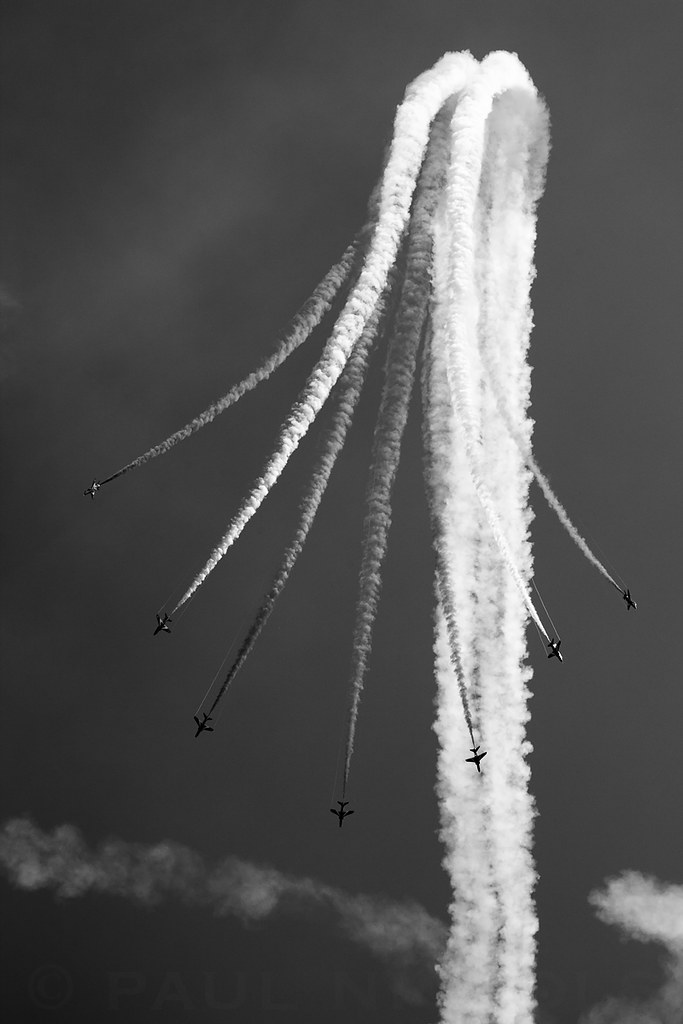
Untitled by Paul Nichols, on Flickr
I wanted the sky quite dark so had to pull it around quite a bit in processing, I've tried to do this with 7D images but they just get torn to shreds and look pretty horrendous but the 5D2 shot took it with absolutely no problem.
I know this isn't a true direct representation of 'quality' as such but it does show how much cleaner images from that fat 5D2 sensor are than those from the 7D. I love my 7D but there's no way could I have pulled an image from it around enough to get this!
woof woof
I like a nice Chianti
- Messages
- 44,020
- Name
- Alan
- Edit My Images
- No
This is where the whole 'it depends on what the photographer needs' thing comes in...
...but there's no doubt the 5D2 utterly blows the 7D out of the water in image quality. I don't mean it's just a little bit better, I mean it's massively better. That isn't to say the 7D is terrible quality; it's a very capable camera but there's still a very clear difference between that and the full frame (and similar pixel count) 5D2.
When looking at my 5D, 20D and G1 shots I can initially see quite a difference and all things being more or less equal the 5D usually wins but after processing involving no real heroic measures, just a boost to contrast, saturation and vibrancy the gap closes to the point that even I can't tell many images apart unless I remember taking the shot or look at the file name.
What I have noticed is that many people I show shots to are attracted to vibrant colours and shallow DoF and of course if those shots come from the G1 whilst the 5D shots are taken in light less likely to produce a punchy image or have lots of DoF then the G1 shot gets the praise and I think it's important to recognise what each of us and the viewer thinks of as image quality.
Last edited:

- Messages
- 3,441
- Edit My Images
- Yes
Very interesting read. So if all things equal, with two cameras (full frame and a cropped sensor) same generation and same pixel size on sensor then we should get similar image quality?
- Messages
- 2,531
- Name
- Paul
- Edit My Images
- Yes
When looking at my 5D, 20D and G1 shots I can initially see quite a difference and all things being more or less equal the 5D usually wins but after processing involving no real heroic measures, just a boost to contrast, saturation and vibrancy the gap closes to the point that even I can't tell many images apart unless I remember taking the shot or look at the file name.
What I have noticed is that many people I show shots to are attracted to vibrant colours and shallow DoF and of course if those shots come from the G1 whilst the 5D shots are taken in light less likely to produce a punchy image or have lots of DoF then the G1 shot gets the praise and I think it's important to recognise what each of us and the viewer thinks of as image quality.
For more standard images edited to 1600 wide/high for Internet use I don't really see any massive differences between the 5D2 and 7D either, they're both capable of very good images indeed at that size under normal circumstances. It's when I'm doing things like shooting gigs and pushing the ISO or editing to a larger size that I really start to tell the difference, or pushing things in a way I normally wouldn't like the Red Arrows shot above.
The thing I can't put into words and have no real idea how to explain is the 'feel' of images from the 5D2. Maybe it's a DoF thing or the slight vignetting that's often present, I'm really not sure but there's a distinctive feel to full frame images that my 7D and none of my other APS-C bodies have had. Full frame just naturally seems much more characterful for some reason, which I know is a profoundly untechnical and largely useless description but it's the best I can do!