Full frame bridge Camera

  • Thread starter Thread starter Deleted member 3428
  • Start date Start date
D

Deleted member 3428

Guest
With todays technology why haven't one of the big players brought out a FF Bridge camera? is it because it would kill off the overpriced lens market that us photogs seem to throw endless pots of money at. I reckon they could easily produce an all bells and whistles bridge with a lens range of 18 to 400 for less than 5k. what do you lot reckon? would you buy it?
 
With todays technology why haven't one of the big players brought out a FF Bridge camera? is it because it would kill off the overpriced lens market that us photogs seem to throw endless pots of money at. I reckon they could easily produce an all bells and whistles bridge with a lens range of 18 to 400 for less than 5k. what do you lot reckon? would you buy it?

The trouble is price, a bridge camera needs to be cheaper than an entry level DSLR or it won't sell. The main reason for this is that bridge cameras by there very nature involve a compromise in performance as the lens is fixed, in you unlikley example the lens would have to be slow and would inevitably have some nasty distortions. If it was cheaper to get an SLR people will go for that option as they change the lens as required and keep maximum quality.

The nearest thing you currently have is something like the Sigma DP1 which is a compact with a fast lens and an APS-c sensor, saldy it's compromises and price have kept sales low.

I definately think we will soon be seeing compact mirror less SLR's from Canon and Nikon as there is definately a market for image quality in a more compact package.
 
It's the sort of thing that keeps me awake at night (well it doesn't but you know.. it might..!). Give it a few years and the lines will not be as distinguishable. One day we'll all have to rely on talent to sell photos(if you're looking at it from a commercial viewpoint), having a big camera just won't cut it.

"Do you remember when we used to worry about ISO?" "Ha, yeah, thems were the days.." :)
 
I'd say that noone yet has the technology to produce a 18-400 lens that will provide enough quality to justify a full frame sensor

That's about it, the physical size of that lens would compromise any 'portability' you might expect from a 'bridge' camera. Physics are physics I'm afraid, they can make a reasonable size P&S with a crop sensor, but they compromise the lens to keep the size down. With a full size sensor I'd expect to find a fixed lens of approx 40mm, making it an expensive and rather inflexible piece of kit.

With a P&S small sensor it's fairly easy to make a superzoom because the sensor is so tiny that the actual lens measurements are small too. So a bridge camera can have a lens of 5mm -75mm (28-420 equiv - Fuji S2500HD). But a 400mm lens is a large object purely because 400mm is 400mm (roughly);).

Sorry that the actual answer isn't as romantic as all the notions of pocketable large format cameras.:)
 
Id love a FF version of Canon G11, it would'nt need massive zoom just a 24-135 ish L glass spec would do me fine,

Excellent low ISO, no shutter lag, built in flash, Optical viewfinder as well as lcd,
CF Card's & SD, in lens leaf shutter, Hotshoe,
Ideal back up camera at weddings & good carry about mini brick...

Id be happy to pay £1250 to canon for this !

Al'
 
That's about it, the physical size of that lens would compromise any 'portability' you might expect from a 'bridge' camera. Physics are physics I'm afraid, they can make a reasonable size P&S with a crop sensor, but they compromise the lens to keep the size down. With a full size sensor I'd expect to find a fixed lens of approx 40mm, making it an expensive and rather inflexible piece of kit.

With a P&S small sensor it's fairly easy to make a superzoom because the sensor is so tiny that the actual lens measurements are small too. So a bridge camera can have a lens of 5mm -75mm (28-420 equiv - Fuji S2500HD). But a 400mm lens is a large object purely because 400mm is 400mm (roughly);).

Sorry that the actual answer isn't as romantic as all the notions of pocketable large format cameras.:)

"Sorry that the actual answer isn't as romantic as all the notions of pocketable large format cameras."

In fact we already have them - they're called 35mm cameras and they use FILM!

Surely it would be possible to replace the film plane with a FF sensor and interchangeable lenses?

After all 35mm cameras were used for what - almost a century (50, 60 70 years)? before digital came along.

But would anyone buy them when most people think pics taken with a phone are good enough?

.
 
Surely it would be possible to replace the film plane with a FF sensor and interchangeable lenses?

.

I think you'd end up with the 5D, remove film stuff, add sensor, processing circuitry, card slot, lcd screen, nice big battery. Its just not very pocketable :D
 
Peter 35mm is not large format. Well... it is in comparison to the microscopic sensors in digital P+S cameras I suppose.
 
Peter 35mm is not large format. Well... it is in comparison to the microscopic sensors in digital P+S cameras I suppose.

Well the original OP asked about FF which is what 35mm is.

.
 
Indeed but it's not really large format in the grand scheme of things... any P+S sensor makes others look large though :thumbs:
 
After 35 years of modular photography I just looked at my little panny fz8 and thought what a joy that little camera is to use and carry around. It just sits in my hand waiting and ready to shoot whatever comes along and the lens covers most things but, it is just the quality of the final product due to sensor size which holds it back from the larger framed cameras. Someone will push this forward one day soon I reckon.
 
if they did one like my lumix bridge with a larger sensor etc it would suit me..
i dont like taking the lens on and off...and more than one lens...
i did hear about dirt and stuff...
the lumix is very quiet and lightweight...easy to use, and thrills the girls..
10Mp would do but with raw facilities and a good sized sensor
perhaps a hotshoe would be good for real flash control

probably not possible in a small space...hmmm

how about this with a zoom lens fixed permanently

frontview-001.jpg
 
"Sorry that the actual answer isn't as romantic as all the notions of pocketable large format cameras."

In fact we already have them - they're called 35mm cameras and they use FILM!

Surely it would be possible to replace the film plane with a FF sensor and interchangeable lenses?

After all 35mm cameras were used for what - almost a century (50, 60 70 years)? before digital came along.

But would anyone buy them when most people think pics taken with a phone are good enough?

.

But my response was regarding a compact camera with a FF sensor AND a superzoom.

As you can see from my answer - I understand that a quality 35mm type compact camera can be built - but the lens is a compromise -because compact and quality means fixed focal length. There are some gorgeous quality 35mm compacts, and they've been followed by digital equivalents - but with the kind of fixed lens which does nothing for a modern consumer who've grown up with 12x zoom as a measure.

Someone mentioned an 18-400mm lens - Physics makes that impossible in a bridge sized body. Even for a FF DSLR that'd be a slow large and expensive optic. I can find a Sigma 18-250, it's 6.3 at the long end and even at that only suitable for a crop.
Or there's the Canon 28-300L suitable for FF which weighs 3lbs and costs 2 grand.
 
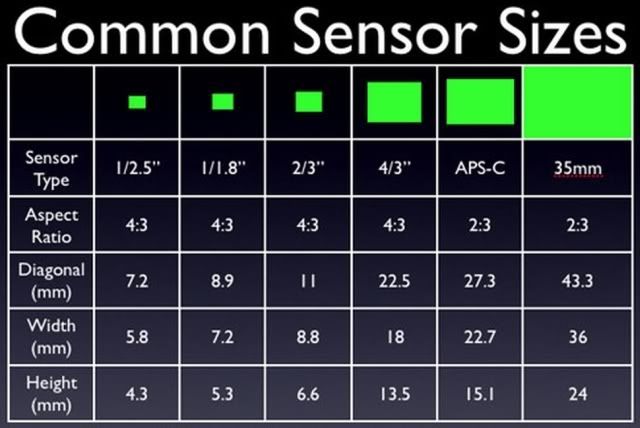
In the table below the 1/1.8" is your average bridge camera sensor, 35mm is full frame - I think you'd struggle to fit the latter into a body designed for the former.....

Sensorsizes_640.jpg
 
Indeed Canon 28-300L is the closest thing to a bridge. Nevertheless it is not the sort of lens I would want to buy - expensive, heavy and relatively soft. Hypothetically, an EVIL version of the lens would shrink in size and weight but would still easily match 24-105mm f/4L. I just don't want it like that.
Perhaps a 5D II with 85mm and 35mm primes is what you really want.
 
The problem is the size of the lens needed to cover a full frame sensor.

You could make a full frame body very small, quite easily. But it's the laws of physics which dictate that an 18-400mm lens, even if it were possible to make (which it isn't currently, not by a long way) would be huge. Massive.

I think that we probably will have full frame versions of cameras like the Pano GF1. Would be nice with a pancake-style 40mm f/2.8 that retracts into the body for a really slim package. But put a mega-zoom on it and it will be just as big as anything we've got now.

is this because 'full frame' must be 36x24...

if it is smaller surely smaller sensors would require smaller lenses to project the circle onto a 'full frame'

why is 36x24 the datum..if it is..if not please explain

i once had a 6x7...is there a full frame digital 6x7

is the full frame to suit the breed of film camera which the digital is replacing
i do appreciate the necessity so one can use the 35mm lens optics on the digital body

is the leica rangefinder full frame

The classic Leica is full frame. The camera that started it all by turning 35mm cine film sideways and putting it in a still camera. The film itself is 35mm wide in total, but after the sprocket holes the image height is 24mm, and to create a nice oblong image, it is 36mm long. That is 'full frame 35mm' as distinct from half-frame, which never caught on for reasons of image quality and is pretty rare.

While this might sound like a bit of a bodge, for mainly optical reasons it's a pretty good size. It's adapted itself very well to the SLR camera design and despite numerous attempts to 'improve' on it, they all failed (notably Kodak APS and it's variants).

Then there is medium format, which basically means 120 film. That comes in three main sizes - 6x6cm, 6x4.5cm, and 6x7cm. You can get digital versions of these, but they're all 6x4.5 or a bit smaller, and cost a fortune, eg Hasselblad £25k. Image quality is quite good :D

Fuji have just introduced a new version of their 6x7cm film rangefinder camera, the GF670. The lens folds away and the whole thing is about the size of a paperback book, which shows that it's not the format that takes up the space. Here http://www.ephotozine.com/article/Fujifilm-GF670-mediumformat-film-camera-announced-13918 A 'full frame 35mm' digital version of that is quite feasable, with a retracting lens, and I think we might see something along those lines, with a short-ish lens. Maybe.

The mega-compacts we see, bridge cameras, have big zoom ranges because they only have to cover a tiny sensor - the size of your little fingernail. Their lenses might be labelled something amazing like 25-400mm, but that is the 'equivalent' focal length range expressed in full frame terms. The actual focal length is more like 5-80mm, and given the tiny image circle they have to deliver and modest maximum apertues, they can be made quite small.

But when you scale that up to cover the image circle rquired by full frame, you inevitably end up with an absolutely massive lens. Even if it was possible, which currently it isn't.

 
In the table below the 1/1.8" is your average bridge camera sensor, 35mm is full frame - I think you'd struggle to fit the latter into a body designed for the former.....

Sensorsizes_640.jpg


Here's another way to see this - the rectangles show sensor size relative to each other.
500px-Sensor_sizes_overlaid_inside.svg.png


It helps to show just how hard it would be to fit a FF sensor in a bridge body like a G11 which uses a 1/1.7" sensor.
 
<snip>

It helps to show just how hard it would be to fit a FF sensor in a bridge body like a G11 which uses a 1/1.7" sensor.

How does it show that? A full frame sensor is about the same size as two postage stamps? There are loads of full frame 35mm film cameras much smaller than a Canon G11.
 
How does it show that? A full frame sensor is about the same size as two postage stamps? There are loads of full frame 35mm film cameras much smaller than a Canon G11.

Yeah, I wasn't being very clear there. :thinking:

What I was trying to say (using psychic powers rather than typing - sorry) was that for a given aperture, lens size is in proportion to sensor size. The difference in size between a G11 sensor and a full frame sensor can give you an idea how big the lens portion of a full frame super zoom bridge camera would need to be, assuming the G11 design is as efficient as Canon can make it.

Maybe a Canon SX10 is a better example as it has a 20x zoom, as well as a smaller sensor. I went with the G11 as it supposed to be good quality for it's size, but with a bit more versatility that something like a DP2.

Anyway, basically the same point you'd already made below. :)

The mega-compacts we see, bridge cameras, have big zoom ranges because they only have to cover a tiny sensor - the size of your little fingernail. Their lenses might be labelled something amazing like 25-400mm, but that is the 'equivalent' focal length range expressed in full frame terms. The actual focal length is more like 5-80mm, and given the tiny image circle they have to deliver and modest maximum apertues, they can be made quite small.

But when you scale that up to cover the image circle rquired by full frame, you inevitably end up with an absolutely massive lens. Even if it was possible, which currently it isn't.
 
I always think the term 'full' as in a full frame DSLR implies some kind of utopia has been reached which we should all get excited about.

Digital simply 'shrank' us back the way - we now consider 'cropped' sensors normal and full frame special.

Far from it 'Full frame' simply equates to nothing more than we always had with the humble 35mm SLR.

If technology allowed Bridge cameras to catch up with today's full frame DSLRs then (for arguments sake) why not asume that those same advances could see our DSLRs move toward medium format.

Just a thought.
 
Yeah, I wasn't being very clear there. :thinking:

What I was trying to say (using psychic powers rather than typing - sorry) was that for a given aperture, lens size is in proportion to sensor size. The difference in size between a G11 sensor and a full frame sensor can give you an idea how big the lens portion of a full frame super zoom bridge camera would need to be, assuming the G11 design is as efficient as Canon can make it.

Maybe a Canon SX10 is a better example as it has a 20x zoom, as well as a smaller sensor. I went with the G11 as it supposed to be good quality for it's size, but with a bit more versatility that something like a DP2.

Anyway, basically the same point you'd already made below. :)

I misunderstood - apologies.

That makes the pont well - how much bigger the glass area would have to be to collect enough light to cover full frame 35mm.

I always think the term 'full' as in a full frame DSLR implies some kind of utopia has been reached which we should all get excited about.

Digital simply 'shrank' us back the way - we now consider 'cropped' sensors normal and full frame special.

Far from it 'Full frame' simply equates to nothing more than we always had with the humble 35mm SLR.

If technology allowed Bridge cameras to catch up with today's full frame DSLRs then (for arguments sake) why not asume that those same advances could see our DSLRs move toward medium format.

Just a thought.

In terms of image quality, full frame digital is now about at the same level as 645 medium format film. That seems to be the best estimate. But it's more of an estimate than a calculation in terms of film resolution vs pixels or something - that doesn't work.

Using the same kind of estimate, my experience of digital is that my crop format 40D was better than anything I ever got from 35mm film, and my new 5D2 is just miles better, so that kind of fits.

As things progress, I'm guessing that the 4/3rds format, slightly smaller than Nikon/Canon crop format, will come to the fore. That's about one quarter the area of full frame and the lenses for it are substantially smaller. Quite a nice compromise between all the various factors.
 
The classic Leica is full frame. The camera that started it all by turning 35mm cine film sideways and putting it in a still camera. The film itself is 35mm wide in total, but after the sprocket holes the image height is 24mm, and to create a nice oblong image, it is 36mm long. That is 'full frame 35mm' as distinct from half-frame, which never caught on for reasons of image quality and is pretty rare.

While this might sound like a bit of a bodge, for mainly optical reasons it's a pretty good size. It's adapted itself very well to the SLR camera design and despite numerous attempts to 'improve' on it, they all failed (notably Kodak APS and it's variants).

Then there is medium format, which basically means 120 film. That comes in three main sizes - 6x6cm, 6x4.5cm, and 6x7cm. You can get digital versions of these, but they're all 6x4.5 or a bit smaller, and cost a fortune, eg Hasselblad £25k. Image quality is quite good :D

Fuji have just introduced a new version of their 6x7cm film rangefinder camera, the GF670. The lens folds away and the whole thing is about the size of a paperback book, which shows that it's not the format that takes up the space. Here http://www.ephotozine.com/article/Fujifilm-GF670-mediumformat-film-camera-announced-13918 A 'full frame 35mm' digital version of that is quite feasable, with a retracting lens, and I think we might see something along those lines, with a short-ish lens. Maybe.

The mega-compacts we see, bridge cameras, have big zoom ranges because they only have to cover a tiny sensor - the size of your little fingernail. Their lenses might be labelled something amazing like 25-400mm, but that is the 'equivalent' focal length range expressed in full frame terms. The actual focal length is more like 5-80mm, and given the tiny image circle they have to deliver and modest maximum apertues, they can be made quite small.

But when you scale that up to cover the image circle rquired by full frame, you inevitably end up with an absolutely massive lens. Even if it was possible, which currently it isn't.


the spy camera minox could be done as full frame as well..:cuckoo:

i do understand the 35mm full frame datum which is quite sensible regarding the vast amount of 35mm film afficionados changing to digital and employing their collection of manual lenses with some success..

i reckon it all comes down to ...quality of optics and transfer media to the digital signal...the sensor...Mp perhaps.. and method of eventual reproduction and to what purpose

for every mountain there is another being formed...to climb
the fruit is in the valleys
cheers hoppy
geof
 
The apart from IQ the big issues missing from these arguments about sensor size are;
Shallow DoF, viewfinders.

When I used MF film the greatest benefits (apart from image quality) were the great viewfinder and the great control over DoF. :cool:

It isn't for everyone, but many of us spend lots of money on fast lenses so that we have better DoF control. And the larger the sensor the more effective this effect.

So although the 4/3 sensor is taking off with newbies and a lot of amateur togs, lots of pro's still gravitate to 'full frame' and even medium format digital cameras. This isn't for 'megapixels' but for the 'feel' that you get from the actual physics ie glass, viewfinders, shallow DoF.

And as image quality improves in smaller sensors it also does in larger sensors. So where I get IQ from the 7d comparable to what I did with medium format, a Hassy MF digital will still give me an exponentially better image. So whilst 4/3 and micro 4/3 will make inroads into DSLR sales, for those that covet the benefits of the larger sensor they are an irrelevance.

However there are now Fujifilm P&S cameras with a 'pro' mode that shoots pictures with bracketed focussing in order to create the appearance of a shallow DoF :gag: Nearly as bad as the 'smile shutter' on my phone:whistling:

I agree, one of the reasons I upgraded to FF is so I can use the shallow DOF effect as I just love subject isolation.

Having said that I didn't notice much difference yet compared to APS-C, but I haven't used my new camera much :(
 
In the table below the 1/1.8" is your average bridge camera sensor, 35mm is full frame - I think you'd struggle to fit the latter into a body designed for the former.....

Sensorsizes_640.jpg

:eek:

hell my sensor is the smallest...damn japanese...:D
 
I agree, one of the reasons I upgraded to FF is so I can use the shallow DOF effect as I just love subject isolation.

Having said that I didn't notice much difference yet compared to APS-C, but I haven't used my new camera much :(

Not sure if I've mis-interpreted this so please forgive me if I have.

Full-frame doesn't actually create shallower DOF than the crop sensors we find in DSLRs. The appearance of DOF is enhanced when two photo's of the same subject are taken from the same viewpoint because the larger sensor typically records more foreground and background which will be the most OOF areas of the photo. The crop sensor focuses on the central portion and so crops the frame to exclude the extremely OOF areas. If you were to take a photo of the same subject but from two separate positions so both were framed identically the DOF would be the same. Hopefully this link can better illustrate my point.
 
but the important thing is the framing not the relative positions, so for a shot framed the same at the same aperture there will be less DoF on full frame
 
Depth of field is principally determined by the size of the sensor (like most other things). Everything follows from that.

The format in turn dictates the focal length required for framing from a given camera position, the size of the circle of confusion, and so on.

The need for different focal length lenses naturally translates into a smaller image size for the smaller format, which delivers greater depth of field at the same f/number.

The change in depth of field is equal to the f/number x crop factor. For APS-C, that is about one and a quarter stops relative to full frame.
 
Photography noob here!:shrug:

I get the basic concept of the thread, dont get me wrong, but could somone please explain what "full frame" actually means??

Thanks!!! :D

Full frame is just short hand to describe a sensor that is the same size as a 'full frame of 35mm film' ie 24x36mm.

The other popular digital sensor is 'crop format' which is short hand for a sensor that has been cropped down to a smaller size. Nikon and Sony use a sensor that is about half the size of full frame, with a 1.5x linear crop factor. Canon is fractionally smaller at 1.6x, and both are also known as (very roughly) APS-C size which is another old reference to a film format.
 
Back
Top