Has D-SLR technology reached a peak?

Messages
1,066
Name
Mark
Edit My Images
No
Just wondering what you all think to the idea that D-SLR camera technology has reached, or is about to reach, a peak? I read recently that one of the top tech guys at Nikon seems to think so.

If this is the case then I'm wondering what they are going to do about it. They can't just keep on making cameras with more megapixels and expect us to upgrade. How will they persuade us to buy the next expensive D-SLR? More movie modes? :gag: Thoughts? :shrug:
 
How will they persuade us to buy the next expensive D-SLR? More movie modes? :gag: Thoughts? :shrug:

Dynamic range, colour reproduction, completely eliminating noise, fine tweaking AF accuracy. And hopefully more video modes too.
 
hmmm not sure....

I think extremely low or even no noise on high ISO would be a good thing to aim at for many people who cant afford top end glass and need to bump the ISO up, like me lol

Cant stand the thought that if I wanted to up to a 7D that so much of the money I am paying is for the video!! grrrr

Video should be optional extra to pay for.
 
24mp FF maybe about the most there should be (Canon wants to go up to 40-ish). However the big improvements would be 1. better video with AF and RAW codec; 2. fully electronic shutter and all the fancy exposure features this may bring; 3. Better high ISO; 4. Real colour sensor without filters 5. and more. You have to get a bit creative with it and I hope people at Nikon, Canon and others are.
 
hmmm not sure....

I think extremely low or even no noise on high ISO would be a good thing to aim at for many people who cant afford top end glass and need to bump the ISO up, like me lol

There is flash and tripod to help you there. Top end glass is really there to get pleasing image with the right DOF effects and sharpness.
 
hopefully more video modes too.


I appreciate that the video function is usefull for the likes of you, Dave, however it seems to me that dslrs are going the way of mobile phones and video has only been introduced as it's about only way that the manufacturers can "add value" to the product to generate new sales.

It wouldn't surprise me if we see built-in modems and gps capability being added in the near future too.
 
"There is flash and tripod to help you there"

Not if you want an available light shot or your subject is moving.

I'll live in hope of a really really really effective anti dust system.
 
It wouldn't surprise me if we see built-in modems and gps capability being added in the near future too.

We will definately see built in GPS and 3G before long, and I for one think the first option at least would be brilliant. Built in GPS would allow tagging of all my pictures for location and ensure the time was alway right especially when I'm on holiday tripping back and forth accross time zones! 3G conectivity wouldn't be particularly usefull to me but I can see that lots of people would find it brilliant for uploads straight to Flickr and Facebook and time sesetive stuff like sports and News reporting could be from camera to editors desk even quicker.

The areas I's really like to see improved for my benefit would be dynamic range, Colour reproduction and high ISO noise. Throw in improved on camera processing options to keep me away from photoshop and I'd be happy as larry.

The DSLR is nowehere near a peak unless the designers insist on just chasing mega pixels and that is without exploring all the exciting options that moving to electronic shutters and away from the traditional mirror box could offer.
 
There is flash and tripod to help you there. Top end glass is really there to get pleasing image with the right DOF effects and sharpness.

by this statement i take it you have never shot anything involving movement in low/bad lighting or anything where flash is not permitted :shrug:

top of the range glass is also there so you can get better and faster AF etc..
 
Dynamic range, colour reproduction, completely eliminating noise, fine tweaking AF accuracy. And hopefully more video modes too.
hmmm not sure....

I think extremely low or even no noise on high ISO would be a good thing to aim at for many people who cant afford top end glass and need to bump the ISO up, like me lol

Cant stand the thought that if I wanted to up to a 7D that so much of the money I am paying is for the video!! grrrr

Video should be optional extra to pay for.
Better dynamic range would be good but I think that would mean a total change in sensor technology to be able to capture a higher dynamic range. A HDR-SLR would be awesome though. Colour reproduction would probably come along with the increased dynamic range.

Eliminating noise would certainly be a good direction for them to go in too. I think they are already addressing adjusting AF accuracy with the microadjustment feature.

As for video/movie modes... I won't get into the pros/cons but I am a photographer not a videographer, enough said.

24mp FF maybe about the most there should be (Canon wants to go up to 40-ish). However the big improvements would be 1. better video with AF and RAW codec; 2. fully electronic shutter and all the fancy exposure features this may bring; 3. Better high ISO; 4. Real colour sensor without filters 5. and more. You have to get a bit creative with it and I hope people at Nikon, Canon and others are.
As I said above video doesn't interest me, in fact I'd rather not have it on my camera. Now the fully electronic shutter... oooh yes please! This is the very reason I'm using the D70. If I could get a D300 with electronic shutter then I'd be using that!

I appreciate that the video function is usefull for the likes of you, Dave, however it seems to me that dslrs are going the way of mobile phones and video has only been introduced as it's about only way that the manufacturers can "add value" to the product to generate new sales.

It wouldn't surprise me if we see built-in modems and gps capability being added in the near future too.
I totally agree Graham. D-SLR's are getting more of the features that are also being built in to mobile phones and mobile phones are gradually getting better cameras built into them. I can see the two coming together in some god awful creation before long.

I think D-SLR's will get built in 3G/WiFi before long and you'll be able to send your pics straight to your facebook, flickr, etc. page. :bonk: If you use an eye-fi card you can actually do this via WiFi already. Admittedly useful for joe bloggs but not so much for most pro togs that post process their own images.
 
"There is flash and tripod to help you there"

Not if you want an available light shot or your subject is moving.

I'll live in hope of a really really really effective anti dust system.

I doubt many beginners care about available light and can't make the best use of it anyway. All pros have good enough lenses and ISO3200 is really more than necessary 95% of the time.

I think you would be surprised to see how much cleaner 40D is compared to older generation dSLRs. I had some very hard time with 30D and 1Ds2 is now getting too dirty in just a couple months time. In contrast 40D only needed a quick clean once so far in over a year. Perhaps it can get better but it is already quite good.
 
I think D-SLR's will get built in 3G/WiFi before long and you'll be able to send your pics straight to your facebook, flickr, etc. page. :bonk: If you use an eye-fi card you can actually do this via WiFi already. Admittedly useful for joe bloggs but not so much for most pro togs that post process their own images.

I doubt they'll build it in to any pro cameras at least... why do that when they can charge £600 for a wireless adapter for the people who need it! Ditto GPS. Could see gps emerging more in a lower end camera though, surprised it hasn't made it even into a mid range sony camera.

For event work, having a camera with two big buttons on the back... 1 'delete forever' and one 'upload to facebook and tag this customer' would be amazing... think I know which most people would be forced into :D
 
3D imaging, how the hell you would do that with a sunset may be an obstacle? although two sensors in one body is feasible and outputted to a 3D display.

The company I work for produces sensors, albeit for medical use, our largest is a 30Mp 24 x 24cm sensor, this gives us the ability to x-ray the whole head and produce a true 3D x-ray, we can also produce 3D without a 360 degree scan.

Better noise handling capability, accurate coulour reproduction wil be the driving force in the near term, a point will come when the manufacturers realise the market is saturated and out will come new technologies, there will be a transition period similiar but much shorter than the film/digital transition.

The camera manufacturers will have a plan, it wont be released until the current one is milked for all its worth, but my money is on some trick 3D technology.
 
Just give me 15mp and Noiseless images @3200 iso and i will be delighted.
Hmm..How does an internal zoom sound for more accurate focusing.
ie, 500mm will still only be 500mm but you can zoom in further to be more accurate.
Bit like Live View Zoom only TTL.
 
I doubt they'll build it in to any pro cameras at least... why do that when they can charge £600 for a wireless adapter for the people who need it!
Thing is with the Eye-Fi cards people can get the same functionality at a much lower cost, so I don't see too many more buying the £600 wifi adapters. I think that WiFi will end up being added to D-SLR's simply to add the extra value, so that you won't have to buy Eye-Fi cards. Either that or they will build it into a grip that doesn't cost £100's more.
 
Thing is with the Eye-Fi cards people can get the same functionality at a much lower cost, so I don't see too many more buying the £600 wifi adapters. I think that WiFi will end up being added to D-SLR's simply to add the extra value, so that you won't have to buy Eye-Fi cards. Either that or they will build it into a grip that doesn't cost £100's more.

The professional users will always keep buying the real thing for £00's. Remote cameras for news and reportage, event photographers, pitchside, news etc... there will always be the demand for these, however (within limits) ludicrously priced they are, especially with the news climate that we are in now, with the speed (in minutes or seconds) that the pictures can appear on the picture libraries' site being the key factor in which photo will get bought and used.

But for consumer users, nah, the eye fi is fine, and I wish they'd release a 'good enough' compact flash card version for lower end event work :(
 
I'm pretty happy with what I've got.
I'm not that into video but can see that it could be fun to have.
I can place most of my pics to within a few metres so don't need GPS.
I'm quite happy plugging cards into readers and don't really need wireless file transfer. If I want to send someone a pic, I'll take the pic with the phone and send that.
Low noise at high ISOs? Got that (D700) if I want it.
12MP is plenty for me. Gives me enough to print to A3+ (at normal viewing distance) even with a little cropping.
I suppose a self leveling sensor could help but it's no real hardship to use the in body level.
More than happy NOT to have built in HDR, although I have been known to use the Active D-Lighting.
 
But for consumer users, nah, the eye fi is fine, and I wish they'd release a 'good enough' compact flash card version for lower end event work :(
Not used the Eye-Fi cards myself but couldn't you just use an SD to CF card adapter? :shrug:
 
I think that DSLRs have a very long way to go yet (someone archive this thread please and come back and read it again in 5 years time :D).

As already stated, the big prize is better dynamic range. DSLRs are still lagging behind film, in terms of available dynamic range and have even further to go before they catch up with the combination of human eye and brain :naughty:.

It will probably take a completely new approach to the way in which light is captured and converted to digital information, before we see any massive strides ahead, as I have also read comments about the existing 'cellular' designs reaching their limits :|.

All that said, there is actually a limit as to what is really desirable in terms of increased dynamic range, as some scenes just look ridiculous and unnatural once you reduce the contrast past a certain point :thumbsdown:.

Let's wait and see :naughty: ...
 
Not used the Eye-Fi cards myself but couldn't you just use an SD to CF card adapter? :shrug:

not reliably annoyingly, and there's still big problems with it, working with different cameras and not with others, and that you need to take the metal cover off the cf adapters...among other problems. Plus you need a wifi router rather than just an adhoc connection to computer

I think that DSLRs have a very long way to go yet (someone archive this thread please and come back and read it again in 5 years time :D).

As already stated, the big prize is better dynamic range. DSLRs are still lagging behind film, in terms of available dynamic range and have even further to go before they catch up with the combination of human eye and brain :naughty:.

It will probably take a completely new approach to the way in which light is captured and converted to digital information, before we see any massive strides ahead, as I have also read comments about the existing 'cellular' designs reaching their limits :|.

All that said, there is actually a limit as to what is really desirable in terms of increased dynamic range, as some scenes just look ridiculous and unnatural once you reduce the contrast past a certain point :thumbsdown:.

Let's wait and see :naughty: ...

aye, fuji had the right idea years ago, the S5 is a wonderful camera... sadly it looks like they've given up on slrs and resigned to producing bog standard point and shoots :(

Olympus have come out and said that they're not going to go above 12MP and concentrate on dynamic range etc instead...
 
But for consumer users, nah, the eye fi is fine, and I wish they'd release a 'good enough' compact flash card version for lower end event work :(

It might be considered fine now but I guarentee that before long you will be able to get an entry level DSLR with built in GPS and some sort of WiFi or 3G for uploading your pics straight to the net.
 
I think it has in terms of 'size', i.e. MPx count.
The D3x is as 'big' as you need to go from a 35mm-sized body: for larger file-sizes, it's better to increase the physical size of the sensor to 6x6cm or larger and use medium-format lenses.
Canon have privately stated that they'll not bother trying to match or beat it - having both a D3x and D3 I can state with some authority that the D3 is a more useful camera for general-purpose use, with the D3x only being unpacked for studio shots where the client requires large prints.

The next development cycle should be increased/smoother ISO and dynamic range for Pro DSLRs and the integration of existing 'pro' facilities to lower-end cameras.
Better processing algorithms to render colours more accurately would also be nice. Power-management would also be better, with battery-life prolonged.

Things like wi-fi and GPS are gimmicks - both relatively expensive to incorporate, not everyone needs or even wants them and I predict they'll only be available as aftermarket bolt-ons...
 
I think extremely low or even no noise on high ISO would be a good thing to aim at for many people who cant afford top end glass and need to bump the ISO up, like me lol

I would hardly call the Canon EF 50mm f/1.8 'top end glass', yet its low light abilities have revolutionised my shooting.
 
One thing I'd really like is someone to actually do something for LOW ISO... So, instead of having a lower limit of 100, and needing to use ND's if you want a slower shutter speed for landscape/waterscape type stuff, howabout a way of turning the gain DOWN and giving us ISO's down to 6 or less?

In fact, there might be a market for a landscape shooters camera. Wouldn't need hyper-speed auto-focus necessarily, but maybe focus coupled to the large (say 5x4") liveview touchscreen - touch the screen, and the camera automatically works out and sets the hyperfocal distance focusing. Pretty much a digital plate camera I suppose...
 
Things like wi-fi and GPS are gimmicks - both relatively expensive to incorporate, not everyone needs or even wants them and I predict they'll only be available as aftermarket bolt-ons...

I can't see why either would be expensive to incorporate at the design stage, aftermarket GPS-tagging stuff is relatively cheap and it would be even cheaper if it was incorporated at the manufacturing stage.

Ultimately it's all about adding "value" - your average camera buyer doesn't understand or care about high ISO performance or dynamic range, they want "features" like video or GPS or big numbers like 18 mega doodahs....
 
I can't see why either would be expensive to incorporate at the design stage, aftermarket GPS-tagging stuff is relatively cheap and it would be even cheaper if it was incorporated at the manufacturing stage.

Ultimately it's all about adding "value" - your average camera buyer doesn't understand or care about high ISO performance or dynamic range, they want "features" like video or GPS or big numbers like 18 mega doodahs....

You may be right - however, the physical size of a GPS reciever and a Wi-Fi transmitter at present prohibits it for now, I hope...I still doubt we'll see them incorporated across the board in the forseeable future...
 
There is flash and tripod to help you there. Top end glass is really there to get pleasing image with the right DOF effects and sharpness.

I'm talking about cases like rugby, football, indoor sports etc
 
Just a side thought here - Do you think we will start to see more of a divide between the consumer and pro D-SLR's? As Graham says, I can see consumers being more interested in movie modes, GPS, Wi-Fi, etc. and Pro's would be more interested in higher dynamic range, improved noise reduction, electronic shutter, etc. so maybe two different ways the D-SLR might evolve to fill two different roles?
 
One thing I'd really like is someone to actually do something for LOW ISO... So, instead of having a lower limit of 100, and needing to use ND's if you want a slower shutter speed for landscape/waterscape type stuff, howabout a way of turning the gain DOWN and giving us ISO's down to 6 or less?

In fact, there might be a market for a landscape shooters camera. Wouldn't need hyper-speed auto-focus necessarily, but maybe focus coupled to the large (say 5x4") liveview touchscreen - touch the screen, and the camera automatically works out and sets the hyperfocal distance focusing. Pretty much a digital plate camera I suppose...

Low iso for long exposure! I would pay for that one!
 
personally i would like to see them at 60mp, decent dynamic range, iso 20 - 36000, 20fps, low or no noise.
 
I'd like a DSLR that has GPS and some kind of wifi built in so that memory cards are no longer required. You simply configure your camera to upload images to a server as soon as you've hit the shutter then you can access them from any PC when you log on and you can tell exactly where and when any photo was taken. Obviously the images will have no noise, perfect colour representation, be prefectly in focus, have as high a dynamic range as the human eye and all this for under £1,000.

I'd also like to see a 10-1000mm f1.2 VR lens that weighs less than 1kg so I'd never have to change my lens ever......although that would defeat the object of having an SLR.
 
How about variable exposure so that it will take the sky at one and the foreground at another all at the same time.... and high speed single shots like say 50 per sec I can not see how its at its peak May be with what we have right now BUT as with every thing its all around the corner.
Who would have thought we have what we got now, say 10yrs back.
 
The mega high FPS could be interesting, but to be honest, I can't personally see a use for it. According to a Canon guy (I think), the fast frame rates are currently limited by the time it takes to fully 'discharge' the sensor - they could probably do a 20fps EOS 1D, but you might get some ghostly weird stuff from the last image on the new one, similar to double exposures on film cameras.

Combining the mega FPS with the bigger MP's - you'll need the mother of all memory cards to be able to write the data fast enough! Imagine trying to write a 5 second 20fps burst of 40MP RAWs :gag:
That's 100 images of, say, 40MB each. Bang goes a 4GB memory card in the time it's taken me to write this sentence.
The camera would make a good noise though! :lol:

Which brings me to my next point... durability! 20 full up and down actuations of the mirror in 1 second? damn, that's going require some pretty efficient shock-proofing whatsit.
 
I think you can say Digital SLR technology will have reached its peak when I can take a half decent photo; on that yardstick I would say no, its got a way to go yet.:lol:
 
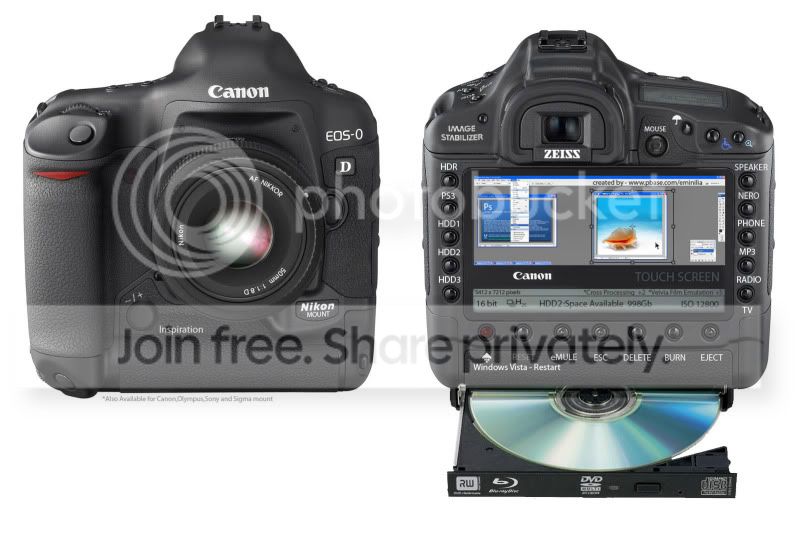
I can see Canon and Nikon merging and one of these being released......:lol:


CAMERA.jpg
 
How about variable exposure so that it will take the sky at one and the foreground at another all at the same time.... and high speed single shots like say 50 per sec I can not see how its at its peak May be with what we have right now BUT as with every thing its all around the corner.
Who would have thought we have what we got now, say 10yrs back.

I sort of referred to that in my post. A different flavour of variable exposure could be adjustable ISO across the sensor (lowering the sensitivity over sky by taking multiple averages - like the current ISO50), and doing this in an intelligent way. For example, if there is a dark building in the shot with a very bright sky a grad filter would be too limiting. However some clever algorithm should be able to take care of that. And so on..
And then VideoRAW at full resolution would enable frame grabs, and could be combined to some very funky long exposures.
 
I can see Canon and Nikon merging and one of these being released......:lol:


CAMERA.jpg

That is so yesterday - a CD drive :cuckoo:, a Nikon 50mm f1.8d :cuckoo: and windows XP to make it unstable and virus prone :bat:

Don't even get me started about HDR button. Direct print is actually useful about once in a lifetime.
 
Better dynamic range would be good but I think that would mean a total change in sensor technology to be able to capture a higher dynamic range.

A total change in sensor technology would not necessarily be a bad thing, especially for those of us for which video is important. The "rolling shutter" wobblies is a problem inherent in CMOS sensors due to the way they record an image (line by line) as opposed to the CCD sensors which record the entire frame at once.

So, I'd welcome a new sensor technology that would help eliminate rolling shutter (and this isn't just for video in DSLRs, but HD video cameras that use CMOS sensors too).

Definitely more dynamic range would be great.

And on the subject of video 23.976, 24, 25, 29.97, 30, 50 and 60fps 1080p please, and let's ditch the motion JPG codec huh Nikon? Oh and the lose the 100 image limit on continuous shooting mode too while you're at it. :)

ISO 100, 50 and 25 would be nice (even if simulated, so I don't have to degrade my lenses by throwing ND filters over the end). ISO 100K with the same amount of noise as ISO200 would be nice too (although I'm probably dreaming with that one). Less noise in the shadows would rock too.

Standardised wireless radio flash system to replace CLS/AWL (I'm not bothered about TTL support, but just a wireless flash "open standard" that would allow different manufacturers of camera & flash to talk to each other even in manual mode would be awesome).

Built in GPS, while occasionally useful would not be essential for me. I'll be picking up the GP-1 at some point, although I'd be perfectly happy if there were a way the Nikon DSLRs could at least talk to my mobile phone and/or an iPhone or something and utilise the GPS already contained within those devices (perhaps via bluetooth?)

Built in WiFi, again, I'm not that bothered about that one. It's not something I'd use all that often, although my attitude on that might change were the feature available. Wireless tethered shooting is a nice idea. :)

Electronic shutter. This is a tricky one, I can definitely see the advantage, but I would like the ability to turn it off if need be. Nikon's High Speed FP sync does just fine for me, and I'd be perfectly happy to live with that forever, I just wish there were more 3rd party flashes that were able to support it (you listening Yongnuo?) :)

 
ISO 100, 50 and 25 would be nice (even if simulated, so I don't have to degrade my lenses by throwing ND filters over the end).

Did you mean ISO 10, 5.0 and 2.5 (maybe also 1.0 and 0.1)? Now that would be cool. 5D and 1Ds do ISO50 as standard.
 
Back
Top