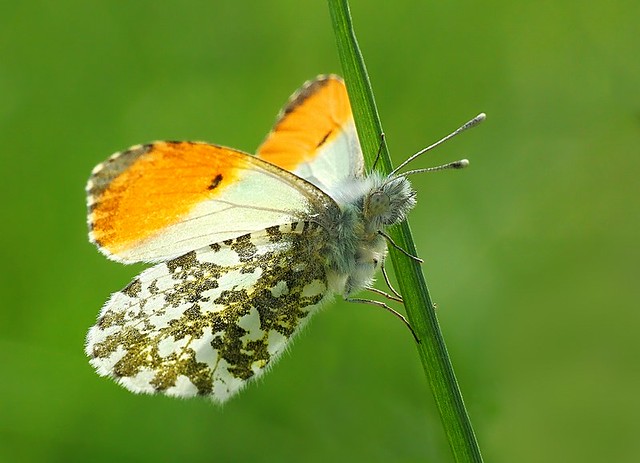
Help: Is a tripod really usable with bug and insects

Messages
1,940
Name
Dini
Edit My Images
Yes
I went out yesterday to try out my 100mm non IS macro lens. Most of the shots came out of focus. I was not using a tripod and found it very difficult to take shots of any kind of bugs. The main problems were

- They never stood still for more than a few second
- You have to wait a very long time for them to appear in a spot that will get a good composition
- You have to actually be on the same level as them i.e. physically lying down on the ground to get anything reasonable.

I was not using a tripod but i was reading around this morning and found that most people are recommending to use a tripod. Given my experience yesterday i just dont see how the tripod can be used. By the time i have set up the tripod the insect would have moved to a different spot which means i have to move the tripod again.

The other thing is that while focusing you have to move the camera backwards and forwards which im guessing is impossible with a tripod.

Do you always use a tripod and if you do how do you use it so that it doesnt slow you down?
 
Last edited:
99% of the time hand held & manual focus - tripod is not practical for macro bugs - keep practicing you'll get there in the end :)
 
For bugs, no tripod but a flash is the way to get them sharp. I sometimes use a tripod for flowers, but never for bugs, its just not practical.
 
Most of my best stuff was shot natural light with a tripod.

Bit of perseverance finding still insects pays off as the keeper rate shoots up thanks to a stable shooting platform.

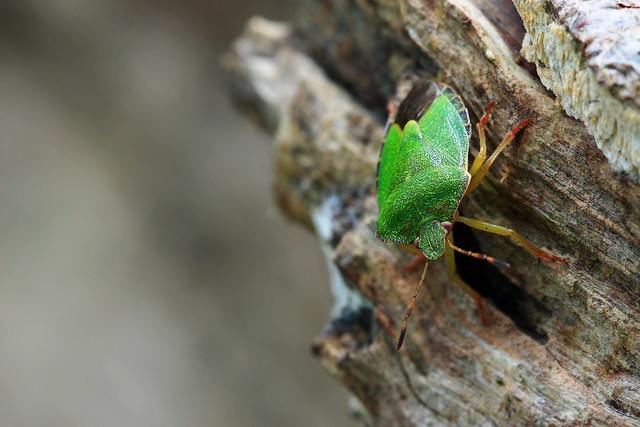
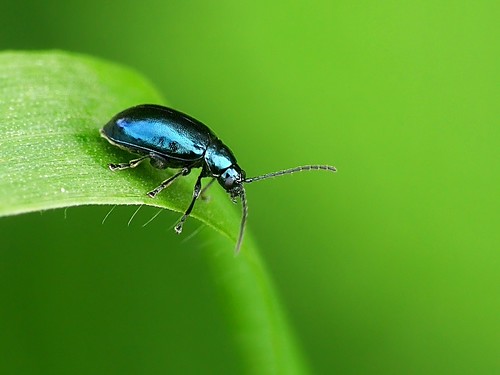
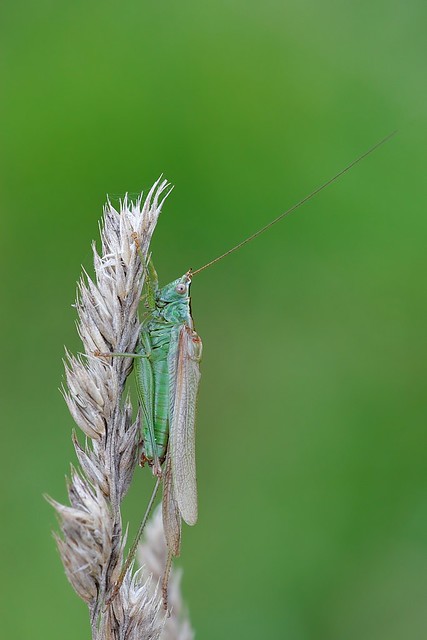
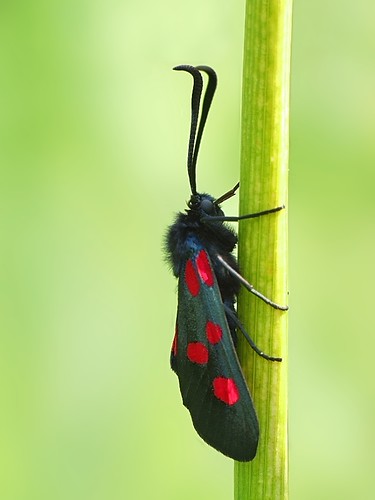
Here's some of my natural light/tripod shots.
5327073066_c3a9b95e28_z.jpg


5096935015_4d80f8b160.jpg


4976975999_8d18071752_z.jpg


4738351725_0d41ffeaef.jpg


4623504101_a60731299c_z.jpg


With all of those shots, I would have had to either up the ISO significantly or use flash if I didn't have a tripod, and flash would have resulted in blacked out backgrounds.
I do also handhold with flash some of the time, which us much more flexible than shooting with a tripod, but the quality of the light is never really the same.
Shooting natural light on a tripod is limited to pretty still days as well, wind movement makes critical focus and framing extremely difficult. A flash is a bit better on breezy days, as can freeze wind movement, but that doesn't do anything to help with the problems of focus and framing.
If you really want good quality natural light insect shots you have to go out at dawn when the insects haven't warmed up. Then you have time to set up the tripod and do long exposures.

One of my favourite macro galleries is this one:
http://www.juzaphoto.com/eng/photo_galleries.htm

This guy shoots almost exclusively natural light early in the morning with a tripod and the results speak for themselves.

A lot of insect photographers don't like tripods though. If you can't get along with it, perhaps try a monopod, having something to take the weight of the camera really helps for critical focus and framing.
 
Last edited:
A tripod can be helpful sometimes but most of the time I reckon you'll find working handheld better just because it gives you more freedom...

The settings you use are very important for getting sharp results. I'm always in full manual mode for macro work. As a rough guide you'll want to be between somewhere between about f8(at the very widest)-f22, shutter of around 1/125 or quicker, ISO at 100.

Light is absolutely crucial. You need to be using flash. If nothing else the subject will generally be underexposed at the settings you should be using otherwise.


Try those things out and see what happens - I reckon you should notice a fairly instant improvement in your results...
 
I was using a the Canon 580EX II flash. I found that the power on the flash was too strong and i could not figure out how to reduce the power so i pointed it at about 45 degrees instead of it pointing directly at the subject.

I notice that a lot of macro shots are taken at between f16 and f22. Is there any reason for this other than increasing the depth of field?
 
Most of my best stuff was shot natural light with a tripod.

Bit of perseverance finding still insects pays off as the keeper rate shoots up thanks to a stable shooting platform.

Here's some of my natural light/tripod shots.
5327073066_c3a9b95e28_z.jpg


5096935015_4d80f8b160.jpg


4976975999_8d18071752_z.jpg


4738351725_0d41ffeaef.jpg


4623504101_a60731299c_z.jpg


With all of those shots, I would have had to either up the ISO significantly or use flash if I didn't have a tripod, and flash would have resulted in blacked out backgrounds.
I do also handhold with flash some of the time, which us much more flexible than shooting with a tripod, but the quality of the light is never really the same.
Shooting natural light on a tripod is limited to pretty still days as well, wind movement makes critical focus and framing extremely difficult. A flash is a bit better on breezy days, as can freeze wind movement, but that doesn't do anything to help with the problems of focus and framing.
If you really want good quality natural light insect shots you have to go out at dawn when the insects haven't warmed up. Then you have time to set up the tripod and do long exposures.

One of my favourite macro galleries is this one:
http://www.juzaphoto.com/eng/photo_galleries.htm

This guy shoots almost exclusively natural light early in the morning with a tripod and the results speak for themselves.

A lot of insect photographers don't like tripods though. If you can't get along with it, perhaps try a monopod, having something to take the weight of the camera really helps for critical focus and framing.

Those are some great example of natural light shots. You really need to have lots of patience with natural light. I need to learn how to best shoot a subject i.e. should it be backlit or sidelit etc.
 
I've never used one, but always thought that the Manfrotto Neotec monopod was rather a handy weapon for available light macro.

Almost as good as a tripod, but almost as fast to use as hand held - put your foot on the bottom, squeeze the trigger, and it instantly adjusts to height even as you're looking through the viewfinder :thumbs:

£130 http://www.warehouseexpress.com/buy-manfrotto-685b-neotec-monopod-with-safety-lock/p1008712

Or ring-flash.

I can see how a small monopod might help.

What is the advantage of the ring flash compared to a normal 580EXII flash? I had to change the angle of the flash to point at a 45 degree angle to avoid overexposing.
 
I've never used one, but always thought that the Manfrotto Neotec monopod was rather a handy weapon for available light macro.

Almost as good as a tripod, but almost as fast to use as hand held - put your foot on the bottom, squeeze the trigger, and it instantly adjusts to height even as you're looking through the viewfinder :thumbs:

£130 http://www.warehouseexpress.com/buy-manfrotto-685b-neotec-monopod-with-safety-lock/p1008712

Or ring-flash.

The minimum height for that monopod is 74.5cm. That is a bit too high for macro but it does look like an interesting monopod for normal shots. :)
 
Ring flash helps to keep exposure even, and bare flash is just too far away unless you find a clever way to bounce from something. You can find ring-flash adapters for 580EX. They are as close as the real thing for a fraction of cost
 
Ring flash helps to keep exposure even, and bare flash is just too far away unless you find a clever way to bounce from something. You can find ring-flash adapters for 580EX. They are as close as the real thing for a fraction of cost

I just had a look at ringflashes on Ebay. They are not cheap.... :exit:
 
One technique for macro stuff is to get focus close to perfect with the lens, and then rock back and forward slightly until it is nailed then fire the shutter, a monopod is really useful for this, although it can still be done hand held.
 
ziggy©;3697705 said:
Looking at the ring flash adapter. Does it not interfere if you are manually focusing? See http://cgi.ebay.co.uk/F170-Macro-O-...ories_CameraFlashUnits_JN&hash=item4aa22ccf26

Mine is a bit bigger (and hence less suited for 1:1) so I don't have any issues. I think you have to be pretty unlucky to get a combination that prevents MF, but clearly it will become slightly crowded around the lens. For that price I think there is little to lose. Mine (Rayfash branded) cost much more than that a couple years ago.
 
I never use a tripod, I'm usually carrying a rucksac of some sort and that can be used as a big bean bag, but really unless you have the Canon IS lens flash is going to be the best option, oh and going out earlier rathe than later.

Never have quite got the hang of that bit.
 
Pleased to see the OP's question - was thinking about asking similar. Shot about 60 frames of macro this morning with only about 3 keepers - main issue was missing the focus !
 
When I photograph bugs handheld in natural light I always use continous shutter - ok there's alot of wasted shots but there's always a better chance that one or two will be decent enough.
 
Back
Top