How important is VR, IS, OS etc

Messages
2,529
Edit My Images
No
I had a conversation with some friend about cameras and lens etc. They claim that having the features mention above is better than not having it and it will effect the images quality.

I told them is only a stablizer for slow shutter, so if i using the lens at good light condition and shooting sports with fast shutter it doesn't really matter i guess?

I only asking because they told me i waste my money buying my sigma 70-200 f2.8 MKII non OS (consider i paid £300 ish for it). First they told me is third party lens so the glass is not as good as the nikon/canon and it does not have IS/VR/OS which is must have feature .......

I agree the glass is better with the canon and nikon but f2.8 70-200 for £300 you can't go wrong really ...... plus i can't see my self paying 5-6 times for something that just better but not miles better.

Am I wrong?
 
Last edited:
Nice summary. You're both right.

I think IS/VR is wonderful, but I'd have a pretty big smile at £300 :) Use a monopod and you've got the IS/VR benefit back.
 
thats what i always use when i know i can't hand hold the lens on that light condition.
 
IS/VR etc. is a luxury but far from an essential one in my book. If you learn how to support a camera effectively you can shoot at a shutter speed well below the rule of thumb of shutter speed equal to or faster than the focal length. Obviously it has it's benefits but at £300 you've got an absolute steal for a great lens. Don't let lens snobs get to you, if you're happy with the photos you take then that's all that matters.
 
It has it's uses but as said, holding technique is the key. After all it wasn't too long ago that we had none of these "aids", but still managed to get the shot.
 
Yeah ....... same to shooting with primes as well. I always tell my friend that people shoot in primes back in the day and produce superb result, so thats why i shoot with primes.
 
The Sigma may be the cheaper option, which is nice, but give most folk a choice of that or a Nikon 70-200 for free and I doubt anyone would choose the Siggy;)
Similarly, give most folk the choice of having IS or not and the decision would normally be to have it. Like all things though you pay for quality.
 
You're probably aware of the unwritten 'rule' that the reciprocal of the shutter speed should equal the focal length (in mms), in order to avoid blur from camera shake :naughty:.

Given this fact, having VR on a long zoom like the 70-200mm starts to make a lot more sense than having it on a short zoom (like the Nikon 16-35mm f/4, for example) :shrug:.

I must admit, the VR switch on my Nikon 70-200mm f/2.8 VR II is seldom set to 'Off' (although it probably would be if I ever used it on a tripod), as it frequently comes to the rescue. I've even been able to shoot at 200mm (hand held) as slow as 1/8th or 1/15th sec and get sharp shots - that really makes this lens worth the high price tag, for me.
 
I'm sure pentax and sony shooters are gloating now, what with their built in sensor based stabilisation!

VR is nice to have, and coupled with the high iso low light capabilities of the likes of the d700, has allowed me to get some shots that I probably couldn't have done previously, or certainly without as much noise or grain.
 
Far from essential on a walkabout zoom - I've recently gone from a 17-55 with IS to a 24-70 without it and don't miss it at all.

Longer lengths are a different story and it's incredibly useful on my 70-200. It's not just handy when shooting in low light - even if there's adequate light to keep the shutter speed up, it helps with framing at longer focal lengths.
 
It has it's uses but as said, holding technique is the key. After all it wasn't too long ago that we had none of these "aids", but still managed to get the shot.

But not every time.

Yes, it is essential to learn good technique when shooting long and slow. But technique and IS isn't an either/or combination. The two of them combined work better than either alone.

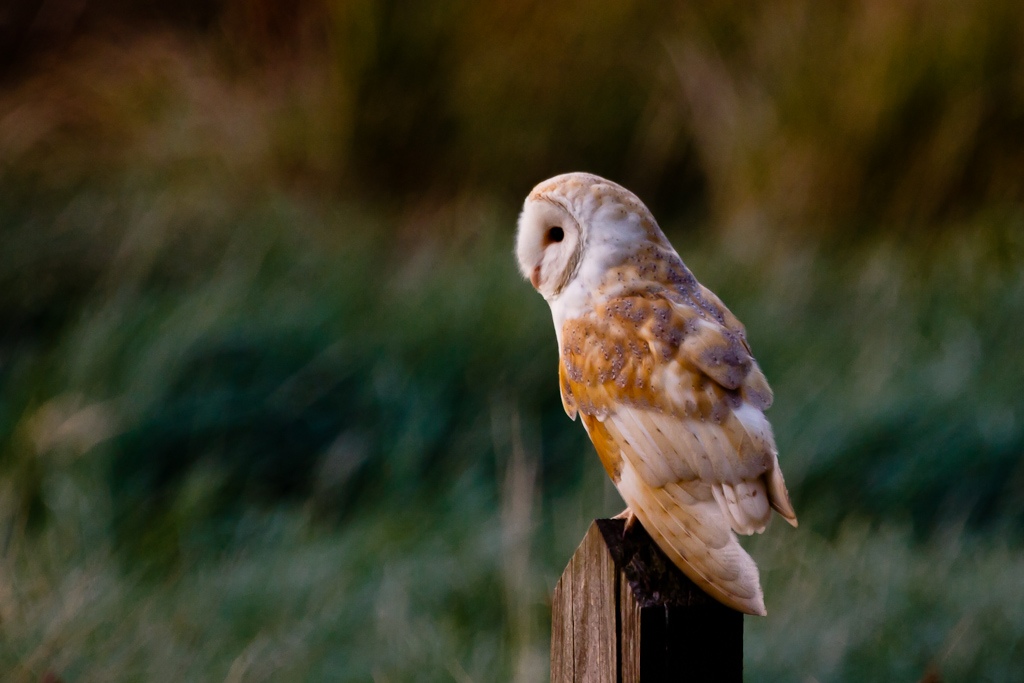
Here's an example - 600mm on APS-C, so a shutter speed of 1/1000s should be required according to the rule of thumb. This is 1/30th - five stops slower than the rule suggests. That's two stops for the IS, two stops for technique and one stop for luck.

Barn%20Owl%2020090909%20001-2.jpg
 
I'm with Frank.....

When I got my 70-200 f4 IS L , the first thing I did was snap 4 shots to see how good it was. At night, standing, hand-held, 200mm, APS-C - and only 1/60s.
Three of them were critically sharp (viewed at 100%) and the fourth was good enough for web use.
Blooming impressive!

And even more outrageous - Panasonic LX3 point and shoot pre-dawn in very sub-zero conditions. 2 second exposure hand held! Pin sharp! So were most of the others I took - only about half were rejected because of camera shake.

Modifying what Franks says - two to four stops for IS, at least two stops for good technique and the rest for luck :)
 
Don't get me wrong, IS/OS/VR is a great thing and is certainly something i want and it will be good to have it as well.

Just one of those if i can spend £300 ish for a lens with no IS/OS/VR on and it does the job ..... then why people are so bother about me not having it and try to tell me my photo is not as good because i don't have it .......

If is 200- 300 pound different i would go for IS/OS/VR version but not with £1000 different lol
 
But not every time.


Barn%20Owl%2020090909%20001-2.jpg

Of course but even with VR IS OS you still won't get the shot every time. Possibly more likely to but not every time.

I just see a reliance on aids sometimes that are not necessary to get the shot. Like histograms, sometimes useful sometimes misleading and we managed without them before they existed.:)
 
Sometimes I wish I had OS on my 70-200 siggy hsm ii, as it means im usually bumping my iso in low light to get that fast shutter required for non blurry image.
But then again for me it was 2x the price for the OS verion, which was a no no.
Given the chance I would have OS, VR any day just cant justify the price
 
I.S,VR,OS are worth having plain and simple. There are places now where you are not allowed tripods because of the health and safety aspects. Now weigh up the faster lens option F2.8 verses F4 for instance the canon f4 70-200 i.s is good for 4 stops i.s i always like to say 3 for safety on full frame the shutter needs to be 1/200 for the 2.8 on the f4 working at 3 stops 1/25 of a second. lets take it a step further Grab shots in low light you can't say to the subject hang on a minute while i erect my tripod just 2 instances that spring to mind. I grew up with film cameras and no i.s would i go back the answer is no do i have lenses without i.s yes and i still use them :D
Regards
Richard
 
What everyone is missing and a very important point is how steady ones hand is. Yes you can use a support resting against something but not every time. Its ok for younger member to say you don't need Image Stabilisation but as you get older ones hands may not be as steady as they once were in which case it is more or less essential.

Realspeed
 
Stabilisation is just another tool to help get the shot you want.

Do you 'need' it - that all depends on what and when you shoot. As already mentioned, the 'rule of thumb' is that shutter speed should be 1/FL or faster.

So if you take shots between ~1(0.25xFL) and ~1/(1.5xFL) then you are in the region where stabilisation will help (unless you are using a tripod, of course).

Since I ma using a Sony, I have stabilisation built in, and leave it on unless using a tripod - and I have certainly taken successful shots significantly slower than 1/FL - Stabilisation, Technique, Luck ?

I don't know, but given a choice between two systems (body + lens), one of which include stabilisation, one which didn't, then if other factors were equal it seems an easy choice to take the one which gives that extra option for when it might help.
 
Back
Top