

You are using an out of date browser. It may not display this or other websites correctly.
You should upgrade or use an alternative browser.
You should upgrade or use an alternative browser.
Image Stableisation And Tripods
- Thread starter glennk
- Start date


- Messages
- 6,584
- Name
- Phil
- Edit My Images
- Yes
I instantly know when I've forgotten to turn stabilization off. Images are always soft.

- Messages
- 3,307
- Name
- Nick
- Edit My Images
- Yes
Phil Young said:I instantly know when I've forgotten to turn stabilization off. Images are always soft.
It's infuriating!

- Messages
- 6,290
- Name
- scott
- Edit My Images
- Yes
tripod off, monopod on.
- Messages
- 6,584
- Name
- Phil
- Edit My Images
- Yes
nickjohnwatson said:It's infuriating!
Especially after a 15 minute exposure....
- Messages
- 3,307
- Name
- Nick
- Edit My Images
- Yes
Phil Young said:Especially after a 15 minute exposure....
Lol, I took a load of photos the other week and was half asleep and forgot I had it on manual focus lol so nothing was in Focus durrrrrrrr

DannyDMR said:How about handheld in studio? On or off
Hand held. On.
- Messages
- 6,290
- Name
- scott
- Edit My Images
- Yes
If using studio lights then i dont think it will matter, my nikon 28-70 f2.8 doent have it and it works, just remember to keep your shutter speed to match the focal length and take into account the crop factor ifyou have a crop sensor camera.

- Messages
- 4,988
- Name
- Laurence
- Edit My Images
- No
This is a question that keeps going round and round my head. There is some information available, one from Canon on how IS works and some info on tripods:
http://cpn.canon-europe.com/content/education/technical/image_stabilization_lenses.do
and another page that's quite interesting:
http://www.dlcphotography.net/TripodAndIS.htm
I will keep IS turned on when using my 100mm F2.8L macro lens on a tripod because my Canon body has a special macro mechanism that utilises IS with this lens (http://www.ronmartblog.com/2011/08/understanding-canons-hybrid-is-and.html). Although it's on a tripod I still keep moving backwards and forwards in MF.
The only other long lens I mount on a tripod is a 500mm F4L. However, I use this with a gimbal head so I keep IS turned on because it's not locked down.
I still don't know if this is correct!


- Messages
- 3,696
- Name
- Frank
- Edit My Images
- Yes
This is a question that keeps going round and round my head. There is some information available, one from Canon on how IS works and some info on tripods:
http://cpn.canon-europe.com/content/education/technical/image_stabilization_lenses.do
Excellent link.
It includes a list of lenses that require IS to be turned off when on a tripod.
EF28-135mm f/3.5-5.6 IS USM
EF75-300mm f/4-5.6 IS USM
EF100-400mm f/4.5-5.6L IS USM
EF300mm f/4L IS USM
I'm surprised at how short it is.
- Messages
- 3,696
- Name
- Frank
- Edit My Images
- Yes
OK, being a scientist I thought I'd try an experiment. These are crops from a 20-second exposure using my 24-105. This lens is said to have an IS system that can tell if it's on a tripod and switch into its 'special' mode. IS-on is on the right (or is it the left?)...
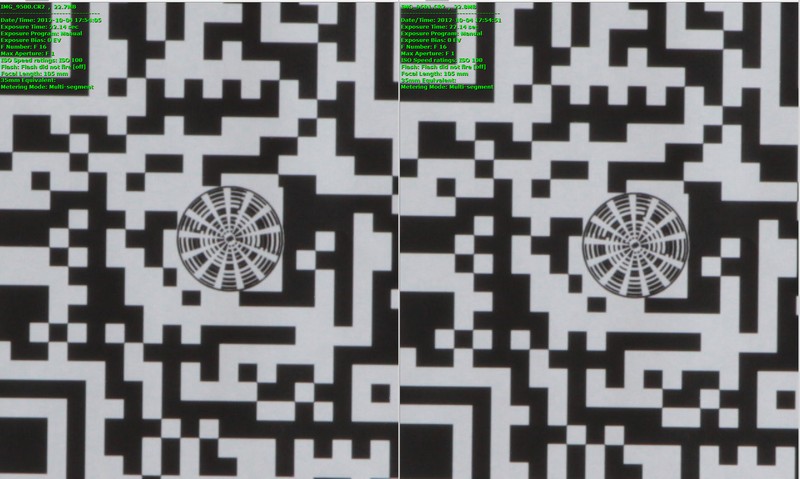
Now with the 100-400. IS-off is on the left...

Now with the 100-400. IS-off is on the left...
- Messages
- 4,988
- Name
- Laurence
- Edit My Images
- No
Interesting results, chalk and cheese really.
I can't see any difference in the 24-105 samples but there are variables that could affect the 100-400 result.
Can I ask how the body/lens was mounted in both cases?
Did you do any tests using faster shutter speeds?
I can't see any difference in the 24-105 samples but there are variables that could affect the 100-400 result.
Can I ask how the body/lens was mounted in both cases?
Did you do any tests using faster shutter speeds?
- Messages
- 3,696
- Name
- Frank
- Edit My Images
- Yes
Interesting results, chalk and cheese really.
I can't see any difference in the 24-105 samples but there are variables that could affect the 100-400 result.
Can I ask how the body/lens was mounted in both cases?
In both cases i used my big, solid tripod. Both were shot using f16, ISO100, 22s.
Did you do any tests using faster shutter speeds?
Nope. The IS effect on the tripod is more obvious with long exposures.

- Messages
- 1,224
- Name
- Adrian
- Edit My Images
- Yes
I remember using my 28-135 on a tripod with Liveview for ring-focussing. Every time I took the shot on the cable release, the tripod head dropped a small number of degrees. I checked the tightness and shot again - same thing. I was getting quite puzzled and annoyed because the head was very tight and I couldn't budge it yet it was still loose enough to drop when I took the shot.
Doh! :bang: - IS was on and the head wasn't dropping at all but the IS was kicking in on the cable release press (and the shots were very vertically smudged).
Doh! :bang: - IS was on and the head wasn't dropping at all but the IS was kicking in on the cable release press (and the shots were very vertically smudged).


- Messages
- 4,016
- Name
- Duncan
- Edit My Images
- Yes
Excellent link.
It includes a list of lenses that require IS to be turned off when on a tripod.
EF28-135mm f/3.5-5.6 IS USM
EF75-300mm f/4-5.6 IS USM
EF100-400mm f/4.5-5.6L IS USM
EF300mm f/4L IS USM
I'm surprised at how short it is.
It is definitely incomplete.
I had a batch of 30s exposures ruined recently using the 70-200 f4 IS until I worked out the blur wasn't wind buffeting. As soon as I tuned off the IS the shots were pin sharp.
- Messages
- 3,696
- Name
- Frank
- Edit My Images
- Yes
It is definitely incomplete.
I had a batch of 30s exposures ruined recently using the 70-200 f4 IS until I worked out the blur wasn't wind buffeting. As soon as I tuned off the IS the shots were pin sharp.
Hmmm. I may have to test that.