Learning photography from AI?

Messages
4,871
Name
Graham
Edit My Images
No
Here is a link to a video about using "Vision Mentor" to help you process a photograph based on "your" vision of what you want the final print to look like.

It's 37 minutes long, so a bit of a watch, but having watched it (after initially dismissing the idea) I'm wondering if there isn't some value in it.

Before watching it, (if you have even considered it) it's probably worth wading through my comments below the link.

View: https://www.youtube.com/watch?v=_uTmLegwk2g


Blake Rudis, a longtime YouTuber, provider of online courses, and Photoshop panels, has developed this software (you pay per session, and it's online only).

Blake studied Fine Art, and started life as a painter. He became rather notorious for his over the top HDR photographs. which he now admits to being rather ashamed of, and now runs an online community for photographers called F64 Academy. Part of his offerings is a 1;1 photo critique, which he charges $247 for. The AI-driven "Vision Mentor" is trained to give the same sort of advice that you would get directly from Blake, but at about $2 a picture.

I have completed several of his courses, many of which come with Photoshop panels that automate things learned during the course. I found the courses very good, but tend not to use the panels. One panel, "The Visionary Panel", featured in the video, is a customised compilation of multiple panels suited to Blake's workflow.

The "Vision Mentor" software begins by asking you what you want from the photograph you are asking for help with. This is written as a statement, which can include describing the reason you took the photograph, the mood you are trying to achieve, the story you are trying to tell, important features you want to emphasise etc.

It then allows you to upload several photographs and suggests which of them best matches your statement.

After this, you select a single photograph, and it suggests how you could process it. The assessment includes information on colour theory (ie does it suit a complementary or analogous, etc colour scheme) and a map indicating how the viewer's eye is likely to move through the picture.

After processing, the software will reassess the picture in terms of your original statement and refine its advice until you are happy with the results.

I thought that "Vision Mentor" chose the wrong picture to best meet Blake's brief, and at the end of the video Blake agrees and his choice matched mine.

It also analyses all the pictures you have asked for help with and identifies "recurring habits".

I have never been that fond of Blake's photographs, finding his "boldness" with colour a bit too much for me, and "Vision Mentor" suggests that Blake's recurring habit is to make his pictures too colourful and over-saturated.

I found it more interesting than expected.

It is probably useful to be forced into describing my expectations from a photograph in more detail than I would normally.

After you wade through the AI gibberish, it seemed to have some useful things to say, and,

Although the technical advice was pretty generic (with a bit of a PS bias) it could well be useful in giving direction when you are trying to achieve a specific effect and don't know how.
 
Before watching it, (if you have even considered it) it's probably worth wading through my comments below the link.
I don't think I saw them... there were only two comments posted/showing... I didn't watch the video.

For a while I kept getting shown ads for this AI software that was all about compositional rules/guides/flow. It supposedly determined the way a person would view an image and how their eyes would move through it. I thought it was largely bunk...

That said, I do think AI can potentially help editing an image... perhaps better than most software/plugins.
 
I don't think I saw them... there were only two comments posted/showing... I didn't watch the video.

For a while I kept getting shown ads for this AI software that was all about compositional rules/guides/flow. It supposedly determined the way a person would view an image and how their eyes would move through it. I thought it was largely bunk...

That said, I do think AI can potentially help editing an image... perhaps better than most software/plugins.
I'm not sure what "two" comments you are referring to ;-(

I had several paragraphs of comments posted below the link to the video, and these are still visible to me.

And I don't get any ads when I click on the link, it goes straight to the video where Blake walks you through how it works.

It all seems a bit strange :-(

But it's my time to be puzzled, you link takes me to a DP review thread on rolling shutter, nothing about editing an image.
 
I'm not sure what "two" comments you are referring to ;-(

I had several paragraphs of comments posted below the link to the video, and these are still visible to me.
Perhaps he's blocking them from public view?
1787499431363.png
And I don't get any ads when I click on the link
I meant directed towards me in general; on social media/etc...
 
The thing that occurs to me about this software, is that it seems to regress photography to the times of the Royal Photographic Society, when every type of picture and subject "had" to be photographed in a particular way and printed according to a set of rigid rules.

I started taking pictures in the mid 1960s, when there was a new paradigm emerging: photography as one of the graphic arts. There were people producing their own magazines using all sorts of technology and they were publishing images that would have had the "gentlemen" of the RPS fainting in their chairs, or reaching for their horse whips. The clarion cry was that "the rules are dead" and while there was, as usual, a lot of dross, there was also a great deal of interesting imagery with photography, print design and typography working together.

This software strikes me as regressing to the RPS phase of history, which I don't consider a good thing.
 
The thing that occurs to me about this software, is that it seems to regress photography to the times of the Royal Photographic Society, when every type of picture and subject "had" to be photographed in a particular way and printed according to a set of rigid rules.

I started taking pictures in the mid 1960s, when there was a new paradigm emerging: photography as one of the graphic arts. There were people producing their own magazines using all sorts of technology and they were publishing images that would have had the "gentlemen" of the RPS fainting in their chairs, or reaching for their horse whips. The clarion cry was that "the rules are dead" and while there was, as usual, a lot of dross, there was also a great deal of interesting imagery with photography, print design and typography working together.

This software strikes me as regressing to the RPS phase of history, which I don't consider a good thing.
Im getting into using ai to help my photography, but limiting the scope to helping me with research and understanding articles/essays, that sort of thing. Google NotebookLM is my friend!

I’d be wary of using it any more than that in my photography for the reasons mentioned above.
 
The thing that occurs to me about this software, is that it seems to regress photography to the times of the Royal Photographic Society, when every type of picture and subject "had" to be photographed in a particular way and printed according to a set of rigid rules.

I started taking pictures in the mid 1960s, when there was a new paradigm emerging: photography as one of the graphic arts. There were people producing their own magazines using all sorts of technology and they were publishing images that would have had the "gentlemen" of the RPS fainting in their chairs, or reaching for their horse whips. The clarion cry was that "the rules are dead" and while there was, as usual, a lot of dross, there was also a great deal of interesting imagery with photography, print design and typography working together.

This software strikes me as regressing to the RPS phase of history, which I don't consider a good thing.
Have you actually watched it, because I didn't think it did this at all.

Why I changed my mind from my initial thoughts was because it was the photographer who guided the AI to help them produce the photograph they wanted to produce.
 
Im getting into using ai to help my photography, but limiting the scope to helping me with research and understanding articles/essays, that sort of thing. Google NotebookLM is my friend!

I’d be wary of using it any more than that in my photography for the reasons mentioned above.
Did you watch the video?
 
Did you watch the video?
More of a click through


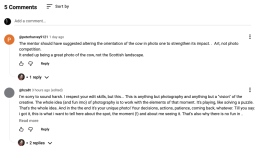
I probably wouldn't recommend it to anyone wanting to develop or learn photography, for several reason really.. AI models are trained to understand what 'good', 'bad, 'successful' is - hence why I agree with Andrews point. I've already started seeing people use Ai critiques in the wild, specifically on a street photography facebook group, and these critiques create an echo chamber between the photographer and the computer. And i'm not sure vision can be taught in terms of a single photograph and defiinitly not in the context of photoshop, vision happens long term when you look at patterns across bodies of work and possibly requires self reflection

if someone wanted to do well in camera club competitions then I would see value in it
 
Last edited:
I skipped through the advert video. But my overall impression was that a) he started with some poor photos so why should I pay any atention, b) it is likely to do just what others have said; reinforce particular ideas of what is good - just like camera clubs and YouTube in general do.

Given his Fine Art background he should know better. What Fine Art did for me was teach me to look at lots of work, including stuff I don't think I like, in various media and form my own opinions.

Really, the only way to make better pictures is to look at loads of them, make many more yourself (including more bad ones than good ones) without being afraid to fail, and think critically about your work in all regards.

What most people coming into any creative space lack is the confidence to make mistakes, hence the popularity of the 'how to make great photographs' videos these days.

Making pictures is the only way to learn. There are no quick fixes that videos or AI can give you.
 
More of a click through


I probably wouldn't recommend it to anyone wanting to develop or learn photography, for several reason really.. AI models are trained to understand what a 'good', 'bad, 'successful' is - hence what I agree with Andrews point. I've already started seeing people use Ai critiques in the wild, specifically on a street photography facebook group, and these critiques create an echo chamber between the photographer and the computer. And i'm not sure vision can be taught in terms of a single photograph and defiinitly not in the context of photoshop, vision happens long term when you look at patterns across bodies of work and possibly requires self reflection

if someone wanted to do well and camera club competitions then I would see value in it
Thanks

I've obviously come away with a very different impression.

I'm not convinced this model has been trained just as simplistically as you suggest. Blake has trained it to replicate the type of critique he provides his f64 members and other paid for critiques he offers.

I see the "Vision" part as being at three levels

The first is your vision for the photograph; without a clear vision that you can articulate, the program doesn't know what to do, nor will you be able to refine your interaction with the program as you go through the process.

I think that as people use this program, they will be forced into reflecting more deeply about the photographs they take, and what they are trying to achieve.

The second part, is in giving practical help with processing the picture so that it matches your vision for it, This is where the program combines Blakes knowledge programmed into the AI, with the AI dreived knowledge of art, colour theory, composition and photographic processing to suggest ways of processing the file to match what you want to achieve.

The third part is that it keeps track of all the pictures you have given it to analyse and gives a critical overview based on all the pictures it's seen.

I liked the fact that that this clearly just a helper applcation, and I felt that over time, you would become better at thinking about the hows and whys at the taking stage (because you need to articulate these to the program) and better at knowing how to use your processing software, because while the program is interactively teaching what you could do, it is still leaving you with the responsibility of actually doing it.

I also liked, contrary to your impression, that the photographer was encouraged into self reflection throughout the process, and if someone was hoping for a quick fix to make prize winning photographs, they would very disapointed with the program.
 
I skipped through the advert video. But my overall impression was that a) he started with some poor photos so why should I pay any atention, b) it is likely to do just what others have said; reinforce particular ideas of what is good - just like camera clubs and YouTube in general do.
Yep, I'm not sure why he picked such a poor picture. But in many respects it's not about making great photgraphs, but leaning how to process pictures to match the vision you have for that picture. Which is what he did.
Given his Fine Art background he should know better. What Fine Art did for me was teach me to look at lots of work, including stuff I don't think I like, in various media and form my own opinions.
I know from his courses and other videos that Blake would absolutely agree with this. But...

The "Vision Mentor" is a cheap, more accesible, alternative to his one to one, and group ctritiques, wich follow the same pattern as the "Vision Mentor". He gets the photographer to explain what their vision for the picture is, and then goes through how he would process the picture to best acheive their vision.

Having seen some of his critique sessions, and thinking about it, as with the "Vision Mentor" he tends not to critique the photograph as a "photograph", but simply assesses it against the photographers "vision" of what they wanted from the picture. He then describes the parts of the picture that he feels don't contribute to this vision, the parts that do, and how things might be improved through different processing. Which is very much what the "Vision Mentor" does. maybe it's got the wrong name.

Really, the only way to make better pictures is to look at loads of them, make many more yourself (including more bad ones than good ones) without being afraid to fail, and think critically about your work in all regards.

What most people coming into any creative space lack is the confidence to make mistakes, hence the popularity of the 'how to make great photographs' videos these days.

Making pictures is the only way to learn. There are no quick fixes that videos or AI can give you.
I obviously agree wiith this, but the "Vision Mentor" is primarily about the processing stage, and improving your skills in making a picture look the way you want it to look, and in understanding the realtionship between what you want the picture to say, and how this can be supported by your processing choices.

How important this is, will depend on the kind of photgraphs you make.

While I find my people and wildife picture easy to process, as they are "subject" driven, I find my landscapes very difficult to process because they are more "mood" driven.
 
I skipped through the advert video. But my overall impression was that a) he started with some poor photos so why should I pay any atention, b) it is likely to do just what others have said; reinforce particular ideas of what is good - just like camera clubs and YouTube in general do.

Given his Fine Art background he should know better. What Fine Art did for me was teach me to look at lots of work, including stuff I don't think I like, in various media and form my own opinions.

Really, the only way to make better pictures is to look at loads of them, make many more yourself (including more bad ones than good ones) without being afraid to fail, and think critically about your work in all regards.

What most people coming into any creative space lack is the confidence to make mistakes, hence the popularity of the 'how to make great photographs' videos these days.

Making pictures is the only way to learn. There are no quick fixes that videos or AI can give you.
At what point in the use of Ai is it no longer a photograph and might as well be fully Ai generated without a shutter having been opened. It feels like it’s back to when software like IG had filters that people applied to EVERY image because the photo was so boring that the only way to make it interesting was to schlep some 1970 Polaroid interpretative filter on it to make it look “retro”.
 
Back
Top