Lens development

Messages
34
Name
CB
Edit My Images
Yes
I recently bought a couple of new lenses for my mirrorless system and it occurred to me that lens development has analogies with electric car development - specifically their batteries. .

Both are old technologies and the pace of improvement is quite slow. Camera lenses have been in production since the 19th century; they still use glass which can mean a lot of weight for wide aperture long lenses and although efforts to reduce bulk have been made, one has to wonder about lack of any real innovation... such as use of materials other than glass.

Is it likely we will see any breakthrough with lens technology? Are manufacturers even bothering with R&D these days - given that statistics suggest only around 5% of photographs are taken with "proper" cameras?
 
Well, you've got me thinking now. I must admit it's difficult to see how they could develop a lens without glass. But it's the sort of thing I enjoy musing over and takes me into the realms of science fiction. And actually, thinking about it I could foresee them dispensing with glass and maybe using some sort of photo sensitive plate instead, combining a sensor and some sort of zoom capability. Beam me up.... :D
 
Last edited:
I realise that some lenses have elements which are not glass but glass predominates and is what causes the weight.

I guess the question could be why after nearly 200 years of development glass still predominates? After all they gave up using glass in aircraft cockpits! :D
 
Last edited:
I realise that some lenses have elements which are not glass but glass predominates and is what causes the weight.

I guess the question could be why after nearly 200 years of development glass still predominates? After all they gave up using glass in aircraft cockpits! :D
The properties needed for craft cockpits rate strength & light weight as priorities, while refractive index & dispersion are more critical for lenses.

Over those 200 years there have been many different types of 'glass' used,
There are quite a few glass types are now banned due to the harmful materials in their formulations, but there are still many types used, especially low dispersion glasses which were not available in the early days....

Another new technology you might want to read up on is diffractive optics, a technology which makes some impressive claims.
 
There's a possibility that those flat nano lenses we heard about a while back may actually happen one day. For those who have no idea what I'm vagally talking about or who want to know more let Google be your friend.
 
I think the latest glass has benefitted from some huge technological improvements:

Computer modelling allows more complex designs. No more reams of calculations for lens designers.
Continuous production produces cheaper and more consistent glass stock.
Modern coatings allow large amounts of individual lenses within a lens as virtually no light is lost at an air-glass boundary.
Better motors allow faster focussing (and bigger lenses) without huge batteries.
Modern plastics are light and can replace metal (and sometimes glass)
Modern manufacturing is just more consistent.

So now you get big lenses which are consistently sharp but are cheap. The top lenses still cost the same as that is what the market works to.

What is next? More Fresnel lenses to make them shorter and lighter? Defocus control? Switchable to continuous aperture for movies? Controllable sharpness or flare?
 
I think a lot of recent development in terms of lenses has been much greater use of computer modelling to optimise designs - we are seeing more f/1.2 primes, sharpness across the frame is improving, etc - there are smaller, lighter lenses, but the 'premium' lenses are generally all about maximising aperture/IQ rather than reducing weight.

@Erty Looks like we had similar thoughts posting at the same time :)
 
Last edited:
I realise that some lenses have elements which are not glass but glass predominates and is what causes the weight.

I guess the question could be why after nearly 200 years of development glass still predominates? After all they gave up using glass in aircraft cockpits! :D

For sure glass is a large part of the lens, but weight with newer higher end mirrorless lenses in particular is also impacted heavily by multiple a.f motors. A lot of premium mirrorless lenses have 4 a.f motors.

I can't remember which brand it was now but I seen a patent for a lens somewhere within the last couple of weeks that was talking about having 6 or even 8 a.f motors.
I recently bought a couple of new lenses for my mirrorless system and it occurred to me that lens development has analogies with electric car development - specifically their batteries. .

Both are old technologies and the pace of improvement is quite slow. Camera lenses have been in production since the 19th century; they still use glass which can mean a lot of weight for wide aperture long lenses and although efforts to reduce bulk have been made, one has to wonder about lack of any real innovation... such as use of materials other than glass.

Is it likely we will see any breakthrough with lens technology? Are manufacturers even bothering with R&D these days - given that statistics suggest only around 5% of photographs are taken with "proper" cameras?
Their has been huge leaps forward with lens design especially in the last 10 years.
 
I realise that some lenses have elements which are not glass but glass predominates and is what causes the weight.

I guess the question could be why after nearly 200 years of development glass still predominates? After all they gave up using glass in aircraft cockpits! :D

The flaw is in the question "why after nearly 200 years of development glass still predominates?".

In those 200 years optical glasses have improved very significantly,

Ian
 
There are more plastic bottles in the world than ever.
There’s also drinking vessels made from plastic. And there’s been huge amounts of investment to promote the use of plastics for those items.

But if I’m buying wine, or enjoying a glass of something with dinner, there’s nothing that is better than a glass bottle of wine or a nice glass to drink it out of.

And to add to @Ian Grant above, lens design has changed dramatically in my lifetime, first with exotic glass, then AF, then with computer aided design, but more significantly with mirrorless cameras, and the assumption that a camera can in some ways mitigate faults in lens designs. I’m saying that as a recent buyer of a 45mm 1.2 lens from a major manufacturer that wasn’t eye wateringly expensive
 
And to add to @Ian Grant above, lens design has changed dramatically in my lifetime, first with exotic glass, then AF, then with computer aided design, but more significantly with mirrorless cameras, and the assumption that a camera can in some ways mitigate faults in lens designs. I’m saying that as a recent buyer of a 45mm 1.2 lens from a major manufacturer that wasn’t eye wateringly expensive

Forgetting advances in Autofocus, the biggest changes have been lens coatings, introduced in 1938, and much later aspherical lens elements.

Carl Zeiss Jena began coating lenses in 1938, but only for a few select lenses, Taylor, Taylor, & Hobson (Cooke) had also perfected lens coatings before WWII but were asked to keep their techniques secret. Around 1939/40 CZJ Patented dual layer coatings.

Post WWII coatings were introduced on all higher end lenses and initially lenses carried a coating symbol, CZJ used a red T, Schneider an inverted red triangle, Wray used red lettering for FL and widest aperture. When all their lenses were coated manufacturers stopped adding the symbols. These early coatings often have a bluish tinge, not an issue with B&W but requiring a warm-up filter for colour reversal films.

Around 1962/3 coatings were improved, giving a better balance for colour photography. The Color Skopar, CZJ Pancolar, Pentax Super Takumar lenses are examples of these newer coatings. These lenses used 2 or more coatings.

The last major improvement was the Carl Zeiss collaboration with Pentax for their Super Multi Coated SMC Takumars, released in 1971, using a 7 layer coating. Other companies followed with their own improved equivalent coatings.

I use many vintage lenses, 1860s onwards, which are uncoated, design affects contrast, surprisingly a pe-WWI Goerz 120mm Dagor has excellent contrast, it only has 2 internal air/glass surfaces, uncoated Tessars have a slight drop in contrast, 4 internal air/glass surfaces, and Ihagee-Goerz dialyte relatively low contrast as it has 6 internal air/glass surfaces.

For some tears I was using a 1953/4 T coated CZJ 150mm Tessar contrast was the same as my Multi Coated LF lenses, as was the Yashinon on a Yashicamat124, also a Tessar type.design. I also use Kodak 203mm f7.7 Ektar lenses, these are coated dialytes, and again excellent contrast.

When I was shooting E6 with my Pentax SLRs you couldn't see any difference between the Super Takumar and the SMC Takumar 55mm lenses.

Where Super Multi Coating, and its equivalents, had the greatest impact was with zoom lenses, and when you look at how many elements and air/glass surfaces there are in modern zoom lenses you realise the importance of these coatings,

Ian
 
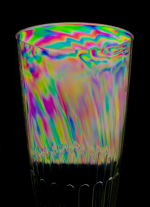
Car rear screens show significant polarized patterns and they're glass!
 
There's probably no incentive to make lenses out of lighter materials. Lens snobs moan about composite lens bodies feeling plasticky. They're not going to shell out thousands on plastic lens elements no matter how good they are!
 
Car rear screens show significant polarized patterns and they're glass!

It's due to the hardening process they go through.

Yes, in the UK such vehicle glazing is called "toughened glass" and the process means the glass will shatter into small fragments designed to be a non cutting hazard.

PS unlike front screen glass that is now laminated and originated IIRC from a time when toughened glass allowed front seat occupants not seat belted in were thrown through the screen with fatal consequences:(
 
It's due to the hardening process they go through.


I'm sure that plastics can be made without the stresses that cause the polarized patterns that your glass shot shows.

Now that the classic cars are emerging from hibernation, I'm sure we'll see plenty of toughened glass front screens (through Polaroid sunnies!)
 
All optical lenses are manufactured from materials that most people wouldn't associate with transparency.

The material is made transparent by a variety of processes and then made into objects such as tumblers or optical lenses by further processing. Various materials have been found to be superior to traditional optical glass for specialised purposes. It seems that plastics are being used more for both technical and cost reasons.
 
Why bother with glass and lenses and all that old fashioned stuff that belongs in a museum when we have holograms. Just ditch the lenses... :exit:
 
Lenses are over rated, we do not really need them in photography to take good interesting images.

Some of the best pictures I have seen here on TP are taken by @Kevin Allan with his pin hole cameras, No Lens at all.
 
I remember reading about metalenses a few years ago, they're only the thickness of a layer of paint and can be optically superior to any glass lens. Whether they'll get developed for the mass market in my lifetime I'm not sure. I think once mainstream there will be no need for traditional cameras as phone will be able to have full frame sensors (or bigger) and be able to produce images as good as anything else.

 
Hmmm plastic lenses are the norm with spectacles , there’s also unsubstantiated adverts coming out of the Chinese market of self adjusting spectacle lenses that adjust from near to distance focus automatically.. this may well be the next step forward. . But as most of the main camera companies are Japanese based ,the owners not the factories.. a lot of r&d is kept very secret. And given a fickle marketplace with phones dictating the market a slow release guarantees a continuous sales market .
Cameras and lenses these days are usually long lived and highly priced no point throwing billons of yen at new products that differ very slightly to what’s already available .
 
Back
Top