Low Light Wedding Photography

Messages
60
Name
Melanie
Edit My Images
Yes
I recently took some photos at my friends wedding (just as guest, not main photographer). Although my daylight photos came out well, the ones shot indoors in low light seems to be something i need to improve on.

I tried with and without flash, using diffuser on the flash and bouncing it off the ceilling all on high ISO 1600 using both the 18-55mm and 35mm lens (see below for detailed spec) but nothing seemed to give me good photos.

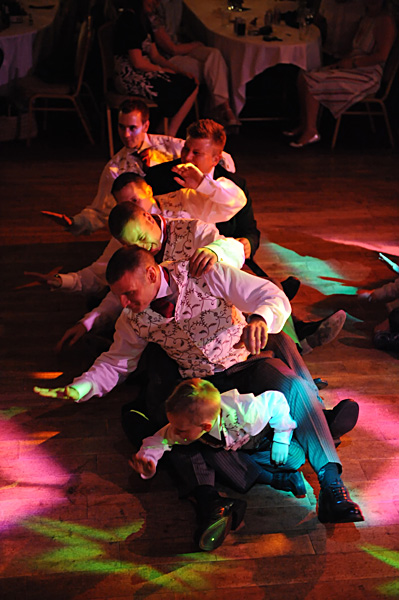
On most of the photos the people seemed a bit 'ghosty' because the people have moved that i was shooting - ie during the first dance song

I have been invited to another wedding soon which I want to take some good photos at, so am looking for any tips on what equipment/settings are best to use to get some good low light photos indoors and outdoors.

thanks in advance.

My equipment - Nikon D40 DSLR camera with 18-55mm f3.5-5.6G lens (came with it), Sigma 70-300mm F4-5.6 DG Macro Lens, Nikon AF-S 1.8G DX, Jessops 360AFD flashgun with a diffuser which fits on it and a Manfrotto tripod
 
Flash and the 35mm is the way to go for me, although I am only a beginner myself.

I dont think high ISO on the D40 will give very good results, I have just upgraded to the D90 and that is one of the major differenes.
 
A D40 at 1600ISO and a f1.4 lens wide open will work wonders. My second shooter used A D40 with the sigma 30mm f1.4 and got some decent results.
Personally, I use the D3 and 24-70 at f2.8 to get this sort of result:
3725437075_a0cf03dde9_o.jpg
 
And that Melanie is one very good reason that wedding pros spend so much on equipment :)

In such low light it's up with the ISO and down with the apertures. All my lenses are f2.8 or better F1.4 being the fastest I have. These give me superb light gathering into the camera and that is one area that you will struggle with in any kind of natural lighting if using your zooms.

So your f1.8 is the way to go and try to have a practice with your flash. Basically you have ghosting because your shutter speed is too slow to freeze the action and you will probably have a sharp bit where the flash went off and a ghosty bit where the people are moving while the shutter is open.

There are a few things to try depending on the effect you want. If you just try to get faster shutter speeds you run the risk of only having the subject sharp and everything else being like a black hole. Ideally you want to be able to blend the ambient lighting with the flash. It depends how quickly the people are moving what kind of shutter speed to go for to get the right amount of movement.

Indoors I favour ISO 800, f4 and 1/60 sec and use the flash for fill on my subject usually held off camera.

For first dance I'll play with the shutter speeds. I have mine set to rear curtain synch which means I get the movement in the pic more behind the sharp bit and I'll go down to 1/20 or slower to deliberately get movement in there.

Have a play with your flash till you get the right mix of flash and ambient for you :)
 
A D40 at 1600ISO and a f1.4 lens wide open will work wonders. My second shooter used A D40 with the sigma 30mm f1.4 and got some decent results.
Personally, I use the D3 and 24-70 at f2.8 to get this sort of result:
3725437075_a0cf03dde9_o.jpg

Personally I'd hate to use a D40 at such a high ISO, my D60 was awful at anything above 400 even with a 1.8, which seems to be the fastest lens she has.
 
As most images are used within an album, and low light images aren't really sold as individual prints, the image size tends to be fairly smallish. Noise is relative to image size and several of the D40 images were used within albums after suitable noise reduction etc.

It's a matter of perspective
I'm aware the OP states she has a 1.8, my mention of the Sigma 1.4 was advisory in nature
 
Personally I'd hate to use a D40 at such a high ISO, my D60 was awful at anything above 400 even with a 1.8, which seems to be the fastest lens she has.

D40 is 6mp, D60 is 10mp so different sensor. More pixels crammed into the same space = more noise for these previous-generation cameras. IIRC the D40 is the same pixel density as the D3 so you can see how the D40 could be pretty good ISO-wise. I've no problem with it at all. In fact, in B&W there is virtually no noise at ISO 1600.

In this case, even though the equipment is lower budget, I see no reason why good results can't be achieved. The lens is really as fast as you need, and ISO 1600 can give good results on the D40. It's the settings that need refining.

So. It sounds like you're using a non-shutter priority metered mode (P or A) with the flash. There's simply too many variables here for the camera to know exactly what look you're after. Do you want the shutter-drag with light trails look, or the sharp subject with darker background look? You need to drive the camera's controls to tell it what to do. Maybe take a few shots in P without the flash to find the correct exposure for the background, choose the correct shutter speed to get the motion frozen, bumping the ISO if necessary to maintain exposure. Set the background to underexpose about a stop, then turn the flash on. I don't know if the Jessops flash is I-TTL, so you may need to adjust the flash power manually to get the look you want. Experiment.

A note about focussing - the 35mm f/1.8 will need accurate focusing to give sharp results at large apertures, and in the dark you'll probably need the focus-assist light, which means AF-C mode and central focus point. If you focus-recompose, the camera might think you're gone out of focus (you probably will, slightly). The D40 will not fire if it thinks you're out of focus unless it's in manual focus, so you might need to flick the lens focus switch if the camera refuses to shoot when you think it should. A foible in the D40 I'm afraid.
 
I use a Gary Fong light sphere and love it for the night time shots. Unless you are trying something like the photo posted by Gareth, you generally want to have your shutter speed slow enough to take in some ambient light of the surrounding area whilst then firing the flash to freeze the main subject you are capturing.

My base settings would be 24-70 lens at f2.8, 1/60sec shutter and iso 400-800 with rear curtain sync and flash set to ttl - I then tweak as a go! I find going too wide open just puts you at risk of missing the focal point of the shot

I have heard of photographers who really slow the shutter speed down and follow the dance by bobbing in time to the couple - but I am not that confident to chance it on a wedding itself!
 
Part of the problem may be that the camera tries to burn the background by slowing down the shutter speed, this will be when you have the camera on AV etc. As Bouncy says using the rear flash curtain fires the flash at the end of the shutter period so highlighting the target and hopefully freezing the action. Alternatively use manual and freeze the action but have a dark background, practice seems to be the watch word.
 
I recently took some photos at my friends wedding (just as guest, not main photographer). Although my daylight photos came out well, the ones shot indoors in low light seems to be something i need to improve on.

I tried with and without flash, using diffuser on the flash and bouncing it off the ceilling all on high ISO 1600 using both the 18-55mm and 35mm lens (see below for detailed spec) but nothing seemed to give me good photos.

On most of the photos the people seemed a bit 'ghosty' because the people have moved that i was shooting - ie during the first dance song

I have been invited to another wedding soon which I want to take some good photos at, so am looking for any tips on what equipment/settings are best to use to get some good low light photos indoors and outdoors.

thanks in advance.

My equipment - Nikon D40 DSLR camera with 18-55mm f3.5-5.6G lens (came with it), Sigma 70-300mm F4-5.6 DG Macro Lens, Nikon AF-S 1.8G DX, Jessops 360AFD flashgun with a diffuser which fits on it and a Manfrotto tripod

We could do with seeing some examples, but you'll probably find better results by putting the camera on to Shutter priority and selecting 1/60 or so as has been suggested earlier.

Even with high iso and flash sometimes the camera will drop the shutter speed below useable speed if using Auto or Aperture priority modes. If you can do rear curtain sync on the flashgun that's useful too.

I tend to use similar settings to The_Bulb above.
 
thank you to everyone for your help.

will stick to using my 35mm prime lens as most people have recommended to use that one.

it just seems to be getting the right balance of using flash but still using the ambient light available.

some of the shots were done on auto but most on manual, so will try using the shutter speed priority option at 1/60th to see if that improves the pics.

I have a cable so i can use my flashgun off camera, but only to about 2 metres *** as it is still attached to my camera.

To 'The Bulb' i have had a look at the Gary Fong lightsphere - it looks like a good bit of kit that might be worth investing in.

To 'gheesom' - that photo is ace! unfortunately dont have any radio triggers or know anyone i can borrow some off - might put them on my xmas list for xmas 2010 ***!

To 'martsharm' i only got the jessops flashgun recently for xmas and unlike the last one, this one has a screen on the back - so i will have a look into how to change the settings as currently i have just been using it in TTL mode and not adjusting anything on the flash.

i have attached a couple of pics for you all to see the results im currently getting the aperture/shutter speed details are under each photo on flikr

Pic 1 - with flash but no ambient light of disco
Pic 2 - think i used flash but is blurry
Pic 3 - think i used flash but is blurry

1) http://www.flickr.com/photos/46674058@N04/4389369884/
2) http://www.flickr.com/photos/46674058@N04/4388601585/
3) http://www.flickr.com/photos/46674058@N04/4388601275/

thank you everyone for your advice.

melanie
 
Back
Top