My new APS-C 50-200mm zoom lens is actually 75-300mm?

Messages
46
Edit My Images
Yes
Ok so i was lucky enough to pick up one of these Sigma 50-200mm f4-5.6 DC Optical Stabiliser HSM for £80 this weekend.
It is sold as a DC (Nikkor DX) lens meaning its made for APS-C camera like my Nikon D5000 so surely the advertised zoom of 50-200mm should be correct?
But am i right in thinking its actually 75-300 due to the sensor on my camera as mentioned on the link above?

In which case would this mean my other two lens the (kit 18-55mm DX lens and a Nikon DX 35mm) follow suit and are actual a larger zoom then advertised? or are they correct and Nikon sell their DX lenses at the correct zoom for APS-C sensor and this is just how some companies ie Sigma advertise there APS-C (DC) lenses by quoting the zoom for a full frame sensor and not a smaller APS-C sensor?
Thanks
 
The lens itself is a 50-200mm no matter what body you put it on. DX or FX, the lens remains the same.

The field of view is altered dependent on which body it is on.
 
Ok so i was lucky enough to pick up one of these Sigma 50-200mm f4-5.6 DC Optical Stabiliser HSM for £80 this weekend.
It is sold as a DC (Nikkor DX) lens meaning its made for APS-C camera like my Nikon D5000 so surely the advertised zoom of 50-200mm should be correct?
But am i right in thinking its actually 75-300 due to the sensor on my camera as mentioned on the link above?

In which case would this mean my other two lens the (kit 18-55mm DX lens and a Nikon DX 35mm) follow suit and are actual a larger zoom then advertised? or are they correct and Nikon sell their DX lenses at the correct zoom for APS-C sensor and this is just how some companies ie Sigma advertise there APS-C (DC) lenses by quoting the zoom for a full frame sensor and not a smaller APS-C sensor?
Thanks

All focal lengths on lenses are quoted 35mm ("full frame" on digital) lengths, so as Fracster says, your lens is a 50-200, no matter what body you put it on, irregardless of whether it is APS-C or full frame.

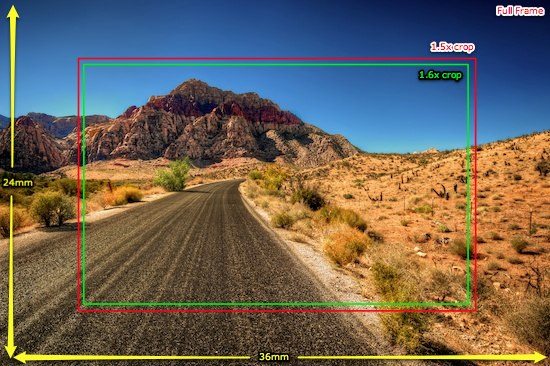
If you look at the example image below you can see that the image recorded by a camera like yours, with an APS-C sensor, is only a portion of the "true" picture, which gives the effect of a longer focal length, but the fl itself doesn't alter.

sensor-size.jpg
 
yeah i know about the cropping that takes place on a APS-C camera.
Just wasnt sure how lenes are marketed and if it differed between companies etc for their APS-C (DX,DC etc) lenes.

So am i right to now think that that all of my lenses quoted zoom is that for a full frame sensor therefore technically on my camera they are say roughly 1.5x there quoted zooms? ie for the 18-55mm kit its 27-82.5mm and for my 35mm prime 52.5mm?
And that the only difference between an APS-C lens ie Nikon DX, Sigma DC etc and a full frame lens is if they were used on full frame bodies i would experience Vignetting?
 
Last edited:
lenses quoted zoom is that for a full frame sensor

Again, focal length has nothing to do with sensors or films. Focal length is a distance from lens on which light from the infinity is focused, full stop.

The same actually applies to the aperture - F2.8 on crop will give the same DOF as F4 on full frame. However in terms of light it's still F2.8, because f-number is how many times focal length is greater then physical diaphragm diameter.
 
Last edited:
yeah i know about the cropping that takes place on a APS-C camera.
Just wasnt sure how lenes are marketed and if it differed between companies etc for their APS-C (DX,DC etc) lenes.

So am i right to now think that that all of my lenses quoted zoom is that for a full frame sensor therefore technically on my camera they are say roughly 1.5x there quoted zooms? ie for the 18-55mm kit its 27-82.5mm and for my 35mm prime 52.5mm?
And that the only difference between an APS-C lens ie Nikon DX, Sigma DC etc and a full frame lens is if they were used on full frame bodies i would experience Vignetting?

Essentially, yes. The difference though isn't with the focal length, that remains the same whether a lens is used on a DX or FX camera, but rather with the field of view, a 50mm lens, for example, field of view on a DX Nikon that would be the same as that of a 75mm lens on full frame, something that is often referred to as the 'effective focal length'.

In reality it's not worth bothering about.....
 
It's not worth getting confused about!

The simple way to explain it is ALL focal ranges on lenses relate to as they would be on a 35mm film camera, regardless if they are for crop of full frame, and they are all relative to eachother.

Take the crop factor out of the equation.

The only difference is the crop lenses cover a smaller image circle as the sensors are smaller.
 
If you come from 35mm to digital, you have a pretty good idea what angle of view to expect from a 50-200 lens, so the crop factor can come as a bit of a shock when you lose some of the width you were expecting. however, if you are just starting with a crop body, what you see through the viewfinder is what you'll get in the finished shot, so don't stress about it.
 
Back
Top