ND Filters for Landscapes

Messages
387
Name
Matt
Edit My Images
Yes
Hi all,

I've been taking landscape photographs for quite some time and I'll soon be trying out some long exposures, most probably of beaches.

I understand I need an ND Filter? I've been looking for these and I see things like ND3, ND4, ND8 etc... I need a 52mm filter.

Could somebody explain how these filters work and which I should get?

Cheers,

Matt
 
Hi Matt

If you are shooting landscapes then I would imagine you will need graduated filters to keep the sky from being too bright. These filters vary in strength and certain manufactures adopt a different numbering system.

0.3 = ND2 - Hold light back by 1 stop
0.6 = ND4 - Holds the light back by 2 stops
0.9 = ND8 - Holds the light back 3 stops
1.2 = ND16 - Holds the light back by 4 stops

Ideally for your typical landscape shot you'd need a 3 stop graduated filter to hold the sky back. You then need to decide if you want soft edged or hard edged. A soft edge is exactly that, a smoother gradient, these are ideal for uneven horizons. If you are shooting a seascape for example where the horizon is flat and uninterrupted then a hard edge will work better.

I would recommend slot in filters opposed to screw in filters. For this you would need a filter holder, a 52mm adaptor ring and of course the filter itself.

Hope this helps.
 
Last edited:
ND filters basically just work like sunglasses, they simply make things darker by allowing less light through. The number is mearly a way to measure the darkness or density of the filter, they can range anything from ND2 to ND1024(commonly referred to a 10 stop filter).

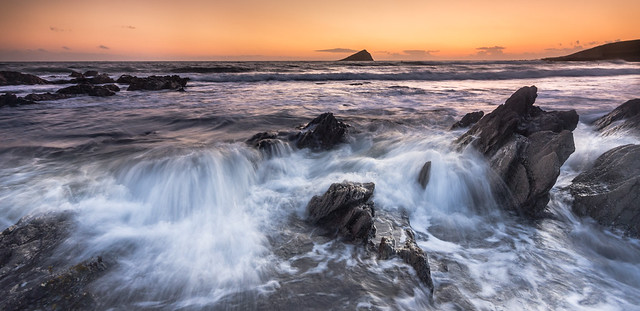
As for what one you want then it depends on the lighting conditions and what you want to achieve. For example an ND4 filter might allow you to slow the shutter speed enough to blur the water a bit like this:
6902036263_110a18fa02_z.jpg


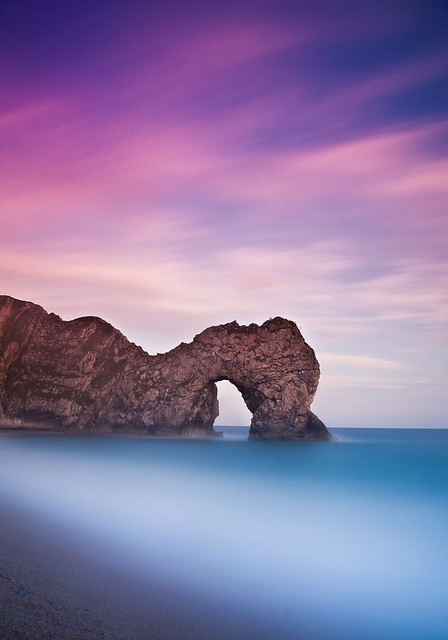
However a 10 stop filter will produce a radically different result more like this:
6040647891_34585f5a7d_z.jpg


Both were taken at a beach so it depends on what you want as I said.
Personally I have an ND8 filter and a two 10 stop filters (a B+W screw in one and a Hitech Pro 10 Stopper). I think personally I want an ND4 to allow me greater flexibility.

I'd recommend buying a slot in filter which means something from Hitech or Cokin will be fine unless you want to spend a lot more money and get a set of Lee filters (excellent quality but they cost a LOT), you will also need a slot in filter holder, I would recommend probably just using the P-series filters (google it to find more) and go from there.

As for 10 stop ND filters I would recommend a B+W ND110 filter, I have one and its immense, much much better than my Hitech Pro 10 stopper and as good as the Lee Big Stopper.

Hope this helps :)
 
Scott makes a valid point, ND grads are similar but different but also immensly useful, if you can afford it get both, personally it took me the best part of a year to get all the filters I have and there are couple more I still ideally want.
 
If you're wanting to do long exposures of say, running water, then you will need a neutral density filter to increase the exposure times to anything up to several seconds long. Each filter manufacturer has their own reference numbers indicating the strength of the filter. Personally, I use B+W screw-in filters and have an ND 106 and ND 110 which require an extra 6 stops and 10 stops respectively.
 
Wow! Thanks for the massive response guys! Really appreciate it, I've taken it all on board and just want to clear some things up!

I use an ND4 for seascapes, and you said it will allow me to blur the water, i take it, it doesn't do it automatically and I still need to slow my shutter speed down yeah?

I use an ND8 for general landscapes?

Sorry if I sound like a complete newb, I just don't want to order the wrong things! lol

Cheers,

Matt
 
I use an ND4 for seascapes, and you said it will allow me to blur the water, i take it, it doesn't do it automatically and I still need to slow my shutter speed down yeah?

You can use whichever suits you best in all honesty. In the case of seascapes or rivers/waterfalls, the longer the exposure, the more of a 'misty' look the water begins to appear. An ND4 is fine, but if you can I'd go for something stronger as well - a 10 stop filter will give you some wonderful results.

As for metering with stronger filters, I personally take the reading without the filter first, and then add the necessary extra exposure once the filter is screwed on.
 
Any ND could be used at the sea or land. Basically if you went to the beach setup your camera and composition etc, then took a meter reading and to expose your shot correctly your camera is saying a shutter speed of 1/40, now if you stick a ND4 filter on the front of your camera a shutter speed of 1/10 will allow you to correctly expose your shot (1/40 x 0.25 = 1/10 as a ND4 lets through 25% of light, an ND8 would let through 12.5%, a ND16 would let through 6.25%, a ND1024 (10 stop filter) would let through 0.098% light etc etc etc).

I hope that helps clear it a bit more but there isnt a right or wrong ND filter for landscapes or seascapes, just the right ND filter for the effect your looking for and the lighting conditions
 
(1/40 x 0.25 = 1/10 as a ND4 lets through 25% of light, an ND8 would let through 12.5%, a ND16 would let through 6.25%, a ND1024 (10 stop filter) would let through 0.098% light etc etc etc).

Minor nitpick, but someone might read this and get confused...

You want (1/40) * 4 as you're increasing the exposure time, '1/40 * 0.25' would actually be 1/160 not 1/10.

The calculation for a n stop filter is actually fairly simple, it's "original_time * 2^no_stops", since a ND4 is a 2 stop filter, you're dealing with 2^2 which is of course 4 - hence the '4' in ND4. (A stop is a doubling/halving of the light available, thus the power of 2 sequence)
 
Any ND could be used at the sea or land. Basically if you went to the beach setup your camera and composition etc, then took a meter reading and to expose your shot correctly your camera is saying a shutter speed of 1/40, now if you stick a ND4 filter on the front of your camera a shutter speed of 1/10 will allow you to correctly expose your shot (1/40 x 0.25 = 1/10 as a ND4 lets through 25% of light, an ND8 would let through 12.5%, a ND16 would let through 6.25%, a ND1024 (10 stop filter) would let through 0.098% light etc etc etc).

I hope that helps clear it a bit more but there isnt a right or wrong ND filter for landscapes or seascapes, just the right ND filter for the effect your looking for and the lighting conditions

Minor nitpick, but someone might read this and get confused...

You want (1/40) * 4 as you're increasing the exposure time, '1/40 * 0.25' would actually be 1/160 not 1/10.

The calculation for a n stop filter is actually fairly simple, it's "original_time * 2^no_stops", since a ND4 is a 2 stop filter, you're dealing with 2^2 which is of course 4 - hence the '4' in ND4. (A stop is a doubling/halving of the light available, thus the power of 2 sequence)

There are mistakes or typos in both answers :thinking: With filters you just have to learn the number of stops invloved.

One stop is a doubling of exposure, therefore x2 (also expressed as an optical density of 0.3, just to confuse things). Therefore two stops is x4 or 0.6, three stops is x8 or 0.9, and so on.

Ten stops is x1024 (often rounded to x1000) or 3.0. That's extremely dark and, for example, increases 1/1000sec to 1 full second.

Edit: to the OP, you need to be clear about the difference between ND filters, that are dark all over and used to lengthen the overall exposure so you can use longer shutter speeds in bright light (milky water etc), and ND Grads that are darker at the top fading to clear, used to darken the sky without affecting the overall exposure time.
 
Last edited:
There are mistakes or typos in both answers

Not entirely sure why you think there's a mistake in stating that 1/40 * 0.25 is 1/160.

Go use a calculator, I'll wait, but you'll find it's correct.

(Hint: 1/40 * 0.25 = 1/40 * 1/4 = 1/(40 * 4) = 1/160)
 
Not entirely sure why you think there's a mistake in stating that 1/40 * 0.25 is 1/160.

Go use a calculator, I'll wait, but you'll find it's correct.

(Hint: 1/40 * 0.25 = 1/40 * 1/4 = 1/(40 * 4) = 1/160)

You're going the wrong way Nikki ;)
 
You're going the wrong way Nikki ;)

No, I was pointing out that pwynn was going the wrong way, the correct application is 1/40 * 4, since you're trying to increase the exposure time by 4.

No matter which way you are attempting to compensate exposure, the underlying mathematics does not change, 1/40 * 0.25 (or 0.025 * 0.25) will always be 1/160 (or 0.00625).

personal opinion: Using woo or intuition instead of mathematics does not lead to a solid understanding of exposure and how to compensate for changes to one of the 4 elements of exposure (speed, aperture, iso/sensor-gain and available light).
 
All this demonstrates is that a sound understanding of stops is all that's needed for using filters.

(The whole x0.25 was a side-track to irrelevance that's not going to help anyone - how much light a filter lets through as a percentage has to be the least useful thing to have an argument about here. I can't think of a single circumstance it would be interesting to know, let alone useful)
 
I can't think of a single circumstance it would be interesting to know, let alone useful
Depends which way you think.

I know that if the filter lets through 50% of the light (1 stop), I need to double the exposure. 0.1% and it needs to be 1000x as long as there are 1000 0.1's in 100.

30% transmission ~ 3x the exposure (3 x 30 ~ 100).
 
No, I was pointing out that pwynn was going the wrong way, the correct application is 1/40 * 4, since you're trying to increase the exposure time by 4.

No matter which way you are attempting to compensate exposure, the underlying mathematics does not change, 1/40 * 0.25 (or 0.025 * 0.25) will always be 1/160 (or 0.00625).

personal opinion: Using woo or intuition instead of mathematics does not lead to a solid understanding of exposure and how to compensate for changes to one of the 4 elements of exposure (speed, aperture, iso/sensor-gain and available light).


If you need to increase the exposure by two stops, then 1/40sec in the example becomes 1/10sec.

Yeah mine was a typo, 1/40 x 4 = 1/10 was what i was meant to write. The light transmittance is 25% for a ND4 filter

Your typo was 0.098% that should have been 0.0098%. I think!
Edit: Or even 0.00098 :eek:


All this demonstrates is that a sound understanding of stops is all that's needed for using filters.

(The whole x0.25 was a side-track to irrelevance that's not going to help anyone - how much light a filter lets through as a percentage has to be the least useful thing to have an argument about here. I can't think of a single circumstance it would be interesting to know, let alone useful)

Quite. Poor OP must be totally baffled by now :eek:

Stick to stops. Simples.
 
Last edited:
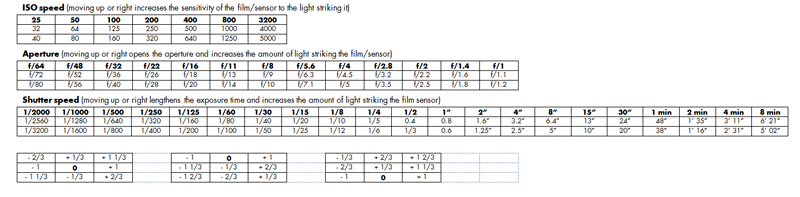
I just think stops.. if I'm metering 1/250 and want 1 second, how many times must I double 1/250 or half 1 second. Makes it easier to do either mentally or on the back of an envelope with a scrap of pencil. It also makes it mush easier when you start trading-off aperture or ISO against your shutter speed as stops becomes a common currency for calculations.

I find a printed table in the camera bag even easier to use in the field..


Left or right is one stop, up or down is 1/3rd stop.


It's also a little simplistic to think of creating long exposures purely by a filter strength. You don't use an ND4 to get a certain water effect.. you use a certain shutter speed in combination with an understanding of the movement in the scene to get the effect. The ND filter is just to get you to that shutter speed in combination with the other exposure parameters. The ND filter required will vary according to the ambient lighting level, and the shutter speed required will vary according to the strength of movement in the scene.


Edit: no prizes for spotting the glaring typo in my table.. time for a reprint and refresh the one in the camera bag
 
Last edited:
Easy way of adjusting exposure for ND filters, assuming your camera is set at one third stop exposure increments, which most are by default.

Just count the clicks on the dial, ie two stops is 2x3=6 clicks, tens stops would be 10x3=30 clicks. Bonus is the number of clicks always remains the same, regardless of the starting point.

You've got to turn the dial anyway, so why not just count them? Handy as a double-check if you prefer working from a table.
 
If you need to increase the exposure by two stops, then 1/40sec in the example becomes 1/10sec.
Which is exactly what NikkiA said ;)

Your typo was 0.098% that should have been 0.0098%. I think!
Nope... 10 stop = 2^10 = 1024 therefore percentage of light let through = (1/1024) * 100 = 0.098 which approximates to 0.1%. 0.098% is correct ;)
 
Which is exactly what NikkiA said ;)

She said 1/160sec, twice! Which is reducing the exposure by two stops. Two stops more exposure than 1/40sec is 1/10sec.

Nope... 10 stop = 2^10 = 1024 therefore percentage of light let through = (1/1024) * 100 = 0.098 which approximates to 0.1%. 0.098% is correct ;)

Damn percentages! Quite right, and apologies to Pwynn :) It's 1/1000th anyway LOL
 
She said 1/160sec, twice! Which is reducing the exposure by two stops. Two stops more exposure than 1/40sec is 1/10sec.

[PEDANT=arad85]
Yes. She did it in correcting pwynn-mackenzie....

Read it again, she said you want 1/40th x 4 which would give 1/10th not 1/40th x 0.25 which would give 1/160th which is what pwynn-mackenzie originally said (but corrected in the next post).
[/PEDANT]
 
Thanks aswell pwynn! I can see myself buying a lot of ND Filters! haha

She's going to kill me! :bang::bonk:

Don't buy lots.. start with an ND4 and an ND8, that will enough to get started. The effects are cumulative.. put a 2-stop filter on a 3-stop filter and you get a 5-stop filter (see how using stops makes things easy..).

Don't buy 52mm round filters unless that's the largest filter size used on any lens you are ever likely to buy. Go larger (77mm) and get a set of step-down rings, or go the Cokin/Hitech/Lee 100mm square filter route.

If you're shooting digital on a budget, the 7DS ND filters aren't that bad (not as bad as the price would suggest). But you do get a better quality of filter by paying for a better make.
 
Theres a few apps that calculate different exposure settings and nd filters.
Well worth a download, very helpful!
 
If you wanted to confuse me you've done it! haha!!

LOL Sorry bud. The reply you got from Digifrog in post #2 was actually spot on! Before we all tried to be helpful :eek:
 
Last edited:
What kinda prices are a budget ND4 and ND8 roughly costing today?
 
What kinda prices are a budget ND4 and ND8 roughly costing today?

Do you mean straight ND or ND Grad? Round screw-in or square slot-in? Either way, from about a tenner to £100 depending, and with a slot-in you'll need to spend similar on a holder and lens adapter ring.

Lee, Cokin, HiTech, Hoya, B+W, Kood, SRB to name a few.
 
Do you mean straight ND or ND Grad? Round screw-in or square slot-in? Either way, from about a tenner to £100 depending, and with a slot-in you'll need to spend similar on a holder and lens adapter ring.

Lee, Cokin, HiTech, Hoya, B+W, Kood, SRB to name a few.

Square slot in ND grads
 
Back
Top