ND Filters

Danny133

Suspended / Banned
Messages
1,530
Name
Daniel
Edit My Images
Yes
Can somebody please explain this to me?

Ive seen pictures with these 10 stops?

But what do they do? They look really nice but i dont get it lol

And these charts i really dont understand.

Can someone put it into idiot speak please and also link me to a couple ..
 
A 10 stop filter will reduce the amount of light reaching the sensor by.... 10 stops therefore you need to decrease the shutter speed accordingly to get the exsposure. It makes it possible to have a 30 second exposure in the middle of the day, this can be good for creating mirror like waters of the movment of clouds in the sky.

The charts you see tell you how long your shutterspeed should be for a given aperture when the 10 stop filter is attached.
 
so i set a 30 second exposure during the day with the filter attached at which aperture? or doesnt that matter?

i guess i expose the image as normal using the light meter .. set the shot up and then attach the filter ..

i dont understand what i set it to .. 30 seconds or remote release for however long ...

confused.com
 
Lets say you are shooting at f8.0 and 1/125 without a 10 stop filter. The scene involves running water and you want that nice misty look to the water, the problem is the shutter just isn't open long enough - we need less light.
If we pick a higher aperture DoF gets changed, which is undesirable, in any case we discover that this still doesn't give a long enough shutter time.

So, we set back to f8.0 and attach our 10 stop filter, we leave the aperture alone but lengthen the shutter time so we can keep it open and get the misty water look. As our filter is rated at 10 stops we need to add 10 full stops to the shutter speed, which gives us 8 seconds shutter time.
Note that although they are rated at 10 stops it appears that sometimes this isn't always dead accurate, so you might need to add (say) only 9 stops to the shutter time.

Look around and there are lists of shutter stops and/or apps that will calculate it for you.
 
Are there any charts out there more accurate than others?

And are there any links to good filters without paying a whack?
 
Are there any charts out there more accurate than others?

And are there any links to good filters without paying a whack?

No offence but if you don't understand "what they do" why on earth are you thinking about buying one?

To use ND, of any strength, it is best to meter without the filter, put the camera into manual, add the filter then adjust what was in your camera by how many stops you want.

eg if you had a 5 stop, and were metering at f/8 and 1/125 you would use f/8 and 1/4
 
Are there any charts out there more accurate than others?

And are there any links to good filters without paying a whack?

Charts ? you mean for stops ? hmm can't say I've ever seen differences, but don't look at them that much, I generally just work it out manually (or guess if its going really long :eek:).
Just remember that you've got 1/3rd stop increments on the camera (by default anyway).

Most end up buying a lee big stopper (hard to get hold of and not cheap) or a B+W screw on, about £80 for a 77mm.

This is a half decent little article http://www.photonhead.com/beginners/shutterandaperture.php

Found this to get you going: http://www.photographyuncapped.com/...er-speeds-by-third-and-half/articles/2009/03/
 
10 stops is basically a factor of 1000X (or close enough). So if you had an exposure without the filter of 1/1000, which is the same as 0.001, then adding the filter would give you an exposure of 1 second. If the exposure without the filter was 1/100, which is the same as 0.01, then the filter would give you a 10 second exposure. If your bare exposure was 1/8, which is the same as 0.125, then your filtered exposure would be 125 seconds.

Just express your bare shutter speed as a decimal instead of a fraction and multiply by 1000 by shifting the decimal point three places to the right.
 
Danny, have you read any of the tutorials on here? Lots of good stuff, including one on there that's aimed directly at folks like you http://www.talkphotography.co.uk/forums/showthread.php?t=99841

Have you got a book on basic photographic theory and technique? You need to get a handle on some simple fundamentals, then a lot of things will just fall into place. ATM you seem to be flitting from one thing to another and missing a lot of the stuff inbetween that makes it hang together ;)
 
No offence but if you don't understand "what they do" why on earth are you thinking about buying one?

because you have to start somewhere and learn sometime .. hence its a forum .. its what its for mate!

nows the time to learn so im asking ...

thanks everyone :)
 
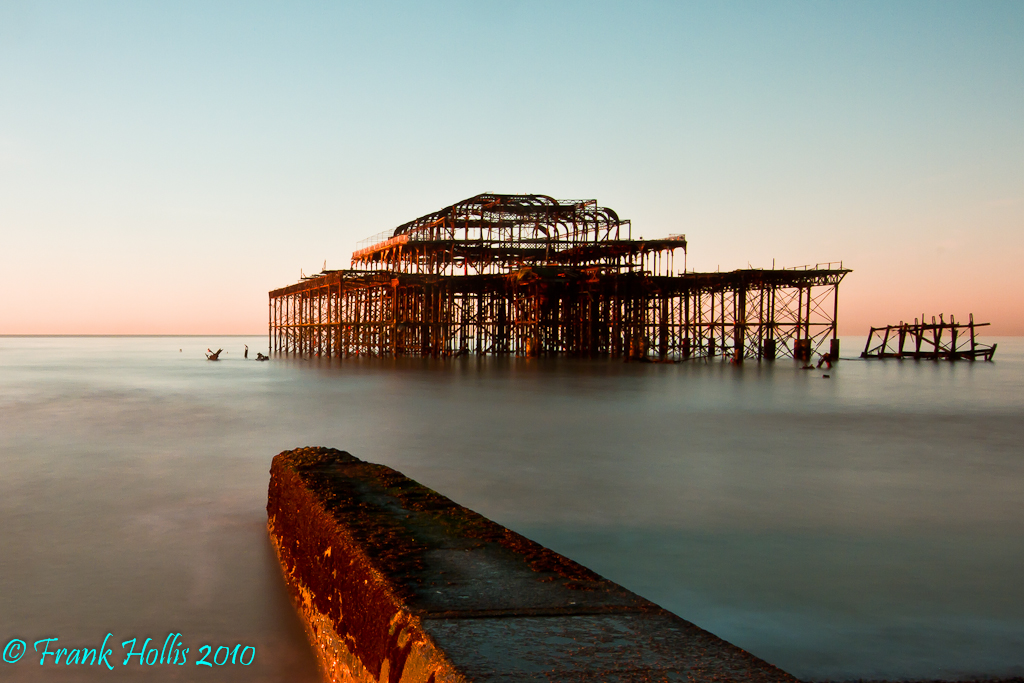
Here's an image with stacked 3 and 6 stop ND filters.

Old%20Pier.jpg


It needed a 20s exposure to get the sea looking flat and misty but I also wanted the bright morning sunlight for the colours.
 
does anyone have any links to ones to buy? 10 stoppers that is
 
Danny, that's only a 3 stop filter, which is quite a way short of 9 or 10 stops. I've actually just ordered one of those Hoya Pro-1 77mm 3 stop filters myself, but for about £20 less including delivery from Digital Rev....

http://www.digitalrev.com/en/hoya-7...g=hoya+77mm&search_category_id=0&match_type=1

1 stop means 2X the exposure
2 stops mean 4X the exposure
3 stops mean 8X the exposure, hence ND8.

My 9 stop filter is an ND500. 10 stops would be ND1000.
 
Last edited:
ahhh every manufacturer has a different numbering system! :@ lol

i want the 10 stop one i assume?
 
What you need depends on what you want to accomplish, how you wish to set the camera up and how bright the ambient light is. You need to consider some lighting scenarios - e.g. sunny day, hazy day, light overcast, heavy overcast, and where you want to end up with shutter speed AND aperture.

Take a look at this guideline of exposures based on the "Sunny 16 Rule" - http://en.wikipedia.org/wiki/Sunny_16_rule. For the different lighting conditions listed, if you choose the corresponding aperture then you can shoot with a shutter speed = 1/ISO without a filter. But changing any of the variables of ambient brightness, aperture or ISO will all have an effect on the suggested shutter speed. You need to figure out, for each scenario, how many stops of filtration you will need to achieve the shutter speed you want.

There is no "one size fits all".
 
Last edited:
what is the most commonly used then?

i cant afford more than 1 so will have to have 1 and hope for the best lol

with summer coming up i would assume 10 would be more useful than 3 lol
 
OK, assuming a bright, sunny day, at f/16 and 100 ISO your "correct" shutter speed would be roughly 1/100. A 3 stop filter (ND8) would get you to 1/13. 9 stop would get you to 5 seconds, which is in the right ballpark for some creamy shots. A 10 stop filter would get you to 10 seconds. Of course, you can jiggle those numbers further by opening the aperture or raising the ISO, but either of those things will speed up your shutter again.

Although stacking filters is not ideal, it is something you could also do. A CPL will lose you between 1 and two stops depending on brand/quality and how you have it set, so a 9 stop ND and a CPL (which is dead handy to have anyway) might be a good combo.

I want the 3 stop for shooting motorsport through fencing and for outdoor portraiture with flash. It might work for landscape type stuff too, but the ND500 is a good balance of price and performance for that sort of work. I also have some ND grads, so between all that lot I do have many options.
 
what is the most commonly used then?

i cant afford more than 1 so will have to have 1 and hope for the best lol

with summer coming up i would assume 10 would be more useful than 3 lol

Depends what your shooting...


Ive got a 3Stop Hoya ND screw in filter - use for waterfalls.

Also have a 4Stop Graduated ND slot in filter - for controlling sky.

...and a Lee Big Stopper 10Stop slot in (on order) for blurred water and clouds.


Tripods (re: the monopod thread) are essential for 10 Stops Id have to say...
 
Last edited:
Yes.
He is awaiting stock though, so if you are in a rush might want to source elsewhere.
Cheers
 
Back
Top