New Canon 5Ds but what lens ?

Messages
761
Name
Andrew
Edit My Images
No
So Canon have announced some lovely new 5Ds and my 5D3 is suddenly outdated :) Its still an awesome camera though and wont be swapping it any time soon.

Looking at some figures from DXO mark which i have always been quite fond of as a test site even if its not everyone's bag - some of the best lenses for Canon ie the Zeiss Otus are rated to be able to resolve around 30mp worth of details , what on earth are you supposed to stick on the end of the new 5Ds/r to be able to match the 50mp sensor ?? Or are you simply going to be losing 20mp worth of quality because the glass is not up to scratch ( excuse the pun )

So as a landscape or med format convert to the canon 5Ds/r what glass would you use ?
 
maybe their new 11-24mm f4 which they are releasing at the same time?

Pretty sure the 5D3 isnt being made obsolete, they are just additions to the product line.

Dont think i have ever looked at a shot from my 1dx or the 5d3 and thought "I need more pixels"..not really seeing the point of them right now.

the thing I think of most when they say 50MP images is...50MP RAW files will be HUGE! CF cards are expensive as it is :)
 
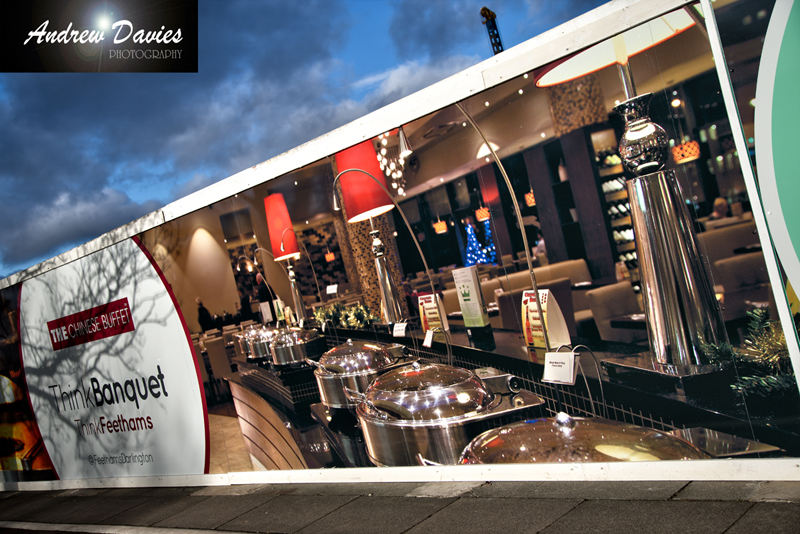
A few sites are suggesting this 5Ds is a 'Billboard ready camera'

I have just taken photographs for a billboard for an ad agency with my 5Dmk3 and could not of asked for them to look any better !

commercial%20photography%20advertising%20hoardings%203.jpg
 
I'm not a big fan of DxO. Looking at their lens/camera body data - if you put a Zeiss Otus lens with a D3s the score for the lens resolution is always less than say the same lens with a Nikon D810.

In this case, that would suggest that the canon version of the Otus lens will easily out 'pix' the score of the D810 meaning that it is not the lens resolution that is being measured but the camera's ability to get information using the particular lens?

Lovely 'bartography' by the way!
 
Last edited:
I'm not a fan of manual focus with an unaided ovf unless the subject is big in the frame and accurate focus is possible. For me manual lenses work best on a CSC with either peaking or better still a magnified view. I suppose you could use live view and the rear screen but that's not for me and I much prefer an evf for accurate manual focus.

If I was in the market for one of these new Canon's I think I'd head over to Sigma for auto focus Art lenses and of course anything else from Canon or anyone else that matches or exceeds their abilities. In other words, anyone getting one of these cameras should I think get the best lenses and not just stick to Canon.
 
well, I agree with the post that these are additions - they are not a 5DMark IV altho I am sure that they will make some people have instant GAS. I agree about the huge files too…
 
Actually that one is something i never understood why when you change the camera the lens itself on dxo is suddenly capable of resolving a different number of pixels. Would it be true to say that all new and current L and primes in the canon range are up to the job of 50mp sensors do we think ?
I would suggest a kit lens on a 50mp sensor would resolve more mp than an Otus on a much lower mp sensor. That's because it's a combination of sensor and lens that gives you the dxo mark scores. Indeed I think they work it on mp resolved. The Zeiss Otus resolves about 30+ of the sony 36mp sensor. It would never resolve all 36 because there are other factors at play. Stick the Zeiss on a 16 mp sensor and it will resolve 15mp, on a 50 probably 40+. There isn't a canon lens in the top 30 of dxo because the nikon has the 36mp sensor.

Your billboard shot proves that 24mp is more than enough even for billboard size applications. I used to think 5mp was enough though!
 
Last edited:
Looks like its already been answered...

http://www.canonrumors.com/2015/02/interview-about-the-eos-5ds-eos-5ds-r-with-mike-burnhill/

"Mike Burnhill is with CPS for Canon Europe and did an interview with Fotosidan about the EOS 5Ds, EOS 5Ds R and how the product came to be, and what the design philosophies were for the camera.

Mike touches on why a large megapixel sensor isn’t ideal for 4K, or even 6K video, which sounds like we’ll see that addressed in an upcoming full frame EOS camera. It’s also interesting to note that Canon L lens design since 2010’s Canon EF 70-200 f/2.8L IS II has had high resolution image sensors in mind, and that every L lens since has been designed for use with these cameras.

You’ll get a pretty simple answer about whether or not shooting with the “R” version of the camera is for you. As well as why Canon decided to stick with Compact Flash over new technology such as CFast 2.0."
 
If we shot the same shot and scene on the 5ds at 50mp once using a kit 18-55 lens and once with a 24-70 2.8LII would the second shot have more detail and hence higher file size from the same camera sensor.

That being the case how do we know exactly which lenses would benefit from the 50mp and which would not , I can see a sort of case where this camera would work and could be shot at different resolutions depending on the job you are doing - leaving the big 50mp in reserve for huge billboards etc , which marries up with the ability to crop factor and extend lenses making this a very much dual purpose camera.
 
It’s also interesting to note that Canon L lens design since 2010’s Canon EF 70-200 f/2.8L IS II has had high resolution image sensors in mind, and that every L lens since has been designed for use with these cameras.

How exactly do they design a lens for a camera they haven't designed yet? Being less critical it sounds like stating the obvious on their part.
 
At a guess, there are even higher resolution sensors on test benches and in test bodies in assorted manufacturers' labs/R&D departments. Making one would be relatively easy but making lots, reliably is the hard part!
 
If we shot the same shot and scene on the 5ds at 50mp once using a kit 18-55 lens and once with a 24-70 2.8LII would the second shot have more detail and hence higher file size from the same camera sensor.

That being the case how do we know exactly which lenses would benefit from the 50mp and which would not , I can see a sort of case where this camera would work and could be shot at different resolutions depending on the job you are doing - leaving the big 50mp in reserve for huge billboards etc , which marries up with the ability to crop factor and extend lenses making this a very much dual purpose camera.

In short any lens will give more resolution (at least in the central area) on a higher mp camera than on a lower mp camera. I would suggest canon L lenses would be fine. My own minolta G lenses work superbly on both full frame 24 meg sensors and even better on 36 mp sensors.
 
How exactly do they design a lens for a camera they haven't designed yet? Being less critical it sounds like stating the obvious on their part.
Because all the DxO mark and 50 megapixel resolution is complete [PLEASE DON'T TRY TO BYPASS THE SWEAR FILTER]. That's not how lenses work or should be measured. It's dumbed down statistics for the digital generation.

Lens resolving power is measured in lines per mm. Which is an optical test, and if you put a really good lens on a low res sensor and on a high res sensor you'll see the lens will find the limitation of the low res sensor.

Follow the maths and you can see where the lens stops out resolving a sensor, it's not rocket science but it might look it to people being asked to believe that a lens will resolve 60 megapixels, because there's too much data missing from that to make it factual. It doesn't mean it's nonsense, it just means that anyone with a knowledge of optics will be laughing up their sleeve.
 
At a guess, there are even higher resolution sensors on test benches and in test bodies in assorted manufacturers' labs/R&D departments. Making one would be relatively easy but making lots, reliably is the hard part!
Doesn't the 7DMkII have a higher pixel density ?...(rhetorical).

Bob
 
Doesn't the 7DMkII have a higher pixel density ?...(rhetorical).

Bob
I know it was rhetorical, but I thought the pixel density was the same, which is the basis for lots of the speculation re DR and noise. And the (cough) ISO cap.
 
I know it was rhetorical, but I thought the pixel density was the same, which is the basis for lots of the speculation re DR and noise. And the (cough) ISO cap.
It may well be the same, Phil. I perhaps over simplified it by taking 20.2Mp and then multiplying by 1.6 squared......51.7?

Bob
 
It may well be the same, Phil. I perhaps over simplified it by taking 20.2Mp and then multiplying by 1.6 squared......51.7?

Bob
You could be right too; I'm sure we'll find out when the full reviews are out.
 
Back
Top