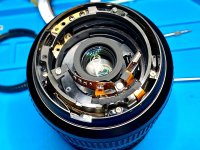
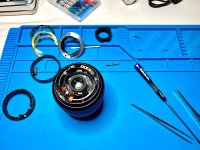
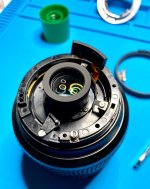
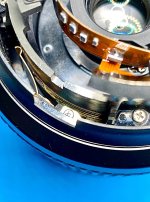
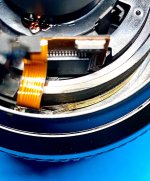
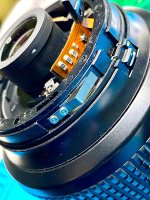
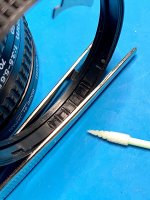
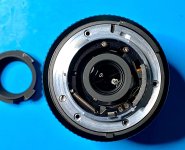
I opened the 24-120 a second time, checked the wipers on the resistance tracks, cleaned them again with electronic cleaner and worked on the contacts on the lens bayonet with the rubber polishing tip on the Dremel.
But unfortunately, no success.
Never mind, I'll just focus manually.

And there are quite nice replacements here which work faultlessly on the Nikon F4S.
I opened the lens one last time
to check the position of the wipers and the resistance tracks in relation to each other. I couldn't find any deviation.
However, to take a closer look I would have to dismantle the zoom further and I don't think that's a good idea. There is always the risk that the adjustment will no longer be correct afterwards.
In order to be able to use the zoom in MF mode with some comfort - the focus ring is narrow and you can feel the gears of the AF mechanism when turning it - I lubricated the accessible gears and gear rings.
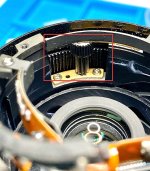

I used my toughest grease, Liqui Moly.
The focus ring now turns a little more smoothly and jerks less.
Repair successful
The solution regarding the stalling autofocus at the short end of the zoom was surprisingly simple after I looked through the repair manual again.
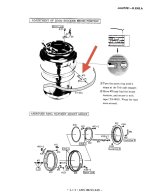
The wiper, which is moved with the zoom ring over the contact field in the tube, sits on a holder (see part #70, red arrow, in the picture).
This holder is inserted into the zoom ring and can be moved. It is secured with an adhesive strip.
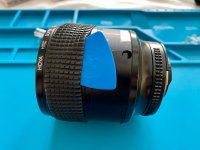
The holder is accessible when you remove the rubber coating from the zoom ring, which is easy to do here because it is not glued. Here I have already removed the bayonet ring, which would not have been necessary.
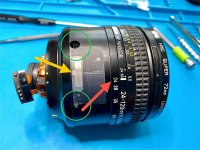
Through two openings (green circles in the picture) to the left and right of the holder (yellow arrow), the position of the wiper on the contact track can be observed.
This requires good lighting and a magnifying aid. I used my strongest magnifying glass.
I saw that when the zoom ring is set to the 24 mm stop, the two ends of the wiper are on a non-conductive surface. However, at all other zoom positions the wiper makes contact.
This matched my observation that the autofocus worked again without stalling when I turned the zoom ring a little towards the longer focal lengths.
I also noticed that the 24 mm mark on the zoom ring is a bit below the white alignment line on the tube (red arrow).
Apparently the stop of the zoom ring at 24 mm was no longer correct. And this slight deviation meant that the slider coupled to the zoom ring no longer had contact.
There were three possible ways to correct the deviation:
- Adjust the glued contact track.
- Correct the stop of the zoom ring.
- Adjust the position of the slider.
ad 1: This would only be possible by removing the glue. This is not practical in the tight space, as neither solvent nor heat can be introduced in a controlled manner. In addition, the plastic construction rules out such measures.
ad 2: I could not identify the stop of the zoom ring, so it was not feasible.
ad 3: The solution, obviously also provided by Nikon
I removed the adhesive tape over the holder, levered it up a little with a screwdriver because it was stuck, and then visually adjusted the slider for the 24-millimeter position.
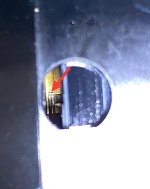
The wiper ends now sit just on the conductive gold contact track (and no longer on the non-conductive black surface underneath.
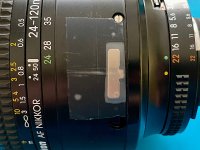
I fixed this new position of the holder again with adhesive tape.
I checked the position of the wiper at the maximum zoom position of 120 mm through the second opening.
Although the wiper is no longer centered on the contact track, the test showed that it makes perfect contact.
As I said, I could have saved myself the trouble of dismantling the bayonet ring, as it was not necessary for adjustment.
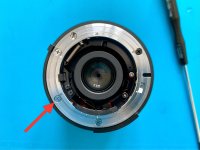
When tightening the bayonet ring, I overtightened one of the two short screws. This happened quickly because this screw engages a plastic thread.
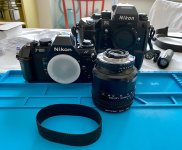
Nevertheless, the bayonet ring is firmly in place, secured by the three other screws.
A test on my Nikon F-501 and Nikon F4 showed that the zoom focuses now without any problems.
Conclusion
- What at first and second glance as a repair appears impossible or only possible with great effort and risk can, at third glance, be a relatively simple matter.
- Obviously Nikon had anticipated problems like this due to the service-friendly design of that lens. In any case, very little effort is required to fix it.
- I cannot understand why this bayonet screw turns in plastic and not in solid metal.
- As I adjusted the wiper on suspicion, I cannot guarantee that the values for the zoom position transmitted to the camera are correct. A test film will show whether it is fine.
The question still remains as to why the zoom ring is misaligned
One explanation would be that there is no ring with which the lens can be gripped when screwing it into the camera bayonet. Anyway the wide and rubberized zoom ring is ideal for this.
Since screwing in always occurs against resistance, the zoom ring turns anti-clockwise to the smallest focal length, which is 24 mm.
Due to the force acting on the stop of the zoom ring, it is conceivable that the stop will shift slightly to the left over time. And that is enough to interrupt the slider on the contact track.
When unscrewing, force acts on the stop for the maximum focal length of 120 mm.
Since there is still enough contact track for the slider beyond the stop, a misalignment has no effect.
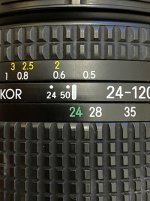
Here you can see the deviation of the 24-millimeter mark from the alignment line to the right more clearly.
But you have to look closely.
Assumptions:
- I assume that the line has to be in the middle of the 24.
- This difference from the target corresponds exactly to the small distance between the wiper ends and the start of the contact track.
- The wiper is literally at zero.
- The AF system obviously depends on detecting the zoom position.
- If it doesn't receive any data, the AF jerks towards the focus point.
- That must have been the case with this zoom here.
- Signal value 0 is obviously not intended.

When set to maximum focal length, the line is in the middle of the 120.
If this is a digital read out, the exact position of the wiper per contact field shouldn't be crucial. The main thing is that it is in the intended range.
It would be different in analogue mode, as the voltage value increases continuously with the resistance value of the resistance track.
This means that I don't have to worry about the wiper here, whether it is just touching the contact surface or in the middle.
However, this is only a guess.
+++
 A word of caution
Please keep in mind that you’ll be using highly flammable solvents for service work, and their fumes are harmful to your health. Soldering also produces fumes that should not be inhaled. Dangerous high voltages can be present when handling electronics, especially in conjunction with electronic flash units and mains. Therefore, familiarize yourself with the safety regulations beforehand and ensure your safety. Depending on the activity, protective gear may be advisable.
All information is provided without guarantee. Any action you take upon the information in this report is strictly at your own risk.
This report describes my personal experience and approach; it does not constitute a professional or certified repair instruction. I am not liable for any property damage or personal injury resulting from actions taken based on the information provided in this report.
Acknowledgments
Without the work of
Master Larry Lyells, in particular, we wouldn’t have the detailed technical information we need today for service/repair of electromechanical SLRs.
The SPT Journal and The Camera Craftsman, which he helped shape significantly as an author, and which contain all the necessary information and instructions are available for a fee through
Learn Camera Repair.
We owe our access to them to Eugene Pate, the founder of Learn Camera Repair.
As a Shodan in Jiu-Jitsu, I view camera repair as part of my Do, the Way. I am grateful to my revered Grandmaster,
Erich Ebetshuber, 10th Dan in Jiu-Jitsu, for everything I have been privileged to learn from him.