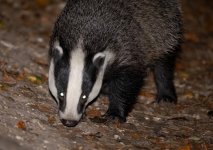
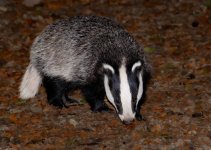
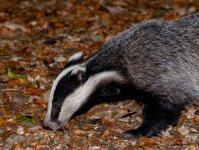
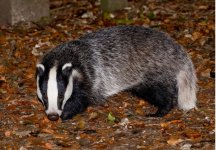
Photographing Badgers in the dark

mav

Messages
925
Edit My Images
No
I am photographing badgers in the wild it’s very dark almost cannot see them . I am using a Nikon z8 with a Godox flash and 300mm f4 . Problem is z8 uses a green af assist light and the godox af assist is red won’t even fire, I am manual focussing but it’s hit and miss any ideas
 
I am photographing badgers in the wild it’s very dark almost cannot see them . I am using a Nikon z8 with a Godox flash and 300mm f4 . Problem is z8 uses a green af assist light and the godox af assist is red won’t even fire, I am manual focussing but it’s hit and miss any ideas
Green lazer pointer? You can get them with patterns as well.
Otherwise maybe a torch mounted on a light stand closer to give some ambient lighting.
 
Manual focus on something about where the badger would be when you take the shot using an object in that position and in visible light. Turn off the auto focus of your Godox flash. When the badger is in frame and where that object has been placed when you set the manual focus, Take the shot, I would assume by a remote trigger. Use a higher F-Stop setting, increasing the depth of the in focus part of your shot would help, even if the badger isn't in the exact correct position, but higher F-Stop setting require higher flash levels, so a little experimenting and test shots before while setting manual focus would help set the stage for that perfect shot.

Question - When you fire a flash at a badger, do they ever come back for a second or third shot? I took a flash photo of our new puppy and for the rest of her life, every time she saw me with a camera, she was gone instantly. The only photos that I was ever able to take of her after that first were taken with my cell phone. No flash so no association with the big black camera.

Back in 2000 I had a Sony Mavica FD-98 camera. A whole 2.1 mega pixels, but it needed light to auto focus. When not enough light existed before the flash fired, the camera would fail to focus, even though the flash would make a good shot. I solved this with a red laser gunsight, modifying it to fit a camera cold shoe and used a bracket with cold shoe attached under the camera at the tripod mount. I turned on the laser before taking the shot and when triggering the camera, the focus function of the camera focused on the red laser dot, which I could later easily remove in Photoshop. I learned quickly to explain how the laser beam was helping with the camera focus, as some about to be photographed thought I was pointing a gun at them. Today my Godox flashes contain the focus assist that produces a crosshatch pattern, and it's on very briefly, so those being photographed don't panic, even when they do see it.

Please post a few photos of them. I want to see your results.

Charley

 
Manual focus on something about where the badger would be when you take the shot using an object in that position and in visible light. Turn off the auto focus of your Godox flash. When the badger is in frame and where that object has been placed when you set the manual focus, Take the shot, I would assume by a remote trigger. Use a higher F-Stop setting, increasing the depth of the in focus part of your shot would help, even if the badger isn't in the exact correct position, but higher F-Stop setting require higher flash levels, so a little experimenting and test shots before while setting manual focus would help set the stage for that perfect shot.

Question - When you fire a flash at a badger, do they ever come back for a second or third shot? I took a flash photo of our new puppy and for the rest of her life, every time she saw me with a camera, she was gone instantly. The only photos that I was ever able to take of her after that first were taken with my cell phone. No flash so no association with the big black camera.

Back in 2000 I had a Sony Mavica FD-98 camera. A whole 2.1 mega pixels, but it needed light to auto focus. When not enough light existed before the flash fired, the camera would fail to focus, even though the flash would make a good shot. I solved this with a red laser gunsight, modifying it to fit a camera cold shoe and used a bracket with cold shoe attached under the camera at the tripod mount. I turned on the laser before taking the shot and when triggering the camera, the focus function of the camera focused on the red laser dot, which I could later easily remove in Photoshop. I learned quickly to explain how the laser beam was helping with the camera focus, as some about to be photographed thought I was pointing a gun at them. Today my Godox flashes contain the focus assist that produces a crosshatch pattern, and it's on very briefly, so those being photographed don't panic, even when they do see it.

Please post a few photos of them. I want to see your results.

Charley

Thanks that’s very helpful I am a novice with flash photo photography hate using it for wildlife.
They don’t seem bothered by the flash they just carry on eating , I am hand holding the camera
They come really close 10ft away at times I only have a 300 f4 lens , I will try stopping it down for more DoF
Should I be using auto iso or manual .

Here’s one from the other night
IMG_0256.jpeg
 
I'm really hoping you don't mean the kind of green laser pointers idiots aim at low flying helicopters. Otherwise poor badgers
I was just going to make the same point...using a laser on animals is an astonishingly irresponsible thing to do.
 
Last edited:
You dont shine it at the badger, just the same distance away, nor do you need a warp strength thing, you only need the dot for the focus to lock onto.
 
  • Like
Reactions: mav
You dont shine it at the badger, just the same distance away, nor do you need a warp strength thing, you only need the dot for the focus to lock onto.
No, just don't. Not wanting to start an argument over this but in the words of of the OP he can hardly see the badgers. How does he know there aren't two there? You could always test its safety on your own eyes........
 
I go to wedding venues a lot. Almost all use lasers in the evening do.
Clearly the whole wedding party and myself haven't been blinded yet.
Nobody is making anyone do it.
It was just a suggestion.
 
We were told at the badger watching session I went to that we must not use any sort of lighting. Strangely this even included infra red illumination that badgers are even less sensitive to than we are!

Most of the shooting I did as light levels dipped was manual focus, but we stopped while there was still enough light to walk back from the hide.

Internet sources claim nocturnal animals are rarely good at seeing red (tell that to our cats, who love red lasers).
 
I go to wedding venues a lot. Almost all use lasers in the evening do.
Clearly the whole wedding party and myself haven't been blinded yet.
Nobody is making anyone do it.
It was just a suggestion.
The trouble is, people could very easily not understand how to use lasers safely with animals at night. Our wildlife has enough problems without adding this to the list.
 
Last edited:
Avoiding shining lasers at, or near anyone's eyes is important, but I found it necessary to get a focus target spot on those being photographed 26 years ago when the camera that I was using had no provision to auto focus in low light otherwise. A simple edit later easily removed the red dot from the shot taken later in POST. It was aimed low, and not near anyone's face, but gave the camera something to focus on. I also explained before the shoot began, that I was using the laser dot for camera focusing, and I was not about to shoot anyone with a laser pointed gun.

The Canada Geese that frequent my lakeside lawn don't seem to be affected much when I shine a red laser near them in the hope of scaring them away, but they don't like the green lasers at all. Again, I shine it on the lawn near them and not at them, but it does get them upset with it moving around near them, causing them to leave quickly and not return for days. I don't mind them eating the grass, there is more than enough. What I don't like is their mess on my sidewalks and driveway. The green laser reminds them to find another lawn to eat for this reason. We have all kinds of wildlife coming across my lawns at night to get to the water, and I never bother them, but being out at night here usually lets you see something. I have come home late at night several times and my car headlights catch several deer down on the point near the lake. Raccoons, Opossums, Skunks, and smaller critters like Chipmunks and squirrels are around here 24/7 and we enjoy watching them.

Charley
 
Back
Top