

Problems adapting a Nikon F mount lens to Canon 5d

Messages
33
Name
Crescenzo
Edit My Images
Yes
Hello All,

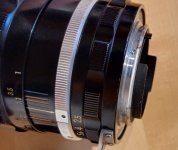
I recently purchased a Nikkor 105mm f2.5 P.C (pre-AI) after reading online that it was possible to adapt it to Canon 5d Mk IV with an adapter (obviously to be used as manual focus only). I bought an adapter from Urth (this one) but the mirror sometimes gets stuck after touching a metal protrusion on the back of the lens (see image). The odd thing is that it doesn't do it all the time but once in a while...

Has any of you also had this issue in the past? Do you know how to fix it? Or do you have any suggestions that might work?

Thanks all!

Best,
Crescenzo
 

Attachments

  • 51139.jpg
    51139.jpg
    170.5 KB · Views: 7
This is a fairly common issue when adapting lenses to DSLRs when the lenses have elements that protrude into the mirror box. If it’s marginal, you may find whether a mirror strike occurs is dependent on the focus distance, zoom setting, or possibly even just the temperature that day.

There is certainly reference material around on the web setting out which lenders are more prone to it with which bodies. IIRC the 5D2 mirror is a little shorter than the the Mk 1 and suffers less, for example.

One trick is to “shave” the bottom of the mirror so that it is just a little shorter and doesn’t hit the lens. You can take a little material off without it affecting normal operation.

There is a description of how to do it here, you may be able to find other guides that suit you better.


Obviously it’s a pretty permanent change to your 5D IV and there are risks associated with it. I never bothered with my 5D classic as only had one Contax lens that very rarely hit this problem.
 
Last edited:
This is a fairly common issue when adapting lenses to DSLRs when the lenses have elements that protrude into the mirror box. If it’s marginal, you may find whether a mirror strike occurs is dependent on the focus distance, zoom setting, or possibly even just the temperature that day.

There is certainly reference material around on the web setting out which lenders are more prone to it with which bodies. IIRC the 5D2 mirror is a little shorter than the the Mk 1 and suffers less, for example.

One trick is to “shave” the bottom of the mirror so that it is just a little shorter and doesn’t hit the lens. You can take a little material off without it affecting normal operation.

There is a description of how to do it here, you may be able to find other guides that suit you better.


Obviously it’s a pretty permanent change to your 5D IV and there are risks associated with it. I never bothered with my 5D classic as only had one Contax lens that very rarely hit this problem.
Thank you, Rob.

This is really useful!

I'm not really inclined to shave off the camera's mirror, to be honest. Alternatively, I was wondering if shaving off the elements protruding from the lens would be a viable solution. My understanding is that those elements made sense in the old Nikon, but have no functions in different, modern cameras. However, I do not know if this is a viable solution and how it can be done without damaging the lens.
 
Hello All!
Just an update in case someone finds this post while trying to fix the same problem I had...
I eventually found an adapter that was 1.5mm thicker, which was enough to eliminate the issue: https://www.big-photo.de/b.i.g.-objektivadapter-nikon-f-g-an-canon-ef
The only thing is that the adapter is now stuck on the lens. :headbang: The adapter manufacturer gave me some suggestions to fix it, but with no avail (and they eventually gave up). The only solution would be to send it to an experienced technician, but I think I will keep it as it is.
Bye!
 
Don't quote me on it but that black protruding shroud bit I believe is removable via 3 screws, one is visible in the photo. It is mainly designed to cut down on internal reflections and to keep stuff from getting down into the lens. I have removed them before and found no noticeable difference in images the lenses produced. If nothing else removing it will make shaving it down a lot easier when its off the lens.

This might seem overly simple but are you turning the adapter the correct way to remove it? Nikkors are the only lens make I can think of that the bayonet unseats by turning the adapter clockwise rather than counter.

Also if the adapter is thicker than others are you still getting infinity? 1.5mm is a lot of difference in adapter thickness and more than enough to throw off infinity.
 
Last edited:
touching a metal protrusion on the back of the lens


Surely the protrusion is on the back of the adaptor rather than the lens?
 
This is just to confirm what Ryan said: the protruding element is on the lens and - with the previous adapter - the mirror kept hitting it when shooting.
 
Last edited:
Don't quote me on it but that black protruding shroud bit I believe is removable via 3 screws, one is visible in the photo. It is mainly designed to cut down on internal reflections and to keep stuff from getting down into the lens. I have removed them before and found no noticeable difference in images the lenses produced. If nothing else removing it will make shaving it down a lot easier when its off the lens.

This might seem overly simple but are you turning the adapter the correct way to remove it? Nikkors are the only lens make I can think of that the bayonet unseats by turning the adapter clockwise rather than counter.

Also if the adapter is thicker than others are you still getting infinity? 1.5mm is a lot of difference in adapter thickness and more than enough to throw off infinity.
Hi Ryan, thank you for the advice.

I didn't try to disassemble it because elsewhere I read that that element could not be removed because essential to the lens... It'd have been good to have this information earlier... :giggle:

Just to confirm, I have tried to turn it clockwise (and at some point also anticlockwise), I have tried by putting it in the freezer for a few minutes, and a couple more things. Perhaps it would take a technician 5 minutes to fix it, but to be fair, I'm just keeping it as it is at this point since I do not intend to buy more vintage Nikkor for now and I only shoot with the 5d, so it's like having an EF lens.. ;)

Regarding the flange distance, I may have made an error in my previous post, I think the difference with the other adapter was 0.5mm not 1.5, but I bought it in October and I'm not anymore sure (at the time, I checked with a caliper, but I cannot do it again because i sent the first adapter back to the seller). Anyway, it was within tolerance (Nikon F flange: 46.5mm / Canon EF flange: 44mm), so I am not having issues with infinite focusing (although I'm mainly using it for portraits, so it wouldn't have been particularly concerning for me anyway).
 
Last edited:
As long as it's only linkages or their shrouds there is no harm removing these from the lens for adapting it. If the linkages themselves are removed/shortened this may prevent the lens being used properly on a Nikon DSLR, but the shroud is only there to prevent the linkage from bending.

I've not heard of this issue with Nikon lenses but the same issue applies to some M42 lenses.
 
it is really one for mirrorless models.
Not so.
Mirrorless models are far more adaptable with lenses, usually being able to use most rangefinder & all SLR lenses, but there are SLR mounts that can be adapted to other SLR lenses.

Canon SLRs are the most adaptable of the common brands, Nikon the worst. Despite this even Canon EF bodies can't take Canon FD lenses.
When Pentax designed their K mount bayonet they designed it to take an adapter for their earlier M42 lenses. I was adapting M42 lenses, as well as using both T2 & Tamron adaptall lenses (which are designed to need an adapter) back in the 1980s.
 
I didn't try to disassemble it because elsewhere I read that that element could not be removed because essential to the lens... It'd have been good to have this information earlier... :giggle:
There might have been some confusion there. When referring to lenses, 'elements' are the optical glass parts and you certainly can't remove the rear element and still have a working lens. The shrouds are a different matter and for the most part serve no optical purpose in the lens so can be removed/ altered.

For an expensive/ rareish lens like the 105/2.5 I would opt to remove the shroud rather than destructively alter it. Keep the shroud with the screws in a little baggie somewhere safe in case you want reinstall it in the future. A missing shroud would reduce it's resale value a lot more than its overall value to the optical performance of the lens.
 
It looks like there is a spring loaded pin that has clipped into the locking position in the back of the lens. There doesn't look like any way of undoing the pin, which would normally be a button on the camera. The place below the slot where the pin is looks like it has a peened over cover. If you drill this point (carefully- if you slip you could trash the lens) you might be able to remove the spring and pin. Then the lens will come off.
 
There might have been some confusion there. When referring to lenses, 'elements' are the optical glass parts and you certainly can't remove the rear element and still have a working lens.
If you remove lens elements you will change the nature of the lens but it can still work. :)
Removing the rear group from many 50mm lenses (and some others) typically leaves a soft focus (less highly corrected) lens of longer focal length that needs extension to get focus.

After seeing a youtube video on a modified Practika I tried it with a Pentax M50/1.7 unscrewing the rear group & adding bellows to allow focus gave a soft lens of about 120mm focal length producing this wide open
soft focus mod fully open by Mike Kanssen, on Flickr

& sharpening up considerably to this half a stop closed down
soft focus mod half stop down by Mike Kanssen, on Flickr
Closing down a few more stops had it looking about as sharp as a normal lens.

I've tried a similar thing with a 105mm telephoto where the rear group was fogged beyond repair and ended up with something close to a 200mm (again needing extension)
Soligor 105 without rear group by Mike Kanssen, on Flickr

This approach may even allow lenses not normally adaptable to a particular SLR to be used, as the issue with adapting is usually lack of space behind the lens.

I've not done much lens hacking, - at some point I want to get round to trying another hack inverting front or rear elements from one of my many swaps. Probably a Helios 44 where this approach has been reported before.
 
Last edited:
If you remove lens elements you will change the nature of the lens but it can still work
I knew when I said that it wasn't strictly true. I have heard of flipping elements like with the Helios but not seen anyone completely remove the rear element. That soft focus looks perfect for a 1970's dream sequence in a movie.

Personally I would never hack a Nikkor 105/2.5 unless it was beyond redemption but for more common stuff it could be interesting to experiment.
 
Back
Top