proper landscape!!!

Messages
384
Name
ben
Edit My Images
No
hi all.

I'm having a problem in that all my scape pictures always come out looking ordinary.
is there some nice person that could do a step by step as to how to go about getting something great.
e.g times of day, camera settings, filters, that sort of thing just to get me going?

many thanks ben.
 
Hi ben, I'm no expert but I'm sure this advice would be given by most people here.....

You can shoot at anytime of the day (different style suit different times) but without a doubt, your best shots will be when you shoot +-45mins at dawn and dusk...

Use a set of ND grad filters to balance the shots exposure. Using these I think you will notice the greatest and immediate difference

Use a tripod, cable relase, spirit level (attaches to the hot shoe) and if your camera has it, use mirror lock-up. This will lead to sharper shots.

A polarizer can be used sometimes (although personally, I don't use one that often) to increase the saturation of colours by reducing the amout of refracted light the camera detects. Very useful when shooting water as glare from this is just refracted light.

Also take several shoots of the same scene, at different exposures, giving yourself a higher chance of getting one that your happy to process.

Good luck. I'm sure with practice and some basic equipment, you'll start to get that good feeling more and more often. Remember, it doesn't always work for any of us!
 
Ben,
Your question is a very very broad one and hard to answer without a specific scene in mind.
I suspect that you would benefit by looking at many landscape pics with the aim of triggering an idea for a shot in your mind (Cornwall - you are in a target rich environment).

Books on landscape work are a great source of inspiration and the website below is not bad either.
http://digital-photography-school.com/11-surefire-tips-for-improving-your-landscape-photography

For starters how about going for something very simple like an uncluttered sunset with perhaps a tree silhouetted against the red sky (meter for the sky then bracket your exposures to ensure you get one that pleases your eye. Use f11 and focus about one third of the way into the pic to maximise overall sharpness.
If you can get reflections on water into the pic that may help as are good cloud formations.
 
hi and thanks for the replies so far.
one of the biggest problems I have is that although it is very beautiful a lot of the shots have nothing to focus on. eg some shots of the dunes out to sea, its just dunes and sea, nothing to draw the eye, no trees or anything i can put into the shot. same with some of the cliff pictures, all cliff and sea but very ordinary.
is there anything I can use to add more colour? I already use nd filters now and always tripod, but the cpl filter does not seam very strong.....
all comments would be great, good or bad.

Ben.
 
one of the biggest problems I have is that although it is very beautiful a lot of the shots have nothing to focus on. eg some shots of the dunes out to sea, its just dunes and sea, nothing to draw the eye

think that answers the question ?
try to "see" the scene before you take the shot
 
hi and thanks for the replies so far.
one of the biggest problems I have is that although it is very beautiful a lot of the shots have nothing to focus on. eg some shots of the dunes out to sea, its just dunes and sea, nothing to draw the eye, no trees or anything i can put into the shot. same with some of the cliff pictures, all cliff and sea but very ordinary.


Ben never be afraid to add to a scene if it's not working for you eg when photographing a beach scene that appears bland then try to include some foreground interest such as a piece of driftwood or in my neck of the woods there are no shortage of lobster pots. Try to get close to the foreground interest and shoot wide angle, Long shutter speeds to introduce water movement (this is where ND and Grad filters come in). Shoot early and late as this is key. Put yourself out and scout for locations and make notes whether they are AM or PM shots. Try these things and you will soon be on your way to taking more pleasing images.
 
hi all.

taken onboard the comments and have gone out and tried this.
I know its not a landscape but it sort of conforms to what has been said.

daff.jpg


any more coments would be great.

Ben.
 
More of a close up really...

If you stood back from the Daff a little, focused on that (but with a high F-Number) and incorporated more of the scene, you would get what you are after...
 
hi and thanks for the replies so far.
one of the biggest problems I have is that although it is very beautiful a lot of the shots have nothing to focus on. eg some shots of the dunes out to sea, its just dunes and sea, nothing to draw the eye, no trees or anything i can put into the shot. same with some of the cliff pictures, all cliff and sea but very ordinary.
is there anything I can use to add more colour? I already use nd filters now and always tripod, but the cpl filter does not seam very strong.....
all comments would be great, good or bad.

Ben.

How about get down to a beach really early before anyone is about and walk the shore line on sand that is wet, but firm enough to leave footprints then photograph back towards where you came from using the footprints to lead the eye into the scene. Make the focal point round about where you can see the footprints start and shoot at f11 or f16.
 
How about get down to a beach really early before anyone is about and walk the shore line on sand that is wet, but firm enough to leave footprints then photograph back towards where you came from using the footprints to lead the eye into the scene. Make the focal point round about where you can see the footprints start and shoot at f11 or f16.
Walk backwards if you do that, then the footsteps will lead into the shot rather than out from it ;)
 
Bopins, i'm no expert on landscapes, i shoot mainly wildlife and sport.

I find that if i go out with a specific goal in mind then i am more likely to get the shot that i want. There is some good advice above regarding trying to find some interest in the scene and the working out how to arrange the scene around the point of interest.

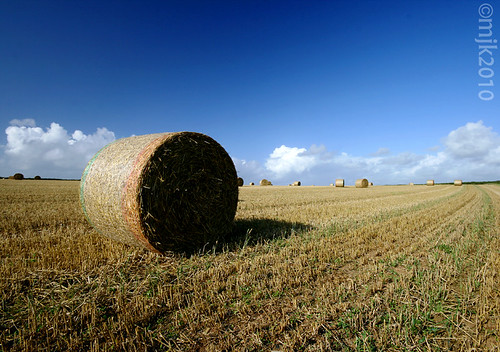
I imagined the shot below and had a picture in my head of how i wanted it to look. It took me a few days to find a field with the rolls in it and then i took quite a few photos from different angles to get a raw image that i could process.

Anyway. You can see that during composition i have stuck to the rule of thirds with the main subject. I tried to get a 'pull' in to the shot using the track to the right of the frame.

As i have already said, i'm no expert and do not profess to know it all, but i thought i would show you an example of an everyday subject and an image that i am quite pround of!

The most important thing is to enjoy going out with your camera You WILL capture an image that you really like and then it will all make sense.

4306257504_8f82a393e3.jpg
 
thanks to all of you for these tips. am going out again today so will see what happens.

Ben.
 
shoot up to 3 hours after sunrise and 2 before sunset
get your horizon in the right place and level...if it is level normally.:)
tripod...low iso...28-35mm lens
be patient...
if conditions dont suit lightwise make a note of the spot for another day
especially puffy clouds and good sun...

get those shadows moving across the fields etc
 
hi all and thanks for the replies sofar.

went out today around newlyn and got a few shots I like. Don't know if this falls in the landscape catagory but is part of the landscape here!!!

oldcrane419x600.jpg


any comments welcome must learn:)
 
hi all and thanks for the replies sofar.

went out today around newlyn and got a few shots I like. Don't know if this falls in the landscape catagory but is part of the landscape here!!!

oldcrane419x600.jpg


any comments welcome must learn:)

Any piece of art including photographs must have the main point of interest or the main subject. It needs to be obvious enough yet subtle and interesting. You need to avoid clutter as much as possible, and only the adding secondary points of interest that lead the viewers attention but not distract it.

This photo seems to be very busy: you have a crane, boxes, water, houses and all sorts of things around. The composition is very tight and does not really focus on anything in particular, nor it does stand out by the light or colour. I think you have to keep it clean and simple and also spot interesting light.
 
hi there.
how would I goabout cloning out the rubbish. It is a working port and all this stuff is everywhere.
Ben.
 
hi there.
how would I goabout cloning out the rubbish. It is a working port and all this stuff is everywhere.
Ben.


I didn't mention cloning out anything. Small details can be successfully cloned out and that has to be done. However, one should be trying to compose a photograph to avoid any clutter and make the subject stand out. The photo also needs to tell a story, not only portray something in a random way. What was that crane doing, what is it for, etc? Perhaps there could be a more dramatic angle and a better light. Great landscapes are rarely taken in the middle of the day...
 
More of a close up really...

If you stood back from the Daff a little, focused on that (but with a high F-Number) and incorporated more of the scene, you would get what you are after...

yes..a landscape should really incorporate all the elements as sharply as possible
firstly landscape is....well landscape format....initially anyway so horizontal would have been better
your subjects are too central and seem to be compressed against each other
wide angle...small aperture....TRIPOD!!!! for absolute sharpness...

then some pp to give it zap..contrast etc
 
Any piece of art including photographs must have the main point of interest or the main subject. It needs to be obvious enough yet subtle and interesting. You need to avoid clutter as much as possible, and only the adding secondary points of interest that lead the viewers attention but not distract it.

This photo seems to be very busy: you have a crane, boxes, water, houses and all sorts of things around. The composition is very tight and does not really focus on anything in particular, nor it does stand out by the light or colour. I think you have to keep it clean and simple and also spot interesting light.

porthleven i think

your would have been better i think in colour to avoid the funny sky
and still the upright format...its so stiff...
loosen up and put more in the shot horizontally then your subject wont dominate the format and end up in the centre
 
hi there.
how would I goabout cloning out the rubbish. It is a working port and all this stuff is everywhere.
Ben.

really the stuff is ok by me...its tactile and texture based....and historically linked to the crane and the fishing port remit

for those items you can go closer...but always getting away from a landscape

try carn galver and the ding dong
 
Hi ben, I'm no expert but I'm sure this advice would be given by most people here.....

You can shoot at anytime of the day (different style suit different times) but without a doubt, your best shots will be when you shoot +-45mins at dawn and dusk...

Use a set of ND grad filters to balance the shots exposure. Using these I think you will notice the greatest and immediate difference

Use a tripod, cable relase, spirit level (attaches to the hot shoe) and if your camera has it, use mirror lock-up. This will lead to sharper shots.

A polarizer can be used sometimes (although personally, I don't use one that often) to increase the saturation of colours by reducing the amout of refracted light the camera detects. Very useful when shooting water as glare from this is just refracted light.

Also take several shoots of the same scene, at different exposures, giving yourself a higher chance of getting one that your happy to process.

Good luck. I'm sure with practice and some basic equipment, you'll start to get that good feeling more and more often. Remember, it doesn't always work for any of us!

sounds like good solid advice, thanks for this post :thumbs:
 
hi geoffrey.
thanks for those comments, understood and will try and put them into practise. the colour version of this photo is pants sky wise!!!
the crane is in fact in newlyn, outside of penzance. still a fishing port, but porthleven is now just more for pleasure boaters and day fisherman.

Ben.
 
the colour version of this photo is pants sky wise!!!

You've had some good advice here but I'll try to distill it;
Photo = Light
Graph = Paint

You'll probably be thinking "yes I know that". But it's the fundamental that people often walk straight past. You can't organise your photography sessions around your other chores, and just pop out in the middle of the afternoon. Great photographs require great light - and more than a little planning.

As others have said, some times of the day are better than others. You have to organise your shooting around the light, unless you're creating your own great light.

Then you need to think about what it is you're trying to convey, as others have said, it's about context.
If the shot of the crane, was backlit with a dramatic sky and a little more context, is that a picture you can see in your mind, is it better than the one you've taken?

The 3 key ingredients are:
Light
Composition
Story

If you get 2 of these, you'll be creating good pictures. If you manage all 3 your pictures will be great.

Have a look around at works by great photographers and see how simple it really is. It isn't about pointing your camera at something that looks 'OK' to you and then trying to polish it later, it's about finding the light, finding the story, then creating a pleasing composition.

As that meerkat would say 'simples' - except it's not really - if it was we'd all be doing it!

 
All good advice so far - I'd add that it's well worth looking up the work of well known landscape photographers online or in books (e.g. Joe Cornish, Charile Waite, etc) and have a really good look at the images that you like. How have they composed them? What is the light like? Which direction is the light coming from? What is there in the scene? What isn't there in the scene?
 
hi geoffrey.
thanks for those comments, understood and will try and put them into practise. the colour version of this photo is pants sky wise!!!
the crane is in fact in newlyn, outside of penzance. still a fishing port, but porthleven is now just more for pleasure boaters and day fisherman.

Ben.

hi ben
you got me there..i used to live in penzance and now you've sorted my blunder i can see the houses up paul hill
apologies
 
Hi Ben,

The advice you have been given is very good, the only thing I would add is go with other photographers as they will see things through different eyes.

Last year on a photographic holiday in the Lake District we went to a beach on the last day. It looked totally flat and characterless. I thought we might stay an hour at most. Four hours later I did not want to leave.

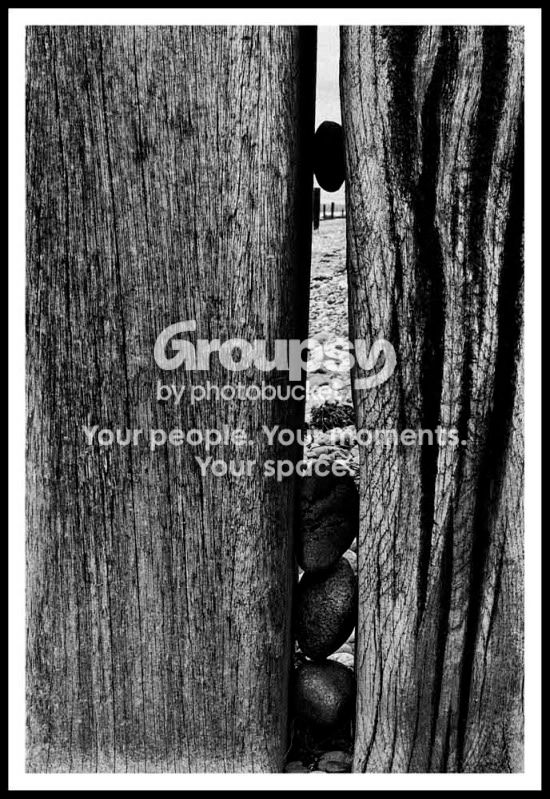
This picture was staring at me but it took a while to spot it:

_DSC7837croppedmono2smaller.jpg


It has recently been accepted into the Bristol Salon. That is after I removed the white post on the left!

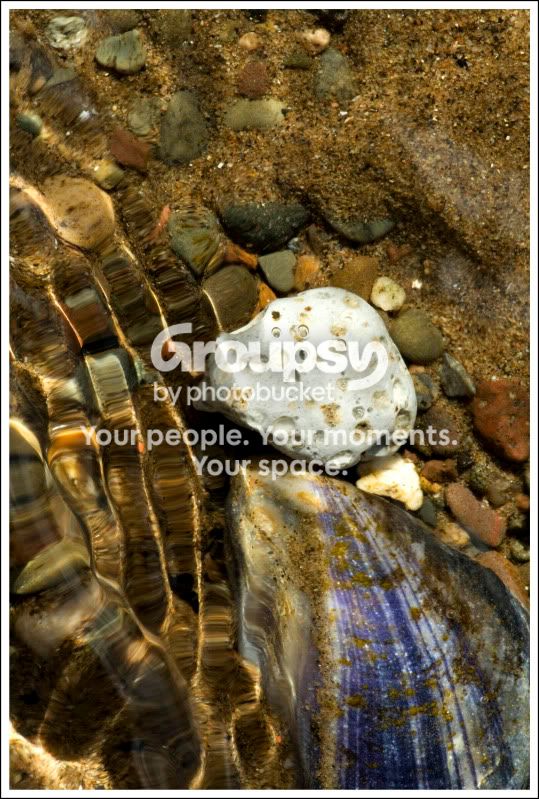
This picture also goes against some of the advice you have been given which shows sometimes you have to break the rules. It is a 10 shot image merged in camera in this case a Nikon D700. Which is why it has that soft appeareance on the grass. This was something I was obviously trying to do. It was also taken around mid day, but with an overcast sky which helped in this case. I also took some macro shots:

_DSC7784Smaller.jpg


_DSC7863smallerpp2.jpg


I find you learn more and pick up ideas by being with other photographers which is why it is always good to out as a group.

Best regards

Chris
 
At this time of year most natural aspects of the landscape will still look dead. It's still virtually winter.

Very, very soon, the landscape will be full of colour, full of interest, wild-flowers etc, trees will be in leaf. Just be patient.

The really good landscapers will choose their day carefully, they may already know the location, what time of day it looks at its best, they'll know their kit inside out, all that sort of thing. They have probably spent half a lifetime learning their craft.

Its probably easier now to learn quickly with digital, the internet etc to help you, but you still can't expect to go out one day and be a genius!
 
Back
Top