Quick survey: What will I do if my analog camera has a problem?

If my analog camera has a problem ...

  • ... I'll have it repaired.

    Votes: 4 28.6%
  • ... I try to fix it myself.

    Votes: 6 42.9%
  • ... I'm selling it for spare parts.

    Votes: 1 7.1%
  • ... I dispose it.

    Votes: 4 28.6%
  • ... see my reply in the thread.

    Votes: 5 35.7%

  • Total voters
    14
Messages
128
Name
Andreas
Edit My Images
No
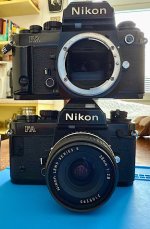
IMG_9463.jpeg

There is a large market for used analog cameras of all formats. But when problems arise, you have to decide how to deal with them. In most cases, manufacturers no longer offer service. That leaves repair shops, do-it-yourself options, selling them as spare-part units, or disposal.

I'd like to find out which of these options you prefer. Or are there other options if an analog camera stops working?
 
Last edited:
Depends on what the camera is worth. Over about 20 years must have thrown away (if I couldn't fix them)....... about 20 cameras as I picked them up for peanuts so no loss and I had/have plenty of cameras to use anyway without them as I have about 40 left.
 
It's not quite so simple. I still have a couple of cameras bought in the 1980s. If my Minolta 7000 goes wrong then it's for recycling, but I'd consider getting my Bronica ETR repaired.
 
Potentially all of the above depending on which camera and what goes wrong with it!

Had a dynax 7 with aperture failure. Tried to get that repaired but sold it for spares to the repairer.
Others I have had to return to the shop I got them from as they failed within the first few months. Had that happen twice.

Ebay buys that fail then there's usually not much you can do.

So far my solution seems to be buy plenty and use them all regularly but carefully. Then see which are left standing. I have several dynax SLRs so potential for scavenging one to save another if two fail with different issues.

Most failures unless it's a dirty battery contact are beyond my fixing skills....
 
The backup of the backup of the backup ... :p
:Da lot of them are joe public cameras and no leicas, I'm a lens man and years ago hunted the hidden gems (when they were cheap).....so I have a good collection of VG lenses and all the ones that I tested that I wasn't happy with went into the bin. But in saying all that, recently bought two lenses that weren't cheap :oops: :$ that I wanted to try 17mm Tokina and Tamron SP 60-300mm and got lucky for the Tokina as did a quick test and it looks sharper than my 19mm and 20mm Canonso_O
 
Last edited:
In sixty years and couple of hundred cameras, I've only ever had one camera repaired and that was a Rolleiflex 2.8E, the repair being done under guarantee.

I still wince when I remember how Royal Mail managed to lose the seller's return parcel for eight weeks, even though it was Special Delivery!

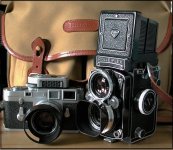
Leica and Rollei from right.jpg
 
If the camera is fundamental sound, (which is why I bought it in the first place?) then I do not mind having it repaired.
Lenses and shutters are the bugbear for me, I am tending away from older shutters that no one knows how to mend, for that reason and trying to buy more modern shutters.
I find hi end Nikon cameras remarkably durable but try getting an F100 without leaky displays is like looking for gold in a Welsh river.
 
Yes, all of the options depending on circumstances.

If it looks simple enough I might do it myself. RF calibration or cleaning maybe.

Or if it's beyond me looks like something a repair person could fix (and I can find one who gives me the sense they know what they're doing) I'd send to a repair place.

There is a cost/benefit issue sometimes - what to do about things you can buy for far less than a CLA cost. So sometimes, things get sold off rather than repaired.

With repair shops there's the question of customer expectations for those of us not using them routinely. What is the foreseeable repair cost? Will the repair firm quickly get to the bottom of the problem and advise accordingly or will they be potentially spending your money on repeated and failed attempts. Will they hold onto your gear for 6 months while they wait for a parts camera to appear (and more importantly will they tell you up front or do you have to repeatedly quiz them until they admit that's what's happening). And will they advise you sooner rather than later if a repair isn't really possible.

I think I've only ever sent 4 things off for repair. Two were simple, efficient, enjoyable experiences done quickly... a third was a bit slow (6 months!) but ultimately came through and the camera worked perfectly thereafter... the fourth was an expensive waste of time and money and the camera never worked properly... ultimately sold that camera for spares/repairs...
 
For me, buying cameras used to be stressful, as was collecting them, because I was constantly worried that something might break.

For a while, I employed two professional repairmen. That cost a lot of money, and I lost trust in one of them. Then I learned to do my own maintenance and repairs, and I’ve found peace ever since.

Over the past few years, I’ve bought up a number of SLRs in more or less unknown condition. They’re now stored in boxes, cataloged by index. Each one is a potential service or repair project; I’ve already worked on most of these camera models and posted repair reports on forums. I’m continuing to do that now.
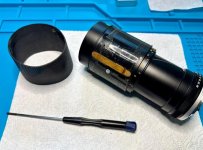
IMG_6053.jpeg IMG_6052.jpeg

Only my lenses worry me, because opening each one to clean the elements or the aperture—especially on zoom lenses—is an adventure. The problem isn’t fungus, but the outgassing of lubricants mixed with condensation, which forms a film on the lenses. Or zoom and Canon FD lenses whose slide bearings are falling apart.

Technical documentation on lens service and repair is available, but instructions are rare. In that case, you have to take the risk of figuring out how to do it yourself. That’s not always the kind of entertainment you’re looking for to relax. For rare and expensive lenses, I seek out specialists, even if its expensive.

 
Last edited:
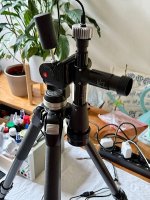
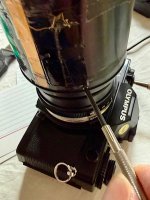
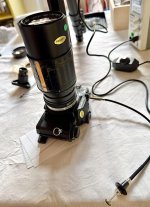
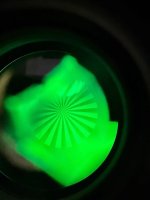
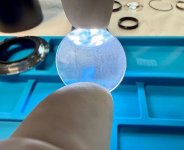
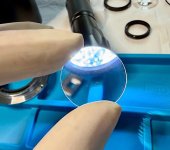
A while back, I used the autocollimator to check whether several lenses were correctly adjusted to infinity. I was in for a few surprises.

It’s relatively easy to get them to the correct setting, but you have to figure out which screws to loosen for the adjustment. The method for doing this varies somewhat from lens to lens.

Zoom lenses are more difficult to adjust—once for the shortest focal length and once for the longest.

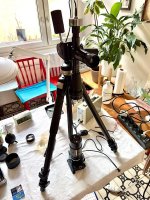
IMG_6050.jpeg IMG_6044.jpeg IMG_6051.jpeg IMG_6040.jpeg IMG_6046.jpeg IMG_6039.jpeg

See

Reveni Labs Autocollimator: Olympus OM Zuiko 65-200/4 auto zoom set to infinity
 
Last edited:
I've had a number of Pentax SLR's CLA'd which has restored them to use. I have a couple of old rangefinders that need TLS, a Leica iiic and a Contax T2, I just need to get around to finding the right repair shop and dealing with it, but as I'm not a fan of using rangefinders, I may not bother and keep them as nice things to look at. I bought a Pentax 645 a few years ago and was shafted by the bay seller, as the electronics are knackered and without that the camera is unusable, but I do want to try just cleaning all the contacts (including a messy battery holder); if that fails, it has a good lens on it which may come in useful on another camera - maybe one of Chroma-Steve's contraptions.
 
****For rare and expensive lenses, I seek out specialists, even if its expensive***

Well I've tried and you can't find one in the UK as no one wants to check my Canon FL19mm f3.5 R as some parts of a shot are out of focus, even asked a popular repair guy could you just check all the elements are in correctly...and he wasn't interested:( DIY well I have the layout for elements but......................................................
 
Generally speaking, I'll have my "proper" cameras (eg the Pentax SLRs) repaired if they develop a problem. They deserve to stay alive. If the problem recurs, it's probably time to let them go (I think I'm up to no 4 in my Pentax MX sequence). I've more problem with AF AE cameras like my Olympus mju II; I think it would probably be hard to find someone to repair those!
 
For me I'm not so bothered by the cost. If I consider a camera is worthwhile, I will more often than not have it serviced. And, by worthwhile I mean important in their way. Not necessarily as prized collectors items, but as practical things that were a pleasure to use, and by that criteria I would rate a Pentax Spotmatic as being on a par with more niche models.
 
The only film cameras I use these days are my Olympus OM2 and OM2N, the last few years I've been buying Olympus OM1 and OM2 cameras for spares/repairs and restoring them, I'm quite confident working on them, most of the ones I restored I sold on, I've got another OM1 to restore when I can find the time to sit at my desk, luckily I've found a few that were in really bad condition, and striped them for spares, so I've got a good source of spare parts.
After spending time working on them,I can see why having cameras repaired isn't a cheap thing to do, if it's not the labour, it's finding the parts needed.
 
Last edited:
Had a dynax 7 with aperture failure. Tried to get that repaired but sold it for spares to the repairer.
Others I have had to return to the shop I got them from as they failed within the first few months. Had that happen twice.

Ebay buys that fail then there's usually not much you can do.

It would be interesting to find out what the problem is with the aperture on the Dynax 7.

Regarding aperture control in general:

With its predecessors, the Minolta 5000/7000/9000 AF, it’s assumed that the aperture magnet becomes dirty, causing it to stop working or function incorrectly. However, it could also be a lubrication issue within the complex aperture control mechanism of these cameras. For now, I’m ruling out the possibility that parts are breaking. But that’s just a guess.

Do you have any more information on this? How does the problem manifest itself?

From what I remember you get a load of dark photos as it doesn't widen the aperture and just gets stuck. I am sure somewhere like Dyxum had a big discussion on it but when mine died it was before someone had worked out a potential solution. The parts were NLA so that was that then.

Found an original email from 2013 and it says 'unrepairable aperture circuit failure' so that must be what the Minolta repair person said.
 
Last edited:
From what I remember you get a load of dark photos as it doesn't widen the aperture and just gets stuck. I am sure somewhere like Dyxum had a big discussion on it but when mine died it was before someone had worked out a potential solution. The parts were NLA so that was that then.

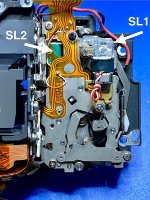
That sounds like a timing issue with the aperture control mechanism, which is still largely mechanical even in newer SLRs. It involves light sensors and perforated masks that rotate like gears to form a digital counter. At a specific point in time, the aperture magnet(s) are triggered and close the aperture. That’s the basic principle I’m familiar with from various SLRs.

The aperture control mechanism in SLRs is one of the most complex parts of the camera; see here the one in the Minolta 9000 AF with two magnets (SL1 and SL2):

IMG_9493.jpeg

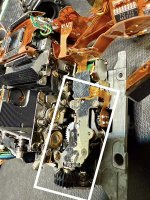
Here is the aperture control mechanism of the newer Minolta Dynax 7000i:

IMG_9494.jpeg
 
I realize that pictures like these don’t really inspire many people to get into DIY. Everything might look confusing, chaotic, and incomprehensible. You might think you’d need at least a degree in electrical engineering to make any headway—not to mention years of hands-on experience.

But when it comes to repairs, it’s rarely about understanding exactly what’s going on inside the electronics in detail—that information isn’t usually documented anyway, since manufacturers understandably keep their cards close to their chest.

What’s important is to follow the professional repair manuals that are available. They also include troubleshooting instructions that you can work through. Then you fix the problem, often by cleaning contacts, removing mechanical obstructions, or replacing parts. As for the electronics, you do what’s feasible.

All you need is interest, patience, a willingness to learn, and the necessary tools. And the knowledge that attempting a repair is always commendable, no matter the outcome.
 
After spending time working on them,I can see why having cameras repaired isn't a cheap thing to do, if it's not the labour, it's finding the parts needed.

I see it exactly the opposite way.

Replacement parts are fairly easy to come by, if you even need any at all. Used cameras of the same model should still be relatively inexpensive to find.

What costs money is the labor. It takes practice, for example, to access the shutter of an SLR; to do so, the SLR has to be completely disassembled, often in more than 30 steps. And then it has to be reassembled the same way back and tested.

That takes hours of focused work.
 
Well trying to remember years ago and first went to Canon and the guy looked on his computer and said "sorry the Canon FL19mm f3.5 R is not on our list", so at the time couldn't, find on youtube, anyone taking one apart...so if you don't know what you are doing why try on a lens that is worth £200 +
 
Well trying to remember years ago and first went to Canon and the guy looked on his computer and said "sorry the Canon FL19mm f3.5 R is not on our list", so at the time couldn't, find on youtube, anyone taking one apart...so if you don't know what you are doing why try on a lens that is worth £200 +

Maybe Fotoservice Olbrich in Germany can help.

They have an excellent reputation for mechanical and repairs; my experience with them has been very good.

I'll post a report right away about the professional repair of an Olympus OM Fisheye, in which I'll mention Olbrich.
 
Last edited:
Back
Top