Raynox DCR 250 - How To Use It Properly & Get The Best Out Of It?

Messages
7,408
Edit My Images
Yes
Hi All,

I have just got my hands on a Raynox DCR 250 and was wondering if anyone can tell me how to use it properly and how to get the best out of it.

Do you use it with the camera auto focus on or do you turn it off and focus manually?

Do turn your camera to macro mode when using it or not?

I have tried using it once and wasn't to impressed with the results but I am sure that is down to me not knowing how to use it properly.

I would appreciate and tips or advice you could share with me.

Many thanks.

Take care,

Keith
 
Might not be the correct way to do it, but...

Maximum zoom (no dedicated macro mode, but it will work with it if you have it)
Minimum aperture (f22 or greater)
Always manual focus - try auto first and switch to manual to see how far out it is !!


These were taken with a Fuji s9600 and DCR-250
img02.jpg


img05.jpg


This, with my Panasonic G1 and DCR-250

img03.jpg


Good lighting and a tripod is definitely the key.
 
Firstly I find that a flash is a must to allow the higher shutter speeds because of the small aperture required. Personally I don't use a tripod. If you are photographing insects move very slowly towards them - I mean at 'slow motion' speeds! It's better to do insects either early morning or late evening when it's cooler as they're not so active.

This is how I do it using a DSLR:
Small aperture to get the required depth of field. This will be razor thin even at small apertures.
Set the lens to manual focus.
Make sure you have a firm grip on the camera and adopt a good posture to minimise camera shake.
Adjust the lens focus to achieve the correct size of subject in frame (you may need to guesstimate this before hand if going for active insects like flies etc).
Exhale and hold your breath. Slowly rock your body backwards and forwards (very small movements here) to achieve focus rather than using the focus ring on the lens.
Squeeze the shutter release slowly rather than jabbing at it the moment the desired part of the subject is in focus.
If you have a quick FPS option it may be worth using this and firing off a few shots as you move in and out - this will give a better success rate whilst perfecting your technique.

Enjoy!

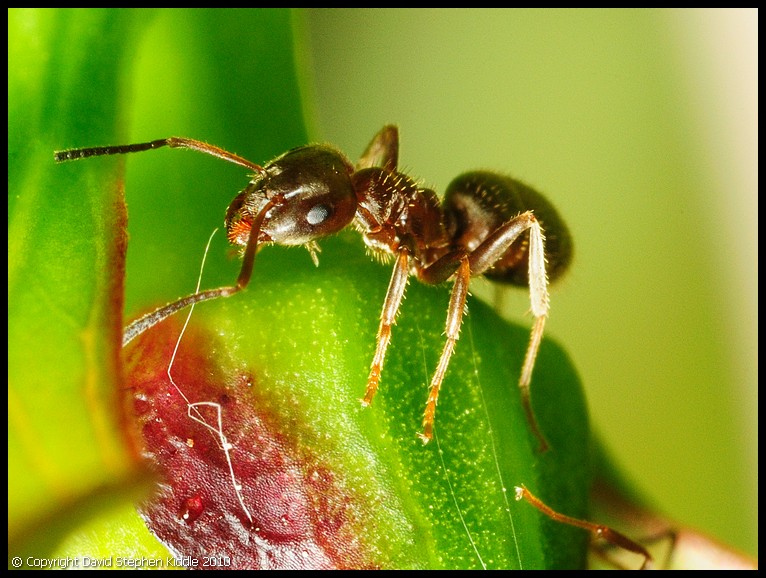
Here's a couple of mine:

Ant
4632325005_bbff65c940_o.jpg


Needle & Cotton
3897352570_d16d780e31_o.jpg
 
If you're shooting static objects (ie dead insects) then a cable release is very handy.
 
Thanks guys :thumbs:

From reading what you put I was doing everything wrong, no wonder my first attempts were pants! :lol:
 
Usual problems are more common to macro in general than the Raynox in particular, but in some ways that's why it works so well for so little money.

The main problem is the shallow depth of field you get with all macro photography, whatever the lens, so you need a high f/number - like f/11, f/16, f/22. That means you get long shutter speeds, and camera shake. This is made worse by the fact that the high magnification of macro emphasises camera movement, so what you actually need is faster shutter speeds, not longer.

You can raise the ISO to achieve that as best you can, or use a tripod, but flash is the better solution - like a ring flash.

The simple Raynox is not as good optically as a pukka macro, but the upside of using a high f/number means that aberrations are dramatically reduced, so its shortcomings are masked. At higher f/numbers it will always be sharp in the centre of the image, often to the point where you can't really tell the difference between a Raynox and an expensive macro lens. It's not so good for critical subjects where you need maximum sharpness right to the edges - stamps, coins, documents etc - but with most macros the main subject is close to the centre and the rest of the image is mostly out of focus anyway, so you never see it.
 
great thread Keith - I've recently got the Raynox 250 and was wondering where I was going wrong too...

and now I'm off to the garden to practice!!! :)
 
Watch out for the small apertures.
f22 will cause diffraction (Google for "digital camera diffraction limit")

On a 6-10mp dSLR f11 is where you should stop if you want optimum sharpness. The problem with that is obviously shallow DOF. To maximise the DOF, you cheat and use something like Zerene Stacker to composite multiple exposures into one, artificially expanding your DOF without compromising sharpness through small-aperture diffraction.

Of course, you have to keep the camera very very still to make sure the multiple exposures align correctly, and the subject has to be kind enough to stay still too! That's why you'll see an awful lot of bug macro's where the insect has dew on it, they've been snagged super early in the morning whilst still asleep! :)
 
Back
Top