Raynox DCR-250

Messages
614
Name
Paul
Edit My Images
No
I recently purchased a Raynox DCR-250 to use with my Canon 450D & Tamron AF 17-50mm F/2.8 lens.
I read what a great piece of kit the Raynox is but I am having to sit the lens almost on top of the subject to get any detail.
I do not know if its the equipment, technique or that I am just a noob.
Any help will be appreciated.

Thanks
 
Hi Paul, I too have the same lens (VC) on my 7D.

However, I prefer to use the Raynox on my 85mm lens.

I believe that the Raynox is more suitable to 50mm+ focul lengths.
 
The 17-50 isn't ideal for the raynox. Really the raynox works well with anything in the 70-300mm region, preferably with IS, and even then you have to get close.

That said, I do use it a fair bit with my nifty fifty.
 
Hi Rob
Thanks for the very quick reply

So do you think I would be better off using a Canon EF 50mm f/1.8 II lens for this sort of work or is there a better option.

Paul
 
Yes, as per my reply!
 
Thanks Jim
Another very informative quick reply :)

I also have a Canon EF-S 55-250mm f/4-5.6 IS lens in my bag.
I gave that a go this morning with the Raynox and it turned into a complete disaster.
All I had was the auto focus motor whirring constantly & no image :shake:
Any more help would be appreciated.

(Told you all I was a noob) :)
 
Ah that's where you are going wrong, I didn't realise you had that gem of a lens, the 55-250 is ideal for the Raynox.

One big point - do not use AF with the Raynox, it's impossible! Turn off the AF on whatever lens you are using. Use the AF button but only to engage IS which will help!

I focus by getting the subject framed as I want, then all you have to do is move backwards and forwards only a few cm and you'll find the focus.

Focusing with the Raynox is an art in itself!
 
Last edited:
OK, turn off auto focus and simply adjust focus manually.

Try a smallish aperture too, like F16 for a larger DOF - it will still be small with the Raynox, but you'll see what I mean.

Keep going :)
 
Thanks Jim
Another very informative quick reply :)

I also have a Canon EF-S 55-250mm f/4-5.6 IS lens in my bag.
I gave that a go this morning with the Raynox and it turned into a complete disaster.
All I had was the auto focus motor whirring constantly & no image :shake:
Any more help would be appreciated.

(Told you all I was a noob) :)

If my experience with the Raynox 150 is anything to go by, I would stick with the 55-250. Use it at the longest end and use manual focus and ideally a tripod.

My technique was to switch lens to manual focus, adjust focus ring to it's minimum distance, stick the Raynox on and then move the camera until my subject was in focus. I would then move the camera in and out very small amounts to make sure I had at least one shot in focus. With a tripod life is easier because you can fix the camera in a position that is just back from the minimum focus length and then fine tune the focus ring using live view zoomed right in to check you have it nailed. Use a remote release or self timer so that you don't nudge the camera when you press the shutter.
 
Thanks Gents for all the input.
I have read through all your input & it has made a massive difference.
I think the MF is the key (thanks to you all for pointing that out).
I have just rushed out to the garden to try & get a shot of a spider that caught my eye this morning.
The only problem is its so windy in swansea, the spider & web have now gone. :|
Therefore I will have to play inside.
I can also understand when you said about getting it into focus & how hard it is holding everything so still.
I think a tripod & remote, as mentioned by Graham is on the cards.
 
Last edited:
Thanks Gents for all the input.
I have read through all your input & it has made a massive difference.
I think the MF is the key (thanks to you all for pointing that out).
I have just rushed out to the garden to try & get a shot of a spider that caught my eye this morning.
The only problem is its so windy in swansea, the spider & wed have now gone. :|
Therefore I will have to play inside.
I can also understand when you said about getting it into focus & how hard it is holding everything so still.
I think a tripod & remote, as mentioned by Graham is on the cards.

Welcome to macro! Frustrating and rewarding in a roughly 90%:10% ratio!

Moving subjects are really hard work as your depth of field is so narrow (especially with a Raynox) that the slightest movement will result in OOF. Persevere though, it can be very rewarding.
 
lol, I can see the frustration already & the only thing that is moving is me :D

Can I get better results without the frustration if a purchased a dedicated lens ?
 
Better results?
Possibly. The raynox is very high quality for what it is, but a supplementary lens on a zoom will never produce quite as good image quality as a dedicated prime (that's not to the say raynox on 55-250 can't produce excellent results though).

Without the frustration?
No ;)
 
Hi Adam
Yes, the results have been a lot better but with everything, this is going to be a practice makes perfect issue.
The weather has deteriorated even further now & the rain is coming down.
This has made the whole house very dark & this has compounded my problems. So I have packed up my photography bag for the day (hopefully a better day tomorrow).
Have you any recommendations for a dedicated lens for macro work?
 
Your 55-250 lens is, as already mentioned, an ideal lens to use with the Raynox but you will probably find that magnification is too high at the long end. The handy thing about using a zoom is that you can frame your subject by moving the zoom in and out to get the best size. Try it at around 150mm focal length for starters as a smaller image is less finicky to focus. You might want to use flash as well to increase your hit rate. It'll freeze your image better and you'll have more light available to stop down further. Use available light when it's sunny and you've managed to nail a few with flash.
The Canon 100mm F2.8 IS L is a cracking macro lens but it's expensive. There are also the non-IS 100mm Canon, the Tamron 90mm and the Sigma 105mm that are very good (Non-IS) alternatives. For butterflies and dragonflies a popular choice among Canon users is the Sigma 150mm macro. The longer focal length gives a bit more breathing space between you and your subject meaning you're less likely to send it flying away before you've got your shot.
I would persevere with the Raynox for a while first to see if you want to continue with this very rewarding, but also very tricky subject.
 
Thanks Mike for you input.
I have been doing a lot of reading tonight regarding the subject of macro photography & I have decided that I have to learn how to use the equipment that I already have.
Thank you for all the pointers regarding lens choice (more reading when i get up later lol) & something I can use as reference at a later time.
I have also spent a lot of time reading reviews on tripods (think I am going to have to start another thread) :)

Thank you all for the help you have given me regarding this subject :thumbs:
 
Last edited:
Thanks Mike for you input.
I have been doing a lot of reading tonight regarding the subject of macro photography & I have decided that I have to learn how to use the equipment that I already have.
Thank you for all the pointers regarding lens choice (more reading when i get up later lol) & something I can use as reference at a later time.
I have also spent a lot of time reading reviews on tripods (think I am going to have to start another thread) :)

Thank you all for the help you have given me regarding this subject :thumbs:

Macro is indeed frustrating, but highly rewarding. It can take a little while for things to start dropping into place - it certainly did for me. I do suggest that as you experiment you keep an open mind and try various approaches. As one example, I know that most people don't use autofocus for macros, but there are some people who do, and for whom indeed macros simply don't work with manual focus.

It is similar with other issues like whether it is possible/sensible/practical to:

use a tripod for macros
use natural light for macros
use very small apertures for macros
use high ISOs for macros

Some people are sure the answer to one or other or all of these is "no" - quite often they have tried and they know it doesn't work. And other people are sure the answer is yes, because they use it all the time. I think each of us needs to experiment and work out approaches that work for us, for our subjects, for our willingness to do post processing and our ability at PP, for our eyesight, reflexes, equipment, budgets, time availability, etc. My advice would be to not close down your options too quickly. (I keep coming back and trying techniques that haven't previously worked for me, as I can see they work perfectly well for others, and perhaps I just haven't got them sussed out yet.)

FWIW I use different techniques depending on the circumstances, and sometimes use auto-focus, sometimes manual focus, sometimes a tripod, sometimes not, sometimes natural light, sometimes fill flash, sometimes flash as the main light source, various apertures, often very small, and various ISOs, sometimes very high.
 
I have the 250 but when I put it on my sigma 70-300 I don't get eny thing just blur .should it still work with this .. On my 17-50 I get some great results
 
I have the 250 but when I put it on my sigma 70-300 I don't get eny thing just blur .should it still work with this .. On my 17-50 I get some great results

I believe it should work. I have found it vital to get a suitable working distance - the distance between the lens (the front of the 250) and the subject.

The actual numbers may be slightly different for your 75-300, but I did some measurements with my Panasonic G3. With the 250 on the 45-200mm, with the 45-200mm at 200mm, I found that I could only gain focus (using autofocus) when the working distance was between 102mm and 119mm. Nearer or further away, and I couldn't gain focus. [EDIT: I need to check the exact numbers because I have just noticed these are inconsistent by 5mm with another example I have documented elsewhere. The fact remains though that I can only gain focus over a narrow range of working distance. EDIT2: These numbers do check out. It was the other example that must be wrong.]

I know you will probably be using manual focus, but I'm pretty sure you will have a similarly narrow band in which you can get sharp focus. If you aren't already doing this, you may want to try putting the focus out towards infinity and then leaving the focus ring alone (and putting the zoom part way out and leaving that alone too). Then just move the camera back and forth, about four inches from something, and you should see it come in and out of focus as you move the camera back and forth.
 
Last edited:
Macro is indeed frustrating, but highly rewarding. It can take a little while for things to start dropping into place - it certainly did for me. I do suggest that as you experiment you keep an open mind and try various approaches. As one example, I know that most people don't use autofocus for macros, but there are some people who do, and for whom indeed macros simply don't work with manual focus.

It is similar with other issues like whether it is possible/sensible/practical to:

use a tripod for macros
use natural light for macros
use very small apertures for macros
use high ISOs for macros

Some people are sure the answer to one or other or all of these is "no" - quite often they have tried and they know it doesn't work. And other people are sure the answer is yes, because they use it all the time. I think each of us needs to experiment and work out approaches that work for us, for our subjects, for our willingness to do post processing and our ability at PP, for our eyesight, reflexes, equipment, budgets, time availability, etc. My advice would be to not close down your options too quickly. (I keep coming back and trying techniques that haven't previously worked for me, as I can see they work perfectly well for others, and perhaps I just haven't got them sussed out yet.)

FWIW I use different techniques depending on the circumstances, and sometimes use auto-focus, sometimes manual focus, sometimes a tripod, sometimes not, sometimes natural light, sometimes fill flash, sometimes flash as the main light source, various apertures, often very small, and various ISOs, sometimes very high.


Nick, thanks for the input.
I agree, this is something I am going to have to work at.
From what I read there are numerous ways to skin this particular cat (even if you are an expert cat skinner).
At the moment I am just happy that I am producing a macro image that is in focus.
I think this is something that will keep me occupied for sometime when I try and develop my technique.


I have the 250 but when I put it on my sigma 70-300 I don't get eny thing just blur .should it still work with this .. On my 17-50 I get some great results


Ian, I was having the same problem as you (no image only a blur).


I believe it should work. I have found it vital to get a suitable working distance - the distance between the lens (the front of the 250) and the subject.

The actual numbers may be slightly different for your 75-300, but I did some measurements with my Panasonic G3. With the 250 on the 45-200mm, with the 45-200mm at 200mm, I found that I could only gain focus (using autofocus) when the working distance was between 102mm and 119mm. Nearer or further away, and I couldn't gain focus. [EDIT: I need to check the exact numbers because I have just noticed these are inconsistent by 5mm with another example I have documented elsewhere. The fact remains though that I can only gain focus over a narrow range of working distance. EDIT2: These numbers do check out. It was the other example that must be wrong.]

I know you will probably be using manual focus, but I'm pretty sure you will have a similarly narrow band in which you can get sharp focus. If you aren't already doing this, you may want to try putting the focus out towards infinity and then leaving the focus ring alone (and putting the zoom part way out and leaving that alone too). Then just move the camera back and forth, about four inches from something, and you should see it come in and out of focus as you move the camera back and forth.


What I found worked for me (& has been pointed out by all you good people within this thread)
Turn AF off & keep the IS on
Zoom the lens out to infinity
Move the camera back & forth until you find the image.
Adjust the focus ring to sharpen the image.
Once you have your image it maybe bigger/smaller than you require.
If it is, move the camera closer/further away from the subject & adjust the focus ring as required.

If anyone can add to this method then I will be more than happy to give it a go.

And to you all, a big THANK YOU for all the help in getting me to this point.
 
From what I read there are numerous ways to skin this particular cat (even if you are an expert cat skinner).

Indeed so!

What I found worked for me (& has been pointed out by all you good people within this thread)
Turn AF off & keep the IS on
Zoom the lens out to infinity
Move the camera back & forth until you find the image.
Adjust the focus ring to sharpen the image.
Once you have your image it maybe bigger/smaller than you require.
If it is, move the camera closer/further away from the subject & adjust the focus ring as required.

If anyone can add to this method then I will be more than happy to give it a go.

Here is a variation on that theme. (I stand ready to be corrected if I haven't got this quite right, because I use a mirrorless camera not a dSLR and I almost always use autofocus rather than manual focus or "rocking focus".)

Zoom the lens out to infinity. (Or, perhaps, just a little less than infinity - I think I read somewhere that the zoom ring on some lenses will go past the infinity focus point. If this is true, then I suspect that with an add-on lens like the 250, and with the lens ring zoomed right out, you will lose some sharpness.)

Move the camera until the image comes into focus.

Use the zoom ring to adjust the magnification until you have the magnification/framing you want (you may have to combine this with adjusting the distance to get it back into focus).

Once you have the magnification/framing like you want it, rock back and forth to get a feel for exactly where it is in focus, then as you are passing through that point next time (or just about to get to that point perhaps) press the shutter button. I understand it takes practice, but once you have the hang of it it works nicely.

I read a description of this technique by Brian Valentine (lordv), who produces truly wonderful macros. I think he grips a pole with one end on the ground to provide some stability while still providing the flexibility to do the rocking back and forth.
 
Thanks Nick, I will give the 'rocking' method a go (seem to do my best rocking when I have had a few drinks but I think this should only be attempted when fully sober) :)

As for the link to lordv's flickr account, thank you very much.
He has produced such wonderful work, truly breathtaking.
I particularly liked the water droplets (truly unbelievable how he gets the reflection in the droplet)
I am also happy that the Mrs was not around when I looked at the spiders :D
I don't think the monitor would take the force of the shoe :shake:
 
Cheers nick now I know it should work I will give it a try


How about on the canon 100 mm macro should it work on this as well seen a few big lenses on show us your macro set up with a 250 fitted on them
 
Last edited:
How about on the canon 100 mm macro should it work on this as well seen a few big lenses on show us your macro set up with a 250 fitted on them

(I don't have a dSLR or a prime macro lens, so I'm open to correction, but I think the answer is ...)

Yes. But...

When you use a close-up lens on a zoom lens you keep the working distance (between the close-up lens and the subject) roughly constant and alter the magnification/framing of the picture by altering the amount of zoom.

With a prime macro lens you don't have any lens zoom; you alter the magnification/framing of the picture by altering the distance to the subject. Closer for more magnification, further away for less magnification.

I imagine that if you put a close-up lens like the 250 on a 100mm prime (or any other non-wide-angle prime) it will work. However, once you have got the image in focus you won't be able to alter the magnification/framing of the picture by using zoom because it is a prime lens. And you won't be able to alter the magnification/framing of the picture (much) by altering the working distance because you will only be able to get sharp focus from a quite narrow range of working distance.

In addition to altering the working distance a very small amount, you may be able to alter the magnification/framing of the picture a bit by moving the focus ring (I'm guessing here - if it does work I have no idea how much latitude it would give you or how easy it would be to use.)

So, I imagine the answer is that yes, you could use the 250 on a prime macro lens, but it may be a bit inflexible in what it lets you do.

......................

Incidentally, what follows won't matter if you are going to get a macro lens, but while you are using close-up lenses have you looked at the Raynox 150 and/or the Canon 500D close-up lenses (or other close-up lenses that are less powerful than the 250)? It depends on what sort of pictures you want to capture, and my preferences are I think not main line, but FWIW although I started out using the 250, the 150 is now what I most often use for insects and the 500D is what I most often use for flowers, larger insects such as crane flies, dragonflies, damselflies and butterflies, and some other "larger small animals" such as large slugs (although it makes you get a bit closer than some of these subjects like).

The 150 is less powerful than the 250. It costs the same as the 250 and is easier to use than the 250 because of the lesser magnification and because it has a greater range of working distance, and it also gets you a bit further from the subject than the 250 (about 6" to 8" for the 150 versus about 4" to 5" for the 250), which can be handy for some insects.

The 500D is less powerful than the 150. It costs (at least) twice as much as the 150 or 250 (the 500D comes in several, progressively more expensive, sizes), but is even easier to use, with a quite large range of working distance, and a working distance of (very roughly, I haven't measured it) 14" to 18".
 
this macro stuff is hard work lol ... the 250 is very hit and miss as well with the incredibly small dof on it so focusing is really hard to do .. it may look in focus through your lens but lots of time it is not

thanks for your wisdom once again nick
 
Agreed, that the dof is very small.
I think I will have to purchase a macro head attachment for a tripot with a slider fitted to move the camera back & forth on a very fine thread.
This should make getting the 'sweet spot' a little less hit & miss. :)
 
I am also happy that the Mrs was not around when I looked at the spiders :D
I don't think the monitor would take the force of the shoe :shake:

:D


For inspiration or help with macros, do have a look at the macro forum here at talk photography. You might also want to dip into the macro forum at photomacography or the macro forum at Digital Grin. And FWIW here are a couple of other individuals whose work I admire: Dalantech and Mark Berkery. While people like lordv, OrionMystery at photomacography and Dalantech produce gob-smackingly amazing images, what I like in particular about Mark Berkery is that he produces terrific results using equipment that is not very advanced - mainly a bridge camera and add-on lenses like the Raynox 250 and 150.
 
Last edited:
this macro stuff is hard work lol ... the 250 is very hit and miss as well with the incredibly small dof on it so focusing is really hard to do ..

But be assured - it really does get easier with practice. A lot easier. The 250 is the most difficult to use of the more common add-on lenses, and was the one I started with. I vividly remember how I couldn't get anything in focus to start with, being very near to giving up because it was "obviously [expletive deleted] impossible".

When it is practical to do so, having some sort of support for the camera can help with focusing too. Not necessarily to keep the camera completely motionless - just reducing the movement can help a lot (or, presumably, in the case of rocking focus, reducing the lateral/vertical movement and helping control and smooth the forwards/backwards rocking movement).

it may look in focus through your lens but lots of time it is not

Having some sort of support for the camera can help with this too so the camera doesn't move so much between getting the picture in focus and actually getting the photo taken. That movement can be enough to take it out of focus.

FWIW that is one reason why I use auto-focus. It is more reliably accurate and faster than I am. Once I have a shot set up (and tested that I can gain focus) I don't use a half-press of the shutter button. I use a full press, and this minimises the time between gaining focus and the picture being captured.
 
Agreed, that the dof is very small.
I think I will have to purchase a macro head attachment for a tripot with a slider fitted to move the camera back & forth on a very fine thread.
This should make getting the 'sweet spot' a little less hit & miss. :)

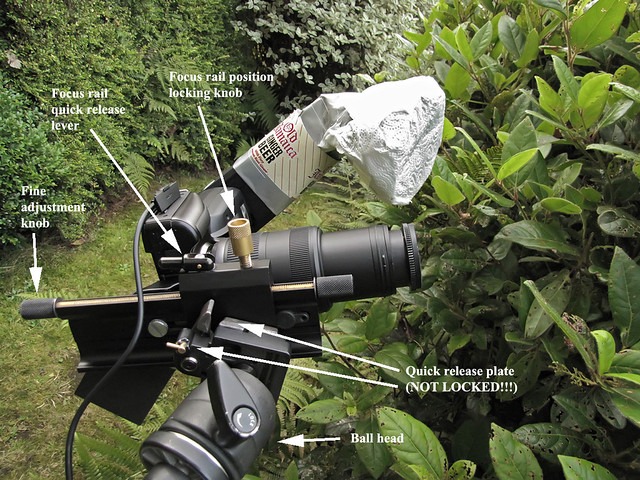
I use one of those - a focus rail, fitted on a ball-head. In this case the Raynox 150 is being used (screwed into the camera lens filter thread using step rings).


Very fine adjustments can be made by turning the Fine adjustment knob. However, this is very slow and is unnecessarily accurate given my way of working. Instead, I lift the Focus rail quick release lever and push the camera forwards or backwards until I see the picture come into focus on the LCD at which point I know the working distance is ok, and I release the lever. I then do fine adjustments to the composition and the focus point position.

(The Focus rail position locking knob remains unscrewed the whole time. This leaves a small amount of play in the focus rail setup which could be reduced by tightening up the position locking knob, but this too is rather too slow for my liking and so I live with the small amount of play.)

Be aware that most people who do macros don't use a focus rail. The reason is (I believe) because of the inflexibility and slowness in use of such a setup. It is much faster to work hand-held.

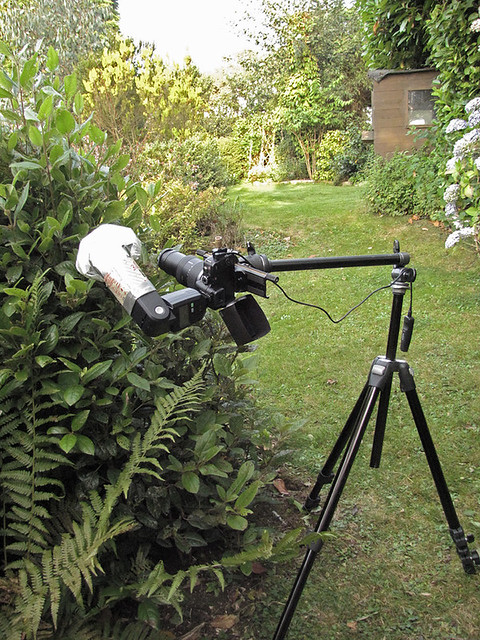
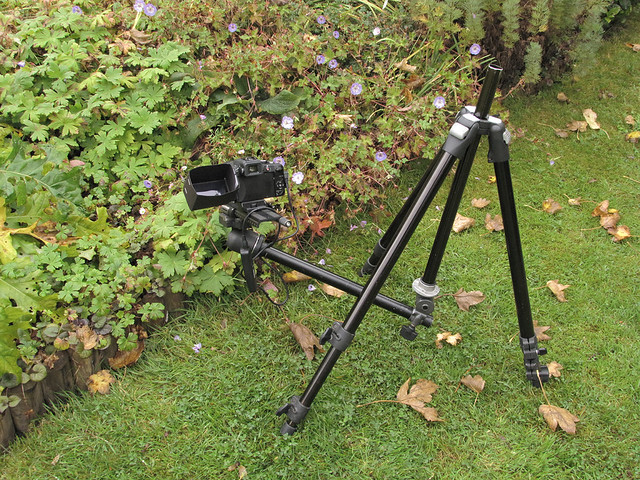
As well as the speed issue, there is also an issue with getting the camera into the right position for the shot you want. This is straightforward when working hand-held for all manner of subject positions and surrounding foliage etc. With an ordinary tripod many positions will be impossible to reach, which is why I use this strange (heavy, slow to use) tripod. There are lighter and quicker to use tripods with lateral arms, although I suspect they are less flexible than mine.


Most people use flash for macros, especially if working hand-held. FWIW this is what my setup more usually looks like, with no flash.


Last edited:
Thanks Nick for showing me the rig that you use (loving the ginger beer can, very ghetto modding) :lol:
I think the penny has finally dropped (as time goes on you will understand I am a bit slow :thinking: ).
How do you get everything set up when your subject matter will not sit still.
Do you have to give everything a little nip of whisky to encourage them to stay (although with such a wonderful garden as yours, I can see why they would)
 
(as time goes on you will understand I am a bit slow :thinking: ).

Welcome to the slow club! Nice to know I'm not alone.:D

How do you get everything set up when your subject matter will not sit still.

Do you have to give everything a little nip of whisky to encourage them to stay

Some people (including some of the macro stars) do sometimes use sugary stuff to keep insects busy or attract them to a pre-rigged photo setup, but it isn't something I've tried yet.

Partly I suppose it's because I shoot flowers as much as insects, spiders etc. Mind you, although buds/flowers/leaves stay put (well, apart from moving in the breeze of course), the light doesn't. I look out for flowers etc which are interestingly lit (in a pool of light, back lit or whatever - typically illuminated by light coming through gaps in foliage, often in the late afternoon when the quality of the light can be rather special). But once I have spotted something promising I do try to set up the shot as quickly as I can, because the effect sometimes only lasts a few seconds more after I have noticed it. Easy to miss those. It is amazing how quickly the light on a small scene can change as the sun and/or clouds move.

There is one situation where I use a tripod where the subject/scene always moves faster than I can respond to. This is where light is falling on to a subject (typically a flower), with sunlight coming through gaps in tree foliage up above which is moving in a slight breeze. This can give continually changing illumination on the subject and from time to time can produce really nice effects. But it changes far too fast for me to spot a nice effect and decide to photograph it, even if I have everything lined up and waiting for the right moment. So I take bursts of shots and sort through them later on the PC to see if I captured anything nice. Sometimes it works a treat.

With insects etc, it depends on the particular animal, and the time of day. For example, I like photographing flies. Many of them do stand around from time to time. If you can find one blowing a bubble the chances are it is going to stay there, very still, for a good while (minutes). Even if not blowing a bubble they quite often stay still for long enough to set up for a shot or three, and sometimes stick around long enough to let you try shots from two or three different angles. Sometimes they groom themselves, and they can spend whole minutes on that. If you are using flash that is fine, but it isn't quite such a good opportunity for me when I am using natural light because their legs move really fast when they are grooming and I usually find it difficult to get a fast enough shutter speed for a nice grooming image.

There are other flies that are much more elusive. For example, I really like scorpion flies, but they (at least the ones I have come across) rarely stay for any length of time in convenient photographable positions. Quite often as I am setting up a shot they move away. So getting a nice picture of a scorpion fly is more of an achievement for me.

Some insects simply move around so much that using a tripod isn't really a runner, for example bees gathering nectar from flowers. Butterflies, dragonflies and damselflies are other subjects that I often have better success with if I work hand-held, although it is more 50/50 as between hand-held and tripod for these, unlike bees which tends to be work handheld or forget it (which is also the case I find for insects in flight).

As for the time of day, when I started visiting local nature reserves several months ago I started getting up really early in the morning and getting on site by dawn (all a bit of a shock to the system for a night owl like me). At that time of day there tends to be much less breeze, and sometimes completely still air. (I monitor the local weather forecasts to pick days with promising forecasts.) Early in the morning you are more likely to find insects that are absolutely still, sometimes standing around in and/or covered by dew droplets, which can look a bit special. Snails, another of my favourite subjects, seem to be more active early in the day too and you can sometimes get lovely shots of them clambering (if that's the word for it) around in bushes - they are much more agile than you might imagine.

There are other insects such as crane flies and shield bugs that stay still in plain sight for long periods, as do some spiders, especially the ones that have webs that they sit in the middle of waiting for lunch to arrive. A problem with spiders in particular (but also for some insects) is that the best photo opportunities are when they leap into action on some prey - and the rapid flexibility of hand-held with flash is usually much better than using a tripod in those circumstances.

So I suppose the answer to your question about setting up time with a tripod is "it depends, and for some subjects/situations it doesn't work very well, or doesn't work at all".

(although with such a wonderful garden as yours, I can see why they would)

The wife was dead chuffed when I told her that! She loves this garden, and she is the Gardener. I get to dig holes, remove tree stumps, mow the grass, and generally do what I'm told (and try not to bend, break or squash the plant life when taking pictures:eek:).
 
Welcome to the slow club! Nice to know I'm not alone.:D

I personally think that admitting it is half the battle :D

Regarding the subject matter.
I agree that spiders & insects will be an easier option for me (especially being a complete novice).
I have been looking around the macro section (some wonderful work posted by people) & I have seen their insect feeders.
I then find myself asking the question, is it easier to get the subject to find you or do you find the subject. (I think that will be a question for next year due to the weather).

As for flowers & leaves, very interesting. I suppose you can study the whole world under a macro lens if you wish. As for subject matter, I think rain has stopped play for this year.
Although we have some very nice japanese red maple tree's in the front garden that look very nice this time of year. (Lovely colours with the low sun in the morning)

As for the background information on flies, very informative, thank you.

From all the information you have given me, I think I am going to have to practice my hand held technique over the coming months ready for the spring.


The wife was dead chuffed when I told her that! She loves this garden, and she is the Gardener. I get to dig holes, remove tree stumps, mow the grass, and generally do what I'm told (and try not to bend, break or squash the plant life when taking pictures:eek:).

As for the garden, tell your wife that its a credit to her and my Mrs has the same problems with me (I mow the lawns & do what I am told, most of the time) ;)
 
I personally think that admitting it is half the battle :D

Absolutely. It was liberating when (after I retired) I finally "came out" about the memory recall problem I had been hiding (with mixed success) since childhood.

I then find myself asking the question, is it easier to get the subject to find you or do you find the subject.

It depends. You'll need to experiment with that one I think.:)

(I think that will be a question for next year due to the weather).

As for flowers & leaves, very interesting. I suppose you can study the whole world under a macro lens if you wish. As for subject matter, I think rain has stopped play for this year.

There may be more around than you realise. Remember that the smallest of the scenes you can photograph are only a half inch or so wide. I found that as I got into close-ups I got drawn into looking around at the small scale and increasingly saw things that previously I would not have registered. I also slowed right down in terms of moving around - the garden (or anywhere else) is a much, much bigger and more varied place when you are looking at it inch by inch.

And as to finding subjects during the cold, wet and windy season, I was just discussing this thread with the wife, and she came out with a list of things including fungi, lichens, bark, buds, berries, dead/half-dead/frosted/dewdrop covered/raindrop covered leaves, seed pods etc. Windy is tricky, but going out into the garden just after it has rained or when it is frosty can be especially good.

Thinking about all this, I looked back at some of my pictures. Here are some examples from last February.

Half-dead (small) leaves with a film of water

0266 2010_02_19 1.1 IMG_8551 Geranium Renardii PS1 CrClExLeCuDf13.30800wBuSS46x0.8 by gardenersassistant, on Flickr


The same leaves, the next day

0266 2010_02_20 2.7 IMG_9178 Geranium Renardii PS1 CrExClLeCuDf5x30 800wSS37x0.3 by gardenersassistant, on Flickr

Seed pod

0266 2010_02_20 2.3 IMG_9072 PS1 CrHiLeClCuSaDf4x30 800wSS20x0.3 by gardenersassistant, on Flickr

Empty seed pod

0266 2010_02_19 1.6 IMG_8879 Pieris PS1b ExLeCuDf4x30 800wSS50x0.3 Sa by gardenersassistant, on Flickr

Feather

0266 2010_02_20 2.2 IMG_9023 Feather PS1a ExLeSaCB-bCuDf7x30 800hSS81x0.3 CuSa- by gardenersassistant, on Flickr


Although we have some very nice japanese red maple tree's in the front garden that look very nice this time of year. (Lovely colours with the low sun in the morning)

Sounds like a good place to start!
 
Last edited:
There may be more around than you realise. Remember that the smallest of the scenes you can photograph are only a half inch or so wide. I found that as I got into close-ups I got drawn into looking around at the small scale and increasingly saw things that previously I would not have registered. I also slowed right down in terms of moving around - the garden (or anywhere else) is a much, much bigger and more varied place when you are looking at it inch by inch.

And as to finding subjects during the cold, wet and windy season, I was just discussing this thread with the wife, and she came out with a list of things including fungi, lichens, bark, buds, berries, dead/half-dead/frosted/dewdrop covered/raindrop covered leaves, seed pods etc. Windy is tricky, but going out into the garden just after it has rained or when it is frosty can be especially good.

Nick, will you please thank your wife for me.
You have both come up with some very interesting suggestions for subject matter.
There is a large woods close to my home & I am sure I will be able to find some of this subject matter within. (just wish it would stop raining).
I will also have to have a look @ the japanese red maple tree's to see whats left of them with the wind (the back garden is now a sea of leafs).

Also thank you for showing me your work, very nice shots.
Was this done with the Raynox 250 or the 150
 
Nick, will you please thank your wife for me.
You have both come up with some very interesting suggestions for subject matter.

Big smile from the wife.:)

There is a large woods close to my home & I am sure I will be able to find some of this subject matter within. (just wish it would stop raining).
I will also have to have a look @ the japanese red maple tree's to see whats left of them with the wind (the back garden is now a sea of leafs).

Good hunting! (And regarding the maple and other trees too, remember that leaves don't have to be on trees to be interesting! Fallen leaves can have wonderful colours. And the colours may look even more interesting/colourful in a photo than in real life.)

Also thank you for showing me your work, very nice shots.
Was this done with the Raynox 250 or the 150

Thanks. To be honest I don't know which close-up lens I used. I change them frequently and don't keep a note of which was used for what. I get too involved in taking pictures to want to break the spell by doing bureaucracy (I had quite enough of that at work!)

As well as the Raynox 150 and 250 I use a Canon 500D close-up lens. It is less powerful than the 150. The first two were probably taken using the 150 or the 500D. The third one was probably taken with the 150. The fourth one was probably taken with the 150, but it might have been the 250 (I really don't use the 250 much). The last one probably the 500D, but just possibly the 150.

The camera for these was a small-sensor, Canon SX10is bridge (superzoom) camera. All used natural light. The shutter speeds ranged from 1/8 sec to 1/20 sec, so all of them would have used a tripod. All used the smallest available aperture, which would be equivalent to about f/22 for your camera - sharpness is lost with such small apertures, but it maximises the DOF. Oh, and like almost all of my images on flickr, these were quite carefully post processed using whatever seemed the best approach at the time (my post processing keeps changing as I learn more, in response to helpful feedback and as my tastes change).
 
Last edited:
I just had a quick look @ the camera you are using (Canon SX10is bridge) & it appears you are unable to change the lens.
Would you happen to know what the equivalent standard lens would be compares to the one fitted to your camera.
 
I just had a quick look @ the camera you are using (Canon SX10is bridge) & it appears you are unable to change the lens.

That is correct.

Would you happen to know what the equivalent standard lens would be compares to the one fitted to your camera.

Your 55-250 is the better of your current zoom lenses to use with a close-up lens, so lets compare to that. To make things easy, I'll convert everything into the 35mm (full frame) equivalent focal lengths, which I'll show as (FF).

Your camera has a 1.6 crop ratio, which means that:

55mm focal length is equivalent to 55 x 1.6 = 88mm (FF)
250mm focal length is equivalent to 250 x 1.6 = 400mm (FF)

My SX10is has a crop ratio of 5.6, and its focal length ranges from 5mm to 100mm, which means that:

5mm focal length is equivalent to 5 x 5.6 = 28mm (FF)
100mm focal length is equivalent to 100 x 5.6 = 560mm (FF)

However, if I use the 150 or 250 on the SX10 I get really bad vignetting at short focal lengths (it is like looking through a porthole). I can use it from a similar (FF) focal length as your 55-250 at its widest angle of 55mm.

So, using the 150 and 250 on the SX10 I get about the same magnification as you get with them at the wide angle end of your 55-250, and at the telephoto end I get slightly more magnification than you get with them on your 55-250 at full telephoto of 250mm.

Since August I have been using a Panasonic G3 (interchangeable lens, mirrorless, micro four thirds camera), with the 150, 250 and Canon 500D used on a 45-200mm lens.

The G3 has a crop ratio of 2, which means that:

45mm focal length is equivalent to 45 x 2 = 90mm (FF)
200mm focal length is equivalent to 200 x 2 = 400mm (FF)

So on my camera the 45-200 is almost exactly the same as your 55-250 on your camera, and so the 45-200 gives almost exactly the same minimum and maximum magnification with the 150, 250 and 500D as for your 55-250 on your camera.

Using the 250 on my 45-200mm lens at full zoom of 200mm, which gives the maximum magnification, I capture a scene about 11mm across, with a working distance (between the end of the 250 and the subject) of between about 102 and 119 mm.

Using the 150 on my 45-200mm lens at full zoom of 200mm, I capture a scene about 18mm across, with a working distance of between about 164 to 210mm.

I imagine that these figures would be much the same on your camera with you using the 250 or 150 on your 55-250. (Of course, since you have the 250 you can test some of this for yourself. You may find it easiest to have the camera and a subject on a table or desk so as to stop anything moving and make it easier to do the measurements.)

I have not done the measurements with the 500D, but the maximum magnification is less than with the 250 [EDIT: I meant to say 150 here. It is true for the 250 too, but not so much so], and the working distance is larger and has a bigger range.
 
Last edited:
Thanks once again Nice for all that information.
My concern was the magnification on the 250, when using the 55-250 lens would be to high. (if thats possible in the world of macro)
Obviously from what you have said there will be no issues (fingers crossed).
The only thing now is practice (can't do that today due to poor weather & very little light inside).

Another thing I should have mentioned, I have a very cheap set of macro extension tubes (they do not have the metal contacts for auto features on the lens).
I have only taken them out of the box, inspected them & returned them to the packaging.
Is it worth experimenting with them?
 
It's up to you whether you want to experiment with cheap extension tubes but the real difficulty is that the auto aperture control is disabled. Since most modern lenses don't have a manually operated aperture control ring you're stuck with shooting wide open, and therefore minimum depth of focus.
Regarding the Canon 500D, I too have this close-up lens, getting it originally for use with a Canon S3. When I switched to my DSLR it merely needed a step-down ring to be used with my 70-210 F4 zoom. It gives very nice results, and although I now have two dedicated macro lenses it's still handy and light enough to drop in the bag when just carrying a body and a couple of zooms.
 
Thanks Mike for the input.
I understand that the extension tubes do not allow control of the aperture but I think I read that this can be overcome by setting up the shot, turning the camera off, fitting the tubes & then taking the picture (unfortunately can't find any confirmation regarding this & happy for someone to prove me wrong).
Regarding the Canon 500D, a very good point that you can pop in into your bag & not have to concern yourself with carrying another full lens.
I think I will add this to my wish list (its along list) :lol:
 
Back
Top