

You are using an out of date browser. It may not display this or other websites correctly.
You should upgrade or use an alternative browser.
You should upgrade or use an alternative browser.
Sekonic L-308s for portraits... but landscape?
- Thread starter KayJay
- Start date

- Messages
- 3,726
- Name
- Mark
- Edit My Images
- No
I don't think the L308s has a spot attachment if I recall correctly. I sometimes use a Gossen light meter with spot attachment for checking the difference between foreground and sky for filters but mostly do it by eye TBH.
I have one and seem to get reasonable results. I tend to point it at the sky and then the ground to take reflective readings, and then work out what shutter speed would be best. Sometimes I take an incident reading (using the dome) from something in the foreground that I want to be properly exposed, and just hope for the best with the sky (or use a grad filter if I think it's going to be too bright). For example in this picture I took an incident reading from the bridge:
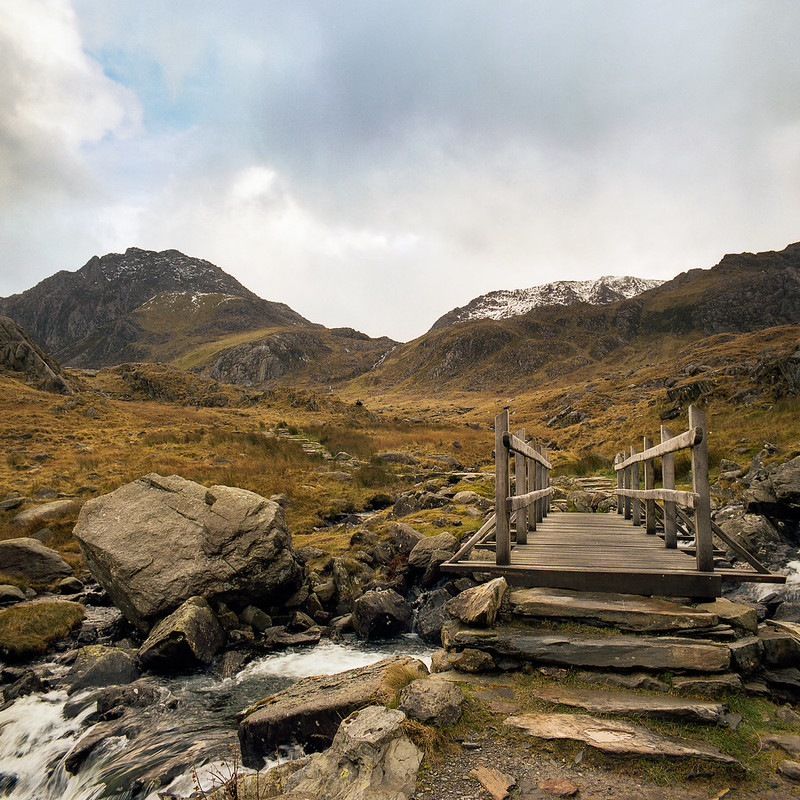
Bridge to the Glyderau by osh80, on Flickr
Bridge to the Glyderau by osh80, on Flickr

- Messages
- 11,746
- Name
- David
- Edit My Images
- No
The L308 will work very well in all situations. People in here are only referring to spot metering because that's a common practice in landscape to take control of the tones more fully. If you just want a good average exposure, it will work well. In all honesty though, it can get a bit tricky using an incident meter when shooting into the light, and unless you fully understand what you are doing, your camera may well give you more reliable exposure in those conditions until you are confident with exposure theory.

- Messages
- 8,251
- Name
- Terry
- Edit My Images
- Yes
Incident readings work very well . They are used the same way as in the studio.
Pointed from the subject to the camera.
Providing both the lightmeter and subject is getting the same light The tones will be as seen. (there is no need to move up to the subject unless the meter is in a shadow)
You can check to see the brightness of the sky by taking a reflection mode reading.
Incident meters were the preferred option with slide film, as they give very consistent tones.
Pointed from the subject to the camera.
Providing both the lightmeter and subject is getting the same light The tones will be as seen. (there is no need to move up to the subject unless the meter is in a shadow)
You can check to see the brightness of the sky by taking a reflection mode reading.
Incident meters were the preferred option with slide film, as they give very consistent tones.
- Messages
- 11,746
- Name
- David
- Edit My Images
- No
Incident meters were the preferred option with slide film, as they give very consistent tones.
Agreed.. but there is a learning curve. Understanding contrast in back lighting, and understanding how to interpret the ratios of incident and reflective in such circumstances.
- Messages
- 8,251
- Name
- Terry
- Edit My Images
- Yes
Agreed.. but there is a learning curve. Understanding contrast in back lighting, and understanding how to interpret the ratios of incident and reflective in such circumstances.
In a majority of back lit situations there is no need to make any adjustment if the meter is pointed at the camera. The tones will be as seen.
However if you want to make it into semi sillouette you will have to make some adjustment. usually in the range of 1/2 to 1 1/2 stops. (to taste)
Wedding couples with their back to the sun usually need no adjustment.
However a boost will a fill flash usually helps.