Tilt-shift Macro?

Messages
123
Name
Colin
Edit My Images
Yes
This is probably a stupid question, so feel free to give it both barrels...

If you can conquer shallow depth of field problems with a tilt-shift lens (I've never used one - not exactly cheap!) and shallow dof is such an issue when doing close-ups with a macro lens, why can't you have a TS macro lens?

Col
 
If you can conquer shallow depth of field problems with a tilt-shift lens ...
It's not that simple.

A tilt-shift lens doesn't change the depth of field. What it does do is give you great control over where the plane of focus is, and so where the in-focus region is. For example if you make the plane of focus horizontal, your subject will be sharp front-to-back but not sharp top-to-bottom. So there will still be parts of it which are out of focus.
 
Cheapest way of getting into quality repeatable Tilt/Shift is with a Mirex adapter and some s/h Mamiya C lenses.

Going back to the original quaestion though, tilt/shift photography can make a huge difference in macro photography provided the subject you are trying to shoot is in the correct plane or can be manipulated into the correct plane.

Imagine a watch/bracelet lying on a bench, in normal circumstances the DOF to cover the bracelet would probablty be too great even at f22 to ensure sharpness from front to back. Now however, imagine the plane of focus as being through the centre of the watchface/bracelet (90 degrees to the previous plane of focus) and the DOF only has to cover the few mms either side of the centre of the bracelet/watchface to ensure all is sharp.

Will try to take a few images later to show what I mean pictorially.
 
EdBray said:
Imagine a watch/bracelet lying on a bench, in normal circumstances the DOF to cover the bracelet would probablty be too great even at f22 to ensure sharpness from front to back. Now however, imagine the plane of focus as being through the centre of the watchface/bracelet (90 degrees to the previous plane of focus) and the DOF only has to cover the few mms either side of the centre of the bracelet/watchface to ensure all is sharp.
Spot on, Ed. Of course a T/S lens can be very helpful in situations like this. I was just trying to stress to the OP that it's not a universal panacea.
 
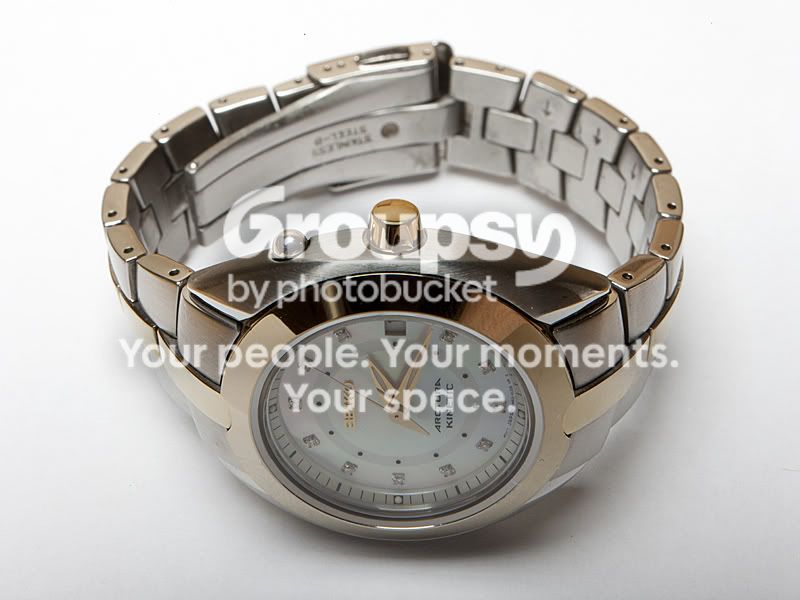
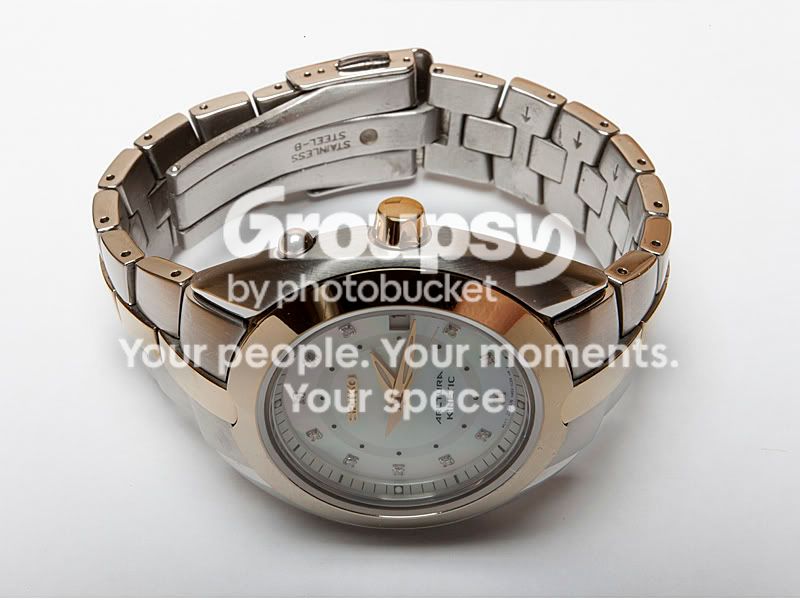
Quick and dirty attempt at showing difference in planes of focus. Used my wife's watch as a subject.

Both shots were taken at f16 (marked although f32 with 2x conversion added) on a Canon 1DsMk3 with an EF 24L TSE MK2 and a 2x Extender Mk3 (which is brilliant by the way) giving a 48mm focal length and lit by an overhead softbox with a bit of fill from a reflector.


1st shot was taken with the focus point on the minute hand and the focal plane in parallel to the watch face, as can be seen the DOF is not enough to fully cover the bracelet. The shooting distance from the front of the lens was about 4 inches.

f16minutehandface.jpg


2nd shot was taken with the focus point on the minute hand at the centre and the focal plane in parallel to the bracelet, as can be seen the DOF is now enough to fully cover the bracelet. The shooting distance from the front of the lens was again about 4 inches.

f16minutehand90face.jpg
 
Thanks very much for the input guys - very useful. Explains why folk photographing plates of food for recipe books use TS lenses. I do a fair bit of table-top work myself - small pieces of sculpture and the likes - and I would love to get my hands on a TS to investigate what can be done with it. My macro work is mostly flies - real and artificial. The artificials are 3-dimensional, though they can usually be set up so the focal plane is just as easy to align with an ordinary macro lens - so probably no real advantage in doing them with a TS lens. Some examples here...

Fishing flies

Col
 
Back
Top