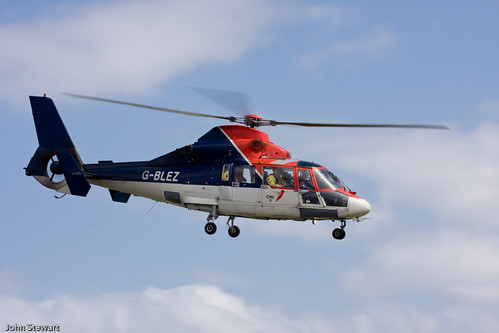
Trying to bend helicopter blades

Messages
1,854
Edit My Images
Yes
Afternoon all

A helicopter landed literally a couple of doors down today, so as it rose up behind a line of trees I thought I'd have a good at bending its blades.

Selected Av, 1/8000, use 70-200mm F2.8. Bright day.

However the blades are simply (very) stationary.

Presumably I over-cooked the shutter speed but perhaps I needed to be closer with a wide-angle too?

Many thanks
 
The ones I took the last time I was in Blackpool were at 1/125 and there wasn't that much blur:

3513862264_897b2f6998.jpg
 
You just need a slower shutter speed. Much slower.

Don't know how you thought you'd capture much blur at 1/8000th of a second! That'd be some fast spinning blades to not be captured stationary at that speed.
 
Btw, this is one situation where bracketing can be real useful, saves you having to refer back to the LCD until you find the right setting.

Even then, as the chopper flies off the blades will speed up and what worked a moment ago may not work any more, so bracketing is a good idea.
 
From my somewhat bad maths, it would seem the blade would have to be going in excess or 4,000mph for you to get motion blur at 1/8000. Helicopter blades probably top out at a few hundred mph on take off, which means you were a bit out :p
 
Hi, thanks for the replies. Actually I wasn't wanting blur at all but trying to create the effect in this photo from wikipedia:

Focalplane_shutter_distortions.jpg


My understanding was that over a certain speed (1/250th?) the shutter doesn't actually open and shut any quicker, but rather a slit is formed that slides across the sensor hence the bend in the blades.
 
Hi, thanks for the replies. Actually I wasn't wanting blur at all but trying to create the effect in this photo from wikipedia:

Focalplane_shutter_distortions.jpg


My understanding was that over a certain speed (1/250th?) the shutter doesn't actually open and shut any quicker, but rather a slit is formed that slides across the sensor hence the bend in the blades.

you,ve got me there james the explanation of the blades bending is quite stange it,s nothing to do with the slit in the camera shutter. i would more suggest the blades are actually bending due to the forces put on them when hovering. or could be the start of motion blur
 
Btw, this is one situation where bracketing can be real useful, saves you having to refer back to the LCD until you find the right setting.

Even then, as the chopper flies off the blades will speed up and what worked a moment ago may not work any more, so bracketing is a good idea.

kinda right but not always

helicopters generally work at a fixed rotor speed as its the varying angle of the blades that create lift etc
also what shutter speed works for one type of heli wont necessarily work for another as different length blades call for different rotor head speeds ;)

also the blades in that pic posted are not bent like they appear!
there may be some slight deflection but they are very very stiff in that direction
 
Thanks, so essentially this will never happen with a DSLR because the slit is moving about 10x too fast. Oh well.
 
I know nothing of this, but a quick google search found this:

http://www.wrotniak.net/photo/tech/heli-puzzle.html

the article is a couple of years old, and I'm still trying to make sense of the numbers, but I hope it helps! the effect is pretty cool, however its produced!

Yep. It's a variation on an effect used by Jaques-Henri Lartigue in a famous photograph of a racing car - the Lartigue effect

http://singularity.ie/interesting-stuff/focal-plane-shutter

A cheap digicam, such as that found in some mobile phones would produce a similar effect quite easily, as the CCD is scanned line-by-line, with the one part of the image being captured momentarily before the rest.
 
on the plus side that distorted blade is kind of a photographic aberration that bears no ties with reality so there's no real reason to want to recreate it is there??
i understand if you just "like" the effect but it just looks wrong to me :gag:
 
The Air Ambulance was out near the house yeaterday and I grabbed the film camera !! Need to process the film too see if I was succesful, but I think I was shoting at around 1/250 / 1/500 so unlikley I picked up any blur.

Will remember for next time to kepp the shuuter slower.
 
I know nothing of this, but a quick google search found this:

http://www.wrotniak.net/photo/tech/heli-puzzle.html

the article is a couple of years old, and I'm still trying to make sense of the numbers, but I hope it helps! the effect is pretty cool, however its produced!

Thanks for that link:) I accidentally achieved the same effect on the prop of this Saab 340.

floppyprop.jpg


Photo was taken with a 3mp Nokia camera-phone.
 
Easiest way to get that effect is to shoot video with your DSLR, it's caused by the blades moving too fast to capture a "still" as the sensor is being scanned (ie lines of the sensor are actived and shut down sequentially instead of using the mechanical shutter to control exposure). This is the "rolling shutter" effect in CMOS, with a CCD this could be avoided.
 
My initial thought when looking at that photo was "fish eye"... However the actual effect is very interesting! :)

Is that a Boskonian helicopter? I'd be careful if I were you :)

I'm intrigued, why?:thinking:
 
you,ve got me there james the explanation of the blades bending is quite stange it,s nothing to do with the slit in the camera shutter. i would more suggest the blades are actually bending due to the forces put on them when hovering. or could be the start of motion blur

so the blades are bending but not breaking, by that much, in that plane, are you absolutely sure its not a photographic explanation........
 
A cheap digicam, such as that found in some mobile phones would produce a similar effect quite easily, as the CCD is scanned line-by-line, with the one part of the image being captured momentarily before the rest.

Thanks for that link:) I accidentally achieved the same effect on the prop of this Saab 340.

Photo was taken with a 3mp Nokia camera-phone.

Yes, camera phones are good for this -- I've seen some really nice examples from iPhones on the web.
 
Yeah, I was going to say I've seen iPhone pictures much like this, possibly in one of those "You'll never believe this isn't photoshopped!" galleries.
 
Compare these:

Taken in Lashkar-Gah, Afghanistan last December.
D3 and 80-200 f/2.8
1/160th sec @ f/20
4588174856_4ec9fb3e9a.jpg


and this one taken in October at the same place
D3, 70-200 f/2.8 VR-I
1/200th sec @ f/6.3
4071477314_b5b534ae18.jpg


You can see that at 160th sec it's just about right, but at 200th, the rotors are starting to 'freeze'...

and at 400th sec. the rotors are almost static:
4071472920_4c8e39e45d.jpg
 
Easiest way to get that effect is to shoot video with your DSLR, it's caused by the blades moving too fast to capture a "still" as the sensor is being scanned (ie lines of the sensor are actived and shut down sequentially instead of using the mechanical shutter to control exposure). This is the "rolling shutter" effect in CMOS, with a CCD this could be avoided.

Yeah I had this effect going on like crazy when videoing out of a prop plane window on my GF1.
 
You get the bendy effect with iPhones etc because they scan a narrow part of the image quite slowly. You used to get it with older cameras using focal plane shutters because they also had a narrow slit moving relatively slowly.

The focal plane shutter in modern DSLRs moves too quickly, relative to rotor blades etc. But you could do it with something moving faster than that.
 
as the CCD is scanned line-by-line, with the one part of the image being captured momentarily before the rest.

CMOS, not CCD. CMOS sensors are scanned line by line - which is why all the current moaning about rolling shutter & "jelly effect" with using DSLRs as video cameras - they all use CMOS sensors. CCD sensors record the whole image at once.
 
Back
Top